In India’s fast-changing industrial scene, safety and quality are no longer just “added benefits”; they are also required by law. Businesses that make or sell industrial parts need to remain ahead of changes in the law in order to be successful.
One of the most important new rules is that all Transmission Steel Roller Chains must have BIS Certification. This is enforced by the Bureau of Indian Standards (BIS). It is important to know IS 14696:2000 if you are an Indian producer or a foreign exporter who wants to sell goods in India.
This article will go into great detail on the prerequisites, the Quality Control Order (QCO), and the step-by-step process for getting your BIS licence for steel roller chains.
What are Transmission Steel Roller Chains?
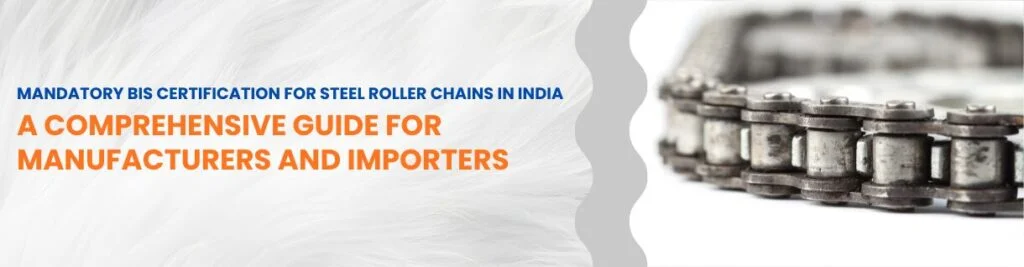
A transmission steel roller chain is a mechanical part that distributes power from one shaft to another. A sprocket drives these chains, which are made up of a succession of short cylindrical rollers that are connected together by side links.
Applications in Industry
These chains are the backbone of many heavy industries, such as:
- Oilfield Machinery: Powering motors and drilling equipment.
- Manufacturing Conveyors: Moving goods along assembly lines.
- Agricultural Equipment: Used in tractors and harvesters.
- Automotive: For timing and drive systems.
These chains work under a lot of stress and huge loads, so if one of them breaks, it could cause a lot of damage to the machinery or an accident at work. That’s why the Indian government has made them get certified.
Legal Framework: BIS Quality Control Order (QCO)
The Department for Promotion of Industry and Internal Trade (DPIIT) released a landmark Quality Control Order (QCO) on July 11, 2025. Without the ISI Mark, this directive makes it illegal to create, import, store, or sell transmission steel roller chains and chain wheels (for oilfields).
The Applicable Standard: IS 14696:2000
All products must strictly adhere to IS 14696:2000. This standard specifies:
- Material Quality: The type of steel and heat treatment required.
- Dimensions: Precise measurements to ensure compatibility with sprockets.
- Mechanical Strength: Minimum tensile strength and fatigue resistance limits.
- Performance Testing: How the chain behaves under continuous operational stress.
Why Is BIS Certification Mandatory?
The main purpose of the BIS mandate is to make sure that all industrial parts are of the same high quality. This is why this change is happening:
Safety and Reliability
Chains that aren’t up to par are likely to “snap” when they are under stress. A broken chain might cause serious injury in an oilfield or a fast-paced manufacturing. BIS makes sure that every chain it sells can bear the weight it says it can.
Curbing Inferior Imports
In the past, a lot of cheap, low-quality industrial chains from other countries came to the Indian market. The QCO keeps out products that don’t match Indian safety regulations, making sure that only safe products get into the country.
Boosting “Make in India”
Indian producers may compete on a global level by making sure that their products are of the same high quality. People trust Indian-made goods that have the ISI mark, which has helped India become a global center for high-quality engineering exports.
Implementation Timeline: When Do You Need to Comply?
The government knows that it takes time to improve how things are made. So, depending on how big the business is, the implementation will happen in stages:
- Large-Scale Manufacturers: Required to comply within 6 months of the notification.
- Small Enterprises (SSI): Given a 9-month window.
- Micro-Scale Industries: Given a 12-month window for transition.
Note: It is crucial to check the specific effective date (August 2025 onwards) to avoid legal penalties.
Step-by-Step Process to Obtain BIS Certification
Securing a BIS license involves a rigorous verification of both the product and the manufacturing facility.
Step 1: Product Identification and Gap Analysis
Manufacturers must read IS 14696:2000 and compare it to their present production before they may apply. You need to change your production process first if the quality of your steel or the size of your rollers don’t match.
Step 2: Documentation
You will need to prepare a comprehensive dossier, including:
Proof of factory premises (ownership or lease).
Manufacturing flow chart.
List of machinery and testing equipment.
Details of the raw materials used.
Step 3: Online Application
You can file the application through the BIS Manak Online Portal under Scheme-I. You need to give information about the different types of products and where the factory is.
Step 4: Factory Inspection
A BIS officer will come to your factory. They won’t simply check the goods; they’ll also check your Quality Control (QC) lab. You need the right tools to test the chains on-site.
Step 5: Sample Testing
The officer will seal samples of the roller chains during the inspection and submit them to a BIS-approved lab. The lab will check for hardness, tensile strength, and how well the parts fit together.
Step 6: Grant of License
BIS will give the license if the test results are good and the factory audit goes well. After that, you can put the ISI Mark on your products and packaging.
Benefits of BIS Certification for Your Business
Compliance may appear like a problem, but it has huge long-term benefits:
- Market Trust: In India, the ISI mark is the most well-known sign of quality. It makes B2B clients trust you right away.
- Government Tenders: Most government contracts and big corporate contracts need parts that have been certified by the BIS. You can’t get to key sources of income without it.
- Reduced Liability: If something goes wrong, having a BIS-certified product shows that you followed all the safety rules, which lowers your legal risks.
- Global Recognition: BIS standards are frequently the same as worldwide ISO standards, which makes it easy to send your goods to other nations.
Risks of Non-Compliance
The BIS Act, 2016 says that running a business without a BIS license after the QCO deadline is a crime. Results include:
- Heavy Fines: Monetary penalties that can reach lakhs of rupees.
- Imprisonment: In severe cases of willful negligence or fraud.
- Product Seizure: Customs or local authorities can seize and destroy non-compliant stock.
- Reputational Damage: Being blacklisted by industrial buyers.
Summary
The fact that all steel roller chains must now get BIS certification is a big change for the Indian industrial sector. It makes sure that the transmission chains, which are like the “veins” of our machines, are robust, safe, and dependable.
Now is the moment for manufacturers and importers to act. It can be hard to figure out the paperwork and technical requirements, but the payoff is a business that is compliant, legitimate, and competitive.