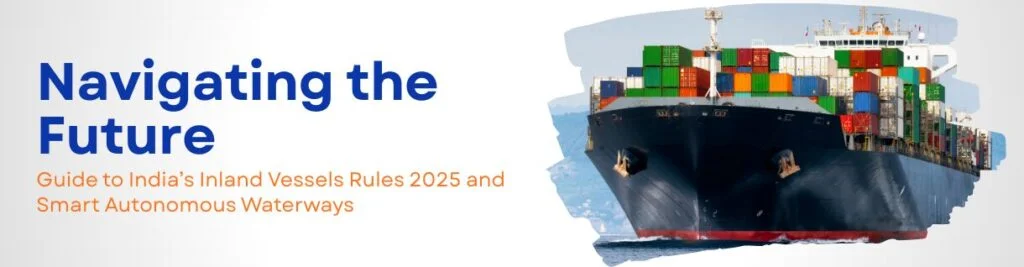
There is a tectonic shift happening in India’s maritime landscape. For many years, our huge network of rivers and canals was an underused resource because railways were faster and roads could reach more places. The government is moving the country toward a “Blue Economy” fueled by technology, nevertheless, with the passage of the Inland Vessels Act in 2021 and the Inland Vessels Rules in 2025.
Moving from traditional manual boating to Smart and Autonomous Waterways is no longer just a dream of the future; it is now a legal fact. These guidelines are meant to apply to a new type of ship that can think, sail, and run itself with little help from people.
This full guide will explain the Inland Vessels Rules 2025, the growth of autonomous shipping, and what these developments entail for ship owners, investors, and the logistics industry.
What are the Inland Vessels Rules 2025?
The Ministry of Ports, Shipping, and Waterways (MoPSW) wrote the Inland Vessels Rules 2025, which are the rules that guide the modernization of India’s Inland Water Transport (IWT). The 2025 Rules are different from earlier rules since they focus on Special Category Vessels instead of manual operation.
Defining the New Fleet:
- Fully Autonomous Vessels: These ships have advanced sensors, GPS, and AI that let them work without a person on board.
- Semi-Autonomous Vessels: These ships use advanced automation to steer and run the engines, but they also have a small crew on board to watch over things and take over in an emergency.
The main goal is to set up a disciplined, technology-driven system that brings India in line with international maritime standards like ISO and BIS.
Why the Shift to Smart Waterways?
You might be wondering why India is putting so much money into technologies for self-driving waterways. The three pillars that hold the answer are Efficiency, Safety, and Sustainability.
- Cost-Effectiveness: Water travel costs a lot less than road or rail. Automation cuts expenses even more by making fuel use more efficient and cutting down on the number of people needed.
- Safety & Accuracy: The main reason for maritime accidents is human mistake. Smart ships employ real-time data to steer clear of other ships and handle dangerous river bends with centimeter-level accuracy.
- Environmental Impact: Autonomous ships are generally made to be electric or hybrid, which helps India reach its aim of lowering carbon emissions in the transportation industry.
Key Provisions of the Inland Vessels Rules 2025
The 2025 Rules are not just ideas; they are strict laws that must be followed. These are the main parts of the new rule:
A. Design and Construction Standards (Rule 3)
All special category vessels must follow the Inland Vessels (Design & Construction) Rules, 2024, as stated in Rule 3(3).
- Standardization: Owners must utilize parts that have been certified by the Bureau of Indian Standards (BIS) or the International Organization for Standardization (ISO).
- Verification: A recognized classification society must oversee the building to make sure the hull and automation systems are “seaworthy.”
B. Manning and Crew Requirements (Rule 3(4))
The “Risk-Based Assessment” for crew strength is one of the most drastic changes.
- Semi-Autonomous: You need at least one Master, one Engine Driver, and one G.P. rating.
- Fully Autonomous: Can run without a crew as long as there is a support center on land and regular remote monitoring.
C. The Survey and Certification Process
Without a Certificate of Fitness, a vessel can’t touch the water. Under Rule 3(6), this certificate is only given if the ship can show that it is stable, has backup systems, and has fail-safe communication methods.
Interstate Recognition: Breaking Border Barriers
In the past, one of the biggest problems for boat owners was that state rules weren’t always the same. A boat that is registered in West Bengal may have to follow various rules in Bihar. Interstate Recognition is how the 2025 Rules fix this. The Jalayan/Navik database makes it so that a Certificate of Fitness from one state is now good across all Indian inland waterways. This “One Nation, One Permit” strategy will make it more easier to do business in the logistics sector.
Technology’s Role: The Brain of the Ship
The “smart” part of smart waterways comes from a tech stack that works together:
- AIS (Automatic Identification System): Allows vessels to “see” each other electronically.
- LiDAR and Radar: Gives you full situational awareness, even in the dark or in heavy fog.
- IoT Sensors: Keep an eye on the engine’s health and fuel levels so you can plan maintenance before something goes wrong.
Challenges on the Horizon
While the roadmap is clear, the journey isn’t without hurdles:
- Initial Capital: Compared to ordinary wooden or steel barges, building autonomous ships costs a lot of money up front.
- Cybersecurity: As ships turn into “computers on water,” the potential of hacking or system failure becomes a big issue for regulators.
- Infrastructure: Ports need to be smart for ships to be smart. We need fast 5G or satellite connections over the whole length of National Waterways so that remote control doesn’t lag.
Economic and Environmental Benefits
By 2030, India aims to increase the share of IWT in the modal mix significantly.
- Boosting Trade: Smart waterways will make it easier for large amounts of cargo, such coal, iron ore, and farm goods, to transit straight to ports.
- Decarbonization: It’s easier to connect autonomous ships to green hydrogen or electric propulsion systems, which will help India reach its “Net Zero” goals.
Transition Period for Existing Vessels
Don’t worry if you already own a semi-automated boat. There is a two-year transition period in the rules.
- Existing Vessels: They have 24 months from the start of the rule to improve their stability, communication, and fail-safe systems so that they satisfy the 2025 standards.
- New Vessels: Must comply with 100% of the rules from day one.
Summary: Steering Toward a Tech-First Future
The Inland Vessels Rules 2025 are more than simply red tape; they are the plan for a modern, safe, and efficient India. India is becoming a global leader in smart maritime logistics by embracing autonomous technologies.
If you want to build ships, run a logistics company, or just be interested in policy, the first step to getting around India’s waterways in the future is to comprehend these guidelines.