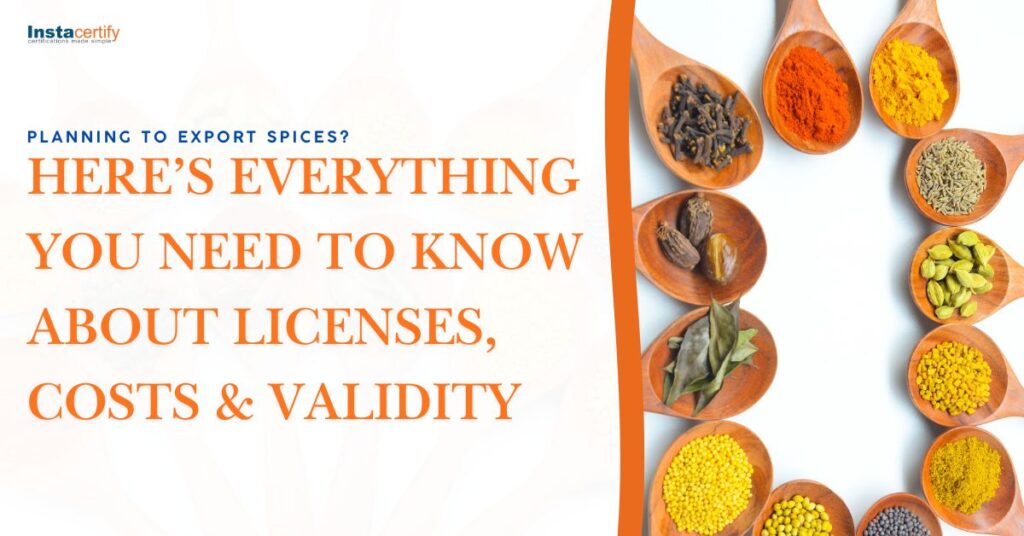
India is known globally as the “Spice Bowl of the World,” commanding a massive share of the international spice trade. For businesses looking to tap into this lucrative market, understanding the regulatory landscape is crucial. At the heart of this regulation is the Spices Board of India, the flagship organization for the development and worldwide promotion of Indian spices.
Whether you are a merchant exporter or a manufacturer, this guide covers everything you need to know about Spice Board registration, recent government schemes for 2025-26, and the critical subsidies available for the sector.
What is Spice Board Registration?
The Certificate of Registration as Exporter of Spices (CRES), commonly known as Spice Board Registration, is a mandatory license for anyone exporting spices from India. Issued by the Spices Board (under the Ministry of Commerce & Industry), this certificate acts as a seal of quality and legitimacy.
It is not just a legal requirement; it is a mark of trust for international buyers. The registration classifies exporters into two main categories:
- Merchant Exporter: Traders who source spices from farmers or manufacturers and export them.
- Manufacturer Exporter: Entities that process and value-add to spices in their own units before exporting.
Without a valid CRES, an exporter cannot ship scheduled spices out of India.
Which Ministry Recently Launched the SPICED Scheme for 2025-26?
In a major boost to the sector, the Ministry of Commerce and Industry recently launched the SPICED Scheme (Sustainability in Spice Sector through Progressive, Innovative and Collaborative Interventions for Export Development).
Key Highlights of the SPICED Scheme:
- Launch Period: The scheme is operational for the remaining period of the 15th Finance Commission cycle, extending up to FY 2025-26.
- Total Outlay: A substantial budget of ₹422.30 Crore has been approved.
- Objective: The scheme focuses on improving the productivity of cardamom, upgrading post-harvest quality, and promoting value addition. It aims to strengthen India’s position as a premier supplier of clean and safe spices to the global market.
- Beneficiaries: It specifically targets farmers’ groups, FPOs (Farmer Producer Organizations), and exporters, with special incentives for the North-Eastern region and SMEs.
Is an FSSAI License Mandatory for Spices?
Yes, absolutely. An FSSAI (Food Safety and Standards Authority of India) license is mandatory for any business dealing with spices, whether for the domestic market or export.
Why is it mandatory for exporters? While the Spices Board focuses on export promotion, FSSAI ensures the safety of the food product.
- Regulatory Compliance: The FSSAI Central License is a prerequisite for obtaining the Spice Board’s CRES. You cannot register with the Spices Board without first having a valid FSSAI license.
- International Standards: Global buyers are increasingly stringent about food safety standards (MRLs, hygiene, etc.). An FSSAI license demonstrates compliance with India’s food safety laws, which is the first step toward meeting international norms like CODEX.
What is the Food Processing Subsidy Scheme 2025?
For 2025, the government is aggressively promoting food processing through schemes like PMFME (Pradhan Mantri Formalisation of Micro food processing Enterprises) and PMKSY (Pradhan Mantri Kisan SAMPADA Yojana).
Key Subsidy Benefits for 2025:
- PMFME Scheme: This is ideal for micro-enterprises and individual units. It offers a credit-linked capital subsidy of 35% of the eligible project cost, with a maximum ceiling of ₹10 Lakh per unit.
- ODOP (One District One Product): If your spice product falls under the ODOP list for your district (e.g., Turmeric in specific districts of Telangana or Maharashtra), you get priority assistance.
- Infrastructure Support: Under PMKSY, subsidies are available for setting up mega food parks, cold chains, and infrastructure for agro-processing clusters, which is vital for preserving the potency of spices.
List of Spices Included Under the Spice Board Act
The Spices Board Act, 1986, schedules 52 specific spices that require mandatory registration for export. Dealing in any of these without a CRES is a violation of the Act.
The list includes (but is not limited to):
- Major Spices: Black Pepper, Cardamom (Small & Large), Chilli, Ginger, Turmeric.
- Seed Spices: Coriander, Cumin, Fennel, Fenugreek, Celery, Aniseed, Bishop’s Weed (Ajwain), Caraway, Dill.
- Tree Spices: Cinnamon, Cassia, Clove, Nutmeg, Mace.
- Others: Saffron, Vanilla, Curry Leaf, Mint, Poppy Seed, Garlic, Asafoetida, Tamarind.
Note: The mandate applies to these spices in all forms—whole, ground, powder, paste, or oil/oleoresin.
Are You Eligible? Check Out the Criteria
Before applying for the CRES, ensure you meet the following eligibility criteria. The process has become entirely digital to ensure transparency.
Basic Requirements:
- Valid IEC: You must hold an Import-Export Code (IEC) issued by the DGFT.
- GST Registration: A valid GST certificate is mandatory.
- Entity Type: You can be a Proprietorship, Partnership, LLP, or Private Limited Company.
- Financial Solvency: A confidential bank report (financial standing certificate) from your bank is often required to prove solvency.
- Clean Track Record: The directors or partners should not be on the “Denied Entity List” (DEL) of the DGFT.
For Manufacturer Exporters:
- You must provide proof of a manufacturing unit (MSME/Udyam Registration or Industrial License).
- Valid pollution control and safety certifications for the factory premises.
Which City Hosted the International Spice Conference 2025?
The prestigious International Spice Conference (ISC) 2025 was hosted in Bengaluru (Bangalore), Karnataka.
- Venue: The Leela Bhartiya City, Bengaluru.
- Dates: February 24th – 27th, 2025.
- Theme: “Building Trust: Beyond Borders.”
The event brought together global leaders, regulators, and spice exporters to discuss sustainability, food safety challenges, and the future of the spice supply chain.
How Long is Spice Board Registration Valid For?
The Certificate of Registration as Exporter of Spices (CRES) is generally valid for a Block Period of 3 Years.
Important Notes on Validity:
- The block periods are fixed by the Board. Even if you apply in the middle of a block period, your certificate will likely be valid only until the end of that current 3-year block.
- Renewal: Exporters must apply for renewal before the current certificate expires to ensure continuity in exports.
- Quarterly Returns: To keep the registration active, exporters must file quarterly export returns with the Spices Board, even if there were no exports during that quarter (Nil return).
What is the Cost & Time of Spice Board Certificate?
The cost and time for obtaining the CRES depend on the category of the exporter. As of the 2025 fee structure (subject to GST changes), the breakdown is as follows:
Government Fees (approximate):
- Merchant Exporter: ₹10,000 + 18% GST = ₹11,800
- Manufacturer Exporter: ₹15,000 + 18% GST = ₹17,700
Processing Time:
- Standard Time: Once the application is submitted online with all correct documents, it typically takes 7 to 10 working days for the certificate to be issued.
- Delays: Timelines can extend if the Spices Board raises a query regarding document clarity or if a physical inspection of the manufacturing premises is required (for manufacturer category).
Conclusion
Navigating the spice export sector requires adherence to strict guidelines, but the rewards are significant. With the SPICED Scheme 2025-26 offering financial support and the International Spice Conference opening doors for networking, now is the perfect time to organize your documentation and get registered.
Disclaimer: Government fees and scheme details are subject to periodic revisions. Always refer to the official Spices Board or Ministry of Commerce notifications for the latest updates.
Frequently Asked Questions
The Certificate of Registration as Exporter of Spices (CRES) is a mandatory license issued by the Spices Board of India for anyone wishing to export scheduled spices.
Yes, an FSSAI Central License is mandatory. It ensures food safety compliance and is a strict prerequisite for obtaining the CRES for both merchant and manufacturer exporters.
The Ministry of Commerce and Industry launched the SPICED scheme for 2025-26 to boost spice productivity, improve post-harvest quality, and support value addition in the export sector.
The Spice Board registration is valid for a block period of three years. Exporters must renew it before the current block expires to continue their business operations.
The government fee for Merchant Exporters is approximately ₹11,800, while Manufacturer Exporters pay around ₹17,700. These fees include GST and are subject to periodic revision.
Once the application and documents are submitted online, the certificate is typically issued within 7 to 10 working days, provided there are no discrepancies or inspection delays.
Any business entity with a valid Import-Export Code (IEC), GST registration, PAN card, and a sound financial track record is eligible to apply for the registration.