
Picture this: It’s April 2, 2026. Your shipments are stalled at Mumbai Port, customs officials are slapping a ₹1 crore environmental compensation notice on your desk, and your boardroom is in panic mode. All because you missed the EPR compliance deadline. Sound like a nightmare? It’s a reality for hundreds of Indian manufacturers, importers, and brand owners every year—and with 2026’s tightened rules on the horizon, the stakes are higher than ever.
Extended Producer Responsibility (EPR) isn’t just bureaucratic jargon; it’s India’s bold push toward a circular economy, holding producers accountable for the lifecycle of their products’ waste. From plastic packaging to e-waste, batteries, tyres, and used oil, non-compliance isn’t a slap on the wrist—it’s a potential business-ender. Under the Environment (Protection) Act, 1986, penalties can soar to ₹1 crore in fines, operational shutdowns, and even imprisonment up to five years. But here’s the good news: With just five months until the April 1, 2026, deadline for expanded EPR rules, you still have time to act.
In this in-depth guide—tailored for 2025’s compliance warriors—we’ll unpack EPR’s evolution, dissect the 2026 deadlines, outline foolproof steps to certify your operations, spotlight real-world penalties, and share insider strategies to dodge the ₹1 crore bullet. Whether you’re a small importer of electronics or a multinational packaging giant, arm yourself with this knowledge to turn compliance into a competitive edge. Let’s dive in.
What Is EPR, and Why Is It India’s 2026 Wake-Up Call?
Extended Producer Responsibility (EPR) flips the script on waste management. Traditionally, governments footed the bill for recycling and disposal. Now, under EPR, producers, importers, and brand owners (PIBOs) must collect, recycle, or responsibly dispose of their products’ end-of-life waste—extending their “responsibility” beyond the sale.
India’s EPR framework stems from the landmark Plastic Waste Management Rules, 2016 (amended multiple times), and has ballooned to cover diverse sectors:
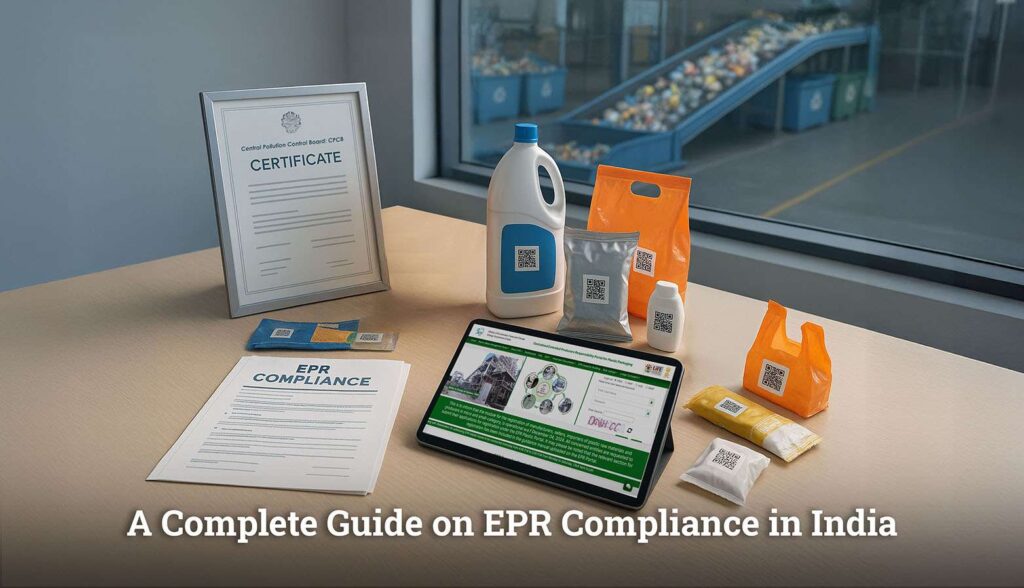
- Plastic Packaging: Multi-layered plastics, carry bags, and rigid packaging.
- E-Waste: Electronics like mobiles, laptops, and appliances.
- Battery Waste: Lead-acid, lithium-ion, and nickel-metal hydride batteries.
- Tyres: End-of-life vehicle tyres.
- Used Oil: Waste lubricating oils from industries.
By 2025, over 50,000 PIBOs are registered on the Central Pollution Control Board (CPCB) EPR Portal, handling 1.5 million tonnes of plastic waste annually alone. But 2026 marks a seismic shift: The Ministry of Environment, Forest, and Climate Change (MoEFCC) is rolling out expanded EPR Rules, 2024, effective April 1, 2026. These target household packaging recycling, introducing EPR for non-ferrous metal scraps, paper, glass, and metals—expanding beyond plastics to foster a zero-waste economy.
Why now? India’s waste crisis is acute: 26,000 tonnes of plastic generated daily, with only 60% collected, and e-waste hitting 1.2 million tonnes yearly. The 2026 deadline aligns with global sustainability goals (UN SDGs) and domestic targets like Swachh Bharat 2.0, pressuring PIBOs to hit recycling quotas or face the music.
The 2026 EPR Deadlines: Mark Your Calendar or Pay the Price
Missed deadlines aren’t forgiving. Here’s a breakdown of key 2026 milestones across EPR categories—note that annual filings continue, but these are the big compliance triggers:
| EPR Category | Key Deadline | What It Means | Who It Affects |
|---|---|---|---|
| Plastic Packaging | April 1, 2026 (Expanded Rules) | Mandatory EPR targets for recycled content (30-100% by 2025-2030); annual returns by June 30. | All PIBOs generating >5 tonnes/year. |
| E-Waste | April 1, 2026 (Non-Ferrous Scrap Amendment) | EPR for metal scraps from electronics; collection targets rise to 70% by 2026. | Electronics manufacturers/importers. |
| Battery Waste | Ongoing, but Q1 2026 Filing | 90% recycling by 2026; quarterly returns starting Jan 2026. | Battery producers (e.g., EVs, mobiles). |
| Tyres | March 31, 2026 (Annual Return) | 100% tyre collection/recycling; blacklist for non-filers. | Tyre manufacturers/importers. |
| Used Oil | April 1, 2026 (Re-refining Targets) | EPR for 75% re-refining; portal updates mandatory. | Oil importers/processors. |
Source: MoEFCC Notifications and CPCB Guidelines, 2025.
Pro Tip: Small-scale PIBOs (under 5 tonnes/year) get phased entry, but everyone must register by December 31, 2025, to avoid pre-deadline audits.

The ₹1 Crore Penalty Trap: How Non-Compliance Hits Hard
Under Section 15 of the Environment (Protection) Act, 1986, EPR violations trigger a cascade of consequences:
- Monetary Fines: Up to ₹1 lakh initial, plus ₹5,000 per day of delay—escalating to ₹1 crore in environmental compensation (EC) for major breaches, like missing recycling targets.
- Operational Shutdowns: CPCB can halt production or imports until compliance.
- Blacklisting: 1-5 years exclusion from government tenders; e.g., a Karnataka firm lost ₹20 crore in contracts after a ₹35 lakh EC.
- Legal Repercussions: Imprisonment up to 5 years for willful evasion.
- Reputational Damage: ESG ratings plummet, scaring investors and partners.
Real Case: In July 2025, Bharat Petroleum Corporation Limited (BPCL) was slapped with a ₹1 crore EC for EPR lapses in used oil management—operations paused for 30 days, costing millions more in lost revenue. Another: A Delhi importer faced ₹19.82 crore in cumulative fines for plastic waste non-compliance across states. Don’t let your story be next.
Step-by-Step Guide: Achieve EPR Compliance Before 2026 Hits
Compliance isn’t rocket science—it’s a structured sprint. Follow this 5-phase roadmap to lock in by March 2026:
Phase 1: Assess and Register (Now – December 2025)
- Audit Your Footprint: Calculate annual waste generation (e.g., plastic via Form-1 on CPCB portal). Tools like SORT’s calculator estimate targets.
- Register on EPR Portal: Visit cpcb.nic.in/epr-portal, submit PAN, GSTIN, IEC, and product details. Fee: ₹5,000–₹20,000 based on scale.
- Appoint PRO/REC: Partner with Producer Responsibility Organizations (e.g., Karma Recycling) or recyclers for collection.
Phase 2: Set Up Collection and Recycling (January – February 2026)
- Hit Targets: Plastics: 30% recycled content by 2025, scaling to 100% by 2030. E-Waste: 60-70% collection rate.
- Tech Integration: Use QR codes on packaging for traceability; apps like Recykal track EPR credits.
- Budget It: Expect ₹10–50 lakhs/year for mid-sized firms, covering logistics and audits.
Phase 3: Documentation and Reporting (March 2026)
- File Annual Returns: Form EPR-1 by March 31; quarterly for batteries/tyres.
- Verify with Third-Party: Auditors certify recycling proofs—avoid fakes, as CPCB cross-checks via blockchain pilots.
- Self-Declaration: For low-risk, but high-volume needs full audits.
Phase 4: Audit-Proof Your Operations (Ongoing)
- Train Teams: Workshops on EPR best practices.
- Monitor KPIs: Use dashboards for real-time target tracking.
Phase 5: Renew and Adapt (Post-2026)
- Annual reviews; adapt to state variations (e.g., Goa’s DRS from April 2026).
Cost Snapshot:
| Scale | Setup Cost (₹) | Annual Compliance (₹) |
|---|---|---|
| Small (<10 tonnes) | 50,000–2 lakhs | 1–5 lakhs |
| Medium (10-100 tonnes) | 5–20 lakhs | 10–50 lakhs |
| Large (>100 tonnes) | 20 lakhs+ | 50 lakhs+ |
Case Studies: Lessons from the Trenches
- Success Story: Attero’s Pivot: Facing e-waste EPR hikes, Attero integrated AI sorting, hitting 2025 targets early and earning EPR credits worth ₹5 crore—positioning for 2026 expansions.
- Cautionary Tale: Anonymous Importer: Delayed plastic EPR filing led to a ₹50 lakh–₹1 crore EC in 2025; recovery took 6 months and SORT Consultancy’s intervention.
Instacertify: Your EPR Compliance Co-Pilot
Navigating EPR solo? Risky. At Instacertify, we’ve guided 2,000+ PIBOs through BIS, CRS, and EPR mazes, achieving 100% on-time filings. Our end-to-end services include portal registration, target modeling, recycler tie-ups, and audit defense—bundled for under ₹1 lakh. Free EPR Readiness Audit: [Book Now] – Secure your spot before the rush.
The April 1, 2026, EPR deadline isn’t a threat—it’s an opportunity to lead in sustainable innovation. By assessing now, registering promptly, and partnering wisely, you’ll sidestep the ₹1 crore penalty and unlock green financing, consumer loyalty, and ESG accolades. India’s circular economy is calling—answer it with action.
Questions? Comment below or WhatsApp Instacertify. Here’s to waste-free wins in 2026 and beyond!