
Complete Process, Documentation, Cost, and Expert Assistance from Instacertify
If you’re planning to import electronic, electrical, or industrial products into India, one of the first regulatory hurdles you’ll face is obtaining a BIS Certification — a mandatory quality and safety approval from the Bureau of Indian Standards (BIS).
Without BIS certification, your imported products can be stopped at customs, banned from sale, or even destroyed.
That’s why every importer or foreign manufacturer must understand how to get a BIS certificate for import — correctly, legally, and efficiently.
In this detailed guide, we’ll explain everything you need to know —
✅ What BIS certification is
✅ Why it’s required for imported goods
✅ The step-by-step process
✅ Documents required
✅ Costs, validity & timelines
✅ How Instacertify can make it 10x easier for you
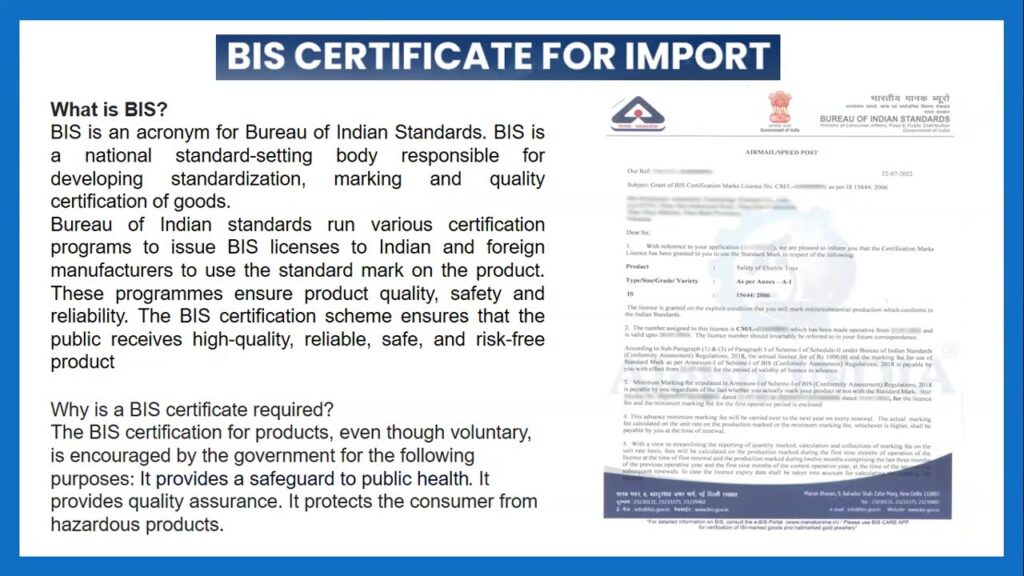
What is BIS Certification?
BIS (Bureau of Indian Standards) is India’s national standards body, operating under the Ministry of Consumer Affairs, Food, and Public Distribution.
It is responsible for ensuring that products sold in India — whether locally manufactured or imported — meet safety, performance, and quality standards.
A BIS Certificate confirms that your product complies with Indian Standards (IS codes) defined by BIS.
Key Objectives of BIS Certification:
- Ensure consumer safety and product reliability.
- Prevent import of substandard or hazardous goods.
- Promote standardization in manufacturing.
- Strengthen India’s domestic industry and public confidence.
Why is BIS Certification Required for Imports?
When you import products into India, they must meet the same safety and quality requirements as domestically manufactured goods.
BIS certification ensures this equivalence.
Without BIS Certification:
- Customs can seize or reject your shipment.
- You cannot legally sell, advertise, or distribute your product in India.
- Penalties and legal actions may apply.
With BIS Certification:
- Smooth customs clearance
- Eligibility for sale in Indian market
- Brand trust and market acceptance
- Legal compliance under Indian Standards
Types of BIS Certification Schemes
BIS offers different certification schemes depending on the product category and manufacturing origin (domestic or foreign).
For importers and overseas manufacturers, the following schemes are applicable:
1. BIS CRS (Compulsory Registration Scheme)
- Applicable to electronic and IT products.
- Covers items like LED lights, laptops, mobiles, power banks, adapters, TVs, and more.
- Foreign manufacturers must register under CRS before exporting to India.
- Mandatory as per Electronics & IT Goods (Requirement for Compulsory Registration) Order, 2012.
2. BIS FMCS (Foreign Manufacturers Certification Scheme)
- Applicable for non-electronic goods like steel, cement, household appliances, and more.
- Allows foreign manufacturers to use the Standard Mark (ISI mark) on their products.
- Involves factory inspection by BIS officers.
3. BIS ISI (Standard Mark Scheme)
- Mandatory for specific domestic products sold in India.
- Products bear the ISI mark to indicate compliance with Indian Standards.
For importers, CRS and FMCS are the most relevant.
Products Requiring BIS Certification for Import
The list is extensive and periodically updated. Below are major categories covered under BIS:
Under the Compulsory Registration Scheme (CRS):
- Mobile phones and smartphones
- Laptops, tablets, and notebooks
- LED lamps, bulbs, and luminaires
- Power adapters and chargers
- Smart watches and fitness bands
- Bluetooth speakers
- Smart TVs
- Microwave ovens
- Set-top boxes
- Electronic musical systems
Under Foreign Manufacturers Certification Scheme (FMCS):
- Steel products
- Pressure cookers
- Electrical cables
- Cement
- Automotive tires and tubes
- Plastic goods
- Safety glass
- Valves and switches
(Instacertify provides complete product eligibility verification before application submission.)
Understanding BIS Schemes for Importers
A. Compulsory Registration Scheme (CRS):
For electronic and IT goods notified by the Ministry of Electronics & IT (MeitY).
- The manufacturer (foreign or Indian) must register each model.
- The product must be tested in an Indian BIS-approved lab.
- Importers can act as Authorized Indian Representatives (AIR) for foreign brands.
B. Foreign Manufacturers Certification Scheme (FMCS):
For non-electronic goods such as industrial or construction materials.
- BIS officers visit the foreign manufacturing site for inspection.
- Factory must implement a Quality Management System (QMS) complying with BIS standards.
- After approval, the manufacturer is authorized to use the ISI mark.
Step-by-Step Process to Get BIS Certificate for Import in India
Let’s go through each step in detail.
The process differs slightly for CRS and FMCS, but we’ll cover both.
Step 1: Identify Product Standard (IS Code)
Every product category has a unique Indian Standard (IS number).
You must identify the correct IS code before applying.
Example:
- LED Lamps → IS 16102 (Part 1):2012
- Power Banks → IS 13252 (Part 1):2010
- Steel Rods → IS 1786:2008
Instacertify identifies the correct IS code and scheme type (CRS/FMCS) for your product.
Step 2: Nominate an Authorized Indian Representative (AIR)
If you are a foreign manufacturer, BIS requires you to appoint a local representative in India — an individual or company authorized to liaise with BIS.
The AIR is legally responsible for:
- Submitting the application
- Coordinating with BIS
- Handling after-sales compliance
Instacertify can act as your Authorized Indian Representative for all certification and communication.
Step 3: Product Testing in BIS-Recognized Lab
Before filing for registration, your product must be tested in a BIS-recognized laboratory in India.
Key points:
- Samples must be imported legally under a testing shipment.
- The lab issues a test report confirming compliance with the relevant Indian Standard.
- The report remains valid for 90 days.
Instacertify manages sample import documentation, lab coordination, and test scheduling end-to-end.
Step 4: Application Submission to BIS
Once test reports are ready, the applicant (manufacturer or AIR) files an online application on the BIS portal along with supporting documents.
Documents required:
- Company registration certificate (foreign manufacturer)
- Authorized Indian Representative’s ID proof and declaration
- Factory address proof
- ISO 9001 certificate (for FMCS)
- Test report from BIS-approved lab
- Product photographs and label artwork
- Fee payment receipt
Instacertify verifies and formats all documents per BIS guidelines to prevent rejections.
Step 5: Factory Inspection (For FMCS Only)
In the case of the Foreign Manufacturers Certification Scheme, BIS officials conduct an on-site inspection of the manufacturing facility.
During inspection, they verify:
- Manufacturing process flow
- Equipment calibration
- Raw material sourcing
- In-house testing capabilities
- Quality management system
Post-inspection, the officer submits a detailed report to BIS headquarters.
Step 6: Grant of BIS Certificate / Registration Number
Once BIS is satisfied with the documentation and testing, the BIS Certificate is issued.
- Under CRS → You get a Registration Number (R-number).
- Under FMCS → You get permission to use the ISI mark on your products.
The certificate allows the import and sale of the product in India.
Step 7: Labeling and Marking Requirements
Each certified product must display:
- The BIS logo
- The Registration/License number
- Manufacturer’s name and address
- Model number
- Energy or safety markings (if applicable)
Instacertify designs compliant BIS labels and packaging templates for clients.
Step 8: Renewal and Compliance Maintenance
BIS certificates are valid for 2 years (FMCS) and 2 years (CRS) and must be renewed before expiry.
Renewal requires submission of:
- Updated test reports
- Renewal application form
- Renewal fee
Instacertify maintains a renewal reminder system and handles all follow-ups proactively.
Documents Required for BIS Certification for Import
| Category | Documents Required |
|---|---|
| Manufacturer Documents | Business License, Company Registration Certificate, Factory Layout, ISO 9001 Certificate |
| Product Documents | Product Specification Sheet, User Manual, Photographs, Test Report from BIS Lab |
| Authorized Representative | Indian ID Proof, Authorization Letter, Undertaking of Responsibility |
| Legal Documents | Power of Attorney, Brand Authorization, Trademark Certificate |
| Miscellaneous | Import-Export Code (IEC), Fee Payment Receipt, Label Sample |
Instacertify provides pre-formatted document templates and verifies every submission before upload.
BIS Certification Timeline
| Stage | Duration (Approx.) |
|---|---|
| Product Testing | 10–15 working days |
| Application Submission & Review | 7–10 working days |
| Factory Inspection (FMCS) | 15–20 working days |
| Final Approval | 30–45 working days total |
With expert management, Instacertify typically achieves certification within 25–35 days.
BIS Certification Cost in India (For Imports)
| Activity | Approx. Cost (INR) |
|---|---|
| Product Testing | ₹20,000 – ₹80,000 per model |
| Application Fee | ₹10,000 – ₹25,000 |
| Registration/License Fee | ₹25,000 – ₹35,000 |
| Inspection Fee (FMCS) | ₹50,000 – ₹1,00,000 |
| Renewal Fee | ₹10,000 – ₹15,000 |
(Costs vary by product, scheme type, and lab location.)
Instacertify provides a clear quotation upfront — no hidden charges, no delays.
Common Challenges Importers Face in BIS Certification
- Incorrect product standard (IS code) selection
- Invalid or foreign lab reports (only Indian BIS labs are accepted)
- Incomplete documentation or wrong format
- Miscommunication between foreign manufacturer and Indian agent
- Delays in sample shipment or customs clearance
How Instacertify Solves These Issues
- Pre-verifies your product eligibility and IS standard
- Handles testing and document translation
- Acts as your Authorized Indian Representative
- Coordinates directly with BIS officials
- Tracks application status daily
Benefits of BIS Certification for Importers
✅ Legal Compliance – Meet Indian import regulations.
✅ Smooth Customs Clearance – No risk of product seizure or rejection.
✅ Market Access – Sell freely across India.
✅ Brand Trust – BIS mark builds customer confidence.
✅ Global Recognition – Enhances international credibility.
✅ Product Safety Assurance – Meets India’s quality benchmarks.
Why Choose Instacertify for BIS Certification?
Instacertify is a leading certification consulting firm in India, offering end-to-end BIS certification solutions for importers, exporters, and manufacturers.
Our Services Include:
- Product eligibility assessment
- BIS application filing (CRS/FMCS)
- Testing coordination with BIS labs
- AIR nomination and documentation
- Label design as per BIS guidelines
- Certificate renewal & modification support
Why We’re Trusted:
- 1000+ BIS certifications delivered
- Experienced technical experts
- Dedicated support for international clients
- Transparent pricing and faster approvals
“At Instacertify, we don’t just file applications —
we take full ownership until your BIS certificate is approved.”
📞 Get Your BIS Certificate for Import Today
Don’t let compliance slow your business growth.
With Instacertify, you can get your BIS certificate faster, cheaper, and 100% hassle-free.
📍 Visit: www.instacertify.com
📧 Email: info@instacertify.com
🚀 Talk to our experts today —
and start importing BIS-approved products with complete confidence.