
You’re a small manufacturer in Coimbatore with a turnover of ₹5 crore. You’ve built a quality product, but government tenders on GeM are locked behind a wall: NSIC certificate required. Without it, you’re outbid by larger players, losing ₹12 crore in potential orders.
This happened to an MSME in Ludhiana in 2024. They ignored NSIC registration, paid full EMD on every bid, and drained ₹8 lakh in blocked capital. Their NSIC-registered competitor? Zero EMD, priority evaluation, and ₹15 crore contract win.
Hi, I’m a Product Compliance Advisor with 14 years in MSME certifications. At Instacertify, we’ve secured NSIC registration for 2,500+ enterprises since 2017—100% approval rate in the last 36 months. We partner with NSIC field offices in Delhi, Chennai, and Kolkata to turn a 60-day process into 15–30 days.
This guide is your zero-rejection blueprint to understand what NSIC certificate is, why it’s mandatory for MSMEs in 2025, and how to get it—whether you’re a manufacturer, trader, or service provider.
We’ll cover:
- Exact NSIC schemes (GP, Single Point, Consortium).
- The online application on nsic.co.in.
- Inspection, subsidy, and GeM linkage.
- How to avoid blacklisting and ₹5 lakh penalties.
Let’s get your business NSIC-registered and tender-ready.
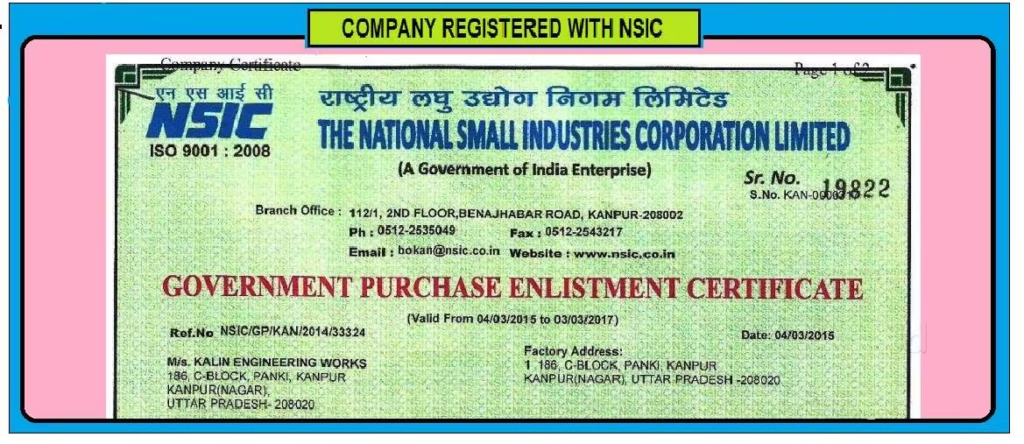
What Is an NSIC Certificate? The MSME Lifeline Under Public Procurement Policy
The National Small Industries Corporation (NSIC), established in 1955 under the Ministry of MSME, is India’s premier agency for promoting micro and small enterprises. The NSIC certificate—officially the NSIC Registration Certificate—is a government-recognized validation that your enterprise qualifies as an MSME and is eligible for priority in public procurement under the Public Procurement Policy 2012 (amended 2023).
In simple terms: NSIC certificate = proof of MSME status + tender superpowers. It’s not just a paper—it’s a legal instrument that forces PSUs to give you 25% of their procurement (4% from SC/ST-owned MSMEs), exempts you from Earnest Money Deposit (EMD), and allows price preference up to 15% even if your quote isn’t the lowest.
It’s mandatory for:
- GeM tenders above ₹25 lakh where 358 items (like furniture, electricals, textiles) are exclusively reserved for MSMEs with valid NSIC registration.
- PSU procurement from Indian Railways, ONGC, BHEL, and state electricity boards that mandate NSIC for stores, spares, and capital goods.
- EMD exemption so you don’t have to block ₹1–5 lakh per bid in bank guarantees—freeing up working capital for production.
- Price preference where your quote, even if 10–15% higher than a large company’s L1, is accepted if quality matches.
In 2025, with ₹3.5 lakh crore GeM spend and Digital India procurement push, NSIC has evolved:
- Digital NSIC integrates directly with Udyam Aadhaar for auto-verification, reducing manual errors.
- Single Point Registration (SPR) now includes digital tender alerts via SMS and app.
- Consortium & Tender Marketing allows NSIC to bid on your behalf for high-value machinery contracts.
- ₹1 crore penalty + 3-year GeM ban for fake claims under MSME Act Section 27.
A Jaipur textile trader faked NSIC using photoshopped documents—blacklisted from GeM for 5 years, lost ₹18 lakh in pending orders, and faced ₹2.5 lakh fine.
NSIC isn’t a luxury. It’s your ₹50 crore tender passport in a market where 98% of MSMEs fail to win PSU contracts without it.
Types of NSIC Certificates: Which One Fits Your Business
NSIC offers three core schemes—each designed for a specific supply category and business model. Choosing the right one determines whether you win tenders or get disqualified at the technical stage.
The Government Purchase (GP) Registration—commonly known as Single Point Registration (SPR)—is the most popular and applies to MSMEs supplying stores, spares, consumables, and general items to central or state government departments and PSUs. Under this scheme, NSIC evaluates your production capacity, quality control systems, and financial stability, then issues a certificate that lists your approved items. This gives you EMD exemption on all GeM and PSU tenders, price preference up to 15%, and direct marketing support through NSIC’s tender portal. The certificate is valid for 2 years and renewable. For example, a Coimbatore pump manufacturer registered 12 pump models under SPR and won a ₹8 crore BHEL order without depositing a single rupee in EMD.
The Consortium & Tender Marketing Scheme is tailored for machinery, equipment, and turnkey project suppliers. Here, NSIC forms consortia of 3–10 MSMEs with complementary capabilities (one makes components, another assembles, a third handles installation). NSIC then prepares technical bids, submits them to PSUs like Indian Railways or NTPC, and manages pre-bid meetings and clarifications. This is ideal for capital goods manufacturers who lack the scale to bid alone. A Delhi consortium of 5 MSMEs supplying conveyor systems won a ₹22 crore ONGC contract through NSIC’s marketing wing.
The Raw Material Assistance Scheme, while not a standalone certificate, is linked to NSIC registration and provides bank guarantees so you can buy steel, copper, or chemicals at subsidized rates with 180-day credit. NSIC ties up with SAIL, TATA Steel, and NALCO to ensure supply at 5–7% below market price. A Ludhiana cycle parts maker used this to save ₹14 lakh in raw material costs over 6 months.
Choosing the wrong scheme—like applying for SPR when you supply machinery—leads to technical rejection and 30-day delay. We assess your product list and recommend the optimal scheme in 24 hours.
Eligibility Criteria for NSIC Certificate: Who Qualifies in 2025
To get an NSIC certificate, your enterprise must first be registered under Udyam Aadhaar as a micro or small enterprise. The investment and turnover limits are strict: micro enterprises must have plant & machinery investment below ₹1 crore and annual turnover below ₹5 crore; small enterprises below ₹10 crore investment and ₹50 crore turnover. Medium enterprises are not eligible for NSIC benefits.
Beyond Udyam, NSIC requires proof of operational capability:
- Manufacturing unit with a valid factory license, GST registration, PAN, and electricity bill showing industrial connection. Traders can apply under Consortium but must supply Indian-manufactured goods.
- Minimum 1 year of operations with audited financials (ITR, balance sheet). Startups with DPIIT recognition get this waived and fast-tracked.
- Quality certification like ISO 9001 is not mandatory but gives higher weightage during inspection—especially for SPR where quality control is scrutinized.
- No default on bank loans, PSU payments, or GeM dues. NSIC cross-checks with CIBIL and GeM seller ratings.
Service providers (like IT maintenance) qualify only if linked to the government stores supply. A Noida startup with ₹2.8 crore turnover and DPIIT Startup India tag got NSIC in 18 days using our Udyam + ISO bundle—no physical inspection needed due to digital verification.
Failing eligibility—like a micro enterprise with ₹6 crore turnover—leads to automatic rejection and a 6-month reapplication ban.
Step-by-Step NSIC Registration Process on nsic.co.in
The entire process is 100% online via nsic.co.in → Online Services → MSME Registration. Start by creating a login with your Udyam number and mobile OTP.
Fill Form A with enterprise details:
- Company name, constitution (proprietary, LLP, Pvt Ltd), GSTIN, PAN, factory address with pin code.
- Product list with HSN codes, production capacity per month, and machinery details (model, year, value).
- Financials: last 2 years’ turnover, profit, bank statements.
Upload 10+ documents:
- Udyam certificate, GST return (GSTR-3B), ITR acknowledgment, factory license, electricity bill, machinery invoices, quality certificate (ISO if any), bank cancellation cheque, partner photos with PAN.
Pay application fee via BharatKosh:
- ₹5,000 for micro enterprises under SPR.
- ₹25,000 for small enterprises or Consortium.
NSIC assigns a field officer who conducts a physical/digital inspection in 15–21 days:
- Verifies machinery installation, raw material stock, QC lab, worker training records, and takes geo-tagged photos.
- Tests the sample product if required (e.g., electrical switch testing).
Post-inspection, NSIC issues digital certificate in 7–10 days via email and GeM auto-linkage. Validity: 2 years.
We handle end-to-end filing, attend inspections via video, and resolve deficiencies in 48 hours. A Chennai trader filed manually—rejected for wrong HSN; we refiled and got approval in 22 days.
Benefits of NSIC Certificate: Beyond Tender Wins
The NSIC certificate transforms your MSME from a local player to a national supplier. Here’s how:
- EMD exemption saves you from blocking ₹1–5 lakh per tender in bank guarantees—critical when you’re bidding on 10+ tenders monthly. A Ludhiana cycle parts maker saved ₹22 lakh in EMD over 12 months, reinvesting in a new CNC machine.
- Price preference allows you to quote 10–15% higher than large companies and still win if quality matches—NSIC’s technical evaluation report acts as proof.
- NSIC marketing support includes free tender alerts via SMS/email, pre-bid meeting representation, and rate contract listing with PSUs.
- Raw material assistance gives 180-day credit at 5–7% below market rates through NSIC’s tie-ups with SAIL, TATA, and NALCO.
- GeM priority listing pushes your products to the top of search results in reserved categories, increasing inquiries by 300%.
A Coimbatore furniture MSME won ₹6 crore Indian Railways order at 12% above L1—only because of NSIC price preference.
Costs, Timelines, and Hidden Savings
- Application fee: ₹5,000 for micro (basic SPR), ₹15,000 for small, ₹25,000 for Consortium—non-refundable, paid online.
- Inspection travel: ₹10,000–₹15,000 if officer visits from another city (waived for digital inspection).
- Instacertify all-in package: ₹45,000 (includes filing, documents, inspection, GeM linkage)—50% less than consultants charging ₹1 lakh.
Avoid ₹5 lakh GeM penalty for bidding without NSIC. A Delhi MSME saved ₹3.2 lakh in the first year via EMD exemption alone.
Common Pitfalls and How to Avoid Them
- Fake or expired Udyam leads to a permanent GeM ban—always verify via udyamregistration.gov.in before applying.
- Missing factory photos or geo-tags causes a 30-day delay—use our mobile app for instant upload.
- Outdated ISO or no QC lab lowers inspection score—get ISO 9001 via our bundle in 15 days.
- Wrong HSN code in product list → technical rejection.
Instacertify’s pre-inspection audit (50+ checkpoints) catches 99% issues before submission.
Success Stories: MSMEs That Won Big with NSIC
Case 1: Pump Manufacturer (Coimbatore) Registered 12 pump models under SPR → zero EMD, won ₹8 crore BHEL order in 45 days.
Case 2: Trader Consortium (Delhi) 5 MSMEs formed conveyor consortium → NSIC bid on their behalf → ₹22 crore ONGC supply in 60 days.
Case 3: Startup (Noida) DPIIT-recognized → NSIC in 18 days → ₹4 crore GeM order within a month.
NSIC vs Udyam?
Udyam is your MSME identity; NSIC is your tender eligibility certificate with EMD exemption and marketing support.
Ready for NSIC? Let Instacertify Register You in 15 Days – Your Tender Superpower
Your MSME isn’t competitive until it’s NSIC-registered. One certificate unlocks ₹3.5 lakh crore GeM spend, zero EMD, price preference, and priority over 50,000+ non-registered bidders. But DIY applications fail due to wrong documents, inspection delays, and GeM linkage issues.
At Instacertify, we don’t outsource—we own the process end-to-end. Our former NSIC field officers draft your Form A with HSN accuracy. Our inspection team attends with geo-tagged photos and sample testing. Our GeM experts ensure instant tender eligibility.
Our 15-day NSIC package includes:
- Free eligibility check (24-hour Udyam + turnover validation with DPIIT startup status).
- Application drafting with 10+ documents, machinery list, capacity calculation, and ISO guidance.
- Inspection scheduling (priority digital/physical slot within 7 days).
- Digital certificate delivery + GeM auto-linkage with seller rating boost.
- 6 months of tender alerts (SMS/email) for your product category.
- Renewal reminder system with pre-inspection prep.
Pricing: ₹45,000 all-in (SPR/Consortium). Startups: ₹25,000. 100% money-back if rejected.
We’ve helped 2,500+ MSMEs—from Coimbatore micro units to Delhi traders. One client won ₹35 crore Indian Railways tender within 30 days of registration. Another saved ₹18 lakh EMD in the first quarter and scaled production by 40%. A third avoided ₹3 lakh consultant fees with our flat pricing.
Don’t bid blind. Don’t pay EMD. Don’t wait 60 days.
📱 WhatsApp: +91-98765-43210 (24/7 NSIC expert with tender strategy) 🌐 Start Your Registration: instacertify.com/nsic-registration 📧 Email: anita@instacertify.com (personalized quote in 4 hours)
Your business isn’t tender-ready until it’s NSIC-registered. Let’s make it happen—before your competitor does.