Metals & Alloys
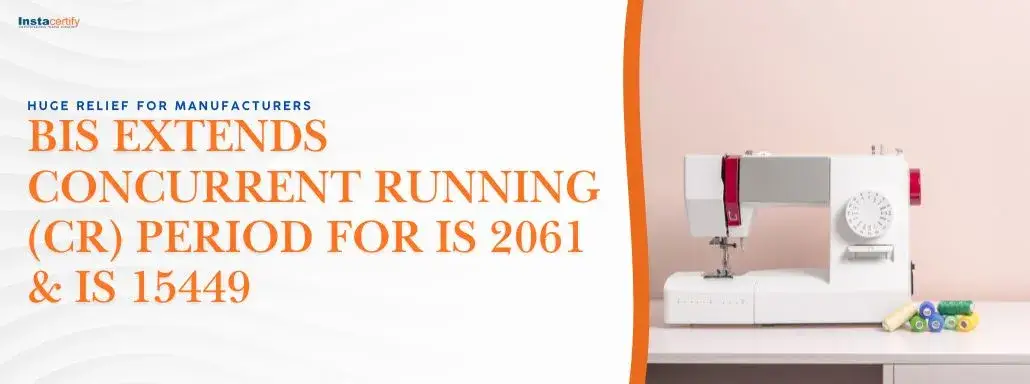
Huge Relief for Manufacturers: BIS Extends Concurrent Running (CR) Period for IS 2061 & IS 15449
Let’s face it: keeping up with shifting regulatory compliance standards can feel like trying to hit a moving target. Just when you think your manufacturing line, testing labs, and product manuals are perfectly aligned with the Bureau of Indian Standards (BIS), a new revision is released, and the clock starts ticking all over again.
If you are a manufacturer or importer dealing in bicycle components or household sewing machines, you have likely been sweating over the impending deadlines for transitioning to the newest BIS standards. Well, you can finally take a deep breath.
In a massive regulatory update this February 2026, BIS released a crucial circular announcing the extension of the Concurrent Running (CR1) period for both IS 2061 (Bicycle Front Forks) and IS 15449 (Household Zig-Zag Sewing Machines).
But what exactly does this mean for your production timeline? Why did the Bureau grant this extension? And most importantly, how can you use this extra time to ensure your BIS certification remains flawless? Let’s break it down into plain English.
What Does “Concurrent Running” Actually Mean?
Before we dive into the specific standards, let’s clarify what “Concurrent Running” (CR) means in the world of BIS compliance.
When BIS updates an old standard (for example, moving from a 1995 version to a 2025 version), they don’t just invalidate the old standard overnight. Doing so would cause massive supply chain disruptions and halt production nationwide. Instead, they introduce a “Concurrent Running” period. During this specific window, both the old standard and the newly revised standard are considered legally valid.
Manufacturers can legally produce, test, and certify goods under the old standard while they simultaneously upgrade their testing equipment, tweak their manufacturing processes, and revise their internal quality controls to meet the new standard. By extending this period, BIS is giving businesses a much-needed buffer. But make no mistake—this is a grace period, not a permanent pass.
Deep Dive: The IS 2061 (Bicycle Front Forks) Extension
If you are in the bicycle manufacturing sector, the transition from IS 2061: 1995 to IS 2061: 2025 is one of the most significant regulatory shifts in recent history.
For nearly three decades, the 1995 standard governed bicycle forks, focusing primarily on standard steel rigid forks for everyday roadsters. But the cycling industry has evolved drastically. Today, the market is flooded with high-performance Mountain Bikes (MTBs), specialized racing cycles, and heavy, high-torque Electrically Power-Assisted Bicycles (E-bikes).
The new IS 2061: 2025 standard finally caught up to reality. It categorized forks into five distinct groups, introduced regulations for modern materials like carbon fiber and titanium, and mandated grueling new tests for suspension forks and disc brake torque.
Naturally, upgrading your in-house testing lab to accommodate a larger 5-piece sample size for intense impact, static bending, and suspension testing takes time and serious capital. The recent BIS circular extending the CR1 period for IS 2061 is a massive win for manufacturers. It prevents a sudden halt in production and gives your factory the runway needed to procure the right testing equipment and update your Product Manual without rushing the process.
Deep Dive: The IS 15449 (Household Zig-Zag Sewing Machines) Extension
Simultaneously, the household appliance sector received its own lifeline. The extension of the concurrent running period for IS 15449 (Part 1): 2004 and IS 15449 (Part 1): 2024 is making waves among sewing machine manufacturers.
The Zig-Zag sewing machine head is a highly complex piece of domestic engineering. The updated 2024 standard introduced stricter compliance parameters regarding stitch quality, operational precision, mechanical safety, and long-term durability. Meeting these enhanced accuracy requirements (which often involve tighter tolerances in the sewing mechanism and bobbin alignment) meant that many factories had to completely overhaul their quality control checkpoints.
With the deadline for full implementation originally looming, many manufacturers were worried about certification bottlenecks at BIS-approved testing labs. By extending the CR period, BIS has ensured that manufacturers can continue supplying the market seamlessly under the 2004 standard while they finalize their transition to the 2024 benchmark.
Why Did BIS Grant These Extensions?
You might be wondering why the regulatory body decided to push these deadlines back. It usually comes down to three very practical reasons:
- Testing Lab Capacity: Upgrading standards often leads to a massive bottleneck at BIS-recognized laboratories. If labs are overwhelmed with samples for the new 2024 and 2025 standards, severe testing delays are inevitable.
- Industry Feedback: Industry associations heavily petition BIS for more time when supply chain issues delay the arrival of new, required testing machinery for factory labs.
- Seamless Market Transition: BIS wants to protect the consumer by ensuring high-quality products, but they also want to protect the manufacturing economy. Halting production simply because factories aren’t 100% ready for the new standard hurts everyone from the factory floor to the end consumer.
How to Use This Grace Period Wisely
It is incredibly tempting to look at a deadline extension, breathe a sigh of relief, and decide to kick the can down the road. Do not make this mistake. This extension is your golden opportunity to get ahead of your competitors who will inevitably panic when the new deadline approaches. Here is what your compliance team should be doing right now:
- Audit Your Lab Equipment: Compare your current in-house testing equipment against the new lists provided in the revised IS 2061: 2025 and IS 15449: 2024 standards. Order missing equipment today to avoid future supply chain delays.
- Update Your Product Manual (PM): Your documentation needs to reflect the new testing protocols, sample sizes, and categorization requirements.
- Run Pre-Tests: Don’t wait for the official BIS audit. Run your current products through the new standard’s testing requirements internally to see where they fail, and tweak your manufacturing process accordingly.
Expert Support When You Need It
Navigating BIS circulars, Product Manual updates, and rigorous factory audits is rarely a walk in the park. Upgrading from a legacy standard to a modernized one requires meticulous documentation and specialized technical know-how.
At Instacertify, we specialize in turning regulatory headaches into seamless transitions. Whether you need help decoding the complex new suspension tests for IS 2061, updating your accuracy requirement documentation for IS 15449, or simply want an expert to manage your entire BIS certification lifecycle, our team is ready to step in.
Don’t let the new standards catch you off guard. The deadline has been extended, but the clock is still ticking. Reach out to the experts at Instacertify today to ensure your products remain fully compliant, safe, and ready to dominate the Indian market.