Skip to content
Instacertify
CallFree quote

HACCP Certification

HACCP (Hazard Analysis and Critical Control Point) is a mandatory, science-based safety framework designed for food processing, catering, hospitality, and pharmaceutical sectors to prevent biological, chemical, and physical hazards. Global markets including India, USA, EU, and Gulf countries require verified HACCP plans.

4.9/5Rated by 28 clients

How HACCP works

  1. 1Identify
  2. 2Plan
  3. 3Approve
  4. 4Deliver
Each step explained

Free Expert Assessment

Free assessment. We reply within 1 business day.

Trusted by Leading Brands Across the Globe

Why HACCP is Required

HACCP is a non-negotiable cornerstone of food safety because it:

  • Serves as a regulatory mandate in most global food authorities
  • Drastically reduces the likelihood of foodborne illness outbreaks and costly product recalls
  • Acts as a “passport” for international trade
  • Demonstrates commitment to public health

What we do for you

  • HACCP Plan Development & Authoring
  • Gap Analysis & Critical Control Point (CCP) Identification
  • HACCP Compliance Certificate for retail, exports, and regulatory audits

Overview

Strategic Blueprint: HACCP Overview

Hazard Analysis and Critical Control Point (HACCP) is a globally recognized preventive framework designed to identify, evaluate, and control food safety hazards. Rather than relying on end-product testing, it embeds safety into the very fabric of your production process.
  • Preventive Science: Focuses on stopping biological, chemical, and physical risks before they occur.
  • Systematic Rigor: Maps every step of the food chain, from raw material sourcing to final distribution.
  • Global Standard: Aligns with Codex Alimentarius and international food trade requirements.
  • Data-Driven: Relies on measurable limits and verifiable records to ensure consistency.
haccp certification

Why it is Required

Imperative: Why HACCP is Non-Negotiable

In the modern food industry, HACCP is no longer optional—it is a cornerstone of operational integrity.

  • Regulatory Mandate: Most global food authorities (FDA, EFSA, FSSAI) require HACCP-based systems by law.
  • Risk Mitigation: Drastically reduces the likelihood of foodborne illness outbreaks and costly product recalls.
  • Market Access: Acts as a "passport" for international trade and is often a prerequisite for supplying major retailers.
  • Consumer Trust: Demonstrates a high-level commitment to public health, protecting your brand’s reputation.

Compliance

Is it mandatory?

HACCP is mandatory for food businesses exporting to the US (under FDA Food Safety Modernization Act), EU, and many other markets. In India, HACCP underpins FSSAI’s advanced food safety requirements.

HACCP serves as the foundational preventive system, whereas ISO 22000 is the comprehensive management extension. It is a prerequisite for achieving higher-level certifications like ISO 22000 and FSSC 22000.

Documents Required

Audit Readiness: Essential Documentation

To build a defensible HACCP plan, the following documentation is vital:

  • Standard Operating Procedures (SOPs) and Sanitation SOPs (SSOPs).
  • Process Flow Diagrams for every product line.
  • Hazard Analysis Worksheets.
  • CCP Monitoring Logs (Temperature, pH, time, etc.).
  • Corrective Action Records.
  • Employee Training Certifications.

Process

HACCP Certification Process with Instacertify

The journey to obtaining your official HACCP certification is structured, manageable, and highly successful when partnered with Instacertify. We break down the complexity into clear, actionable phases. We also facilitate the entire process, including the option for streamlined haccp certification online training and documentation management.

Phase 1: Preparation and GAP Analysis

Our consultants begin with a thorough Gap Analysis of your current food safety operations against the required haccp guidelines. We identify existing prerequisite programs (PRPs)—such as Good Manufacturing Practices (GMPs), sanitation, and pest control—and build a strong foundation for the HACCP plan.

Phase 2: HACCP Plan Development

Based on the analysis, we assemble and train your internal HACCP team. Together, we systematically apply the 7 principles to your processes, resulting in a documented, site-specific HACCP plan. This plan becomes the blueprint for your entire haccp food safety system.

Phase 3: Implementation and Training (Including HACCP Certification Online)

A plan on paper is only the start. We assist with full system implementation, including process changes, equipment setup, and establishing monitoring stations.

We provide comprehensive HACCP certification online training for your entire workforce—from management to floor staff. Our digital training modules ensure all personnel clearly understand the new haccp guidelines, their roles, and the importance of adhering to critical limits, which is vital for maintaining the certification. This is an efficient, flexible way to manage training without logistical overhead.

Phase 4: Internal Audit and Pre-Assessment

Before the official audit, Instacertify conducts a thorough internal audit to identify and resolve any last-minute non-conformities. This crucial step minimizes the risk of failure during the official certification audit.

Phase 5: Official Third-Party Audit and Certification

We coordinate the final audit by a recognized third-party certification body. Our consultants are typically on-site (or available remotely) to support your team through the audit process. Upon successful completion, your facility is issued the internationally recognized HACCP certification. This HACCP certification effectively serves as your official haccp license to operate globally with confidence.

Timeline

Projecting the Clock: Expected Timeline

The duration depends on the complexity of your facility and your current state of readiness:

  • Planning & Training: 4 to 8 weeks.
  • System Implementation & Data Collection: 3 to 6 months (to show a history of compliance).
  • Final Audit & Certification: 2 to 4 weeks after the site visit.

Products Covered

Scope of Compliance: Products Covered

HACCP is adaptable to nearly every sector of the food and beverage industry, including:

  • Meat, Poultry, and Dairy processing.
  • Seafood and Shellfish operations.
  • Fresh Produce and Juice production.
  • Canned and Thermally Processed foods.
  • Bakery, Confectionery, and Ready-to-Eat (RTE) meals.
  • Food Packaging and Cold Chain Logistics.

Cost & Fees

Investment Analysis: Costs & Fees

The financial commitment varies based on facility size and scope. Key cost drivers include:

  • Consultancy Fees: For plan development and gap analysis.
  • Infrastructure Upgrades: Improving facility hygiene or equipment.
  • Monitoring Tools: Thermometers, data loggers, and testing kits.
  • Certification Fees: Paid to the Registrar/Certification Body for the audit and certificate issuance.

Validity & Renewal

Sustaining Excellence: Validity & Renewal

  • Validity: HACCP certificates are typically valid for 1 to 3 years, depending on the issuing body.
  • Surveillance: Annual surveillance audits are usually required to ensure the system hasn't lapsed.
  • Renewal: A full recertification audit is conducted before the expiry date.
  • Dynamic Review: The plan must be updated whenever there is a change in ingredients, equipment, or processes.

Frequently asked questions

What are the 7 steps of HACCP?

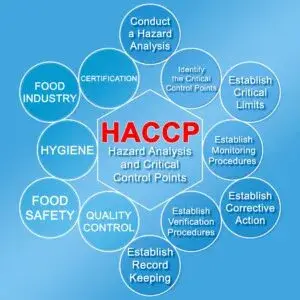
The seven principles: Hazard Analysis, Determine CCPs, Establish Critical Limits, Establish Monitoring Procedures, Define Corrective Actions, Set Verification Procedures, and Maintain Record-Keeping.

What is HACCP in food safety?

A proactive, systematic management system that shifts the focus from ‘inspecting the final product’ to ‘controlling the process.’

What are the 5 points of HACCP?

The 5 Preliminary Tasks: assembling HACCP team, describing product details, identifying intended use, constructing process flow diagram, and on-site verification.

Why are the 7 principles of HACCP important?

They provide a universally accepted framework that ensures no safety risk is left to chance.

How to explain HACCP in an interview?

Define it as a preventive food safety management system that focuses on identifying and controlling hazards at critical points in the production process.

Why is HACCP important?

Beyond foodborne illness prevention, it protects a company’s brand reputation by preventing costly and embarrassing product recalls.

What are the 4 controls for food safety?

Clean, Separate, Cook, and Chill. Clean focuses on rigorous washing; Separate involves keeping raw meats away from ready-to-eat foods; Cook ensures food reaches safe temperatures; Chill involves proper refrigeration.

What are the three main types of HACCP hazards?

Biological (bacteria, viruses, parasites), Chemical (cleaning agents, pesticides, allergens), and Physical (glass shards, metal fragments, wood splinters).

What is a HACCP audit?

A formal, systematic examination of a food safety system to verify that the HACCP plan is being followed as written and is effectively controlling hazards.

How does HACCP relate to other food safety standards?

HACCP is the foundational ‘engine’ that powers most modern food safety standards, including ISO 22000, FSSC 22000, and BRCGS.

What industries use HACCP?

While born in the food and beverage industry, HACCP’s preventive logic has expanded into Pharmaceuticals, Cosmetics, Pet Food, Nutraceuticals, and Water Treatment facilities.

What are the benefits of HACCP certification?

A significant competitive advantage by serving as a mark of quality recognized by global retailers and regulatory bodies.

What is the difference between HACCP and ISO 22000?

HACCP is a specific methodology for hazard control, whereas ISO 22000 is a complete Management System standard. HACCP tells you how to keep food safe, while ISO 22000 tells you how to manage the entire company.

What are the three main types of HACCP?

HACCP classifies food safety risks into three primary categories of hazards: Biological, Chemical, and Physical. Biological hazards include microorganisms like bacteria, viruses, and parasites (e.g., Salmonella or E. coli); Chemical hazards involve substances like cleaning agents, pesticides, or unlisted allergens; and Physical hazards refer to foreign objects that could cause injury, such as glass shards, metal fragments, or wood splinters. A successful HACCP plan must address all three to be considered complete.

What is the first principle of HACCP?

The first principle is Conduct a Hazard Analysis, which is arguably the most critical step of the entire process. It involves a deep dive into every ingredient and every processing step to identify any potential biological, chemical, or physical hazards that are "reasonably likely to occur." During this stage, the HACCP team evaluates the severity of each hazard and the probability of it happening, which then determines which risks are significant enough to require a Critical Control Point later in the plan.

What our clients say

“Instacertify helped us get BIS CRS certification for our entire product range within just 6 weeks. Their team handled everything from documentation to lab coordination. Highly professional service.”
Akash GuptaBIS CRS · Electronics brand
“They handled complete certification for us, from ISO 9001 to BIS for PVC cables and plugs. Thorough, professional and always available — they knew what needed to be done and when.”
Shivank VishnoiISO 9001 & BIS · Cables
“Getting TEC approvals for our access-control products seemed confusing and complex, but Instacertify made it simple.”
Jiten ShahTEC approval · Access control

Not sure which certification you need?

Send us the product name and the countries you sell in. A specialist replies with the standards that apply, the documents to prepare, the lab cost and the timeline. The assessment is free.

  • The list of approvals comes to you in writing
  • Get Started with the Right Expert
  • Testing, certification and registrations handled by one team
Get a free assessment

Free Expert Assessment

Free assessment. We reply within 1 business day.

CallWhatsAppFree quote

Free Expert Assessment

Free Expert Assessment

Free assessment. We reply within 1 business day.

Prefer to talk? +91 99991 18039 or WhatsApp