Regulatory
How the Transition Facilitation QCO 2026 Impacts Indian Businesses
India's regulatory landscape is continuously evolving to strengthen product quality while supporting industrial growth. In a significant move, the Government of India has introduced the Transition Facilitation (Quality Control) Order, 2026 (TFQCO 2026). This new framework is designed to create a balance between stringent quality requirements and the practical challenges faced by manufacturers, importers, and industries during regulatory transitions.
For businesses dealing with products regulated under Quality Control Orders (QCOs), understanding this latest development is essential. The new order aims to ensure seamless compliance, reduce supply chain disruptions, and promote ease of doing business in India.
What is the Transition Facilitation (Quality Control) Order, 2026?
The Transition Facilitation (Quality Control) Order, 2026 is a regulatory mechanism introduced by the Government of India to provide industries with greater flexibility during the transition period of newly notified Quality Control Orders.
Traditionally, once a QCO became effective, manufacturers and importers had to ensure immediate compliance with the prescribed Indian Standards. However, sudden implementation often created operational challenges, especially for businesses dependent on global supply chains.
The TFQCO 2026 addresses these concerns by enabling a structured transition framework, thereby allowing industries to adapt without compromising product quality and consumer safety.
Why Was the TFQCO 2026 Introduced?
The Government recognized several industry concerns related to QCO implementation, including:
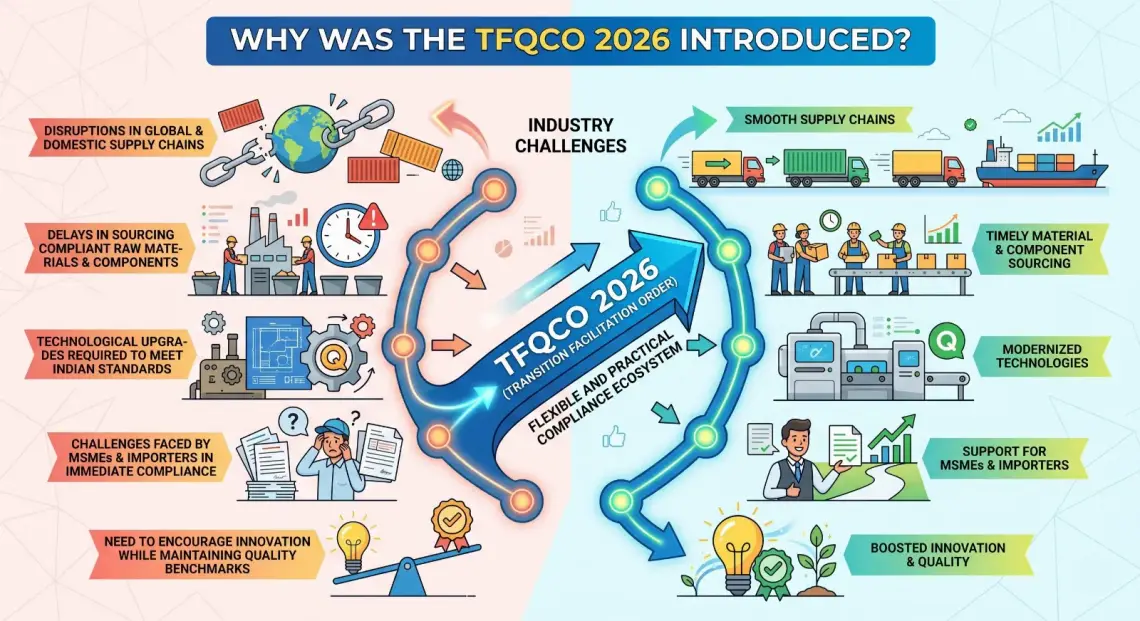
- Disruptions in global and domestic supply chains.
- Delays in sourcing compliant raw materials and components.
- Technological upgrades required to meet Indian Standards.
- Challenges faced by MSMEs and importers in immediate compliance.
- Need to encourage innovation while maintaining quality benchmarks.
The Transition Facilitation Order seeks to overcome these challenges by introducing a more flexible and practical compliance ecosystem.
Key Objectives of the Transition Facilitation (QCO) Order, 2026
1. Ensure Smooth Regulatory Transition
The primary objective is to facilitate a smooth migration from non-compliant to compliant products without causing business interruptions.
2. Strengthen Supply Chain Resilience
Industries often depend on multiple international suppliers. The order enables businesses to maintain continuity during periods of transition and sourcing adjustments.
3. Promote Technological Innovation
Companies introducing advanced technologies or innovative products may require additional time for compliance adaptation. The framework supports innovation while ensuring adherence to quality standards.
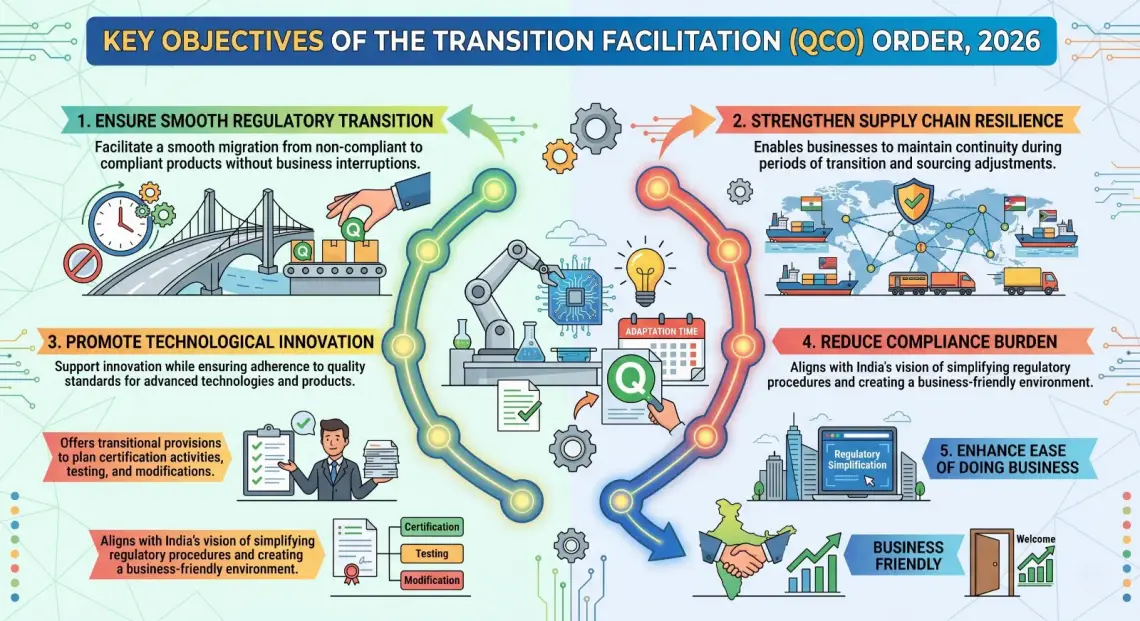
4. Reduce Compliance Burden
By offering transitional provisions, businesses can effectively plan certification activities, testing, and product modifications.
5. Enhance Ease of Doing Business
The order aligns with India's vision of simplifying regulatory procedures and creating a business-friendly environment for manufacturers and importers.
Industries Likely to Benefit from TFQCO 2026
Several sectors regulated under Quality Control Orders are expected to benefit, including:
- Electrical and electronic products
- Machinery and industrial equipment
- Consumer goods
- Automotive components
- Steel and metal products
- Chemical products
- Renewable energy equipment
- Industrial raw materials
These sectors frequently face sourcing and certification challenges during the implementation of new QCO requirements.
How Does the Transition Framework Benefit Businesses?
Reduced Supply Chain Interruptions
Manufacturers can continue sourcing critical components while simultaneously completing compliance formalities.
Better Inventory Management
Businesses can strategically manage existing inventories and transition them into compliant product lines.
Improved Compliance Planning
Organizations receive additional flexibility to plan:
- Product testing
- Factory inspections
- BIS certification activities
- Technical documentation preparation
- Product redesign, if required
Support for MSMEs
Small and medium enterprises often lack extensive compliance infrastructure. The transition mechanism provides valuable time to achieve full conformity.
Impact on Importers and Foreign Manufacturers
Foreign manufacturers exporting products to India often require certifications from the Bureau of Indian Standards (BIS) under various QCOs. Sudden enforcement timelines can create significant hurdles.
The Transition Facilitation Order provides much-needed support by allowing businesses to:
- Align manufacturing processes with Indian Standards.
- Complete mandatory testing requirements.
- Obtain BIS licenses within prescribed timelines.
- Minimize shipment delays and customs-related issues.
This development is expected to encourage greater international participation in the Indian market while ensuring product quality standards remain uncompromised.
Compliance Still Remains Mandatory
While the TFQCO 2026 introduces flexibility, businesses should understand that it does not exempt products from compliance requirements.
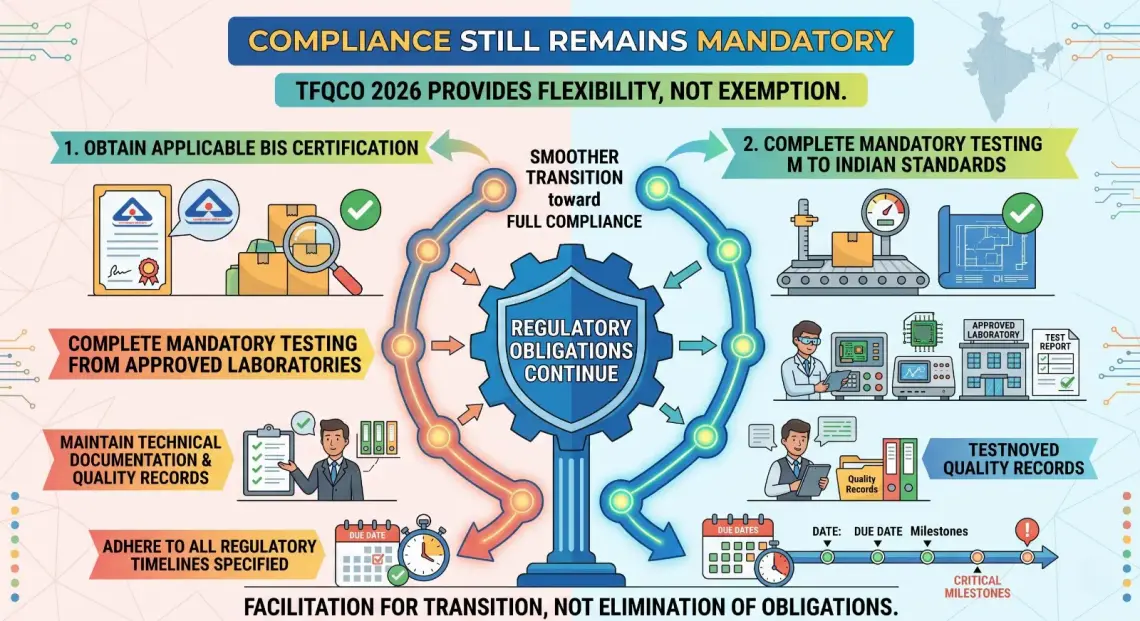
Manufacturers and importers must continue to:
- Obtain applicable BIS certification.
- Ensure products conform to relevant Indian Standards.
- Complete mandatory testing from approved laboratories.
- Maintain technical documentation and quality records.
- Adhere to all regulatory timelines specified under the applicable QCO.
The order merely facilitates a smoother transition toward full compliance rather than eliminating regulatory obligations.
How Instacertify Can Help
Navigating Quality Control Orders and BIS certification requirements can be complex. At Instacertify, we assist businesses at every stage of the compliance journey.
Our services include:
- BIS Certification Assistance
- QCO Compliance Advisory
- Product Testing Coordination
- Documentation Support
- Factory Inspection Guidance
- Foreign Manufacturer Certification Support
- Regulatory Consultation
Whether you are a domestic manufacturer, importer, or overseas exporter, our experts ensure a hassle-free certification process and timely market access.
Final Thoughts
The Transition Facilitation (Quality Control) Order, 2026 represents a progressive regulatory approach by the Government of India. By balancing quality assurance with industrial flexibility, the framework strengthens India's manufacturing ecosystem while supporting innovation, investment, and global trade.
Businesses should proactively assess their compliance obligations and utilize the transition provisions effectively to ensure uninterrupted operations and long-term regulatory success.
As India's quality ecosystem continues to evolve, staying informed and prepared will remain the key to sustainable business growth.