
Indian Compliance
BIS Certification for Water Tanks: Everything You Need to Know About IS 12701
Water is life, but how we store it defines our health. In India, the black plastic tank on the roof is an iconic sight, but not all tanks are created equal. As a manufacturer, how do you prove your product is durable, safe, and leak-proof? As a consumer, how do you know the plastic won’t leach chemicals into your drinking water?
The answer lies in IS 12701:1996.
If you are in the business of manufacturing water tanks, obtaining the ISI Mark under IS 12701 isn’t just a badge of honor—it’s often a mandatory requirement to sell in the Indian market. In this guide, we break down the Bureau of Indian Standards (BIS) Product Manual for IS 12701, decoding the technical requirements into plain English so you can understand exactly what goes into making a certified water tank.
What is IS 12701?
IS 12701 is the Indian Standard specification for Rotational Moulded Polyethylene Water Storage Tanks.
In simpler terms, it is the rulebook for making those cylindrical vertical tanks and rectangular loft tanks used in millions of Indian homes. It specifies everything from the type of plastic you must use to the thickness of the tank walls, ensuring that the tank doesn’t collapse under the weight of water or degrade under the harsh Indian sun.
Scope of the Standard
According to the product manual, this standard covers two specific types of tanks:
- Cylindrical Vertical Tanks: Ranging from 200 Litres to 20,000 Litres in capacity.
- Rectangular Loft Tanks: Ranging from 150 Litres to 500 Litres in capacity.
It applies to both Single Layer and Double Layer tanks. If you are manufacturing tanks within these capacities using the rotational moulding process, IS 12701 is your Bible.
Secret Sauce: Raw Material Requirements
You can’t make a good tank from bad plastic. The BIS manual is very strict about what goes into the mould.
1. Polyethylene Resin (PE)
The core material must be Rotational Moulded Grade Polyethylene. This ensures the tank has the necessary structural integrity. The density and melt flow rate of the resin are tested rigorously to ensure consistency.

2. Carbon Black for UV Protection
Ever wonder why most water tanks are black? It’s not a fashion choice; it’s science.

The standard requires the addition of Carbon Black (usually 2.0% to 3.0%). This acts as a UV stabilizer, preventing the plastic from becoming brittle and cracking when exposed to direct sunlight for years. Without this, a tank on a roof would degrade rapidly.
3. Safety First: The “Overall Migration” Test
This is perhaps the most critical test for consumer health. Since these tanks store potable (drinking) water, the plastic must be food-grade.

The Overall Migration test (Clause 7.6) ensures that no harmful chemicals or particles “migrate” from the plastic wall into the water inside. If a tank fails this test, it is unsafe for human use.
Testing Gauntlet: How a Tank Earns the ISI Mark
To get certified, a manufacturer cannot just claim their tank is strong; they have to prove it. The BIS Product Manual outlines a series of “torture tests” that samples must survive.
1. The Drop Test (Resistance to Impact)
Imagine a clumsy installer dropping a heavy tool on the tank, or the tank itself taking a knock during transport.
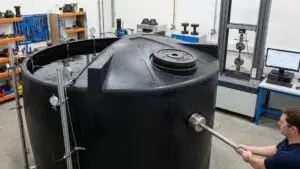
- Test: A sample is struck with a weighted striker (2.5 kg) to check for cracks or punctures. A certified tank must absorb the impact without failure.
2. The Bulge Test (Resistance to Deformation)
Water is heavy. A 1,000-litre tank holds a tonne of weight pushing outwards against the walls.
- Test: The tank is filled with water and left for a specific period. The laboratory measures how much the walls bulge or deform. If it bulges too much, the wall thickness is insufficient.
3. The “Standing Man” Test (Top Load Resistance)
Tanks are often placed on roofs where space is tight. People might step on them during cleaning or maintenance.
- Test: The top of the tank must withstand a load of 100 kg without collapsing. This simulates the weight of an average person standing on the lid.
4. Structural Integrity (Tensile & Flexural Tests)
The plastic itself is pulled and bent in a laboratory machine to measure:
- Tensile Strength: How much pulling force it can take before snapping.
- Flexural Modulus: How stiff the material is.
Navigating the Certification Process
For manufacturers, the path to the ISI Mark involves a few key steps defined in the Scheme of Inspection and Testing (SIT).
Step 1: Grouping Your Products
You don’t need to test every single size of tank you make. The BIS allows for “Grouping” to simplify the process.
Tanks are divided into groups based on capacity. For example:
- Group 2: 700 to 3,000 Litres.
- Group 4: 10,000 to 20,000 Litres.
Golden Rule: If you test the tank with the highest capacity in a specific group, the approval covers all smaller capacities in that same group. This saves time and testing costs.
Step 2: The Control Unit
In your factory, a “Control Unit” is defined as 100 tanks of the same capacity and type, manufactured from the same batch of raw material. BIS requires you to test samples from these control units regularly to maintain your license.
Step 3: Labelling and Marking
Once certified, your tank must proudly display the information required by IS 12701. This includes:
- The ISI Mark.
- Manufacturer’s Name or Trademark.
- Capacity (in Litres).
- License Number (CM/L – XXXXXXX).
Why Compliance Matters for Your Business
If you are a manufacturer, you might be thinking, “This sounds like a lot of work. Is it worth it?”

- Legal Mandate (QCOs): The Government of India frequently issues Quality Control Orders (QCOs) making BIS certification mandatory for water tanks. Selling non-certified tanks can lead to stock seizures and heavy fines.
- Market Trust: In a crowded market, the ISI mark is the only differentiator that matters to an educated customer. It signals that your product won’t leak in a year or poison their water.
- Government Tenders: You cannot bid for government supply contracts (e.g., Jal Jeevan Mission projects) without a valid BIS license.
Ready to Get Certified?
Navigating the Bureau of Indian Standards (BIS) landscape can be tricky. From setting up your in-house laboratory to preparing the Scheme of Testing and Inspection (STI), one small error can delay your license by months.
Whether you are a startup looking for your first license or an established player adding a new variety to your scope, accurate guidance is key.
Need help with IS 12701 Certification?
Don’t let compliance hold you back. Ensure your products stand tall with the ISI mark.
(Disclaimer: This article is for informational purposes based on the IS 12701 Product Manual. Always refer to the latest official BIS standards for compliance.)