Indian Compliance
BIS CRS Certification 2026: Latest Compliance Requirements for Electronic Products
India has one of the world's fastest-growing markets for electronics, IT equipment, and smart consumer devices. To ensure these products meet essential safety and quality requirements before reaching consumers, the Government of India mandates BIS CRS Registration for several notified product categories.
Whether you are an Indian manufacturer, foreign manufacturer, importer, brand owner, or e-commerce seller, understanding the Bureau of Indian Standards (BIS) Compulsory Registration Scheme (CRS) is essential for legally entering the Indian market.
In this comprehensive guide, we'll explain everything you need to know about BIS CRS Registration in 2026, including the registration process, latest guidelines, required documents, eligibility, applicable products, recent regulatory updates, and common compliance mistakes.
What is BIS CRS Registration?
BIS CRS (Compulsory Registration Scheme) is a mandatory product certification scheme operated by the Bureau of Indian Standards (BIS) under Scheme II of the BIS (Conformity Assessment) Regulations, 2018. The scheme primarily covers electronic and IT products notified by the Government of India under various Quality Control Orders (QCOs).
Under this scheme, manufacturers must:
- Test their products in a BIS-recognized laboratory.
- Demonstrate compliance with the applicable Indian Standard (IS).
- Obtain BIS Registration before manufacturing, importing, distributing, or selling the product in India.
- Affix the BIS Standard Mark along with the assigned Registration Number (R-Number) on the product and packaging.
Unlike the BIS ISI Mark Scheme, CRS follows a self-declaration of conformity model, where BIS grants registration after verifying product testing and documentation.
Why is BIS CRS Registration Mandatory?
The primary objective of BIS CRS is to protect Indian consumers by ensuring that electronic products available in the market comply with prescribed safety standards.
The scheme helps:
- Prevent unsafe electrical products from entering the market.
- Improve consumer confidence.
- Reduce electrical hazards.
- Promote product quality.
- Ensure fair trade practices.
- Support regulatory compliance for manufacturers and importers.
Selling or importing a notified product without valid BIS CRS Registration may result in customs detention, product seizure, penalties, or restrictions on market access.
Latest BIS CRS Guidelines 2026
The BIS CRS framework continues to evolve through revised standards, new product notifications, and administrative updates. Some notable 2026 developments include:
1. Revised Licence Validity and Renewal Provisions
BIS issued revised provisions for licence validity, renewal, and annual fee payment under the CRS in May 2026. Manufacturers should review these updated administrative requirements and ensure timely compliance with fee payments and renewal obligations.
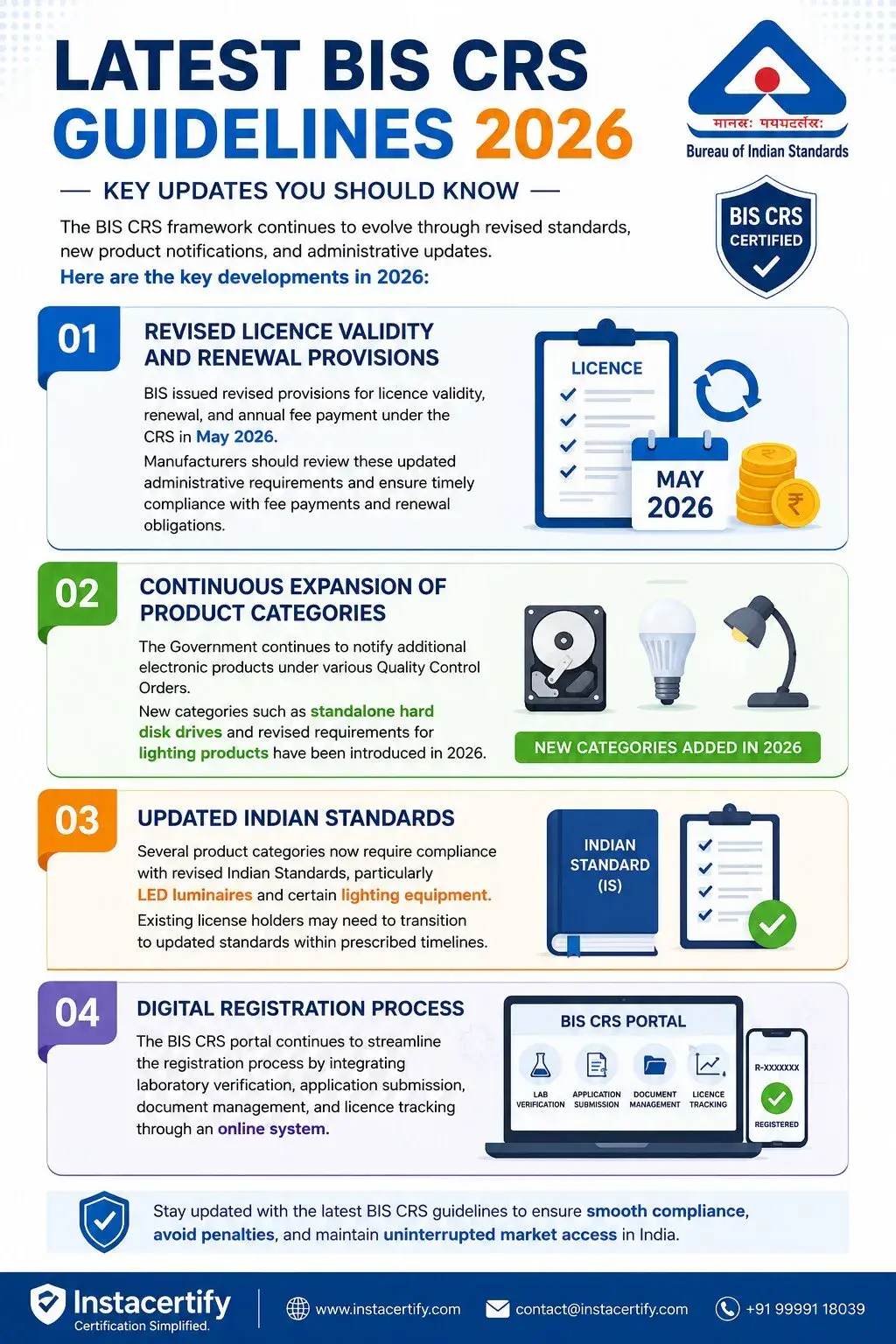
2. Continuous Expansion of Product Categories
The Government continues to notify additional electronic products under various Quality Control Orders. New categories such as standalone hard disk drives and revised requirements for lighting products have been introduced in 2026.
3. Updated Indian Standards
Several product categories now require compliance with revised Indian Standards, particularly LED luminaires and certain lighting equipment. Existing license holders may need to transition to updated standards within prescribed timelines.
4. Digital Registration Process
The BIS CRS portal continues to streamline the registration process by integrating laboratory verification, application submission, document management, and licence tracking through an online system.
Products Covered Under BIS CRS
As of 2026, the scheme covers more than 70 notified product categories, including:
- Mobile phones
- Laptops
- Tablets
- LED televisions
- Smart TVs
- Power adapters
- Mobile chargers
- LED lamps
- LED luminaires
- CCTV cameras
- Printers
- Scanners
- Smart speakers
- Wireless keyboards
- Wireless mice
- UPS systems
- Microwave ovens
- Induction cooktops
- Smart watches
- Bluetooth devices
- Electronic musical systems
- Automatic data processing machines
- Optical disc players
- Electronic games
The list continues to expand as new Quality Control Orders are issued. Manufacturers should always verify whether their products fall under the latest notified categories before importing or selling in India.
BIS CRS Marking Requirements
After approval, manufacturers must display:
- BIS Standard Mark
- Registration Number (R-XXXXXXX)
- Product information
- Manufacturer details
The marking must comply with BIS labelling requirements and remain clearly visible on the product or its packaging.
Common Mistakes to Avoid
Many applications face delays due to avoidable errors.
Some common mistakes include:
- Selecting the wrong Indian Standard
- Testing in a non-recognized laboratory
- Incorrect product model declaration
- Missing technical documents
- Improper product labelling
- Expired laboratory test reports
- Incomplete AIR documentation
- Applying under the wrong manufacturer name
Working with an experienced compliance consultant can significantly reduce these risks.
BIS CRS vs BIS ISI Mark
Although both certifications are issued by BIS, they serve different purposes.
| BIS CRS | BIS ISI Mark |
|---|---|
| Primarily for electronic and IT products | Primarily for industrial and consumer products |
| Scheme II Registration | Product Certification Scheme |
| Self-declaration after successful testing | Licence based with additional conformity assessment requirements |
| Uses Registration Number (R-Number) | Uses ISI Licence Number |
| Product testing in BIS-recognized labs | Certification based on applicable BIS product certification procedures |
How Long Does BIS CRS Registration Take?
The overall timeline depends on:
- Product category
- Laboratory testing schedule
- Documentation quality
- BIS verification
- Response time for queries
If documentation is complete and testing proceeds smoothly, the process is generally completed within a few weeks, although timelines may vary depending on product complexity and regulatory workload.
SummaryBIS CRS Registration is no longer just a regulatory requirement—it is an essential step for entering the Indian electronics market. As the Government continues expanding the list of regulated products and updating Indian Standards, manufacturers and importers must stay informed about the latest compliance requirements.
The 2026 updates, including revised licence validity provisions, new product notifications, and updated standards for selected categories, highlight the importance of proactive compliance planning.
Whether you are launching a new product or expanding your business into India, obtaining BIS CRS Registration through a structured compliance process ensures smoother market access, stronger consumer confidence, and long-term regulatory success.
Need expert assistance with BIS CRS Registration? Instacertify provides comprehensive support—from product testing coordination and documentation to application filing, BIS query resolution, and post-registration compliance—helping manufacturers and importers achieve certification efficiently and confidently.
Frequently asked questions
How long does the BIS CRS Registration process take?
The registration timeline depends on product testing, documentation accuracy, and BIS verification. If all required documents are complete and laboratory testing is successful, the process is generally completed within a few weeks, subject to regulatory review.
What is the validity of BIS CRS Registration?
Under the latest BIS guidelines, CRS Registration remains valid according to the licence terms issued by BIS and requires timely renewal with applicable annual fee payments. Manufacturers should monitor renewal deadlines to maintain uninterrupted regulatory compliance.
Is BIS CRS Registration mandatory for importers?
Yes. Importers can only import notified products if the manufacturer has obtained valid BIS CRS Registration. Products without the required registration may face customs clearance issues, shipment delays, penalties, or restrictions on entry into the Indian market.
What happens if a product is sold without BIS CRS Registration?
Selling or importing a notified product without valid BIS CRS Registration may result in regulatory action, customs detention, product seizure, financial penalties, and restrictions on market access. Compliance is essential to avoid legal and commercial risks.
Can one BIS CRS Registration cover multiple product models?
Generally, each product model requires separate BIS CRS Registration unless BIS permits model grouping under specific guidelines. Manufacturers should carefully evaluate product variations and consult applicable BIS requirements before submitting registration applications.
What is the difference between BIS CRS and BIS ISI Certification?
BIS CRS is primarily applicable to electronic and IT products under the Compulsory Registration Scheme, while BIS ISI Certification applies to products covered under the Product Certification Scheme. Both ensure compliance with Indian Standards but follow different certification procedures and marking requirements.
Can foreign manufacturers apply for BIS CRS Registration directly?
Foreign manufacturers can apply for BIS CRS Registration, but they must appoint an Authorized Indian Representative (AIR) if they do not have a registered office in India. The AIR acts as the official liaison with BIS throughout the registration and compliance process.
Is product testing mandatory before applying for BIS CRS Registration?
Yes. Every notified product must be tested at a BIS-recognized laboratory according to the applicable Indian Standard. The test report is one of the most important documents required for submitting a successful BIS CRS Registration application.
What is an Authorized Indian Representative (AIR) under BIS CRS?
An Authorized Indian Representative (AIR) is an entity or individual appointed by a foreign manufacturer to represent them before BIS. The AIR manages regulatory communication, application submissions, and compliance responsibilities when the manufacturer has no office in India.
Can BIS CRS Registration be renewed after expiry?
Yes. BIS CRS Registration can be renewed by submitting the required application, paying applicable fees, and complying with the latest BIS renewal provisions. Manufacturers should begin the renewal process well before the licence expires to avoid business interruptions.