
Indian Compliance
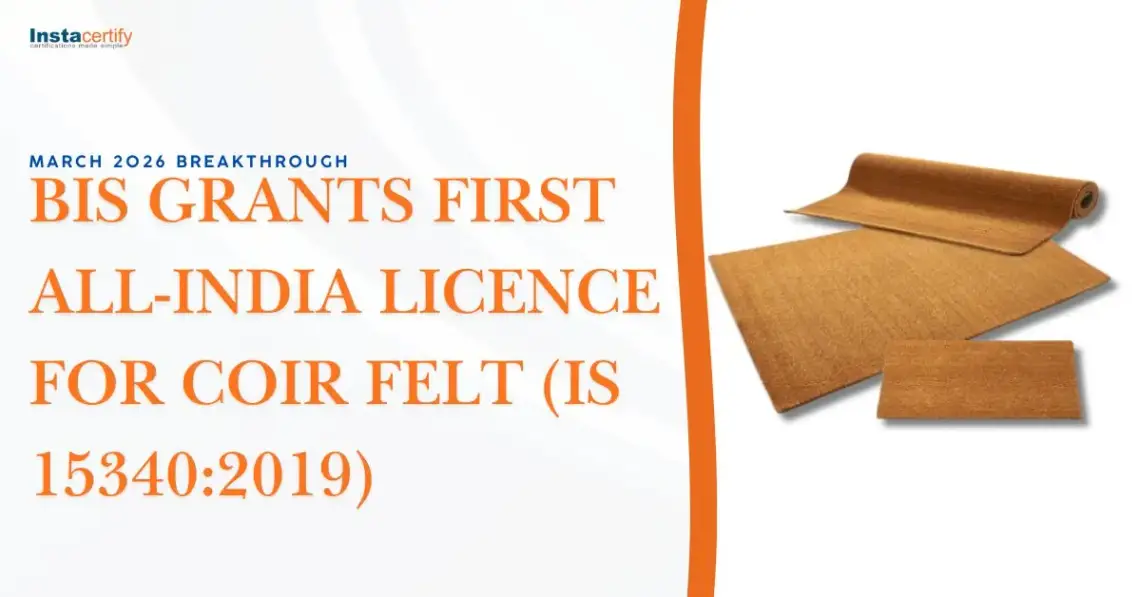
March 2026 Breakthrough: BIS Grants First All-India Licence for Coir Felt (IS 15340:2019)
If you are manufacturing or supplying coir felt in India, navigating the regulatory landscape is crucial to establishing market dominance. As the world rapidly shifts toward sustainable, eco-friendly, and agro-based products, coir felt has emerged as a high-demand material across agriculture, geotextiles, insulation, and the bedding industry. However, to truly capitalize on this demand and win the trust of top-tier buyers and government bodies, achieving the ISI mark is non-negotiable.
This comprehensive guide breaks down everything you need to know about getting BIS Certification for Coir Felt as per IS 15340 : 2019, the latest industry updates, and how to seamlessly navigate the compliance journey.
Latest Industry Update: March 2026 Breakthrough
Before diving into the technicalities, it is crucial to highlight a massive milestone in the coir industry. In March 2026, the Bureau of Indian Standards (BIS) officially announced the grant of the All India First Licence for “Coir Felt” as per IS 15340 : 2019.
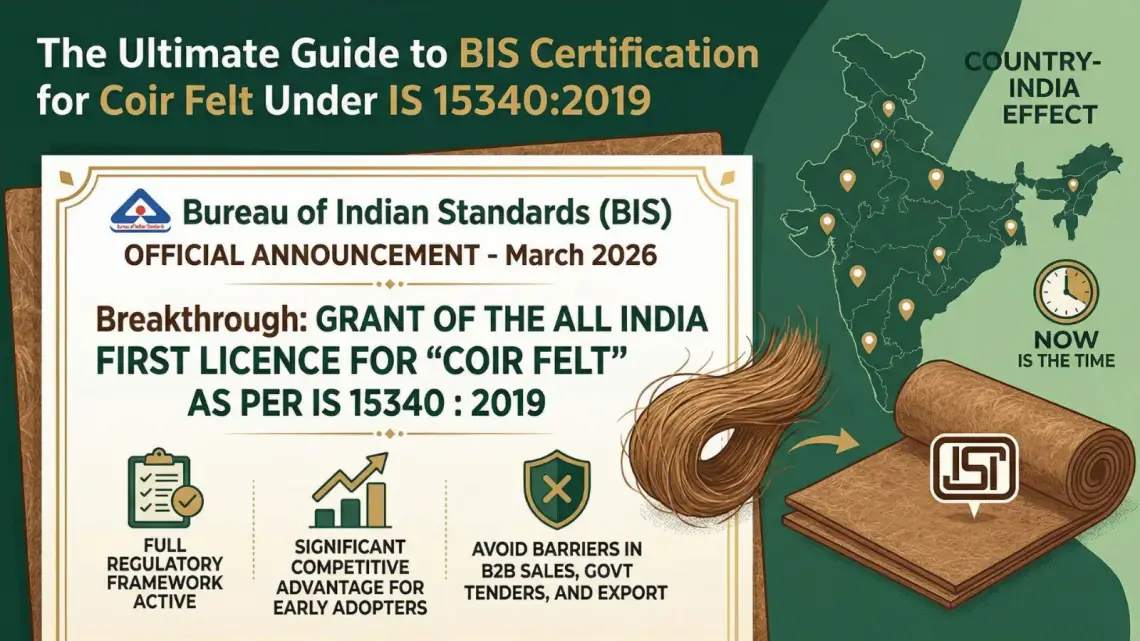
What does this mean for your business? It signals that the regulatory framework for coir felt is fully active, and early adopters who secure their BIS license now will have a significant competitive advantage. As standardization becomes strictly enforced, uncertified manufacturers will likely face major barriers in B2B sales, government tenders, and export opportunities. Now is the exact right time to initiate your certification process.
What is IS 15340 : 2019?
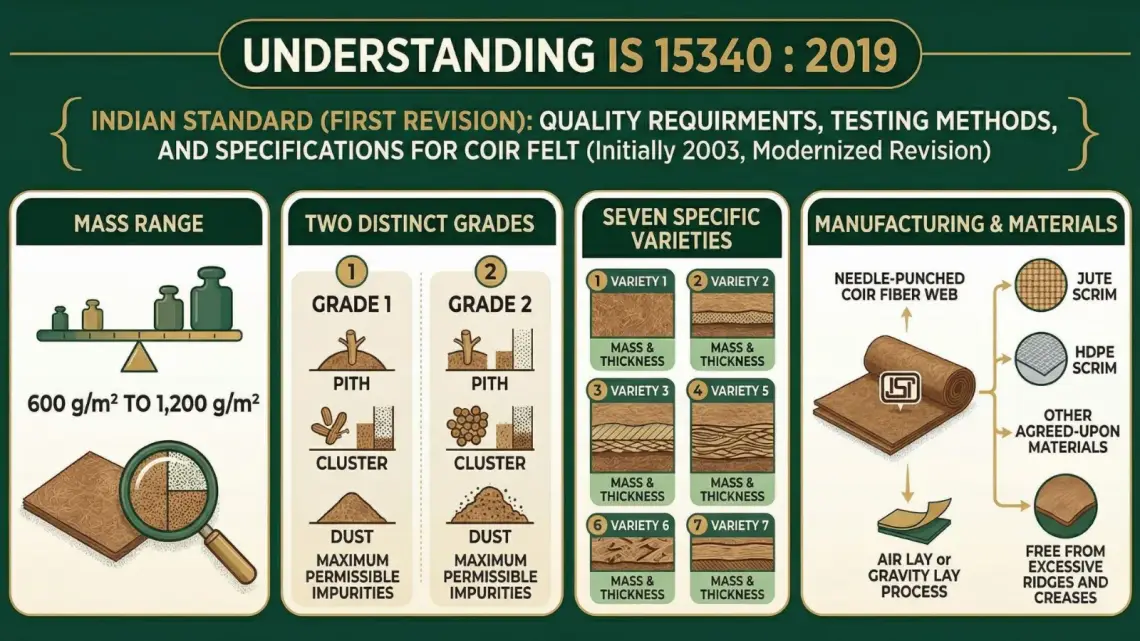
IS 15340 : 2019 is the Indian Standard (First Revision) that prescribes the quality requirements, testing methods, and specifications for coir felt. Initially published in 2003 to support the coir industry's push for environment-friendly products, the standard was revised to keep up with modern manufacturing capabilities.
The standard specifically covers:
- Mass Range: Coir felts having a mass ranging from 600 g/m² to 1,200 g/m².
- Grades: Two distinct grades based on the maximum permissible impurities (like pith, cluster, and dust).
- Varieties: Seven specific varieties within each grade, categorized strictly by their mass and thickness.
According to the standard, high-quality coir felt is manufactured by needle-punching a coir fiber web (created via air lay or gravity lay processes). It can also be manufactured with jute, HDPE scrim backing, or other agreed-upon materials, provided it remains free from excessive ridges and creases.
Why is BIS Certification Crucial for Coir Felt?
Obtaining the ISI mark from the Bureau of Indian Standards is more than just a regulatory checkbox; it is a powerful business growth tool. Here is why compliant manufacturers are leading the market:
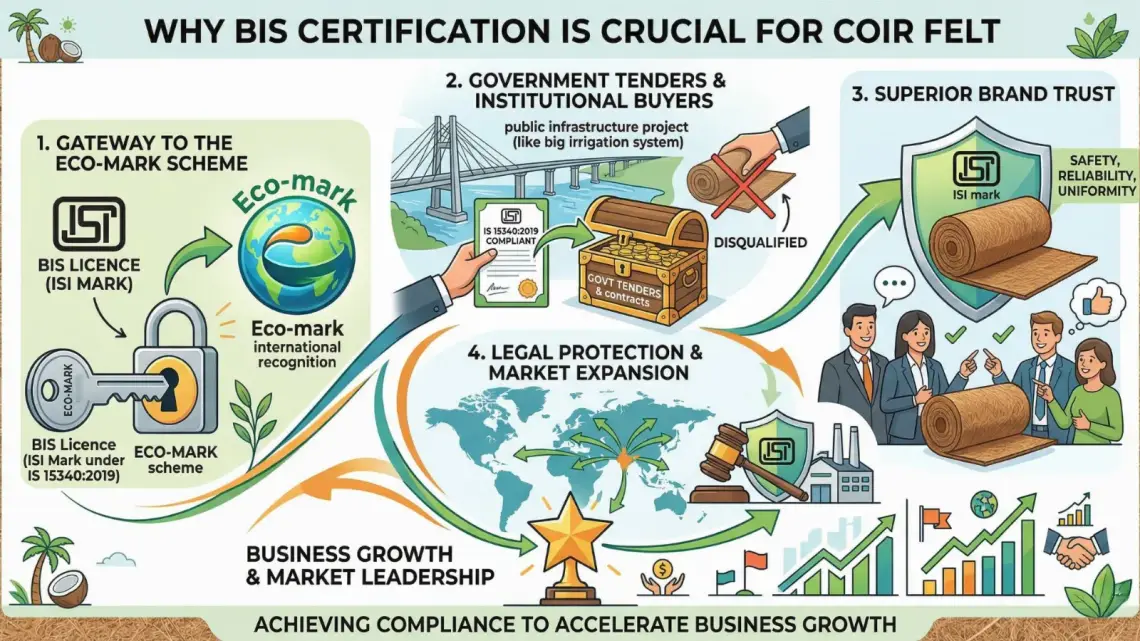
1. The Gateway to the Eco-Mark Scheme
The Eco-mark scheme is operated by BIS to globally identify environment-friendly products. However, to obtain the licence to use the prestigious Eco-mark on your coir felt, it is a mandatory prerequisite to first obtain the standard BIS licence (ISI Mark) under IS 15340:2019. You cannot get one without the other.
2. Government Tenders & Institutional Buyers
Government departments, infrastructural projects, and large-scale agricultural initiatives heavily rely on BIS-certified products. Without IS 15340:2019 compliance, your product is automatically disqualified from lucrative government procurement channels.
3. Superior Brand Trust
Consumers and B2B clients alike associate the ISI mark with safety, reliability, and stringent quality control. Displaying this mark assures buyers that your coir felt won't easily degrade, has the correct thickness, and is free of excessive manufacturing impurities.
4. Legal Protection & Market Expansion
Having your products standardized mitigates the risk of rejection at the buyer’s end and protects you from legal liabilities regarding product quality. Furthermore, certified products face zero friction when expanding across state lines or scaling up operations globally.
Key Quality Requirements & Testing Under IS 15340:2019
To achieve BIS certification, your coir felt must undergo rigorous laboratory testing to prove it meets the standard’s criteria. The key parameters evaluated include:
- Impurity Content: The standard sets strict limits on the presence of pith, clusters, and dust. Excess impurities compromise the structural integrity, durability, and acoustic/thermal properties of the felt.
- Mass and Thickness: The felt must strictly adhere to the declared mass (g/m²) and thickness (mm) for its specific variety, with a tightly permitted tolerance level of ±5%.
- Dimensions: Length and width must be uniform. The felt should ideally have straight edges and be devoid of manufacturing defects like creases or prominent ridges.
- Raw Material Quality: The raw mechanically extracted coir fibers used in the felt must conform to the base standards, typically IS 9308 (Part 3).
Common Challenges Manufacturers Face During Certification
Getting certified isn't always a walk in the park. Many manufacturers face hurdles that delay their licensing for months. The most common pitfalls include:
- Improper Equipment Calibration: Having testing equipment is not enough; it must be regularly calibrated according to BIS guidelines. Uncalibrated equipment during a factory audit leads to instant rejections.
- Incomplete Paperwork: Missing documents regarding raw material sourcing or inaccurate factory layout plans frequently halt the application process.
- Pre-Testing Failures: Submitting samples that fail to meet the exact ±5% tolerance limits for mass or thickness will require a complete restart of the testing phase.
Step-by-Step BIS Certification Process
The journey to securing the ISI mark involves a meticulous evaluation of both your manufacturing facility and your product. Here is the standard roadmap:
Step 1: Pre-Requisite Preparation
Ensure your manufacturing unit is equipped with the necessary machinery (bale openers, cross-lappers, needle-punching machines) and an in-house testing laboratory that meets BIS testing protocols.
Step 2: Sample Testing
Before submitting the formal application, you must test a sample of your coir felt in a BIS-recognized laboratory to ensure it completely conforms to IS 15340:2019.
Step 3: Application Submission
Submit the application through the BIS online portal. This must include all technical documents, raw material details, the layout of your manufacturing premise, and the preliminary test reports.
Step 4: Factory Audit & Inspection
A designated BIS official will visit your manufacturing premises. They will inspect the production process, verify the testing equipment, and evaluate the competence of your quality control personnel. During this visit, the officer will draw random samples of the coir felt for independent lab testing.
Step 5: Grant of Licence
If the independent test report is satisfactory and the factory audit reveals no non-conformities, BIS will grant the licence. You are then legally authorized to apply the ISI Mark to your coir felt products!
Essential Documents Required for IS 15340:2019 Compliance
Keeping your paperwork organized will significantly speed up the certification timeline. Prepare the following documents:
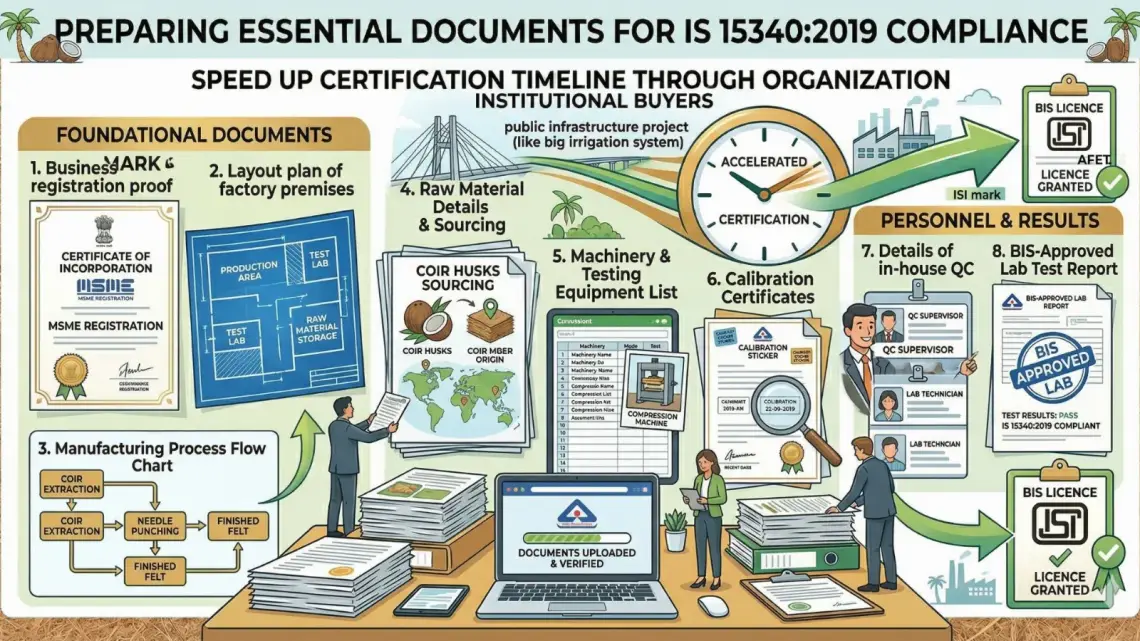
- Business registration proof (Certificate of Incorporation, MSME registration, etc.)
- Layout plan of the factory premises
- Detailed list of manufacturing machinery and testing equipment
- Calibration certificates for all testing equipment
- Flow chart detailing the complete manufacturing process
- Details of the raw materials used and their sourcing
- Details of the in-house quality control personnel
- Independent test report from a BIS-approved lab
Conclusion
Coir felt is a product of the future—sustainable, versatile, and highly demanded. Securing your BIS Certification under IS 15340:2019 elevates your product from a generic commodity to a verified, high-quality industrial material. With the BIS actively issuing new licenses in 2026, the market standard is officially set. Getting certified not only builds immense buyer trust but opens the doors to Eco-mark branding and premium B2B contracts.
Ready to get your coir felt certified? Reach out to the experts at Instacertify today and let’s get your products ISI marked without the hassle!
Frequently asked questions
Is BIS certification mandatory for Coir Felt?
While voluntary for general sales, BIS certification under IS 15340:2019 is strictly mandatory for securing lucrative government tenders and applying for the prestigious international Eco-mark.
How long does the BIS certification process take?
The complete certification process typically takes around 45 to 60 days, assuming all factory documentation is perfectly accurate and your initial coir felt samples pass independent lab testing smoothly.
Can I get the Eco-mark without an ISI mark?
No, you absolutely cannot. The Bureau of Indian Standards explicitly mandates that obtaining a valid ISI mark under IS 15340:2019 is the strict prerequisite for any Eco-mark application.
What is the validity period of a new BIS licence?
A newly granted BIS licence for coir felt remains valid for exactly one year. Afterward, manufacturers can easily renew it for up to five years based on compliance history.
Does the IS 15340 standard allow backing materials?
Yes, the standard permits manufacturing coir felt with jute, HDPE scrim backing, or other mutually agreed-upon materials, provided the final product strictly meets all core mass and impurity requirements.