
Indian Compliance
BIS ISI Mark Certification for Welding Cables (IS 9857:1990)

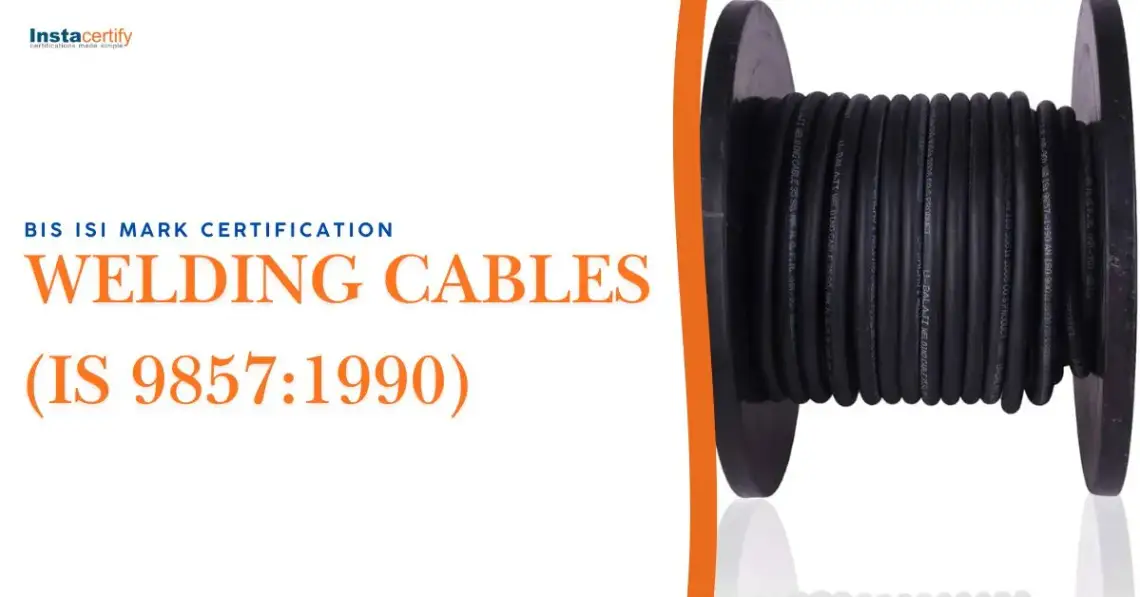
In the heavy industrial sector, safety and durability are paramount. Welding operations, particularly in shipyards, automotive manufacturing, and construction, require cables that can withstand extreme conditions. This is where IS 9857:1990 comes into play.
If you are a manufacturer or importer of welding cables, understanding the Bureau of Indian Standards (BIS) requirements is not just about quality assurance—it is a legal necessity. Under the Cables (Quality Control) Order, 2020, welding cables generally fall under the mandatory certification list, meaning they cannot be sold, manufactured, or imported in India without a valid ISI Mark.
What is IS 9857:1990?
IS 9857:1990 is the Indian Standard specification that covers Insulated & Sheathed Welding Cables. These are single-core, flexible cables designed specifically to transmit high currents from the electric welding machine to the welding tool (electrode holder).
Unlike standard house wiring, welding cables must endure rough handling, dragging across abrasive surfaces, exposure to oil and grease, and significant thermal shocks. Therefore, IS 9857 specifies that these cables must use HOFR (Heat Resisting, Oil Resisting, and Flame Retardant) elastomeric insulation to ensure safety and longevity.
Why is BIS Certification Mandatory for Welding Cables?
The Government of India, through the Department for Promotion of Industry and Internal Trade (DPIIT), has issued Quality Control Orders (QCOs) for various electrical products to curb the influx of sub-standard goods.
For welding cables, the mandatory ISI Mark ensures:
- Safety: Protection against electrical shocks and fire hazards in volatile industrial environments.
- Quality: Assurance that the copper or aluminum conductors meet conductivity standards.
- Marketability: Products without the ISI Mark are liable to be seized, and manufacturers can face heavy penalties.
Technical Requirements Under IS 9857
To obtain the license, your product must pass specific laboratory tests defined by BIS. Key parameters include:
- Conductor Material: The standard allows for high-conductivity annealed copper or aluminum. Flexibility is a critical test parameter.
- Insulation Material: The covering must be durable. The standard mandates tests for tensile strength and elongation at break of the insulation.
- HOFR Test: The cable is subjected to oil immersion and heat treatment to verify it does not degrade, swell, or lose its flame-retardant properties.
- High Voltage Test: Ensuring the cable can handle the designated voltage without breakdown.
- Resistance Test: Verifying that the conductor resistance falls within the permissible limits to prevent overheating.
BIS Certification Process for Welding Cables
Obtaining the ISI Mark involves a systematic process under Scheme-I of the BIS conformity assessment.
Step 1: Documentation & Application
The manufacturer must prepare technical documents, including the factory layout, list of machinery, quality control personnel details, and manufacturing flowcharts. An application is then submitted on the Manak Online portal.
Step 2: Factory Inspection
A BIS officer will visit the manufacturing unit to audit the production process and the in-house testing facilities. They will verify that you have the necessary testing equipment (like tensile testing machines and ohmmeters) to maintain daily quality standards.
Step 3: Sample Drawing & Testing
During the audit, the officer will draw random samples of the welding cables. These are sealed and sent to a BIS-recognized third-party laboratory for independent testing against IS 9857 parameters.
Step 4: Grant of License
If the factory audit is successful and the independent lab report confirms the product meets the standard, the BIS license is granted.
If you want to isi mark for cable, please visit: BIS ISI Mark
Documents Required for BIS Registration
To fast-track your application with Instacertify, ensure you have the following ready:
- Proof of office and factory address (e.g., Business License, Rent Agreement).
- MSME/SSI Registration certificate (if applicable).
- List of Manufacturing Machinery.
- List of Testing Equipment with valid calibration certificates.
- Process Flow Chart.
- Details of the Quality Control Manager (Degree/Diploma certificate).
- Trademark Registration copy.
Frequently asked questions
What is the IS 9857:1990 standard for welding cables?
The IS 9857:1990 standard specifies the manufacturing, chemical, and physical requirements for flexible welding cables. It ensures safe electrical conductivity, durable insulation, and mechanical strength to minimize risks like electric shock, overheating, and premature failure during operations.
Is BIS ISI mark certification mandatory for welding cables?
Yes, obtaining the BIS ISI mark certification is completely mandatory for all welding cables sold in India. This strict regulation protects consumers by ensuring that manufacturers consistently meet the highest national safety, durability, and quality benchmarks.
What tests are required for this BIS certification?
Manufacturers must pass several rigorous evaluations at approved laboratories. Key testing parameters involve conductor resistance checks, high voltage spark assessments, tensile strength evaluations, and flexibility tests to confirm the cables can endure harsh industrial environments safely.
How long does the ISI certification process usually take?
The estimated timeline generally depends on the applicant's location and testing readiness. For domestic Indian manufacturers, the standard procedure typically takes around thirty to forty days, while foreign manufacturers might experience processing times closer to six months.
What happens if welding cables lack the ISI mark?
Producing or selling these cables without the mandatory ISI mark violates government regulations. Non-compliant businesses face heavy penalties, including stock seizures, immediate cancellation of operating licenses, and potentially severe legal action under the BIS Act.
What documents are necessary for the BIS certification application?
You must submit comprehensive factory registration documents, detailed manufacturing process flowcharts, in-house testing equipment calibration certificates, and raw material sourcing details. Proper documentation proves your facility is fully equipped to maintain continuous quality control standards.
How is the factory inspection conducted for this certification?
A designated BIS officer visits the manufacturing facility to thoroughly verify production processes, evaluate in-house testing capabilities, and randomly draw product samples. These samples are subsequently sent to authorized independent laboratories for final compliance testing.
What is the validity period of the BIS ISI certificate?
Initially, the BIS ISI mark certificate is granted for a period of one to two years. Manufacturers can easily renew this certification by submitting the required application and fees, provided they have maintained consistent product quality.