
Indian Compliance
What Is CDSCO? Complete Guide to CDSCO Registration, License, Certificate & Latest Updates in 2026

If you manufacture, import, distribute, or sell drugs, pharmaceuticals, medical devices, in-vitro diagnostic devices (IVDs), or cosmetics in India, you may have already come across the term CDSCO.
But what exactly is CDSCO? Is a CDSCO certificate the same as a CDSCO license? When is CDSCO registration required? What are the current CDSCO guidelines for medical devices and other regulated products? And what has changed in 2026?
This guide explains CDSCO compliance in simple language, covering the regulatory framework, registration and licensing requirements, medical device compliance, the SUGAM application process, and the latest updates businesses should know before entering the Indian market.
What Is CDSCO?
CDSCO stands for Central Drugs Standard Control Organisation. It is India's national regulatory authority for drugs, medical devices, cosmetics, and certain related products. CDSCO functions under the Directorate General of Health Services, Ministry of Health & Family Welfare, Government of India.
Its regulatory framework includes the Drugs and Cosmetics Act, 1940; Drugs Rules, 1945; New Drugs and Clinical Trials Rules, 2019; Medical Devices Rules, 2017; and Cosmetics Rules, 2020.
In practical terms, CDSCO helps ensure that regulated healthcare and consumer products entering or being manufactured in India meet applicable requirements for quality, safety, efficacy and performance.
For businesses, this means compliance is not simply about obtaining a document. The correct regulatory pathway depends on what the product is, how it is used, its risk classification, whether it is imported or manufactured in India, and which regulations apply.
Medical Device CDSCO Compliance Explained
The medical device CDSCO framework has become increasingly important as more products are brought under India's medical device regulatory system.
Medical devices are regulated through the Medical Devices Rules, 2017, with a risk-based classification system.
The first major step is therefore device classification.
Step 1: Identify the Medical Device
Determine whether the product falls within the regulatory definition of a medical device or IVD.
The intended purpose is extremely important. A product's regulatory classification is not determined only by its commercial name.
Step 2: Determine the Risk Class
The device is classified as Class A, B, C or D based on the applicable rules.
Higher-risk devices generally face more extensive regulatory requirements.
CDSCO maintains classification lists and guidance documents covering different medical device categories. Recent updates have also included classification lists for specific areas such as oncology, interventional radiology and radiotherapy.
Step 3: Determine Import or Manufacturing Pathway
For imported devices, the applicant needs to follow the applicable import licensing pathway.
For example, the current CDSCO checklist for medical device import licensing identifies Form MD-14 as the application for grant of an import licence in Form MD-15.
For manufacturing, different forms apply depending on the risk class and activity.
Step 4: Prepare Technical Documentation
Medical device applications can involve substantial technical documentation.
For imported medical devices, the current CDSCO checklist includes documents such as:
- Power of Attorney
- Regulatory certificates
- Free Sale Certificate or Marketing Authorization, where applicable
- Overseas manufacturing-site information
- Quality Management System certificates
- Declaration of Conformity
- Plant Master File
- Device Master File
- Technical information and supporting documents
The precise requirements depend on the product and application.
Step 5: Submit the Application
CDSCO uses online regulatory systems for many applications. Applicants need to select the appropriate application type, upload documents, pay applicable fees and respond to regulatory queries or deficiencies.
The medical device division maintains dedicated guidance documents, forms and checklists for different regulatory pathways.
What Are the Latest CDSCO Guidelines in 2026?
CDSCO compliance is not static. The regulatory authority continues to issue new notices, guidance documents, circulars, classifications and procedural updates.
Some of the most important developments visible in 2026 include the following.
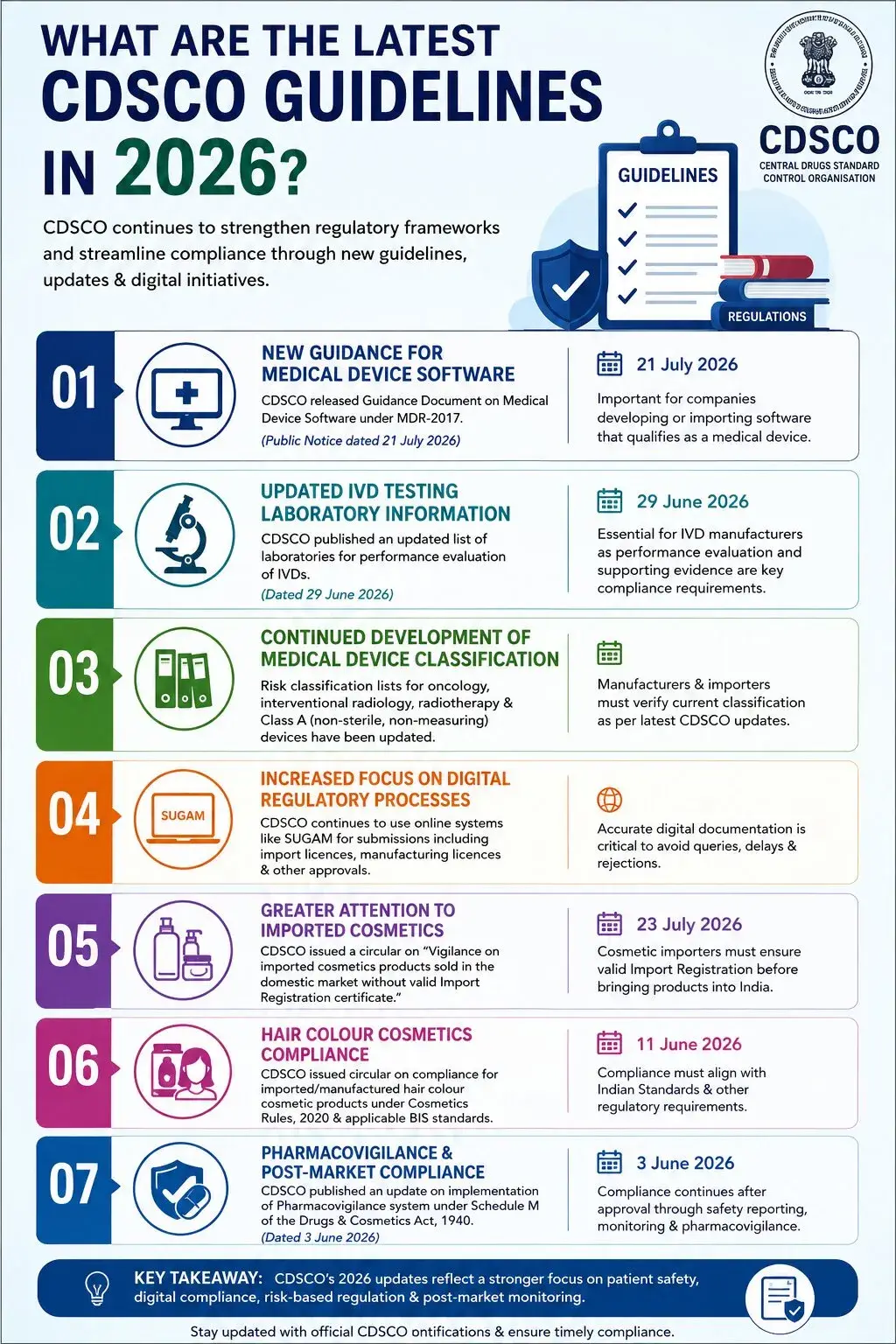
1. New Guidance for Medical Device Software
One of the most notable 2026 developments is CDSCO's Guidance Document on Medical Device Software under MDR-2017, published as a public notice on 21 July 2026.
This is particularly relevant for companies developing or importing software that qualifies as a medical device.
Software-driven healthcare products are becoming increasingly common, including diagnostic applications, clinical decision-support solutions and other digital health technologies.
Businesses dealing with medical device software should therefore assess whether their software falls within the medical device framework and review the applicable CDSCO guidance before commercialization.
2. Updated IVD Testing Laboratory Information
CDSCO published an updated list of laboratories for conducting performance evaluation of IVDs, dated 29 June 2026.
This is relevant to IVD manufacturers and applicants because performance evaluation and supporting evidence are important elements of IVD regulatory compliance.
3. Continued Development of Medical Device Classification
CDSCO has continued publishing and updating risk classification information for medical devices.
Recent published material includes risk classification lists relating to oncology, interventional radiology and radiotherapy, along with a risk-based classification list for certain Class A non-sterile and non-measuring medical devices.
Manufacturers and importers should therefore verify the current classification rather than relying solely on older classifications or third-party information.
4. Increased Focus on Digital Regulatory Processes
CDSCO continues to use online systems such as SUGAM for regulatory submissions.
The medical device regulatory system provides online pathways and dedicated checklists for applications such as import licences, manufacturing licences and other approvals.
This makes accurate digital documentation increasingly important. A missing document, incorrect form, inconsistent product information or incomplete technical file can create avoidable regulatory queries.
5. Greater Attention to Imported Cosmetics
A significant recent compliance development concerns imported cosmetics.
On 23 July 2026, CDSCO issued a circular titled "Vigilance on imported cosmetics products sold in the domestic market without valid Import Registration certificate."
This is an important signal for cosmetic importers. Businesses should not assume that a product can legally be marketed in India simply because it is already approved in another country.
The applicable Indian registration requirements must be checked before import and sale.
6. Hair Colour Cosmetics Compliance
On 11 June 2026, CDSCO issued a circular regarding compliance for imported/manufactured hair colour cosmetic products under the Cosmetics Rules, 2020 and applicable BIS standards.
This demonstrates an important point: CDSCO compliance may sometimes need to be considered together with applicable Indian standards and other regulatory requirements.
7. Pharmacovigilance and Post-Market Compliance
CDSCO's 2026 updates are not limited to pre-market approvals.
On 3 June 2026, CDSCO published an update concerning implementation of a pharmacovigilance system under Schedule M of the Drugs and Cosmetics Act, 1940 and associated rules. CDSCO also continues to maintain guidance and systems for periodic safety reporting.
This highlights that regulatory compliance continues after a product receives approval.
CDSCO Guidelines: Why Businesses Should Follow the Latest Version
One of the biggest mistakes businesses make is using an old checklist or outdated regulatory information.
CDSCO regularly publishes:
- Notifications
- Circulars
- Public notices
- Guidance documents
- FAQs
- Application checklists
- Classification lists
- Regulatory clarifications
- SUGAM updates
For medical devices, CDSCO currently provides guidance covering software, grouping, free-sale certificates, essential principles, classification and regulatory pathways.
Therefore, companies should verify the latest applicable requirements before submitting an application.
CDSCO Registration vs CDSCO License vs CDSCO Certificate
These terms are often used interchangeably, but they should not be treated as identical.
| Term | General Meaning |
|---|---|
| CDSCO Registration | Regulatory registration process applicable to certain products/activities |
| CDSCO License | Authorization to conduct a specified regulated activity |
| CDSCO Certificate | General business term that may refer to a particular regulatory certificate or approval |
| Medical Device CDSCO Approval | Product-specific regulatory authorization under MDR 2017 |
| Cosmetic Import Registration | Registration required for applicable imported cosmetics under Cosmetics Rules, 2020 |
The actual document and application form should always be identified from the applicable rules and CDSCO checklist.
Why Is CDSCO Compliance Important?
CDSCO compliance is important for more than simply avoiding regulatory problems.
Proper compliance can help businesses:
- Enter the Indian market legally: Regulatory approval may be a prerequisite for importing, manufacturing or marketing regulated products.
- Build customer confidence: Healthcare products directly affect consumers and patients, making regulatory credibility particularly important.
- Reduce import and approval delays: Proper documentation can help reduce avoidable queries and deficiencies.
- Support business expansion: A well-prepared regulatory file can make future product additions and regulatory submissions easier to manage.
- Manage regulatory risk: Following current CDSCO requirements helps businesses respond to changing rules, classifications and regulatory expectations.
Common CDSCO Compliance Mistakes
Businesses frequently make mistakes such as:
Using the wrong product classification
A medical device classification determines much of the subsequent regulatory pathway. Using an incorrect classification can affect the entire application.
Treating foreign approval as Indian approval
A product approved in the USA, EU, UK or another country does not automatically mean that it can be marketed in India without satisfying applicable Indian requirements.
Using outdated CDSCO guidelines
Regulatory requirements evolve. Always check the latest CDSCO notification, guidance and checklist.
Inconsistent documentation
Product names, manufacturer details, model numbers, intended use and other information should remain consistent across technical and regulatory documents.
Ignoring post-market obligations
Compliance does not necessarily end when a license is granted. Depending on the product, businesses may have continuing obligations relating to safety monitoring, reporting, changes and other post-market requirements.
Why Work With a CDSCO Compliance Consultant?
CDSCO applications can become complicated when a product involves multiple technical documents, overseas manufacturers, testing reports, risk classification, authorized representatives or post-approval changes.
A professional compliance consultant can help with:
- Product regulatory assessment
- CDSCO applicability evaluation
- Medical device classification
- CDSCO registration support
- CDSCO license application support
- Technical documentation review
- Document gap analysis
- Application preparation
- SUGAM submission support
- Regulatory query response
- Import compliance
- Post-approval compliance
- Ongoing regulatory updates
The objective should not simply be to "get a certificate." The objective is to build a correct and defensible regulatory pathway for the product.
Final Takeaway CDSCO compliance in India is a product-specific regulatory process rather than a single universal certification. Whether you need CDSCO registration, a CDSCO license, a CDSCO certificate, medical device approval, IVD compliance or cosmetic import registration depends on your product, intended use, risk classification, manufacturing/import model and applicable Indian regulations. For medical devices, the Medical Devices Rules, 2017 provide the central regulatory framework, with devices classified into Classes A, B, C and D according to risk. Imported medical devices can require an import licence, while manufacturing requirements depend on the applicable device class and activity. The regulatory landscape is also actively evolving in 2026. Recent developments include new guidance for medical device software, updated IVD testing-laboratory information, continued updates to medical device classification, stronger attention to imported cosmetics, and additional digital regulatory processes. For manufacturers, importers and businesses planning to launch regulated products in India, the safest approach is to identify the correct regulatory category first, verify the latest CDSCO guidelines, prepare the applicable technical documentation, and then follow the correct registration or licensing pathway. Note: CDSCO requirements can vary significantly by product and regulatory activity. The information above is intended as a general compliance guide and should be checked against the latest applicable legislation, CDSCO notifications, guidance documents and official application checklists before making a regulatory submission.Frequently asked questions
What are the latest CDSCO guidelines in 2026?
The latest CDSCO guidelines in 2026 cover medical device software, IVD performance evaluation, device classification, digital submissions, imported cosmetics, hair-colour products, and pharmacovigilance, reflecting stronger regulatory oversight and continued updates to India's healthcare compliance framework.
What is the new CDSCO guidance for medical device software?
CDSCO published guidance for medical device software under MDR 2017 in July 2026. It is particularly relevant to companies developing or importing software that qualifies as a medical device and requires regulatory assessment before commercialization.
Has CDSCO updated IVD testing requirements in 2026?
Yes, CDSCO published updated information on laboratories conducting performance evaluation of in-vitro diagnostic devices. This is important for IVD manufacturers and applicants because appropriate performance evaluation and supporting evidence are essential parts of regulatory compliance.
Are CDSCO medical device classifications changing in 2026?
CDSCO continues updating medical device risk classifications in 2026, including categories covering oncology, interventional radiology, radiotherapy, and certain Class A devices. Manufacturers and importers should verify current classifications before preparing registration or licensing applications.
What is SUGAM in CDSCO compliance?
SUGAM is CDSCO's online regulatory platform used for submitting various applications, licences, registrations, and approvals. Accurate digital documentation is important because incorrect forms, missing information, or inconsistent product details can lead to regulatory queries and delays.
What are the latest CDSCO updates for imported cosmetics?
CDSCO has increased attention toward imported cosmetics sold without valid Import Registration Certificates. Cosmetic importers should verify applicable registration requirements and ensure products meet Indian regulatory requirements before importing, distributing, or marketing them domestically.