
Indian Compliance
Why DC Product Compliance Is Mandatory Before Exporting to India
India has emerged as one of the world's fastest-growing consumer markets, creating significant opportunities for global manufacturers and exporters. However, entering the Indian market is not as simple as shipping products across borders. Manufacturers must ensure that their products comply with Indian regulatory requirements before they can be legally imported, sold, or distributed.
Among the various categories of regulated products, DC supplied products have gained considerable attention due to the increasing popularity of battery-operated and rechargeable appliances. To ensure consumer safety and product quality, the Government of India and the Bureau of Indian Standards (BIS) have introduced mandatory compliance requirements for several DC-powered electrical products.
If you manufacture or export DC supplied products to India, understanding these compliance requirements is essential to avoid customs delays, penalties, or market restrictions.
What Are DC Supplied Products?
DC supplied products are electrical appliances and equipment that operate using Direct Current (DC) power instead of conventional Alternating Current (AC) mains supply. These products generally derive power from batteries, rechargeable battery packs, USB ports, adapters, or other DC power sources.
With technological advancements and increasing demand for portable electronics, DC-powered products have become an integral part of modern lifestyles. Their portability, energy efficiency, and convenience make them highly popular among consumers worldwide.
Why Compliance Is Mandatory Before Exporting DC Products to India
Product compliance is not merely a regulatory formality. It serves as a crucial mechanism to ensure that imported products meet established safety and quality benchmarks.
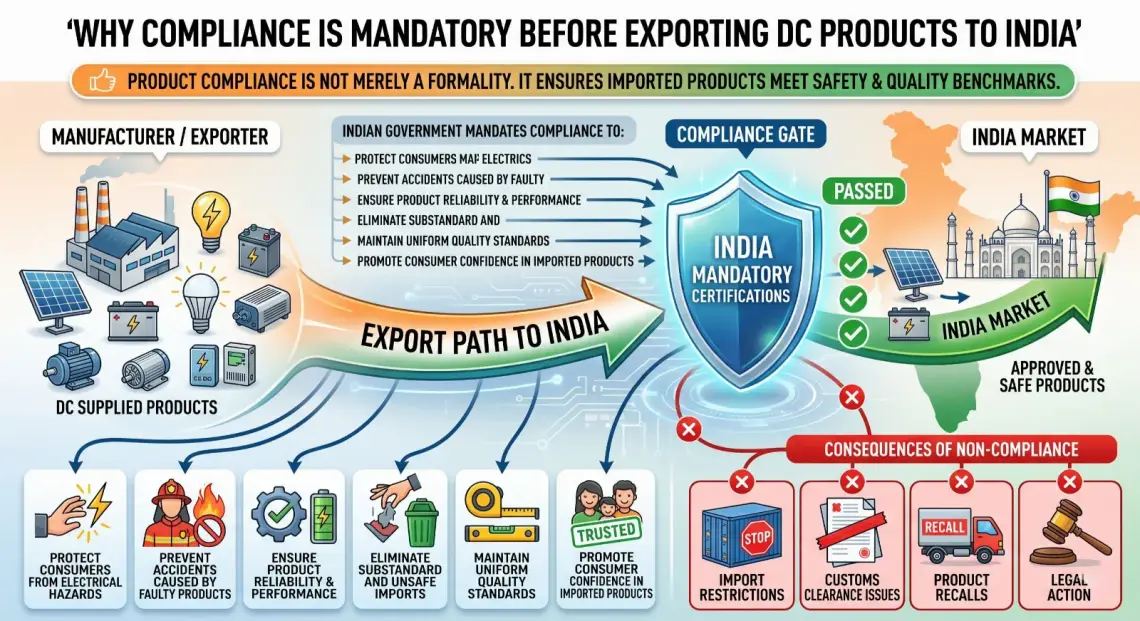
The Indian government mandates compliance for various DC supplied products to:
- Protect consumers from electrical hazards.
- Prevent accidents caused by faulty products.
- Ensure product reliability and performance.
- Eliminate substandard and unsafe imports.
- Maintain uniform quality standards across the market.
- Promote consumer confidence in imported products.
Without obtaining the necessary approvals and certifications, manufacturers may face import restrictions, customs clearance issues, product recalls, or legal action.
Growing Demand for DC Supplied Products in India
India's increasing adoption of smart devices, portable appliances, rechargeable gadgets, and energy-efficient technologies has significantly expanded the market for DC-powered products.
Several factors are driving this growth:
- Rising disposable income.
- Rapid urbanization.
- Expansion of e-commerce platforms.
- Increased preference for cordless appliances.
- Growing awareness of energy-efficient products.
- Advancements in battery technologies.
As demand continues to rise, regulatory authorities are strengthening compliance requirements to ensure product safety and consumer protection.
Examples of DC Supplied Products Covered Under Compliance Requirements
A wide range of household and personal care appliances powered by DC sources are likely to fall under mandatory compliance requirements.
Some common examples include:
Personal Care Appliances
- Electric shavers
- Hair trimmers
- Beard groomers
- Hair clippers
- Electric toothbrushes
- Facial cleansing devices
- Personal massagers
Household Cleaning Appliances
- Cordless vacuum cleaners
- Handheld vacuum cleaners
- Robotic vacuum cleaners
Kitchen Appliances
- Portable blenders
- Rechargeable juicers
- Mini food processors
- Battery-operated kitchen gadgets
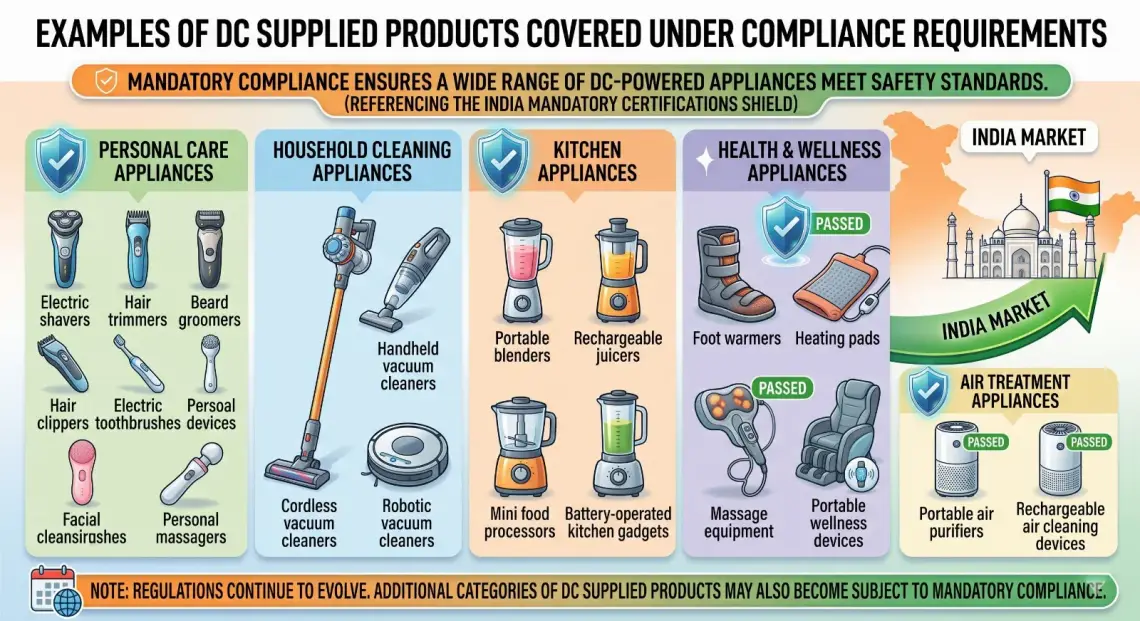
Health and Wellness Appliances
- Foot warmers
- Heating pads
- Massage equipment
- Portable wellness devices
Air Treatment Appliances
- Portable air purifiers
- Rechargeable air cleaning devices
As regulations continue to evolve, additional categories of DC supplied products may also become subject to mandatory compliance.
Applicable Safety Standards for DC Supplied Products
DC powered products intended for household and similar use are generally required to comply with relevant Indian Standards notified by the Bureau of Indian Standards (BIS).
One of the key safety standards applicable to many household electrical appliances is:
IS 302 (Part 1)
IS 302 (Part 1) specifies the general safety requirements for household and similar electrical appliances. The standard addresses various safety aspects to ensure that products do not pose risks during normal usage or foreseeable misuse.
Manufacturers are required to demonstrate compliance through product testing conducted at recognized laboratories.
Key Safety Parameters Evaluated During Testing
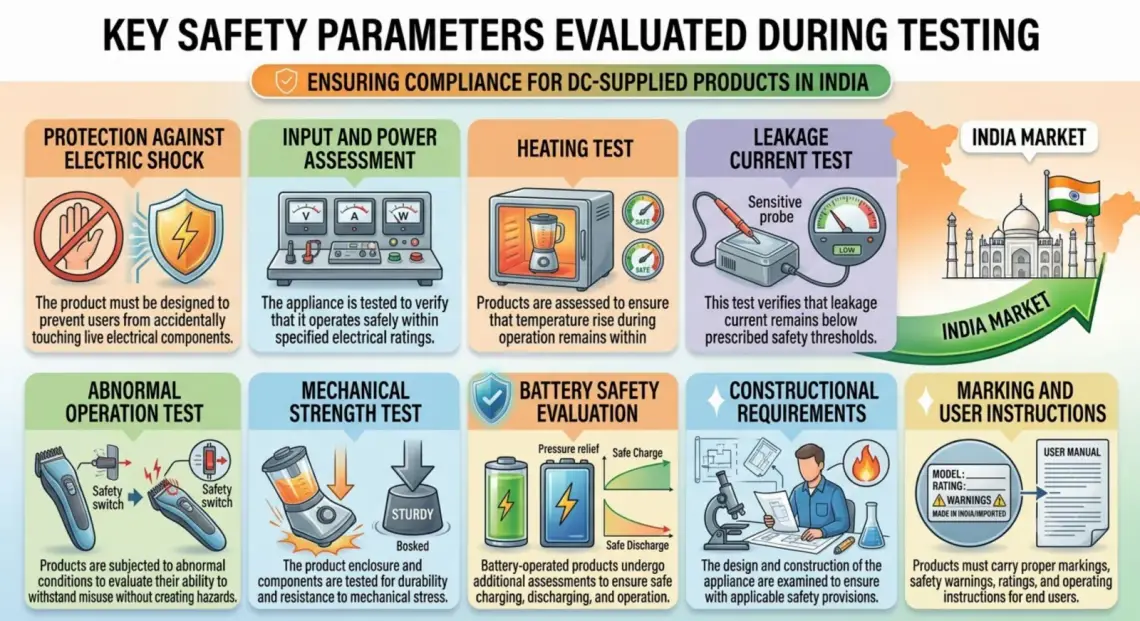
To ensure compliance, DC supplied products undergo extensive safety evaluation. Some major testing parameters include:
Protection Against Electric Shock
The product must be designed to prevent users from accidentally touching live electrical components.
Input and Power Assessment
The appliance is tested to verify that it operates safely within specified electrical ratings.
Heating Test
Products are assessed to ensure that temperature rise during operation remains within permissible limits.
Leakage Current Test
This test verifies that leakage current remains below prescribed safety thresholds.
Moisture Resistance
Appliances likely to be exposed to moisture are tested to ensure continued safety under humid conditions.
Abnormal Operation Test
Products are subjected to abnormal conditions to evaluate their ability to withstand misuse without creating hazards.
Mechanical Strength Test
The product enclosure and components are tested for durability and resistance to mechanical stress.
Battery Safety Evaluation
Battery-operated products undergo additional assessments to ensure safe charging, discharging, and operation.
Constructional Requirements
The design and construction of the appliance are examined to ensure compliance with applicable safety provisions.
Marking and User Instructions
Products must carry proper markings, safety warnings, ratings, and operating instructions for end users.
Compliance Process for Exporting DC Supplied Products to India
Manufacturers planning to export DC powered products to India should follow a structured compliance approach.
Step 1: Identify Product Scope
Determine whether the product falls within the scope of mandatory Indian regulations.
Step 2: Determine Applicable Standards
Identify the relevant Indian Standard and regulatory requirements applicable to the product.
Step 3: Product Testing
Submit product samples for testing at BIS-recognized laboratories.
Step 4: Documentation Preparation
Compile technical documentation, test reports, product specifications, and manufacturing details.
Step 5: Certification Application
Submit the certification application along with required documents and test reports.
Step 6: Approval and Market Entry
After successful assessment and approval, the manufacturer can legally import and sell the product in India.
Consequences of Non-Compliance
Exporting non-compliant products to India can result in significant business challenges, including:
- Shipment detention at customs.
- Import rejection.
- Product recalls.
- Financial penalties.
- Legal consequences.
- Loss of market reputation.
- Delays in product launch.
Therefore, obtaining compliance approvals before shipping products is essential for smooth market access.
Benefits of Obtaining Compliance Before Export
Ensuring compliance offers numerous advantages to manufacturers and importers:
- Faster customs clearance.
- Legal access to the Indian market.
- Enhanced consumer trust.
- Reduced business risks.
- Improved product credibility.
- Stronger brand reputation.
- Better competitive positioning.
Compliance not only fulfills regulatory obligations but also demonstrates a manufacturer's commitment to safety and quality.
Final Thoughts
India presents tremendous growth opportunities for manufacturers of DC products. However, regulatory compliance has become an indispensable requirement for successful market entry.
Manufacturers exporting battery-operated, rechargeable, or DC powered appliances should proactively evaluate applicable Indian standards and complete all necessary compliance procedures before shipment.
A well-planned compliance strategy helps businesses avoid costly delays, ensures regulatory conformity, and builds long-term trust among Indian consumers.
If you are planning to export DC supplied products to India, obtaining expert guidance can simplify the certification process and accelerate your market entry journey.
Frequently asked questions
Why is compliance mandatory for exporting DC products to India?
The Indian government mandates compliance to protect consumers from electrical hazards, prevent accidents, ensure product reliability, and maintain uniform quality standards. This crucial mechanism eliminates substandard imports and strongly promotes consumer confidence in the market.
What happens if a manufacturer fails to obtain necessary compliance approvals?
Without obtaining the required approvals and certifications, manufacturers face severe consequences. They may encounter strict import restrictions, face customs clearance issues, be forced to execute product recalls, or even be subjected to serious legal actions.
What types of personal care and household appliances require mandatory compliance?
A wide range of DC-powered appliances require compliance. Common personal care items include electric shavers, hair trimmers, and toothbrushes. Household cleaning devices like cordless, handheld, and robotic vacuum cleaners are also strictly covered under these regulations.
How are products evaluated for electrical shock and power safety?
Products undergo extensive evaluation to prevent users from accidentally touching live electrical components. Additionally, an input and power assessment is conducted to strictly verify that the appliance operates safely and efficiently within its specified electrical ratings.
What safety tests do battery-operated and moisture-exposed products undergo?
Battery-operated products undergo specific assessments to ensure safe charging, discharging, and overall operation. Furthermore, appliances likely to be exposed to moisture are rigorously tested to guarantee continued safety and prevent hazards under highly humid environmental conditions.
Why are heating and leakage current tests critical during compliance evaluation?
The heating test ensures that product temperature rise during operation remains within permissible limits. Concurrently, the leakage current test verifies that electrical leakage stays below prescribed safety thresholds to protect users from potential shocks.
What are the mechanical and constructional requirements for DC products?
Products are evaluated via a mechanical strength test to ensure enclosure durability against physical stress. Additionally, the appliance's overall design and construction are thoroughly examined to guarantee compliance with all applicable safety provisions.
How does the abnormal operation test protect consumers from hazards?
This test subjects DC products to unexpected, abnormal conditions or potential user misuse. It rigorously evaluates the appliance's inherent ability to withstand such circumstances safely without creating dangerous hazards, fires, or electrical failures.
Which kitchen and air treatment appliances fall under these regulations?
Covered kitchen appliances include portable blenders, rechargeable juicers, and mini food processors. For air treatment, portable air purifiers and rechargeable air cleaning devices are subject to testing, with more categories likely to be added later.
What marking and instruction requirements must compliant products meet?
Compliant products must carry clear, prominent markings directly on the device. They are required to provide essential safety warnings, operational ratings, and comprehensive user instructions to guide end users toward safe day-to-day operation.