
Indian Compliance
EPR in India Explained: Plastic Compliance, Registration & Latest Rules
EPR full form is Extended Producer Responsibility: producers, importers and brand owners must take back or recycle the plastic packaging they put on the market. Under the Plastic Waste Management Rules, 2016 and CPCB’s EPR guidelines, they register on CPCB’s centralised EPR portal, meet yearly targets with EPR certificates from registered plastic waste processors, and file annual returns.
Plastic packaging has made modern business easier—but it has also created a growing environmental challenge. Every year, manufacturers, importers, brands, merchants and e-commerce enterprises put vast amounts of plastic packaging on the market. The important question is: Who is responsible for managing that plastic after it becomes waste?
This is where EPR comes into the picture.
EPR stands for Extended Producer Responsibility. It is a regulation strategy that holds corporations responsible for the environmental impact of the items or packaging they place on the market, especially when the products become waste.
In India, EPR for plastic packaging is implemented under the Plastic Waste Management Rules, 2016, along with subsequent amendments and the Guidelines on Extended Producer Responsibility for Plastic Packaging notified in 2022. The framework requires eligible Producers, Importers and Brand Owners (PIBOs) to take responsibility for the processing of plastic packaging waste through recycling, reuse, or permitted end-of-life disposal.
But EPR compliance is no longer just about obtaining a registration number and forgetting about it. With stronger monitoring, annual-return requirements, environmental compensation provisions, recycled-content requirements, and the latest 2026 amendments, businesses need to understand the entire compliance cycle.
Let's break it down.
What is the EPR Full Form?
The EPR full form is Extended Producer Responsibility.
The fundamental premise is straightforward: when a corporation places a product or packaging onto the market, it must also assume responsibility for the management of the trash generated by that product or packaging.
For plastic packaging, this responsibility generally applies to Producers, Importers and Brand Owners, commonly referred to as PIBOs. Plastic Waste Processors (PWPs), such as recyclers and other authorised processing entities, also play an important role in the EPR system.
Instead of leaving plastic waste management entirely to municipalities or consumers, EPR creates a system where businesses contribute to the collection, recycling, reuse and environmentally appropriate processing of the plastic waste associated with their operations.
In simple words:
You put plastic packaging into the market → you have responsibility for its waste management.
That is the heart of EPR Plastic compliance.
What is EPR Plastic?
EPR Plastic refers to the Extended Producer Responsibility framework applicable to plastic packaging under India's Plastic Waste Management Rules.
The framework covers different types of plastic packaging, including rigid packaging, flexible packaging and certain multilayered packaging.
The principal categories include:
Category I – Rigid Plastic Packaging
This includes rigid plastic packaging such as bottles, containers, jars and similar packaging formats.
Category II – Flexible Plastic Packaging
This covers flexible packaging made from single-layer or multilayer plastic, including plastic sheets, covers, carry bags, sachets and pouches.
Category III – Multilayered Plastic Packaging
This category covers packaging containing at least one layer of plastic and at least one layer of another material.
Category IV – Compostable Plastic Packaging
This includes plastic sheets or similar packaging and carry bags made from compostable plastics, subject to applicable requirements.
These categories are important because EPR obligations and compliance requirements depend on the type and quantity of plastic packaging introduced into the market.
What is an EPR Certificate?
An EPR certificate is an important part of the EPR Plastic compliance mechanism.
Plastic trash Processors that are recognised under the plastic EPR framework process acceptable plastic trash and issue EPR certificates based on the quantity of plastic waste processed, in compliance with the relevant system.
Obligated PIBOs can use eligible certificates to demonstrate fulfilment of their EPR obligations.
This creates a traceable digital mechanism connecting:
Business → Plastic Waste Obligation → Registered Plastic Waste Processor → Processing → EPR Certificate → Compliance
The CPCB's EPR system was designed to improve accountability, traceability and transparency in the fulfilment of EPR obligations.
An EPR certificate should therefore not be treated as simply a commercial document. It forms part of a regulated compliance mechanism, and businesses need to ensure that the underlying plastic waste processing and transactions are legitimate and properly recorded.
Latest EPR Plastic Update in 2026
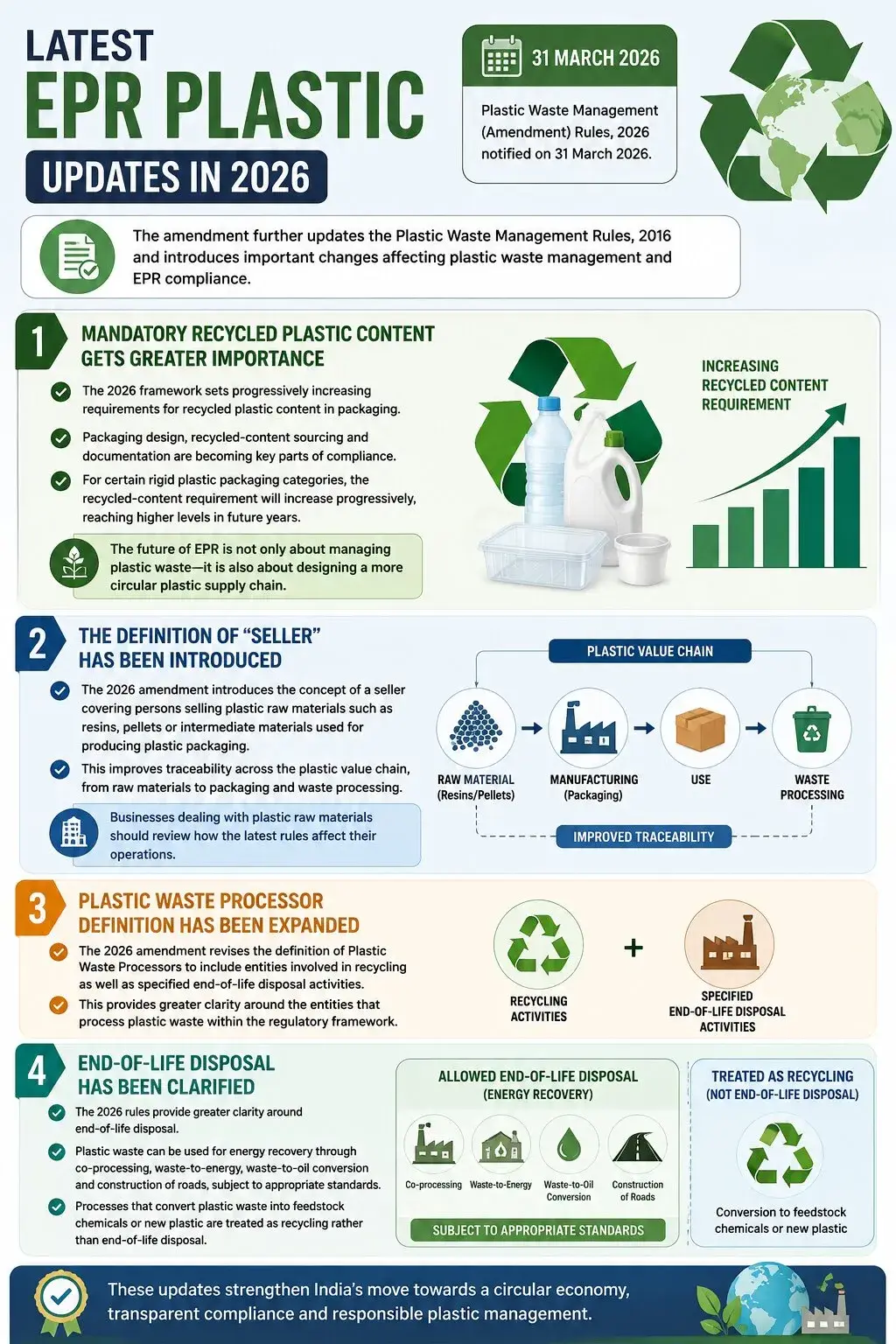
One of the biggest developments in 2026 is the Plastic Waste Management (Amendment) Rules, 2026, notified on 31 March 2026.
The amendment further updates the Plastic Waste Management Rules, 2016 and introduces important changes affecting plastic waste management and EPR compliance.
1. Mandatory Recycled Plastic Content Gets Greater Importance
The 2026 framework builds on the shift toward a circular economy by setting progressively increasing requirements for recycled plastic content in packaging.
This means businesses should no longer look at EPR purely as a waste-processing obligation. Packaging design, recycled-content sourcing and documentation are becoming increasingly important parts of compliance.
For certain rigid plastic packaging categories, the recycled-content requirement is designed to increase progressively, reaching higher levels in future compliance years.
This creates a clear message for manufacturers and brands:
The future of EPR is not only about managing plastic waste—it is also about designing a more circular plastic supply chain.
2. The Definition of “Seller” Has Been Introduced
The 2026 amendment introduces the concept of a seller covering persons selling plastic raw materials such as resins or pellets or intermediate material used for producing plastic packaging.
This is significant because the regulatory framework is increasingly focused on improving traceability across the plastic value chain, from raw materials to packaging and waste processing.
Businesses dealing with plastic raw materials should therefore review how the latest rules affect their operations.
3. Plastic Waste Processor Definition Has Been Expanded
The 2026 amendment revises the definition of Plastic Waste Processors to include entities involved in recycling as well as specified end-of-life disposal activities.
The updated definition is intended to provide greater clarity around the entities that process plastic waste within the regulatory framework.
4. End-of-Life Disposal Has Been Clarified
The 2026 rules provide greater clarity around end-of-life disposal.
The modified framework allows for the use of plastic waste for energy recovery thru co-processing, waste-to-energy, waste-to-oil conversion and construction of roads, subject to appropriate standards.
At the same time, processes that convert plastic waste into feedstock chemicals or new plastic are treated as recycling rather than end-of-life disposal.
This distinction matters when businesses and processors assess how waste processing contributes to their compliance obligations.
Major EPR Portal Update: What Changed in 2026?
Another major development is digital.
The earlier Centralized EPR Portal for Plastic Packaging was discontinued from 28 June 2026.
CPCB states that registered-user data was migrated to the newly developed Common EPR Portal, and users were instructed to verify their migrated information and report discrepancies through the new system.
The old portal is now retained primarily for stakeholders to verify historical data up to the migration date.
CPCB has also indicated that the Common EPR Portal provides a broader digital environment for EPR-related compliance, with Single Sign-On functionality across EPR portals.
What does this mean for businesses?
If you already have an EPR registration, you should not simply assume that everything has transferred correctly.
Businesses should:
- Access the Common EPR Portal
- Link/verify their existing account
- Check company information
- Verify authorised-person information
- Check registration details
- Review migrated records
- Verify EPR-related data
- Report discrepancies where required
- Continue monitoring CPCB notifications
For existing users, CPCB specifically advises that the same Authorised Person PAN and Company PAN be used when linking the existing account to the Common EPR Portal.
EPR Annual Returns: Why They Matter
Getting EPR registration is only the beginning.
Annual return filing is an important part of ongoing compliance. CPCB has issued notices and extensions concerning annual returns for previous financial years and has also taken compliance action against entities that failed to fulfil their obligations or submit required returns.
This shows that EPR enforcement is becoming more active.
Businesses should therefore maintain accurate records throughout the year instead of trying to reconstruct packaging and waste data when the return deadline approaches.
A good internal compliance system should track:
- Quantity of plastic packaging introduced
- Category of plastic packaging
- Packaging material details
- Sales and transaction records
- Waste processing records
- EPR certificates
- Registered processor details
- Annual return information
- Supporting invoices and documents
EPR Plastic Compliance: What Businesses Should Do in 2026
If your business manufactures, imports, sells or brands products involving plastic packaging, 2026 is a good time to review your complete EPR compliance process.
Here is a practical checklist:
- Check whether your business is covered by EPR
- Identify all plastic packaging introduced into the market
- Correctly classify your packaging category
- Review your existing EPR registration
- Verify migrated data on the Common EPR Portal
- Review your EPR targets and obligations
- Work only with appropriate registered Plastic Waste Processors
- Maintain proper EPR certificate and transaction records
- Review recycled-content requirements
- File annual returns within applicable timelines
- Monitor CPCB and SPCB/PCC notifications
This approach can reduce last-minute compliance problems and make environmental reporting much easier.
Why EPR Compliance Is Becoming More Important
The Indian EPR framework is moving toward greater accountability and traceability.
Earlier, businesses could think about plastic compliance mainly in terms of registration. Today, the picture is broader.
EPR increasingly connects:
Packaging → Business Responsibility → Waste Processing → Recycling → Certificates → Digital Records → Annual Returns → Regulatory Monitoring
The 2026 amendments further reinforce this direction by increasing attention on recycled plastic, reuse, traceability and the wider plastic value chain.
For businesses, this means sustainability and regulatory compliance are becoming closely connected.
A company that understands its packaging footprint today will be better prepared for future EPR requirements.
Who needs plastic EPR registration (PIBO)?
PIBO stands for Producers, Importers and Brand Owners, the three groups that must register on the CPCB portal:
- Producers: businesses that make plastic packaging material, or use plastic packaging for products made under contract for brand owners.
- Importers: businesses that import plastic packaging, or import products in plastic packaging, carry bags or plastic sheets.
- Brand owners: businesses that sell products under their own brand in plastic packaging, including through e-commerce.
Plastic waste processors (recyclers, co-processors and others) register separately, because they generate the certificates PIBOs buy. Manufacturers and importers of plastic raw material also have to register; see EPR registration for importers of plastic raw material.
Plastic EPR registration steps on the CPCB portal
- Create an account on CPCB’s centralised EPR portal for plastic packaging and choose your entity type: producer, importer or brand owner.
- Enter company details, the authorised person, and office and plant addresses.
- Upload documents, typically PAN, GST, the certificate of incorporation, IEC for importers, consent from the State Pollution Control Board for producers, and an authorisation letter.
- Declare the plastic packaging you put on the market by category (I to IV) for past years, with projections.
- Pay the processing fee shown on the portal and submit.
- Answer CPCB’s queries, if any. The registration certificate is then issued on the portal.
Menu names on the portal change from time to time, so follow the current on-screen steps. See our EPR for plastic waste service.
EPR targets and certificates
Each year, a PIBO’s target is set as a share of the plastic packaging it put on the market, separately for each category. The obligations cover recycling, reuse for rigid packaging, minimum use of recycled plastic content and, for plastic that cannot be recycled, end-of-life disposal.
PIBOs meet recycling targets by buying EPR certificates generated on the portal by registered plastic waste processors, which are transferred to them on the portal. Not every certificate counts towards every target; see why end-of-life certificates no longer count towards recycling targets.
Penalties for non-compliance
CPCB levies Environmental Compensation on PIBOs that miss their targets, calculated on the shortfall. Part of it can be returned if the shortfall is made up in later years, as set out in the guidelines. Operating without registration, false declarations or missed annual returns can also lead to compensation, suspension or cancellation of registration, and action under the Environment (Protection) Act, 1986. Check the EPR compliance deadlines for 2026.
Other EPR categories
Plastic is one of several EPR regimes in India, each with its own rules and CPCB portal:
- Battery waste EPR, under the Battery Waste Management Rules, 2022
- E-waste EPR, under the E-Waste (Management) Rules, 2022
- Tyre waste EPR
- Used oil EPR
For a short overview of all of them, read our EPR full form and compliance guide.
Frequently asked questions
What is the EPR full form?
The EPR full form is Extended Producer Responsibility. It is a regulatory approach that places responsibility on producers, importers, brand owners and other applicable entities for managing the environmental impact and waste associated with products or packaging introduced into the market.
What is EPR Plastic?
EPR Plastic refers to the Extended Producer Responsibility framework applicable to plastic packaging under India's Plastic Waste Management Rules. It requires eligible businesses to manage applicable plastic packaging waste through recycling, reuse or permitted end-of-life disposal mechanisms.
What is an EPR certificate?
An EPR certificate is generated within the applicable EPR system based on eligible plastic waste processed by registered Plastic Waste Processors. Obligated entities can use eligible certificates toward fulfilling applicable EPR obligations.
Who needs EPR registration?
Producers, Importers and Brand Owners handling covered plastic packaging may need EPR registration. Plastic Waste Processors also have registration requirements. Applicability depends on the entity's activity, packaging and regulatory circumstances.
Is EPR registration mandatory for importers?
Importers introducing covered plastic packaging or packaged products into India should evaluate their applicability under the Plastic Waste Management Rules. Where covered, EPR registration and related obligations may apply.
Is EPR registration a one-time process?
Registration itself is an important starting point, but EPR compliance is ongoing. Businesses may also have obligations relating to targets, waste processing, certificates, recordkeeping and annual returns.
What is the penalty for EPR non-compliance?
CPCB levies Environmental Compensation on producers, importers and brand owners that miss their EPR targets, based on the shortfall. Registration can also be suspended or cancelled, and action can be taken under the Environment (Protection) Act, 1986.
What is PIBO?
PIBO stands for Producers, Importers and Brand Owners: the businesses that must register for plastic packaging EPR on the CPCB portal and meet yearly targets.