
Indian Compliance
How to Get a TEC Certificate Before Importing, Selling, or Using Telecom Equipment in India
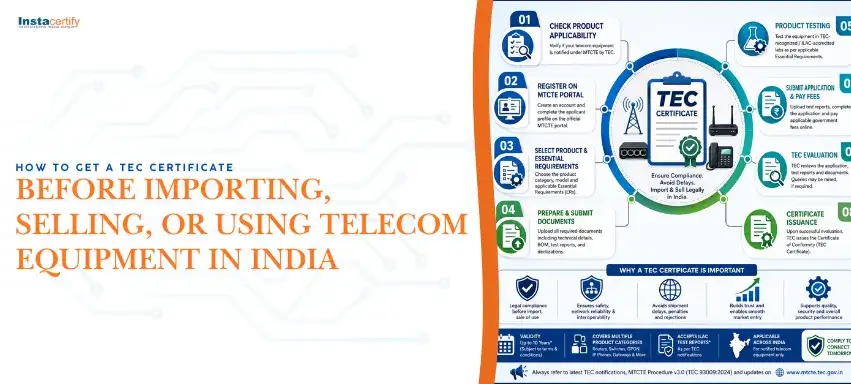
India's telecom industry is one of the fastest-growing digital ecosystems in the world. Every year, thousands of telecom and wireless products—including routers, switches, IP phones, GPON equipment, IoT devices, enterprise networking products, and communication hardware—are imported into the country. However, before these products can legally enter the Indian market, many must obtain a TEC Certificate under the Mandatory Testing and Certification of Telecommunication Equipment (MTCTE) framework.
If your telecom equipment falls within the notified product categories, you cannot legally import, sell, distribute, connect to a telecom network, or use it in India without obtaining the required Certificate of Conformity through the MTCTE process. The current framework is governed by the Telecommunications (Framework to Notify Standards, Conformity Assessment and Certification) Rules, 2025, and implemented by the Telecommunication Engineering Centre (TEC), Department of Telecommunications (DoT).
Whether you are an importer, overseas manufacturer, OEM, distributor, startup, or brand owner, understanding the TEC certification process is essential to avoid customs delays, regulatory issues, and costly disruptions.
What is a TEC Certificate?
A TEC Certificate is an official Certificate of Conformity issued by the Telecommunication Engineering Centre (TEC), the technical arm of the Department of Telecommunications (DoT), Government of India. The certificate confirms that a telecom product complies with India's Essential Requirements (ERs) for safety, electromagnetic compatibility, technical performance, interoperability, and other applicable parameters.
Unlike voluntary quality certifications, a TEC Certificate is a legal compliance requirement for notified telecom products covered under the MTCTE framework. Without a valid certificate, covered products cannot be imported, sold, deployed on telecom networks, or otherwise used in India.
The objective of TEC certification is to ensure that telecom equipment:
- Meets India's technical standards.
- Does not interfere with existing telecom networks.
- Protects end users from electrical and electromagnetic hazards.
- Supports reliable network performance.
- Complies with prescribed Essential Requirements.
Understanding MTCTE
Many businesses mistakenly think that "TEC Certificate" and "MTCTE Certificate" are different approvals. In reality, the TEC Certificate is issued under the Mandatory Testing and Certification of Telecommunication Equipment (MTCTE) framework administered by TEC.
The MTCTE system establishes Essential Requirements for notified telecom products. Manufacturers or authorized applicants submit products for testing at recognized laboratories, upload the required technical documentation, and apply through the official MTCTE portal. After successful evaluation, TEC issues the Certificate of Conformity.
The framework is designed to ensure that telecom equipment entering the Indian market satisfies regulatory, safety, technical, and network compatibility requirements before commercial deployment.
Why is a TEC Certificate Mandatory Before Importing Products into India?
India has strengthened its telecom regulatory framework to improve network reliability, user safety, cybersecurity, and product quality. Consequently, telecom equipment covered under MTCTE must be certified before import, sale, deployment, or use in India.
Obtaining the TEC Certificate before importing helps ensure that:
- Imported products comply with Indian telecom regulations.
- Equipment does not adversely affect public telecom networks.
- Products meet applicable safety and EMC requirements.
- Technical interoperability is maintained across telecom infrastructure.
- Importers avoid compliance issues that may delay market entry.
Failure to complete the required certification before import can result in shipment delays, inability to market the product, and other regulatory consequences depending on the applicable legal provisions.
Who Needs a TEC Certificate?
A TEC Certificate may be required for:
- Indian manufacturers
- Foreign manufacturers exporting to India
- Importers
- Brand owners
- Original Equipment Manufacturers (OEMs)
- Authorized Indian Representatives (AIRs) acting on behalf of overseas manufacturers
- Telecom equipment distributors
- Enterprise networking solution providers
For overseas manufacturers, an Authorized Indian Representative (AIR) is generally required to manage the certification process when the manufacturer does not have a legal presence in India.
Which Products Require a TEC Certificate?
TEC has notified multiple product categories in phases under MTCTE, with additional products added over time. The exact applicability depends on the current notifications and Essential Requirements issued by TEC.
Common categories include:
Broadband Equipment
- GPON OLT
- GPON ONU
- DSL equipment
- Optical network products
Enterprise Networking Products
- Routers
- LAN switches
- Ethernet switches
- Enterprise gateways
Wireless Communication Products
- Fixed wireless phones
- Cellular customer premises equipment (CPE)
- Wireless access devices
Security Equipment
- Network security appliances
- Web application firewalls
- DDoS protection equipment
- IP security equipment
- Malware analysis systems
Telecom Infrastructure
- Optical transmission equipment
- Media gateways
- Satellite communication equipment
- Network synchronization equipment
Consumer and Office Communication Devices
- IP phones
- Voice gateways
- Session border controllers
- Unified communication systems
As TEC periodically expands the list of regulated products, businesses should verify whether their specific model falls under the current MTCTE notifications before import.
Why This Certification Matters for Importers
Many importers focus on logistics, customs documentation, and taxation while overlooking product compliance. A TEC Certificate should be treated as part of your import planning, not as an afterthought. Identifying the applicable Essential Requirements, arranging testing, and completing certification before shipping can help reduce the risk of delays and support a smoother product launch in India.
How Much Does a TEC Certificate Cost?
One of the most common questions from importers is:
"What is the cost of obtaining a TEC Certificate?"
There is no single fixed price because the total cost depends on several technical and administrative factors.
The overall cost generally includes:
- Government application fees
- Product testing charges
- Laboratory evaluation fees
- Documentation preparation
- Technical file review
- Authorized Indian Representative (AIR) charges, if applicable
- Consultancy or compliance support fees (if engaged)
The exact amount varies depending on:
- Product category
- Number of applicable Essential Requirements (ERs)
- Number of product models
- Whether the product qualifies for family or associated model certification
- Number of laboratory tests required
- Security certification requirements, where applicable
For this reason, businesses should obtain a product-specific quotation rather than relying on generic cost estimates. TEC has also revised fee structures for certain categories from time to time through official notifications.
How Long Does It Take to Obtain a TEC Certificate?
There is no universal processing timeline because every application follows its own technical evaluation path.
The certification period depends on:
- Product complexity
- Laboratory availability
- Test duration
- Number of Essential Requirements
- Accuracy of submitted documents
- Applicant response time to TEC observations
- Overall application workload
Applications with complete technical documentation and compliant test reports are generally processed more efficiently than those requiring multiple corrections or clarifications.
Validity of the TEC Certificate
Under the current MTCTE framework, the Certificate of Conformity is generally issued with a validity of 10 years, subject to the applicable terms, conditions, and regulatory requirements. Businesses should also monitor any changes affecting the certified product, as modifications may require additional compliance actions.
What Are Associated Models?
Many manufacturers launch the same telecom equipment under multiple model numbers with only cosmetic or minor non-critical differences.
To simplify compliance, MTCTE provides a mechanism for adding Associated Models to an already certified product, provided the eligibility conditions defined by TEC are satisfied.
Examples include:
- Different colour variants
- Different memory options
- Different branding
- Regional model numbers
- Minor hardware variations that do not affect compliance with the applicable Essential Requirements
Using the associated model mechanism can reduce duplicate testing when the conditions specified by TEC are met.
Acceptance of ILAC Test Reports
To facilitate international trade and reduce repetitive testing in appropriate cases, TEC has issued notifications allowing the acceptance of certain ILAC-accredited laboratory test reports for specified parameters and product categories, subject to the applicable conditions and validity periods announced by TEC.
However, this does not mean that every overseas test report is automatically accepted.
Applicants should verify:
- Whether the product category is covered
- Which technical parameters qualify
- The eligibility conditions
- Documentation requirements
- The latest notification applicable at the time of filing
Because TEC periodically updates these provisions, applicants should always refer to the latest official notifications before relying on ILAC reports.
Product Exemptions Under MTCTE
Not every telecom product is treated in the same manner.
TEC periodically issues exemption notifications for:
- Certain interfaces
- Specific technical parameters
- Particular product categories
- Temporary regulatory relaxations
- Defined testing requirements
Similarly, special notifications have been issued for products such as PON family broadband equipment and certain security-related categories. Importers should review the latest exemption circulars before initiating certification to determine whether any notified relaxation applies to their equipment.
Common Mistakes That Delay TEC Certificate Approval
Many delays occur because applicants underestimate the technical review process.
Some of the most common issues include:
1. Incorrect Product Classification
Choosing the wrong product category can result in the wrong Essential Requirements being applied.
2. Incomplete Technical Documentation
Missing block diagrams, user manuals, BOMs, declarations, or authorization letters often lead to queries from TEC.
3. Inconsistent Product Information
The model number should match across:
- Test reports
- Datasheets
- User manual
- Product label
- Application form
Any inconsistency can delay evaluation.
4. Testing Against Incorrect Essential Requirements
Testing under an outdated or incorrect ER can make reports unusable for certification.
5. Delayed Response to TEC Queries
If TEC raises observations, responding promptly with complete information helps avoid unnecessary delays.
6. Ignoring Security Certification Requirements
Certain notified telecom products may require additional security certification under the applicable MTCTE schemes. Businesses should verify these requirements early in the planning stage.
Latest MTCTE Regulatory Updates (2026)
The MTCTE framework continues to evolve. Recent developments include:
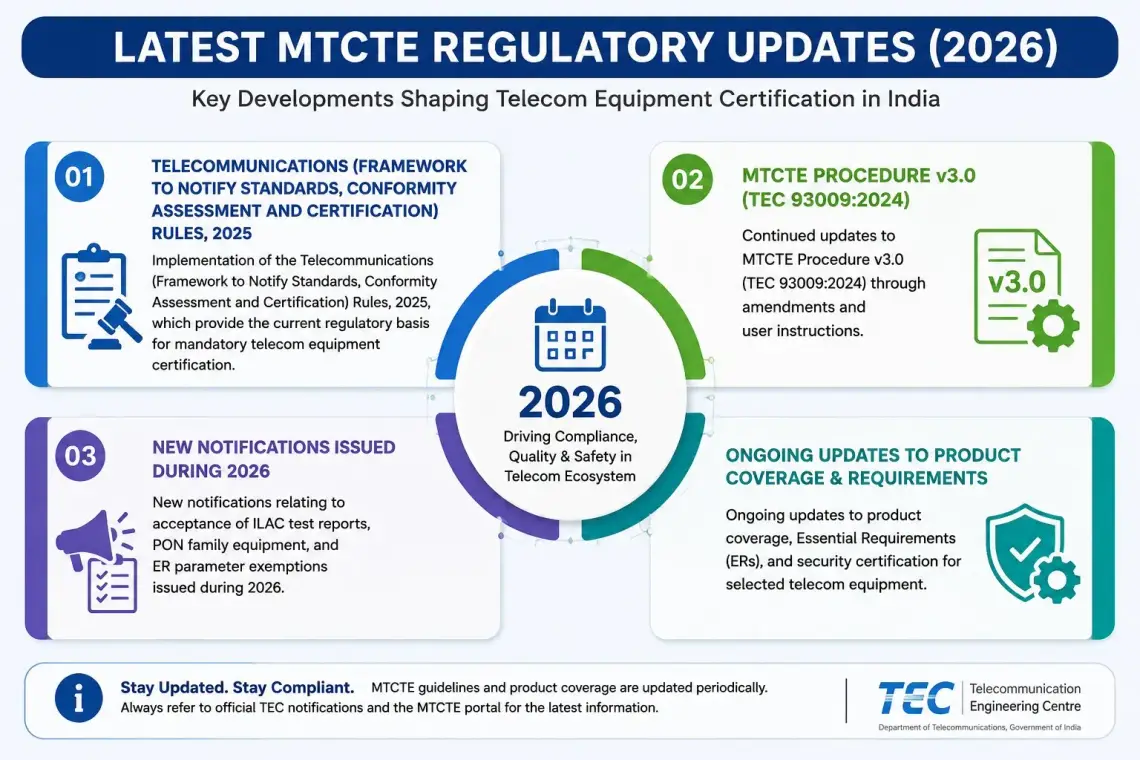
- Implementation of the Telecommunications (Framework to Notify Standards, Conformity Assessment and Certification) Rules, 2025, which provide the current regulatory basis for mandatory telecom equipment certification.
- Continued updates to MTCTE Procedure v3.0 (TEC 93009:2024) through amendments and user instructions.
- New notifications relating to acceptance of ILAC test reports, PON family equipment, and ER parameter exemptions issued during 2026.
- Ongoing updates to product coverage, Essential Requirements, and security certification for selected telecom equipment.
Why Businesses Should Start the TEC Certification Process Early
Many companies begin compliance only after the products have been manufactured or shipped.
A better approach is to integrate TEC certification into the product launch timeline. Early planning provides more time for:
- Technical review
- Laboratory scheduling
- Document preparation
- Testing
- Addressing observations
- Coordinating with customs and commercial launch plans
Starting early helps minimize the risk of avoidable delays and supports a smoother entry into the Indian market.
Frequently asked questions
What is a TEC Certificate?
A TEC Certificate is an official Certificate of Conformity issued under the MTCTE framework by the Telecommunication Engineering Centre (TEC), Department of Telecommunications. It confirms that notified telecom equipment complies with India's applicable Essential Requirements before it can be imported, sold, or used.
Is a TEC Certificate mandatory for importing telecom equipment into India?
Yes, a TEC Certificate is mandatory for telecom equipment covered under the MTCTE framework. Importing, selling, or using notified products without the required certification may lead to regulatory non-compliance and delays in commercial deployment or market access.
Which products require a TEC Certificate?
Various telecom products, including routers, switches, GPON equipment, IP phones, gateways, wireless devices, optical transmission equipment, and certain network security products, require a TEC Certificate if they fall under the notified MTCTE product categories and Essential Requirements.
Who can apply for a TEC Certificate?
Indian manufacturers, foreign manufacturers, importers, brand owners, Original Equipment Manufacturers (OEMs), and Authorized Indian Representatives (AIRs) can apply for a TEC Certificate, depending on the applicant's business structure and the applicable MTCTE certification requirements.
What documents are required for a TEC Certificate application?
Applicants typically need company registration documents, product datasheets, user manuals, technical specifications, block diagrams, Bill of Materials (BOM), authorization letters, laboratory test reports, and other supporting documents required under the applicable MTCTE certification procedure.
How long does it take to obtain a TEC Certificate?
The certification timeline depends on the product category, laboratory testing, document accuracy, technical evaluation, and applicant response to observations. Applications with complete documentation and compliant test reports are generally processed more efficiently than incomplete submissions.