
Indian Compliance
How to Prepare HDPE/PP Woven Cement Sacks for BIS Compliance
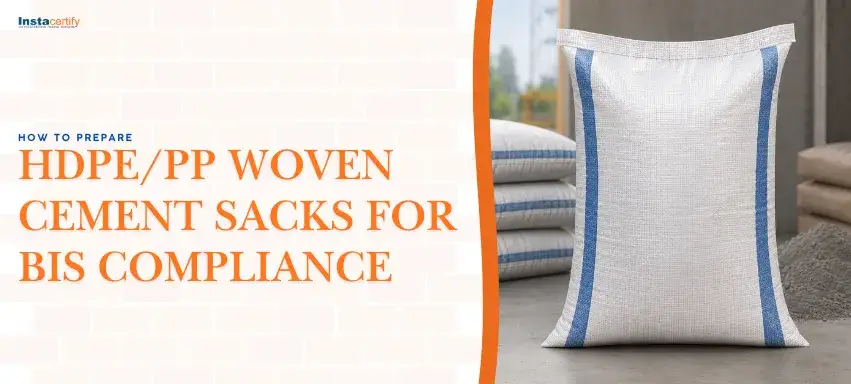
The cement industry is one of the largest consumers of industrial packaging in India. Every day, millions of cement bags are transported from manufacturing plants to warehouses, distributors, retailers, and construction sites. During this journey, the packaging must withstand rough handling, stacking, loading, unloading, vibration, and varying weather conditions without tearing or leaking.
A damaged cement sack not only results in product loss but also affects brand reputation, increases logistics costs, creates dust pollution, and may lead to customer complaints. For this reason, the quality of HDPE and PP woven sacks has become just as important as the quality of the cement itself.
To ensure consistent quality, the Bureau of Indian Standards (BIS) has published IS 11652:2017 – High Density Polyethylene (HDPE)/Polypropylene (PP) Woven Sacks for Packaging of 50 kg Cement – Specification. The standard establishes uniform requirements for the manufacture, testing, performance, dimensions, and quality of woven sacks intended for 50 kg cement packaging.
With the Government of India progressively enforcing mandatory quality requirements through the Quality Control Order (QCO), manufacturers and suppliers should prepare for compliance. Recent notifications include Amendment No. 3 to IS 11652:2017, with implementation for BIS licensees by 7 January 2026, while the latest QCO amendment extends mandatory enforcement for the notified product category to 6 October 2026. These updates affect implementation timelines rather than replacing the technical standard.
What are HDPE/PP Woven Cement Sacks?
HDPE (High-Density Polyethylene) and PP (Polypropylene) woven sacks are industrial packaging bags manufactured by weaving narrow plastic tapes into a strong fabric. The woven fabric is then converted into sacks suitable for filling, storing, and transporting cement.
Unlike ordinary plastic bags, woven sacks have a fabric-like structure that provides excellent mechanical strength while remaining lightweight. Their construction enables them to withstand high loads, making them ideal for packaging a standard 50 kg cement bag.
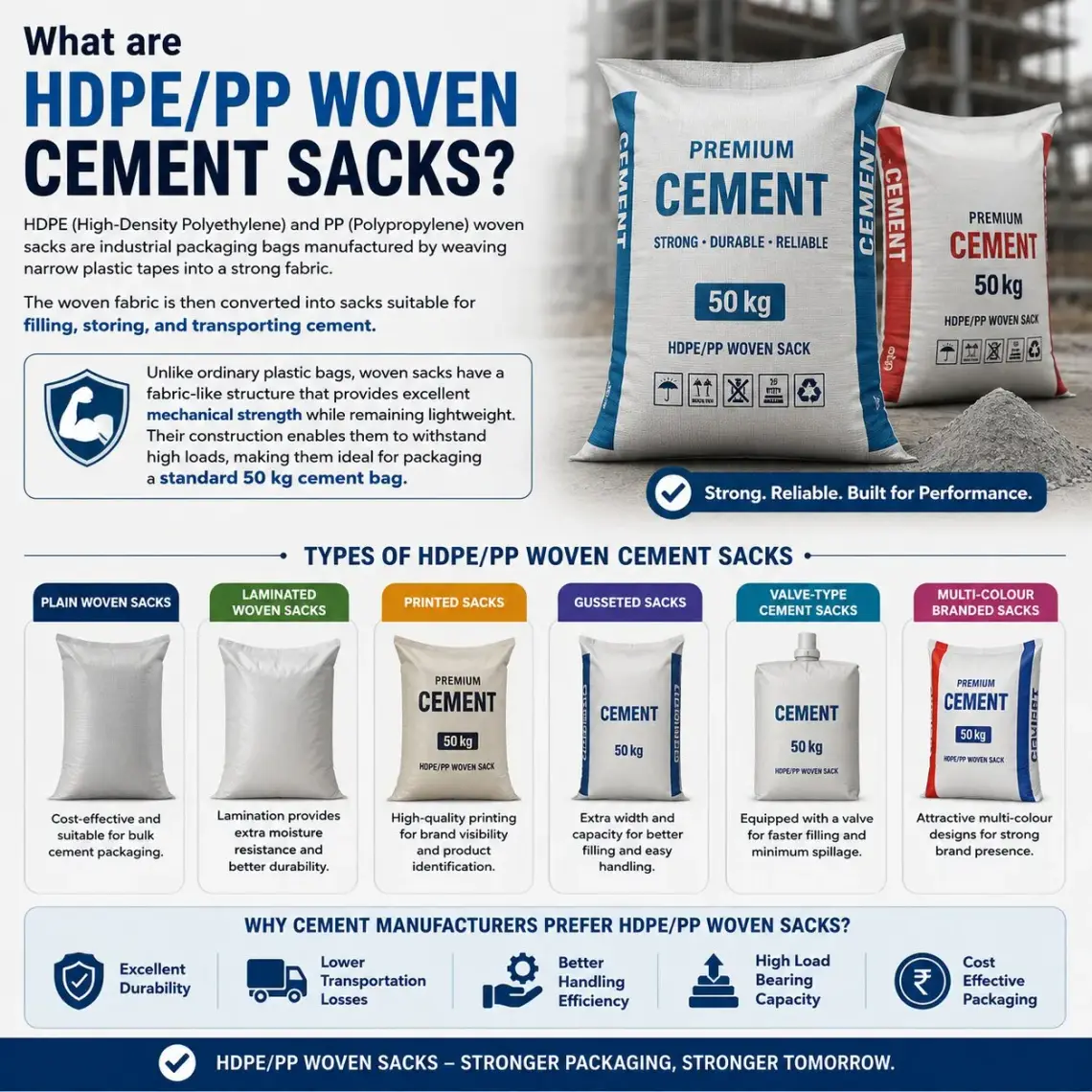
Depending on customer requirements, these sacks may be:
- Plain woven sacks
- Laminated woven sacks
- Printed sacks
- Gusseted sacks
- Valve-type cement sacks
- Multi-colour branded sacks
Today, nearly every major cement manufacturer relies on HDPE or PP woven sacks because they offer excellent durability, lower transportation losses, and better handling efficiency.
Why Quality Matters in Cement Packaging
Many people focus only on cement quality and overlook the packaging. In reality, packaging is the first line of protection for the product.
A poor-quality sack can lead to:
- Cement leakage during transport
- Burst bags during loading or unloading
- Moisture ingress that reduces cement quality
- Product wastage
- Higher transportation losses
- Safety hazards for workers
- Customer dissatisfaction
- Financial losses throughout the supply chain
High-quality woven sacks help preserve the cement until it reaches the end user while maintaining the manufacturer's brand image.
Understanding IS 11652:2017
IS 11652:2017 is the Indian Standard developed by BIS to establish minimum quality requirements for HDPE and PP woven sacks used specifically for packaging 50 kg cement.
Rather than focusing on a single property, the standard covers the complete performance of the sack, including:
- Material quality
- Fabric construction
- Dimensional accuracy
- Mass
- Stitching quality
- Mechanical strength
- Performance under handling
- Marking requirements
- Test methods
The objective is to ensure that every sack supplied to the cement industry performs consistently under actual service conditions.
Objectives of the Standard
The standard has several important objectives:
1. Product Safety
Strong packaging reduces accidental rupture during handling and transportation.
2. Uniform Product Quality
Manufacturers across India follow a common benchmark, resulting in consistent packaging quality.
3. Reduced Material Loss
Properly designed sacks minimize cement spillage throughout the logistics chain.
4. Improved Supply Chain Efficiency
High-performance sacks reduce complaints, returns, and transportation damage.
5. Consumer Confidence
Reliable packaging reflects the quality of the cement brand itself.
Scope of IS 11652:2017
The standard applies to woven sacks manufactured from:
- High-Density Polyethylene (HDPE)
- Polypropylene (PP)
These sacks are intended specifically for packaging 50 kg cement.
The standard primarily specifies:
- Construction requirements
- Fabric properties
- Sack dimensions
- Mechanical performance
- Testing methods
- Quality requirements
- Marking provisions
It is intended for manufacturers, cement companies, testing laboratories, quality engineers, procurement teams, importers, and regulatory authorities.
Products Covered
The standard generally covers woven sacks used for packaging:
- Ordinary Portland Cement (OPC)
- Portland Pozzolana Cement (PPC)
- Portland Slag Cement (PSC)
- Blended Cement
- White Cement (where applicable)
- Other 50 kg cement products requiring woven sack packaging
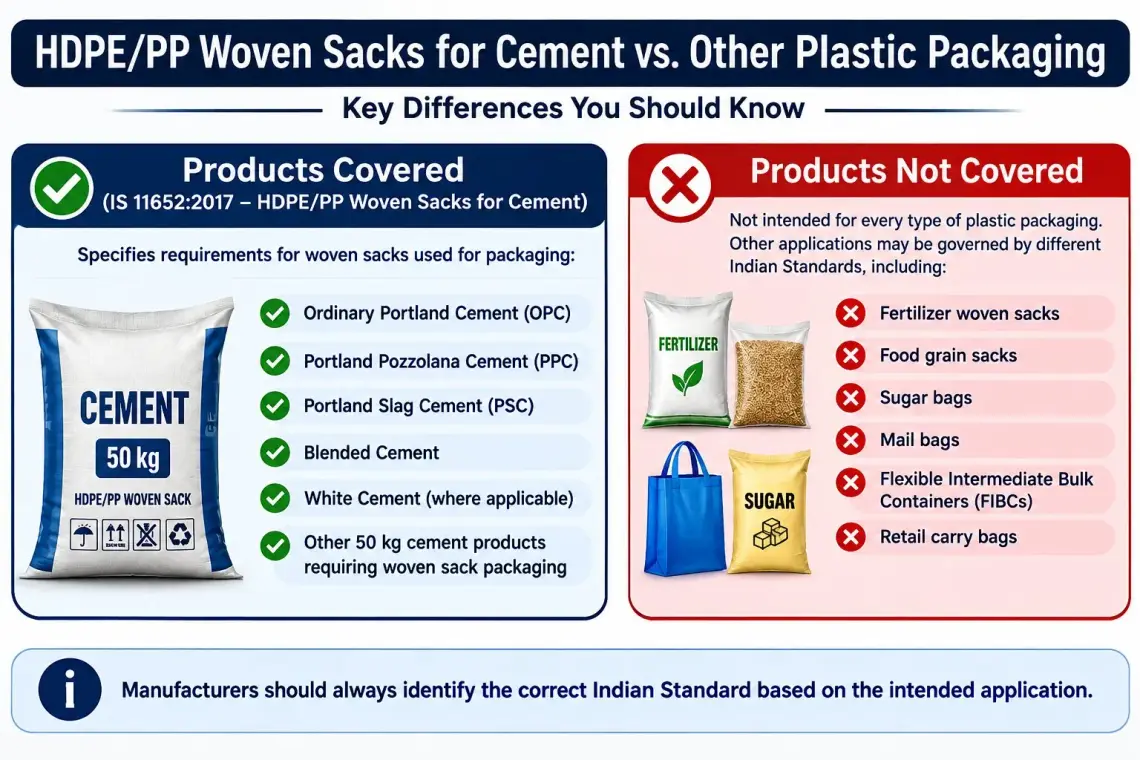
Products Not Covered
The standard is not intended for every type of plastic packaging. Other applications may be governed by different Indian Standards, including:
- Fertilizer woven sacks
- Food grain sacks
- Sugar bags
- Mail bags
- Flexible Intermediate Bulk Containers (FIBCs)
- Retail carry bags
Manufacturers should always identify the correct Indian Standard based on the intended application.
HDPE vs PP – Which Material is Better?
Both HDPE and PP are widely used for woven cement sacks, but each has unique characteristics.
HDPE
HDPE provides excellent stiffness, high tensile strength, good chemical resistance, and reliable performance under heavy loads. It is particularly suitable where dimensional stability is important.
PP
Polypropylene offers excellent flexibility, lower weight, good fatigue resistance, and high impact strength. It also accepts printing well and is widely preferred for premium branded cement packaging.
In practice, manufacturers select the material based on performance requirements, production processes, and customer specifications while ensuring compliance with IS 11652:2017.
Basic Construction of a Woven Cement Sack
A typical cement sack consists of several components working together:
- Extruded HDPE or PP tapes
- Woven fabric
- Lamination (where specified)
- Top and bottom stitching
- Side seams
- Printing area
- Identification markings
Each component contributes to the sack's overall strength and durability.
Latest Regulatory Updates (2026)
Manufacturers should be aware of two important developments:
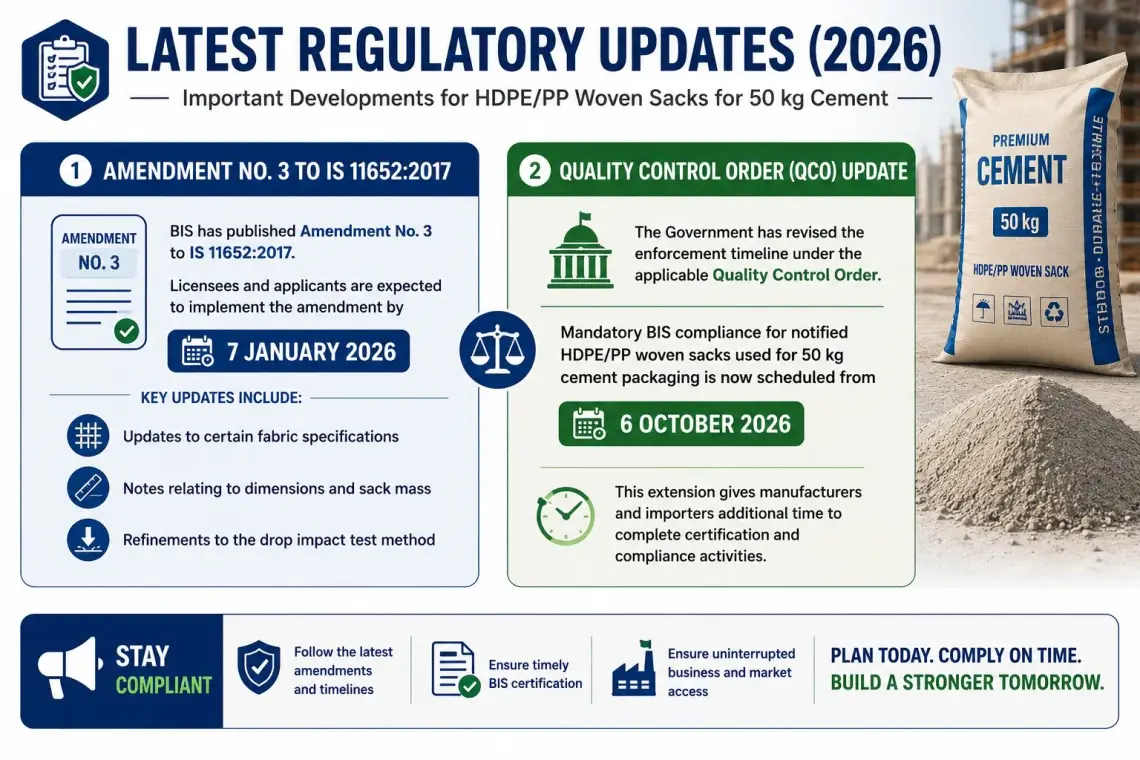
- Amendment No. 3 to IS 11652:2017 has been published by BIS. Licensees and applicants are expected to implement the amendment by 7 January 2026. The amendment includes updates to certain fabric specifications, notes relating to dimensions and sack mass, and refinements to the drop impact test method.
- Separately, the Government has revised the enforcement timeline under the applicable Quality Control Order. Mandatory BIS compliance for notified HDPE/PP woven sacks used for 50 kg cement packaging is now scheduled from 6 October 2026, giving manufacturers and importers additional time to complete certification and compliance activities.
Frequently asked questions
What is IS 11652:2017?
IS 11652:2017 is an Indian Standard that specifies the quality, construction, dimensions, and performance requirements for HDPE and PP woven sacks used for packaging 50 kg cement. It helps ensure strong, durable, and reliable packaging for storage and transportation.
What are HDPE/PP woven cement sacks?
HDPE/PP woven cement sacks are heavy-duty industrial packaging bags manufactured from woven polyethylene or polypropylene tapes. They are designed to safely pack, store, and transport 50 kg cement while providing excellent strength, durability, and resistance to handling damage.
Why is testing of HDPE/PP woven cement sacks important?
Testing verifies that woven cement sacks meet the required quality and performance standards. It helps prevent bag failures, cement leakage, transportation losses, and customer complaints while ensuring reliable packaging and compliance with applicable Indian Standard requirements.
Which products are covered under IS 11652:2017?
The standard generally covers HDPE and PP woven sacks used for packaging 50 kg Ordinary Portland Cement (OPC), Portland Pozzolana Cement (PPC), Portland Slag Cement (PSC), blended cement, white cement, and similar cement products requiring woven sack packaging.
Which products are not covered by IS 11652:2017?
IS 11652:2017 does not apply to woven sacks used for fertilizers, food grains, sugar, mail bags, Flexible Intermediate Bulk Containers (FIBCs), or retail carry bags. These products are covered under separate Indian Standards based on their intended applications.
What tests are performed on HDPE/PP woven cement sacks?
Common tests include dimensional verification, sack mass, tensile strength, seam strength, bursting strength, drop impact performance, top lift performance, workmanship inspection, and other quality evaluations specified under the applicable Indian Standard.
Who should get HDPE/PP woven cement sacks tested?
Manufacturers, importers, suppliers, exporters, cement companies, and packaging businesses should get HDPE/PP woven sacks tested to verify product quality, meet customer requirements, and prepare for applicable BIS certification or regulatory compliance obligations.
What is the latest regulatory update for HDPE/PP woven cement sacks?
Recent regulatory updates include Amendment No. 3 to IS 11652:2017 and revised implementation timelines under the applicable Quality Control Order (QCO). Manufacturers should review these updates and complete testing and certification before mandatory compliance dates.