
Indian Compliance
IS 1391 Part 1 Explained: Testing, Grouping, and Compliance for Unitary ACs
If you are a manufacturer or importer in the Indian HVAC sector, you know that the market is heating up—quite literally. As temperatures rise, so does the demand for cooling solutions. But before you can get your window air conditioners into the homes and offices of millions of Indian consumers, there is one major gatekeeper you need to pass: The Bureau of Indian Standards (BIS).
Navigating the regulatory landscape can feel like trying to cool a room with the windows open—inefficient and frustrating. But it doesn’t have to be.
At Instacertify, we believe compliance should be a competitive advantage, not a roadblock. In this guide, we are tearing down IS 1391 (Part 1): 2017, the holy grail of standards for Unitary Air Conditioners. Whether you are launching a new product line or trying to clear a shipment stuck at customs, this is everything you need to know.
What is IS 1391 (Part 1): 2017?
First, let’s clear up the confusion between the different standards.
- IS 1391 (Part 1): Covers Unitary Air Conditioners. In plain English, these are your standard Window ACs—self-contained units where the evaporator and condenser are housed in a single casing.
- IS 1391 (Part 2): Covers Split Air Conditioners.
If you are dealing with a single-box solution that sits in a window or wall opening, you are in the right place. IS 1391 (Part 1): 2017 specifies the construction, safety, and performance requirements that these units must meet to earn the coveted ISI Mark.
Why Is This Standard Non-Negotiable?
Gone are the days when certification was optional. Under the Air Conditioner and its Related Parts, Hermetic Compressor and Temperature Sensing Controls (Quality Control) Order, BIS certification is mandatory.
This isn’t just about paperwork. It is about trust and safety. The standard ensures that:
- Safety: The unit won’t cause electrical shocks or fires.
- Performance: A 1.5-ton AC actually provides 1.5 tons of cooling.
- Durability: The unit can survive the harsh Indian summer (and the erratic power supply).
Without this certification, you cannot manufacture, import, or sell Unitary ACs in India. Non-compliance leads to stopped shipments, heavy fines, and a damaged brand reputation.
Technical Deep Dive: What Actually Gets Tested?
When you submit your product for testing, BIS-approved labs are going to push it to its limits. Here are the critical parameters extracted from the standard that your product must survive.
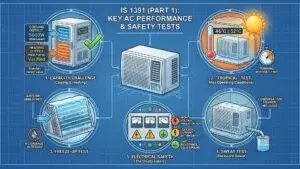
1. Capacity Challenge (Cooling & Heating)
This is the heart of the standard. The lab will test if your “Rated Cooling Capacity” matches reality.
- Cooling Capacity Test: They measure the heat removal rate. If you claim 5000 Watts, the lab needs to see 5000 Watts (within a specific tolerance).
- Heating Capacity (for Heat Pumps): If your unit also heats, it faces a similar test to verify its heating output.
2. “Tropical” Test (Maximum Operating Conditions)
India is hot. Really hot. The standard includes a Maximum Operating Conditions Test where the AC is run at extremely high ambient temperatures (often up to 46°C or 52°C depending on the class). The unit must keep running without tripping its thermal overload protector. If it trips, you fail.
3. Freeze-Up Test
On the flip side, what happens when it’s humid and not scorching hot? The Freeze-Up Test runs the unit in conditions that encourage ice formation on the evaporator coil. The standard requires that ice must not block the airflow or damage the unit.
4. Sweat Test (Enclosure Sweat)
No customer wants a puddle of water on their floor. This test ensures that condensation doesn’t form on the exterior of the unit where it shouldn’t, and that the condensate water drains away properly without leaking inside.
5. Electrical Safety (The Dealbreakers)
These are critical for consumer safety. A failure here is an instant rejection.
- High Voltage Test: Applying high voltage to ensure insulation doesn’t break down.
- Leakage Current Test: Ensuring no stray electricity can shock the user.
- Earth Resistance: Verifying the grounding is solid.
Grouping Guidelines: Do You Need to Test Every Single Model?
This is a question we get asked constantly at Instacertify. “I have 10 models. Do I need 10 tests?”
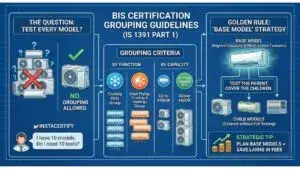
The good news is: No.
The BIS Product Manual for IS 1391 (Part 1) allows for Grouping.
- By Function: Cooling Only units are one group. Cooling & Heating (Heat Pump) units are another.
- By Capacity: Capacities are often grouped (e.g., Up to 4400W, and Above 4400W).
Golden Rule: You typically test the model with the highest cooling capacity and the most severe features in a group. If the “parent” model passes, the smaller “child” models in that group may be covered under the same license without full testing (though they still need to be listed).
Strategic tip: Planning your “Base Models” correctly can save you lakhs of rupees in testing fees.
Certification Process: Step-by-Step
Getting the ISI mark isn’t an overnight affair. Here is the roadmap:
Step 1: Documentation Setup
You need to prepare your Technical Construction File (TCF). This includes circuit diagrams, PCB layouts, component lists (CCL), and raw material certificates (motor, compressor, etc.). Note: Key components like the compressor must often have their own BIS certification.
Step 2: Application Submission
Submit the application online via the Manak Online portal. This generates your test request.
Step 3: Factory Inspection
This is where many fail. A BIS officer will visit your factory (or your foreign manufacturer’s factory). They aren’t just looking at the product; they are auditing your Quality Control (QC) process. They want to see that you have the in-house testing equipment (calorimeters, safety testers) to check every unit coming off the line.
Step 4: Sample Selection & Lab Testing
During the visit, the officer will seal random samples. These samples must be sent to a BIS-recognized third-party lab in India.
Step 5: Grant of License (CML)
Once the factory audit is clear and the lab report shows “PASS,” BIS grants the license. You can now print the ISI mark on your product and packaging.
Common Pitfalls (And How to Avoid Them)
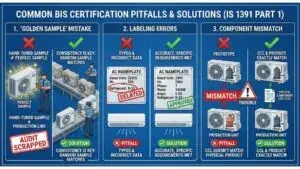
1. “Golden Sample” Mistake
Manufacturers sometimes send a hand-tuned “perfect” sample for testing, but the factory production line runs differently. If the BIS officer picks a random sample from the line that doesn’t match the “Golden Sample,” the audit is scrapped. Consistency is key.
2. Labeling Errors
The standard has very specific requirements for the nameplate (Rated volts, Hz, Phase, Watts, Amps, Refrigerant, etc.). A typo here can delay your file by weeks.
3. Component Mismatch
If your prototype uses a compressor from Vendor A, but your production unit uses Vendor B, you are in trouble. Your Critical Component List (CCL) must match the physical product exactly.
Why Compliance Strategies Matter
In the world of certification, time is money. A delay of two months because of a failed test or a paperwork error can mean missing the entire summer sales season.
The “Do-It-Yourself” approach often leads to rejected applications because the nuances of IS 1391 (Part 1) are buried in technical annexures that are easy to misinterpret.