
Indian Compliance
IS 2082:2018 Specification: Mandatory Testing for Storage Water Heaters
In the world of home appliances, few devices are as essential—and potentially hazardous—as the electric water heater. For manufacturers, ensuring these devices are safe isn’t just about good engineering; it’s a legal necessity.
Enter IS 2082:2018, the Indian Standard that governs Stationary Storage Type Electric Water Heaters.
If you are a manufacturer or importer eyeing the Indian market, understanding this standard is your first step toward compliance. With the recent Quality Control Orders (QCOs) making BIS certification mandatory, the “ISI Mark” has transformed from a badge of quality into a license to sell.
What is IS 2082:2018?
IS 2082:2018 is the comprehensive specification set by the Bureau of Indian Standards (BIS) for stationary electric storage water heaters. It covers the general, safety, and performance requirements for geysers intended for household use.
Unlike instantaneous (tankless) heaters, which are covered under different standards, IS 2082 focuses on heaters that store hot water. It applies to:
- Single-phase appliances: Rated voltage up to 250V.
- Other appliances: Rated voltage up to 415V.
Whether the tank is made of stainless steel, copper, or vitreous enamel, if it stores and heats water using electricity, it falls under this ambit.
Why is Certification Mandatory?
The Government of India, through the Department for Promotion of Industry and Internal Trade (DPIIT), has issued the Electrical Appliances for Domestic Water Heating (Quality Control) Order.
This order makes it illegal to manufacture, import, store, or sell electric water heaters that do not bear the Standard Mark (ISI Mark).
The “Why” Behind the Mandate
- Consumer Safety: Water heaters combine electricity and water—a deadly mix if not managed correctly. Certification ensures protection against electric shocks and tank explosions.
- Energy Efficiency: The standard places heavy emphasis on “Standing Loss,” ensuring that heaters don’t waste electricity when idle.
- Market Credibility: The ISI mark is the most trusted symbol of quality in India. It tells your customers that your product has survived rigorous testing.
Inside the Standard: Key Technical Requirements
To get certified, your product isn’t just looked at; it’s tortured. The IS 2082:2018 standard mandates a series of grueling tests to ensure durability and safety.
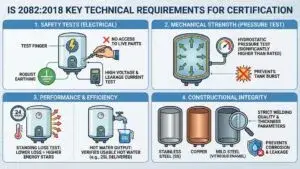
1. Safety Tests (Electrical)
This is the baseline. The device is tested for High Voltage resistance and Leakage Current. The earthing connection must be robust enough to handle faults without electrifying the outer casing.
- Protection Against Access to Live Parts: A “test finger” is used to ensure that a user cannot accidentally touch any internal wiring.
2. Mechanical Strength (Pressure Test)
The inner tank is the heart of the heater. It undergoes a Hydrostatic Pressure Test where it is subjected to pressures significantly higher than its rated capacity. This ensures the tank won’t burst even if the pressure release valve fails or if the municipal water pressure spikes.
3. Performance & Efficiency
- Standing Loss Test: This measures how well the insulation works. The heater is left on for 24 hours, and the energy required to maintain the temperature is measured. Lower standing loss means higher energy stars.
- Hot Water Output: It verifies that a “25-liter” geyser actually delivers 25 liters of usable hot water, not just a mix of hot and cold.
4. Constructional Integrity
The standard specifies strict requirements for the inner tank material. Whether you use Stainless Steel (SS), Copper, or Mild Steel with Vitreous Enamel coating, the thickness and welding quality must meet specific parameters to prevent corrosion and leakage.
Grouping Guidelines: How to Save on Testing Costs
One of the most critical aspects of the Product Manual for IS 2082 is the “Grouping Guidelines.” BIS allows you to group similar models together so you don’t have to test every single variant independently.
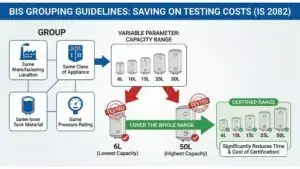
A “Group” is defined by models that share:
- Same manufacturing location.
- Same class of appliance (Class I, II, etc.).
- Same inner tank material.
- Same pressure rating.
Variable Parameters:
If you have a range of capacities (e.g., 6L, 10L, 15L, 25L, 50L) that share the technical specs above, you generally only need to test the model with the highest capacity and the lowest capacity (or specific representative samples as per the lab’s discretion) to cover the whole range. This significantly reduces the time and cost of certification.
Certification Process: Step-by-Step
Navigating the BIS portal can be daunting, but the process follows a logical flow:
- Documentation: You must compile technical details, including the circuit diagram, PCB layout, user manual, and the list of raw material suppliers (who must also be BIS certified or compliant).
- Application Submission: Submit the application online via the Manak Online portal.
- Factory Inspection: A BIS officer will visit your factory. They don’t just look at the product; they audit your Quality Control (QC) capabilities. Do you have the testing equipment on-site? Is your QC staff competent?
- Sample Draw: During the visit, the officer will seal random samples of your product and send them to a BIS-approved third-party lab.
- Lab Testing: The samples undergo the full suite of IS 2082 tests.
- Grant of License: Once the factory audit is cleared and the lab report comes back passing, the license is granted.
Common Challenges & Solutions
Challenge: Failure in Standing Loss Test.
Solution: This is the most common failure point. It usually stems from poor-quality PUF insulation or gaps in the insulation layer. Ensure your foaming process is uniform.
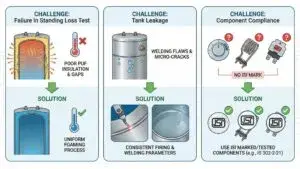
Challenge: Tank Leakage.
Solution: Verify your welding parameters. For glass-lined tanks, ensure the firing process is consistent to prevent micro-cracks.
Challenge: Component Compliance.
Solution: Every critical component—the thermostat, the heating element, the cutout—must be ISI mark or tested to their respective standards (like IS 302-2-21).
Summary
Obtaining BIS certification for IS 2082:2018 is more than a regulatory hurdle; it is a commitment to quality. In a market flooded with unbranded, unsafe options, the ISI mark sets your brand apart as a responsible, premium player.
At Instacertify, we understand that decoding these technical manuals can be overwhelming. Whether you need help with the documentation, pre-compliance testing, or managing the factory audit, proper guidance can turn a 6-month struggle into a seamless success story.
Don’t let compliance bottlenecks cool down your sales. Ensure your water heaters are safe, certified, and ready for the Indian home.
Frequently asked questions
Is testing according to the IS 2082:2018 specification mandatory for storage water heaters in India?
Yes, compliance with IS 2082:2018 is mandatory. Under the Electrical Appliances for Domestic Water Heating (Quality Control) Order, manufacturers must obtain BIS certification and display the ISI mark to legally sell these products in the Indian market.
What does the IS 2082:2018 standard cover?
This standard specifies the manufacturing, physical, chemical, and performance requirements for stationary storage-type electric water heaters. It ensures that appliances are designed for safety, energy efficiency, and protection against electrical hazards, such as overheating or short-circuiting.
What happens if a manufacturer fails to obtain this certification?
Selling or manufacturing non-certified water heaters is illegal under the Bureau of Indian Standards Act, 2016. Non-compliance can lead to severe penalties, including heavy fines, product seizure, market bans, and the potential shutdown of manufacturing facilities.
Which types of water heaters fall under this mandate?
The mandate applies to various stationary storage-type electric water heaters, including closed-outlet, open-outlet, cistern-fed, and heat-exchange models. It covers appliances designed for both residential and commercial use that store and heat large volumes of water.
What is the process for obtaining BIS certification?
The process involves submitting an application to the BIS, undergoing a factory inspection to evaluate quality control, and testing product samples in BIS-approved laboratories. Upon successful verification, the manufacturer is granted a license to use the ISI mark.
Does the IS 2082:2018 standard apply to imported water heaters?
Yes, the mandate applies equally to imported storage water heaters. Foreign manufacturers must obtain a BIS license through the Foreign Manufacturers Certification Scheme (FMCS) to legally export and sell these appliances within the Indian market.
How does this certification benefit consumers?
The ISI mark serves as a guarantee of quality and safety. It ensures that the water heater has undergone rigorous testing to prevent electric shocks, overheating, and pressure-related failures, providing consumers with reliable, high-performance domestic heating appliances.
Are there regular audits for certified manufacturers?
Yes, obtaining the license is not a one-time process. BIS conducts periodic surveillance audits of the manufacturing facility and selects random samples from the market for re-testing to ensure ongoing compliance with the IS 2082:2018 quality standards.