
Indian Compliance
IS 374:2019 Certification for Ceiling Fans: Testing, Costs, and Compliance Guide
If you are a manufacturer or importer in the Indian electrical appliance market, you know that “compliance” is no longer just a buzzword—it is the gatekeeper to your business success. With the enforcement of Quality Control Orders (QCOs), obtaining a BIS license is mandatory.
Today, we are diving deep into IS 374:2019, the definitive Indian Standard for electric ceiling fans. Whether you are dealing with traditional induction motors or the latest energy-efficient BLDC technology, this guide will walk you through the technical labyrinth of testing, grouping guidelines, and inspection schemes, helping you get your product to market faster with Instacertify.
What is IS 374:2019?
IS 374:2019 is the revised Indian Standard Specification that governs the safety and performance of electric ceiling type fans. This isn’t just about making sure the fan spins; it’s about ensuring it delivers air efficiently, doesn’t overheat, and poses no electrical shock hazard to the user.
Scope: What’s Covered?
According to the Bureau of Indian Standards (BIS) Product Manual, this standard covers a wide range of ceiling fans:
- Motor Types: It includes both the conventional squirrel cage induction motors (capacitor type) and the modern Brushless DC (BLDC) motor fans.
- Accessories: It applies to fans with or without speed regulators or remote control devices.
- Specifications: It covers various fan sizes, rated voltages (up to 250V), and frequencies (50 Hz).
If you are manufacturing the new wave of “energy-saving” fans, you fall squarely under this mandate.
“Grouping Guidelines”: How to Save on Testing Costs
One of the most valuable secrets in the BIS Product Manual is the Grouping Guideline (Annex A). Understanding this can save you significantly on testing fees and time. You do not necessarily need to test every single variant you produce.
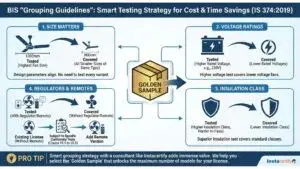
Here is how the hierarchy works:
- Size Matters: If you test an electric ceiling fan of the highest fan size, that approval can cover all smaller fan sizes of the same type. You don’t need to test the 600mm model if the 1200mm model passes, provided the design parameters align.
- Voltage Ratings: Testing a fan at a higher rated voltage can cover fans with lower rated voltages.
- Insulation Class: If you test a fan with a higher insulation class (which is harder to pass), it covers fans with a lower insulation class.
Regulators & Remotes:
- If you test a fan with a speed regulator or remote, the license also covers the version without it.
- Conversely, if you already have a license for a fan without a remote, you can add the remote-controlled version later, subject to specific conformity tests like Clause 10.1 to 10.8.
Pro Tip: Smart grouping strategy is where a consultant like Instacertify adds immense value. We help you select the “Golden Sample” that unlocks the maximum number of models for your license.
Testing Gauntlet: What Happens in the Lab?
To get that ISI mark, your fans must survive a rigorous testing regime. The Product Manual lists specific equipment and test methods that manufacturers must have in-house or outsource to recognized labs.
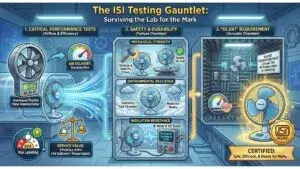
1. Critical Performance Tests
Your fan’s primary job is to move air. The lab uses an Analogue or Digital Vane Anemometer to measure:
- Air Delivery: The volume of air moved per minute.
- Service Value: The efficiency ratio (Air Delivery divided by Power Input). This is crucial not just for BIS, but for BEE Star Labeling.
2. Safety & Durability
The standard demands that fans be safe for continuous use.
- Mechanical Strength: The fan shouldn’t wobble or fall. Tests involve impact and stability checks.
- Environmental Resilience: Fans are subjected to a Humidity Test Chamber to ensure they don’t short-circuit in India’s humid monsoon weather.
- Insulation Resistance: Using an IR Meter and HV Tester, the lab ensures that current doesn’t leak to the body of the fan.
3. “Silent” Requirement
A noisy fan is a rejected fan. The standard includes a Silent Operation test (Clause 13), ensuring the motor doesn’t hum excessively and the bearings don’t grind.
Factory Compliance: The Scheme of Inspection and Testing (SIT)
Obtaining the license is step one; keeping it is step two. The BIS mandates a strict Scheme of Inspection and Testing (SIT) that your factory must follow daily.
“Control Unit” Concept
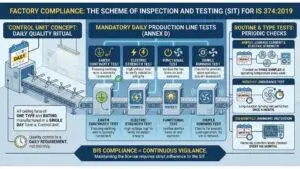
BIS defines a “Control Unit” as all ceiling fans of one type and rating manufactured in a single day. This means your quality control isn’t a monthly affair—it’s a daily ritual.
Mandatory Daily Tests
According to Annex D of the manual, the following tests must be conducted on the production line:
- Earth Continuity Test: Ensuring the earthing wire is actually connected.
- Electric Strength Test: Zapping the fan with high voltage to check insulation.
- Functional Test: Does it actually turn on?.
- Simple Running Test: Ensuring smooth operation.
Routine & Type Tests
While some tests happen daily, others are periodic. For example:
- Leakage Current & Electric Strength at operating temperature must be checked on three samples every week.
- Harmonic Distortion is checked every six months.
- Endurance Test (running the fan for a long duration) is performed once a month.
Documentation & Labelling
You cannot just pass the test; you must prove it. The manufacturer is required to maintain detailed Test Records for every control unit.
Furthermore, the labeling on your fan must be precise. It must carry the Standard Mark (ISI Mark) as per IS 374:2019. If you are using components like capacitors or regulators, they must also adhere to their respective standards (e.g., IS 648 for stampings, IS 11037 for regulators).
If you want to ISI Mark Please visit: ISI Mark Certificate
Why This Matters Now
The Indian market is shifting. Consumers are becoming energy-conscious, looking for 5-Star rated BLDC fans. The government is cracking down on unsafe, uncertified electrical goods.
- Legal Requirement: You cannot sell non-ISI fans in India.
- Market Trust: The ISI mark is the most recognized trust seal for Indian consumers.
- BEE Star Labeling: You cannot apply for energy efficiency stars without first having the BIS license (IS 374).