
Indian Compliance
Is Your Emergency Light Legal to Sell? The Truth About IS 10322 (Part 5/Sec 8)
Imagine being in a crowded shopping mall or a busy hospital when the power suddenly cuts out. Pitch black. In those critical seconds, panic can set in—unless a reliable, bright beam cuts through the darkness, guiding everyone to safety. That is the power of Emergency Lighting.
But for manufacturers and importers in India, producing these life-saving devices isn’t just about connecting a battery to an LED. It’s about adhering to strict safety protocols. Enter IS 10322 (Part 5/Section 8): 2013, the Indian Standard that governs the safety, performance, and reliability of emergency luminaires.
If you are in the business of lighting, you know that the Bureau of Indian Standards (BIS) doesn’t take shortcuts. In this guide, we’re going to decode this standard, explain why it’s mandatory, and walk you through how to get your product certified without the headache.
What is IS 10322 (Part 5/Section 8): 2013?
At its core, IS 10322 (Part 5/Section 8): 2013 is the specific section of the Indian Standard for “Luminaires” that deals with Emergency Lighting.
Unlike your standard room bulb, an emergency light has a very specific job: it must work when everything else fails. This standard covers:
- Self-contained luminaires: Units that have the battery, lamp, and control gear all in one box (like those exit signs you see above doors).
- Centrally supplied luminaires: Lights connected to a central emergency power system.
- Maintained vs. Non-maintained: Lights that stay on all the time (maintained) versus those that only kick in when the power dies (non-maintained).
This standard essentially acts as a promise to the consumer: “When the grid fails, this light will turn on, it will stay on for the rated duration, and it won’t catch fire while doing so.”
Why Is This Standard Mandatory? (The Legal Stuff)
You might be asking, “Can’t I just sell high-quality emergency lights without this specific paper?”
The short answer is: No.
The Ministry of Electronics and Information Technology (MeitY) and BIS have brought Emergency Lighting under the Compulsory Registration Scheme (CRS). This means:
- It is Illegal to Sell Without It: Manufacturing, importing, or storing emergency lights without a valid BIS Registration Number is a violation of Indian law.
- Customs Will Stop You: If you are importing lights from China or elsewhere, Indian Customs will seize the shipment if it lacks the Standard Mark.
- Market Trust: Large tenders (government projects, hospitals, corporate parks) will automatically disqualify any vendor who is not BIS certified.
This standard isn’t just a “nice-to-have” badge; it is your license to operate in the Indian market.
Decoding the Technical Requirements: What Gets Tested?
When you send your sample to a BIS-recognized lab, they don’t just switch it on and off. They put it through a “boot camp.” Here are the key tests your product needs to survive to pass IS 10322 (Part 5/Sec 8).
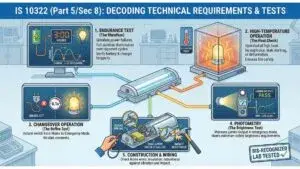
1. Endurance Test (The Marathon)
Your emergency light claims to have a “3-hour battery backup.” But does it really?
- The Test: The lab will charge and discharge the battery repeatedly. They simulate power failure conditions to ensure the light provides the required illumination for the full rated duration—not just when it’s new, but after repeated cycles.
- The Goal: To prove that the battery won’t degrade instantly and that the internal charger works correctly.
2. High-Temperature Operation (The Heat Check)
Emergency lights often sit in ceilings or closed casings where heat builds up.
- The Test: The luminaire is operated at elevated temperatures to see if the battery explodes, leaks, or if the plastic casing melts/deforms.
- The Goal: Fire safety. A device meant to save people during a fire shouldn’t start a fire.
3. Changeover Operation (The Reflex Test)
When the mains power is cut, the switch to battery power must be instantaneous.
- The Test: The lab measures the time it takes for the light to switch from “Mains Mode” to “Emergency Mode.” It needs to be a fraction of a second.
- The Goal: Ensuring nobody is left in the dark, even for a moment.
4. Photometry (The Brightness Test)
An emergency light that is too dim is useless.
- The Test: Engineers measure the “Lumen Output” in emergency mode. Note that the brightness in emergency mode is often lower than in mains mode (to save battery), but it must meet the specific minimum lux levels required for safety.
5. Construction & Wiring
- The Test: Checking for loose wires, proper insulation (Class I or Class II), and ensuring the unit is robust enough to handle vibration and impact.
Certification Roadmap: How to Get Your R-Number
Getting certified can feel like navigating a maze. Here is the simplified 4-step process for manufacturers.
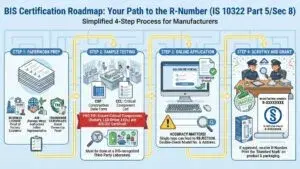
Step 1: Paperwork Prep
Before you even touch the product, you need your documentation in order.
- Business License: Proof that your factory exists (ISO certificate, MSIE, etc.).
- AIR (For Foreign Manufacturers): If you are located outside India, you must nominate an Authorized Indian Representative (AIR) to be liable for compliance in India.
- Trademark Certificate: You must own the brand you are putting on the product.
Step 2: Sample Testing
This is the most critical phase. You cannot test this in your own factory; it must be done at a BIS-recognized Third-Party Laboratory.
- You submit a sample along with the CDF (Construction Data Form) and CCL (Critical Component List).
Pro Tip: Ensure your Critical Components (especially the Battery, LED Driver, and LEDs) are already BIS certified or hold valid IEC certificates. If your internal components aren’t compliant, your whole product fails.
Step 3: Online Application
Once the lab issues the Test Report (and assuming you passed!), you submit the report and documents to the BIS online portal.
- This is where accuracy matters. A single typo in the model number or address can lead to rejection.
Step 4: Scrutiny and Grant
BIS officers review your application. If everything aligns with IS 10322 (Part 5/Sec 8), they grant you the Registration Number (R-XXXXXXXX).
- You can now print the “Standard Mark” (the CRS logo) on your product and packaging.
Common Pitfalls to Avoid
As compliance experts, we see manufacturers make the same mistakes over and over. Save yourself time and money by avoiding these:
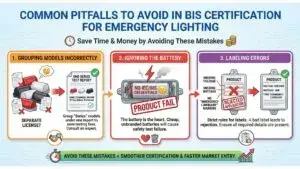
- Grouping Models Incorrectly: You don’t need a separate license for every single color or minor variation. You can group “Series” models under a single test report if they share the same technical design (same driver, same battery, same enclosure). Consult an expert to structure this wisely and save on testing fees.
- Ignoring the Battery: The battery is the heart of an emergency light. If you use a cheap, unbranded battery without IEC/BIS credentials, your product will fail the safety test.
- Labeling Errors: The standard has strict rules on what must be written on the product label (voltage, wattage, “Emergency Luminaire” marking). A bad label = a rejected application.
Conclusion: Compliance is Your Competitive Edge
Obtaining BIS certification under IS 10322 (Part 5/Section 8): 2013 might seem like a regulatory hurdle, but it is actually a massive business opportunity.
In a market flooded with cheap, unreliable imports, a BIS-marked product stands out. It signals to architects, builders, and safety inspectors that your brand is trustworthy. It opens doors to government contracts and large-scale infrastructure projects that are closed to non-compliant competitors.
Don’t let the paperwork dim your shine.
If you are ready to get your Emergency Lighting products certified but aren’t sure where to start, we are here to guide you. From selecting the right series to handling the lab coordination, we simplify the compliance journey so you can focus on manufacturing.
Ready to get certified? Contact us today to start your BIS journey!
Frequently asked questions
Is it mandatory to have BIS certification to sell emergency lights in India?
Yes, it is mandatory. Under the Compulsory Registration Scheme (CRS) of the Bureau of Indian Standards, all emergency lighting must comply with IS 10322 (Part 5/Sec 8) to be legally manufactured, imported, or sold in India.
What happens if I sell non-compliant emergency lights?
Selling or importing emergency lights without valid BIS registration is illegal. Penalties for non-compliance include heavy financial fines, the immediate confiscation of stock, an official import ban, and potential imprisonment of up to two years.
Does the standard apply to both self-contained and central battery emergency systems?
Yes, the standard covers all types of emergency luminaires. This includes self-contained units with built-in batteries, centrally supplied systems, as well as both maintained and non-maintained lighting modes, provided they fall under the specified regulation.
What critical factors does the BIS testing process evaluate?
Testing verifies essential safety and performance, including rated battery duration, charging-circuit reliability, switchover time during power failures, light output, electrical safety (shock protection), thermal resistance, and fire hazard safety under abnormal conditions.
Are there any updates to the standard I should be aware of?
Yes, the standard has been updated to IS 10322 (Part 5/Sec 8):2026. All manufacturers and license holders must fully transition and comply with this revised 2026 version by the mandatory deadline of August 2, 2026.
Who is responsible for obtaining the BIS registration?
The legal responsibility for obtaining the BIS registration lies with the manufacturer. Importers may act as an Authorized Indian Representative (AIR) to facilitate the application process, but the final license is granted specifically to the manufacturing site.
Can I sell emergency lights with a test report from a non-BIS lab?
No, test reports from non-BIS recognized laboratories are invalid for compliance purposes. To legally sell emergency lights in India, you must obtain a BIS registration based exclusively on test reports generated by NABL-accredited, BIS-recognized laboratories.
Does having a CE or UL certificate exempt me from BIS requirements?
No, international certifications like CE or UL do not exempt products from Indian regulations. BIS registration is an independent, mandatory requirement under Indian law; having foreign certifications does not legally permit the sale of emergency lights in India.