
Indian Compliance
Planning to Manufacture Ductile Iron Fittings? Read This IS 9523:2000 Guide First
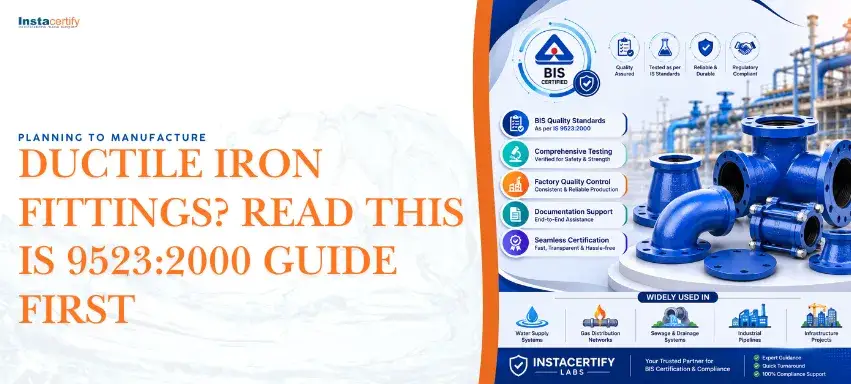
When it comes to water supply, sewage systems, gas distribution, and industrial pipeline networks, ductile iron fittings are the backbone of a reliable infrastructure. These fittings connect, redirect, reduce, and control the flow of pressure pipelines, making their quality and durability essential for public safety and long-term performance.
A single defective fitting can result in leakage, pressure failure, costly repairs, and operational downtime. That's why the Bureau of Indian Standards (BIS) has established IS 9523:2000, a standard that defines the quality, design, material, testing, and performance requirements for ductile iron fittings used in pressure pipelines.
If you manufacture or import ductile iron fittings for the Indian market, understanding BIS certification is no longer just about compliance—it's about building customer confidence, improving product quality, and expanding your business opportunities.
At Instacertify Labs, we simplify the entire BIS certification journey. From technical documentation and product testing to application filing and liaison with BIS, our compliance experts help you achieve certification quickly, accurately, and with complete peace of mind.
Whether you're a new manufacturer, an established brand, or an overseas supplier entering India, our end-to-end support helps you navigate the certification process with confidence.
Latest Update on IS 9523:2000 (2026)
Manufacturers and importers should stay informed about the latest regulatory developments to avoid delays in certification and market access.
Here's what you need to know:
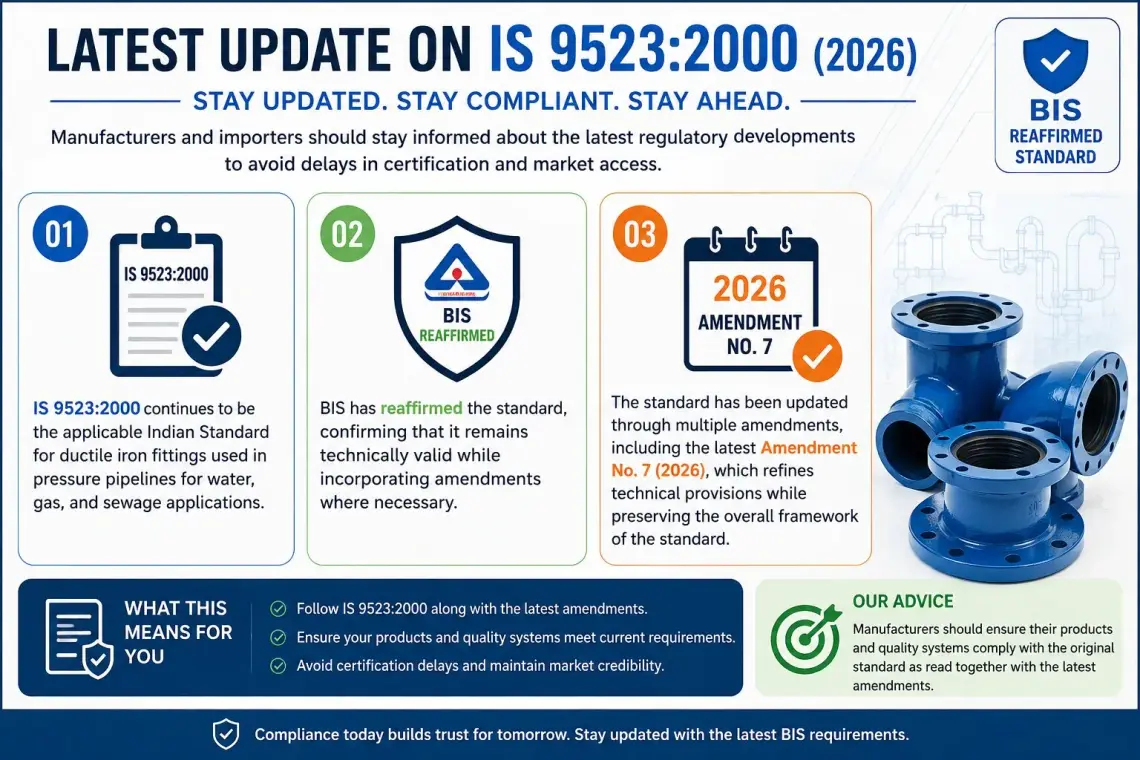
- IS 9523:2000 continues to be the applicable Indian Standard for ductile iron fittings used in pressure pipelines for water, gas, and sewage applications.
- BIS has reaffirmed the standard, confirming that it remains technically valid while incorporating amendments where necessary.
- The standard has been updated through multiple amendments, including the latest Amendment No. 7 (2026), which refines technical provisions while preserving the overall framework of the standard. Manufacturers should ensure their products and quality systems comply with the original standard as read together with the latest amendments.
Why This Matters
Regulatory requirements evolve to improve product quality, safety, and consistency. Keeping up with the latest amendments helps manufacturers:
- Avoid non-compliance during BIS inspections.
- Reduce the risk of certification delays.
- Meet current technical expectations.
- Improve product reliability and market acceptance.
- Maintain customer trust and business credibility.
At Instacertify Labs, our compliance specialists stay updated with the latest BIS notifications and help you align your products with the current requirements, reducing the chances of costly mistakes during certification.
What is IS 9523:2000?
IS 9523:2000 is the Indian Standard that specifies the requirements for Ductile Iron Fittings for Pressure Pipes for Water, Gas and Sewage.
The standard establishes uniform requirements for manufacturing, dimensions, materials, mechanical properties, protective coatings, testing, inspection, and marking of ductile iron fittings used in pressure piping systems.
Its primary objective is to ensure that every fitting can withstand operating pressures, resist corrosion, and deliver dependable performance throughout its service life.
By following IS 9523:2000, manufacturers can produce fittings that are interchangeable, durable, and suitable for critical infrastructure projects across India.
What Are Ductile Iron Fittings?
Ductile iron fittings are specially designed pipe components used to connect, divert, extend, reduce, or terminate pressure pipelines. Unlike ordinary cast iron, ductile iron offers significantly higher tensile strength, impact resistance, and flexibility, making it ideal for demanding applications.
These fittings are widely used because they provide:
- High mechanical strength
- Excellent pressure resistance
- Long service life
- Superior corrosion resistance with appropriate coatings
- Leak-proof pipeline connections
- Reliable performance under varying environmental conditions
From municipal water supply networks to industrial process pipelines, ductile iron fittings play a crucial role in ensuring safe and uninterrupted fluid transportation.
Why Is BIS Certification Important for Ductile Iron Fittings?
BIS certification is more than a regulatory requirement—it is a mark of quality and reliability.
When your products comply with IS 9523:2000, customers and project authorities gain confidence that the fittings have been manufactured and evaluated according to recognized Indian quality standards.
Key Benefits of BIS Certification
- Demonstrates compliance with Indian Standards.
- Enhances credibility with government departments, contractors, and private buyers.
- Improves product consistency through standardized quality control.
- Reduces the likelihood of product failures and customer complaints.
- Supports participation in infrastructure, water supply, and utility projects.
- Strengthens brand reputation in the competitive market.
- Facilitates smoother procurement for projects that specify BIS-compliant products.
For manufacturers and importers, certification is not only about meeting regulations—it is also a valuable business advantage that reinforces trust and opens new market opportunities.
Products Covered Under IS 9523:2000
Ductile iron fittings are essential components that connect, redirect, reduce, or terminate pressure pipelines. To ensure compatibility, strength, and long-term reliability, IS 9523:2000 covers a wide range of fittings commonly used in water, gas, and sewage distribution systems.
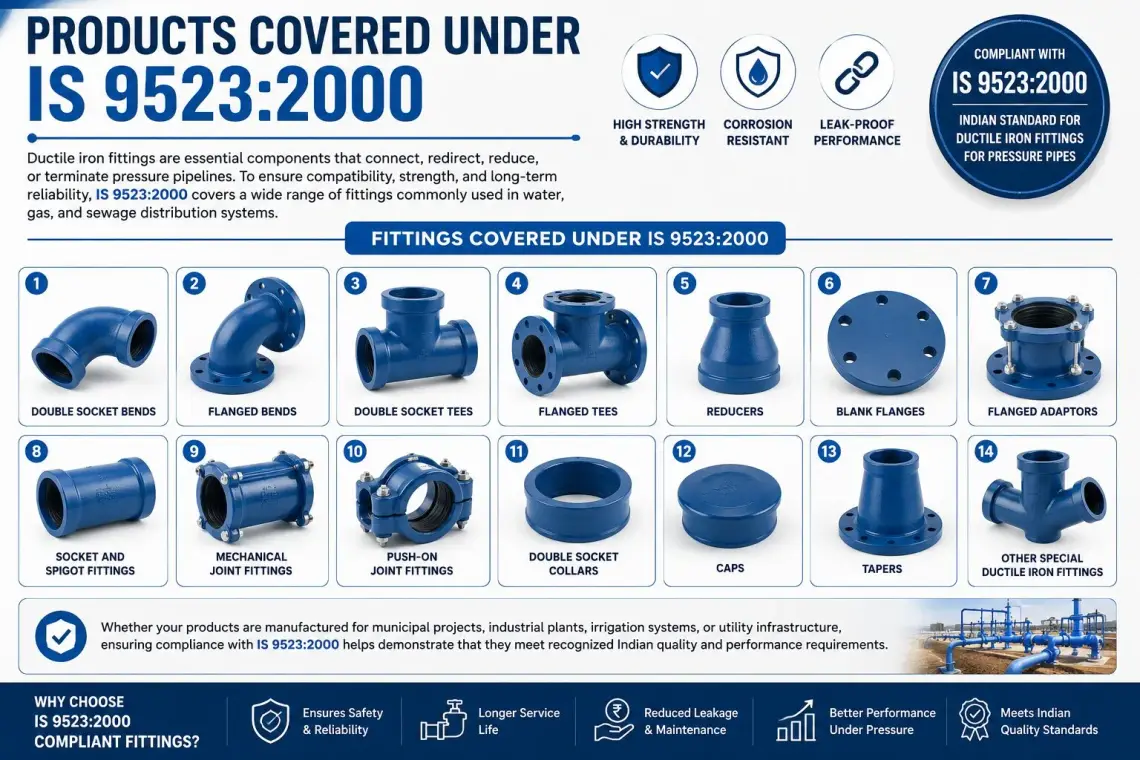
Depending on the pipeline design and project requirements, the standard applies to products such as:
- Double Socket Bends
- Flanged Bends
- Double Socket Tees
- Flanged Tees
- Reducers
- Blank Flanges
- Flanged Adaptors
- Socket and Spigot Fittings
- Mechanical Joint Fittings
- Push-on Joint Fittings
- Double Socket Collars
- Caps
- Tapers
- Other Special Ductile Iron Fittings
Whether your products are manufactured for municipal projects, industrial plants, irrigation systems, or utility infrastructure, ensuring compliance with IS 9523:2000 helps demonstrate that they meet recognized Indian quality and performance requirements.
Where Are Ductile Iron Fittings Used?
Ductile iron fittings are trusted across industries because of their excellent mechanical strength, pressure resistance, and long service life. Their versatility makes them suitable for both underground and above-ground pipeline installations.
Common Applications
Municipal Water Supply
Cities and municipalities rely on ductile iron fittings to build durable water distribution networks capable of operating under varying pressure conditions.
Drinking Water Projects
These fittings help maintain safe and leak-resistant pipelines for transporting potable water from treatment plants to consumers.
Sewerage & Wastewater Systems
High corrosion resistance and mechanical strength make ductile iron fittings suitable for sewage collection and wastewater management infrastructure.
Irrigation Networks
Agricultural irrigation projects use ductile iron fittings to create reliable pipeline systems capable of handling continuous water flow over long distances.
Fire Protection Systems
Many industrial and commercial fire-fighting pipeline networks use ductile iron fittings because of their durability and dependable pressure performance.
Industrial Pipelines
Manufacturing plants, power stations, and processing facilities depend on these fittings for transporting water and other compatible fluids safely.
Gas Distribution Networks
Selected ductile iron fittings are also used in gas pipeline systems where applicable standards and project specifications permit.
Infrastructure & Smart City Projects
Large-scale infrastructure developments require high-quality pipeline components that deliver long-term performance with minimal maintenance.
Product Testing Requirements
Testing is one of the most critical stages of BIS certification. It verifies that ductile iron fittings meet the performance requirements specified in IS 9523:2000 before they are placed on the market.
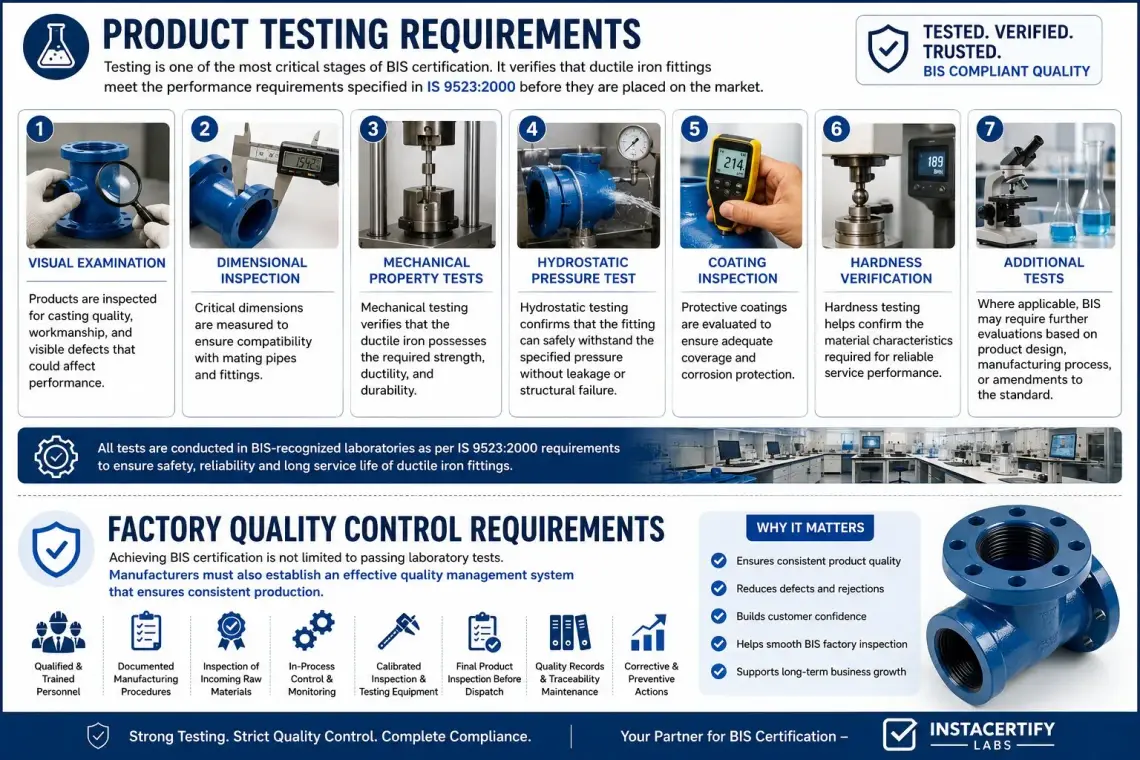
Depending on the product type and applicable provisions of the standard, testing may include:
Visual Examination
Products are inspected for casting quality, workmanship, and visible defects that could affect performance.
Dimensional Inspection
Critical dimensions are measured to ensure compatibility with mating pipes and fittings.
Mechanical Property Tests
Mechanical testing verifies that the ductile iron possesses the required strength, ductility, and durability.
Hydrostatic Pressure Test
Hydrostatic testing confirms that the fitting can safely withstand the specified pressure without leakage or structural failure.
Coating Inspection
Protective coatings are evaluated to ensure adequate coverage and corrosion protection.
Hardness Verification
Hardness testing helps confirm the material characteristics required for reliable service performance.
Additional Tests
Where applicable, BIS may require further evaluations based on product design, manufacturing process, or amendments to the standard.
Factory Quality Control Requirements
Achieving BIS certification is not limited to passing laboratory tests. Manufacturers must also establish an effective quality management system that ensures consistent production.
A compliant manufacturing facility should have:
- Qualified technical personnel
- Standardized manufacturing procedures
- Calibrated inspection and testing equipment
- Documented quality control records
- Raw material inspection procedures
- Process monitoring systems
- Final product inspection before dispatch
- Corrective and preventive action procedures
Maintaining strong factory quality control helps reduce defects, improve consistency, and build confidence during BIS inspections.
Frequently asked questions
What is IS 9523:2000?
IS 9523:2000 is the Indian Standard that specifies the requirements for ductile iron fittings used in pressure pipelines for water, gas, and sewage applications. It defines material, dimensions, testing, inspection, marking, and quality requirements to ensure reliable and safe performance.
Is BIS certification mandatory for ductile iron fittings?
If your product falls under the applicable BIS Quality Control Order (QCO), obtaining BIS certification is mandatory before manufacturing, selling, importing, or distributing the product in India. Manufacturers should always verify the latest BIS notifications applicable to their product category.
Which products are covered under IS 9523:2000?
The standard covers various ductile iron fittings, including bends, tees, reducers, flanged adaptors, collars, caps, tapers, socket and spigot fittings, mechanical joint fittings, and other special fittings used in pressure pipeline systems.
What tests are conducted under IS 9523:2000?
Testing typically includes visual examination, dimensional inspection, mechanical property testing, hydrostatic pressure testing, hardness verification, coating inspection, and other evaluations specified by the standard to ensure the fittings meet quality and performance requirements.
What is the latest update on IS 9523:2000?
IS 9523:2000 continues to be the applicable Indian Standard for ductile iron fittings. BIS has reaffirmed the standard and issued several amendments, including the latest Amendment No. 7 (2026), to update technical requirements while maintaining the core framework.
Who should apply for BIS certification under IS 9523:2000?
Manufacturers and importers of ductile iron fittings intended for the Indian market should obtain BIS certification where required. Compliance helps meet regulatory obligations, enhances product credibility, and supports participation in government and infrastructure projects.
What documents are required for BIS certification?
The certification process generally requires manufacturing details, factory registration documents, quality control records, product specifications, test reports, calibration certificates, machinery details, and other technical documents as specified by BIS during the application process.
How long does the BIS certification process take?
The certification timeline depends on product testing, document verification, factory inspection, and BIS evaluation. Submitting accurate documentation and ensuring product compliance can help minimize delays and support a smoother approval process.