Global Compliance
What is an MSDS Certificate? A Complete Beginner’s Guide to MSDS/SDS (2026)
If you manufacture, import, export, sell, or transport chemical products, you may have heard about an MSDS Certificate. Whether you deal with cosmetics, paints, detergents, lubricants, industrial chemicals, adhesives, cleaning products, or laboratory chemicals, an MSDS is one of the most important safety documents.
Many people search for terms like "What is an MSDS certificate?", "What is the MSDS full form?", or "How to prepare an MSDS sheet?". In this guide, we explain everything in simple language so that even beginners can understand the concept.
What is an MSDS Certificate?
An MSDS (Material Safety Data Sheet) is a technical document that provides detailed information about a chemical product. It explains the product's hazards, safe handling methods, storage requirements, emergency procedures, and disposal instructions.
Today, the term SDS (Safety Data Sheet) is more commonly used because of the Globally Harmonized System (GHS) for classifying and labeling chemicals. However, many businesses and customers still use the term MSDS Certificate, which is why both names are commonly seen.
An MSDS/SDS helps workers, transporters, emergency responders, and customers understand how to use a chemical safely and what to do in case of an accident.
Simply put: An MSDS is a safety guide that tells users everything they need to know before handling a chemical product.
What is the MSDS Full Form?
The full form of MSDS is:
Material Safety Data Sheet
The modern and internationally accepted term is:
SDS – Safety Data Sheet
Although the name has changed in many countries, the purpose remains the same: to provide clear and accurate safety information about chemical products.
Purpose of MSDS/SDS
The main purpose of an MSDS/SDS is to protect people and the environment by providing important safety information.
Some of the key objectives include:
- Identifying chemical hazards before use.
- Explaining safe handling procedures.
- Providing storage recommendations.
- Informing users about required personal protective equipment (PPE).
- Giving first-aid instructions in case of exposure.
- Explaining fire-fighting measures.
- Providing spill and leak response procedures.
- Supporting safe transportation and disposal.
- Helping businesses comply with chemical safety regulations.
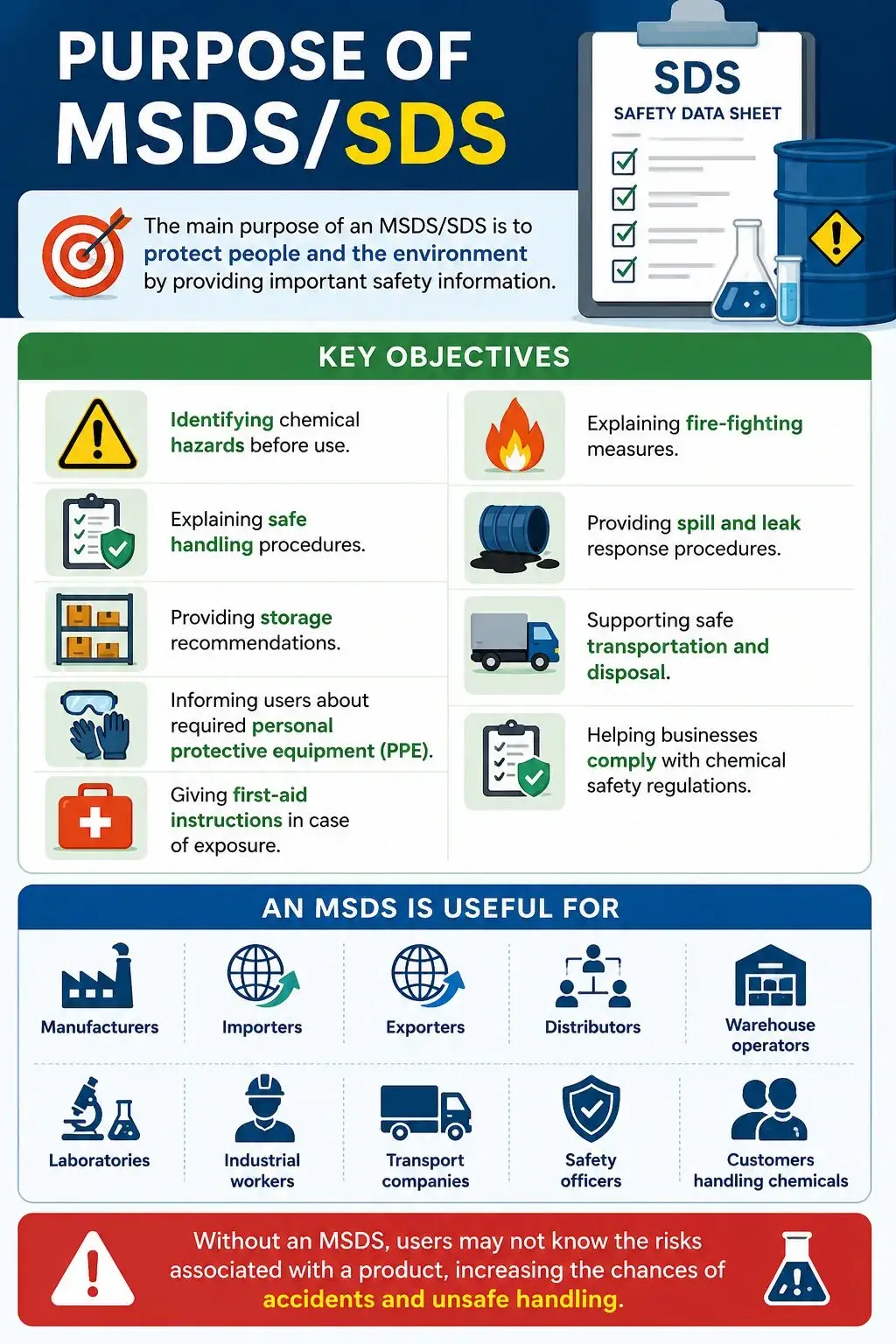
An MSDS is useful for:
- Manufacturers
- Importers
- Exporters
- Distributors
- Warehouse operators
- Laboratories
- Industrial workers
- Transport companies
- Safety officers
- Customers handling chemicals
Without an MSDS, users may not know the risks associated with a product, increasing the chances of accidents and unsafe handling.
Contents of an MSDS/SDS
An MSDS/SDS contains complete safety information about a chemical product. The exact format follows international GHS guidelines and includes information such as:
Product Identification
This section provides:
- Product name
- Manufacturer details
- Supplier information
- Emergency contact number
- Recommended use of the product
Hazard Information
This section explains:
- Whether the product is flammable
- Toxicity level
- Health hazards
- Environmental hazards
- Signal words such as "Danger" or "Warning"
Composition
This includes:
- Chemical ingredients
- CAS Numbers
- Concentration of hazardous components
First Aid Measures
It explains what to do if the product comes into contact with:
- Eyes
- Skin
- Nose
- Mouth
It also provides medical advice for emergency situations.
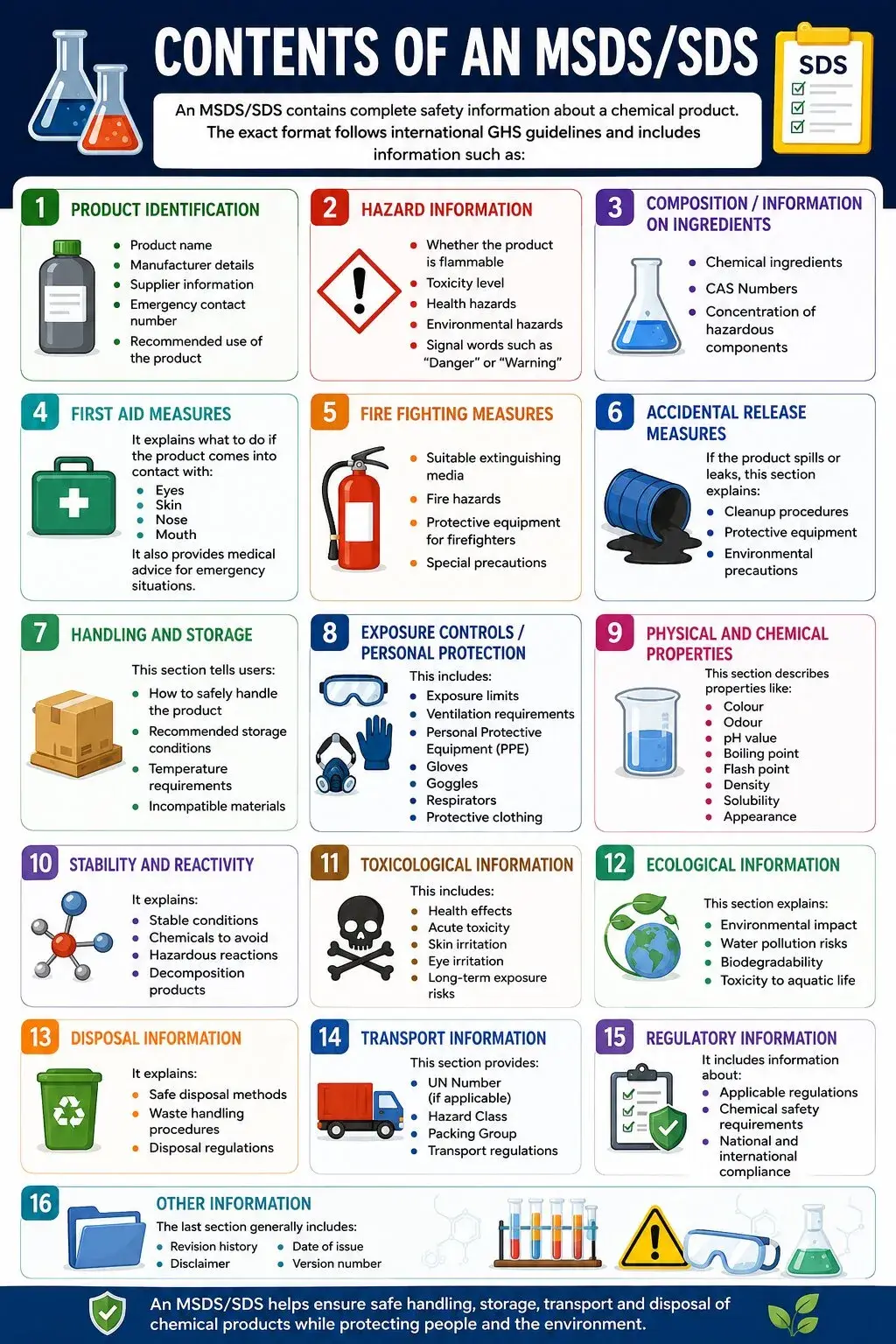
Fire Fighting Measures
This section includes:
- Suitable extinguishing media
- Fire hazards
- Protective equipment for firefighters
- Special precautions
Accidental Release Measures
If the product spills or leaks, this section explains:
- Cleanup procedures
- Protective equipment
- Environmental precautions
Handling and Storage
This section tells users:
- How to safely handle the product
- Recommended storage conditions
- Temperature requirements
- Incompatible materials
Exposure Controls
This includes:
- Exposure limits
- Ventilation requirements
- Personal Protective Equipment (PPE)
- Gloves
- Goggles
- Respirators
- Protective clothing
Physical and Chemical Properties
This section describes properties like:
- Colour
- Odour
- pH value
- Boiling point
- Flash point
- Density
- Solubility
- Appearance
Stability and Reactivity
It explains:
- Stable conditions
- Chemicals to avoid
- Hazardous reactions
- Decomposition products
Toxicological Information
This includes:
- Health effects
- Acute toxicity
- Skin irritation
- Eye irritation
- Long-term exposure risks
Ecological Information
This section explains:
- Environmental impact
- Water pollution risks
- Biodegradability
- Toxicity to aquatic life
Disposal Information
It explains:
- Safe disposal methods
- Waste handling procedures
- Disposal regulations
Transport Information
This section provides:
- UN Number (if applicable)
- Hazard Class
- Packing Group
- Transport regulations
Regulatory Information
It includes information about:
- Applicable regulations
- Chemical safety requirements
- National and international compliance
Other Information
The last section generally includes:
- Revision history
- Disclaimer
- Date of issue
- Version number
What are the MSDS 16 Points?
Under the Globally Harmonized System (GHS), every Safety Data Sheet follows a standard 16-section format.
These 16 sections are:
- Identification
- Hazard Identification
- Composition / Information on Ingredients
- First Aid Measures
- Fire Fighting Measures
- Accidental Release Measures
- Handling and Storage
- Exposure Controls / Personal Protection
- Physical and Chemical Properties
- Stability and Reactivity
- Toxicological Information
- Ecological Information
- Disposal Considerations
- Transport Information
- Regulatory Information
- Other Information
Using this standard structure helps ensure consistency, making it easier for workers, safety officers, and emergency responders to locate important information quickly.
How to Prepare an MSDS Sheet?
Preparing an MSDS is a technical process that requires accurate product information and hazard classification. The following steps are commonly followed:
Step 1: Collect Product Information
Gather details such as:
- Product name
- Product type
- Manufacturer information
- Intended use
Step 2: Obtain Ingredient Details
Prepare a complete list of ingredients, including:
- Chemical names
- CAS Numbers
- Percentage composition
- Hazard classifications
Step 3: Classify the Hazards
Evaluate the product according to the applicable GHS classification criteria to identify physical, health, and environmental hazards.
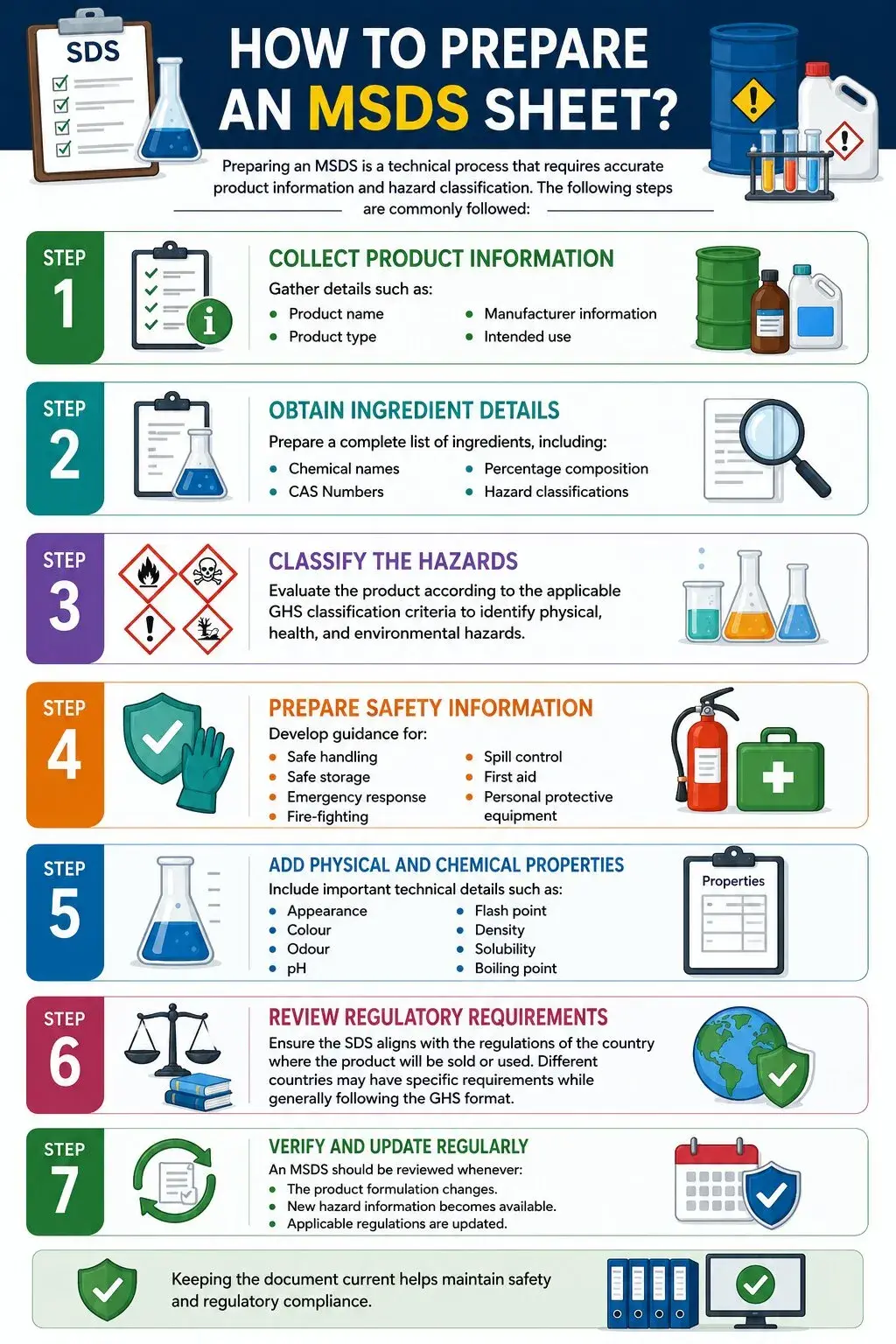
Step 4: Prepare Safety Information
Develop guidance for:
- Safe handling
- Safe storage
- Emergency response
- Fire-fighting
- Spill control
- First aid
- Personal protective equipment
Step 5: Add Physical and Chemical Properties
Include important technical details such as:
- Appearance
- Colour
- Odour
- pH
- Flash point
- Density
- Solubility
- Boiling point
Step 6: Review Regulatory Requirements
Ensure the SDS aligns with the regulations of the country where the product will be sold or used. Different countries may have specific requirements while generally following the GHS format.
Step 7: Verify and Update Regularly
An MSDS should be reviewed whenever:
- The product formulation changes.
- New hazard information becomes available.
- Applicable regulations are updated.
Keeping the document current helps maintain safety and regulatory compliance.
Why is an MSDS Important?
An MSDS is more than just a document—it is an essential part of chemical safety management. It helps reduce workplace accidents, improves emergency preparedness, supports regulatory compliance, and promotes the safe handling, storage, transportation, and disposal of chemical products. Businesses that maintain accurate and up-to-date SDS documents also build greater confidence with customers, suppliers, and regulatory authorities.
Summary An MSDS (Material Safety Data Sheet), now commonly known as an SDS (Safety Data Sheet), is an essential document for anyone involved with chemical products. It provides critical information on hazards, safe handling, emergency measures, storage, transport, and disposal. Understanding the MSDS full form, the purpose of MSDS/SDS, the 16 standard sections, and the process of preparing an MSDS sheet helps businesses improve workplace safety and meet regulatory expectations. Whether you are a manufacturer, importer, exporter, distributor, or user of chemical products, maintaining a clear, accurate, and up-to-date SDS is an important part of responsible chemical management.Frequently asked questions
What is an MSDS certificate?
An MSDS certificate, now commonly called an SDS (Safety Data Sheet), is a document that provides important safety information about a chemical product. It explains hazards, safe handling, storage, first aid, and emergency procedures to help protect users and ensure regulatory compliance.
What is the full form of MSDS?
MSDS stands for Material Safety Data Sheet. Under the Globally Harmonized System (GHS), it is now officially known as an SDS (Safety Data Sheet). Both terms refer to a document that provides detailed health, safety, and handling information for chemical products.
Why is an MSDS/SDS important?
An MSDS/SDS is important because it helps users understand the hazards of a chemical product and explains how to handle, store, transport, and dispose of it safely. It also supports workplace safety, emergency preparedness, and compliance with chemical safety regulations.
What information is included in an MSDS/SDS?
An MSDS/SDS includes product identification, hazard details, ingredient information, first-aid measures, fire-fighting instructions, safe handling and storage guidelines, exposure controls, physical properties, transport details, disposal methods, regulatory information, and other important safety instructions.
What are the 16 sections of an MSDS?
The standard MSDS/SDS contains 16 sections covering identification, hazards, composition, first aid, fire-fighting measures, accidental release, handling and storage, exposure controls, physical properties, stability, toxicology, ecology, disposal, transport, regulations, and additional information.
Who needs an MSDS certificate?
Manufacturers, importers, exporters, distributors, warehouses, laboratories, transport companies, and businesses dealing with chemical products usually require an MSDS/SDS. It helps ensure safe product handling while meeting customer, shipping, and regulatory documentation requirements.
How do you prepare an MSDS sheet?
Preparing an MSDS requires collecting product details, ingredient composition, hazard classification, physical and chemical properties, first-aid measures, handling instructions, transport information, and regulatory data. The document should follow the internationally accepted GHS 16-section format.
Is an MSDS mandatory for all products?
No. An MSDS/SDS is generally required for chemical and hazardous products. Non-hazardous products may not always require one, depending on applicable regulations and customer or market requirements. Businesses should verify the rules applicable in their target market.
What is the difference between MSDS and SDS?
There is no major difference in purpose. MSDS is the older term, while SDS is the updated name introduced under the GHS. SDS follows a standardized 16-section format, making safety information easier to understand and use worldwide.
How often should an MSDS be updated?
An MSDS/SDS should be updated whenever the product formulation changes, new hazard information becomes available, or regulatory requirements are revised. Regular updates ensure the document remains accurate, compliant, and useful for safe chemical handling.