Others
Why the Ministry of Textiles Rescinded the Cotton Bales QCO 2023 Mandate
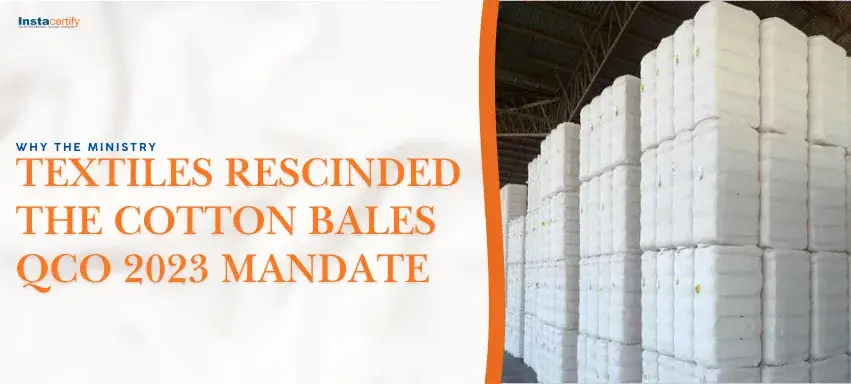
In a highly anticipated move that brings massive relief to the Indian agricultural and textile sectors, the Ministry of Textiles has officially withdrawn the Cotton Bales (Quality Control) Order, 2023. Through a recently issued official gazette notification, the government has entirely rescinded the mandate that would have required all cotton bales to comply with mandatory Bureau of Indian Standards (BIS) certification.
This abrupt cancellation marks a major shift in the regulatory compliance landscape for the textile industry, effectively removing the legal obligation for domestic manufacturers, ginners, and importers to bear the ISI mark under the IS 12171:2019 standard.
Background: What Was the Cotton Bales QCO?
The Cotton Bales Quality Control Order was initially introduced with the goal of standardizing the quality of raw cotton produced and traded across India. Under this ambitious framework, any entity manufacturing, storing, importing, or selling cotton bales was supposed to obtain a valid BIS license.
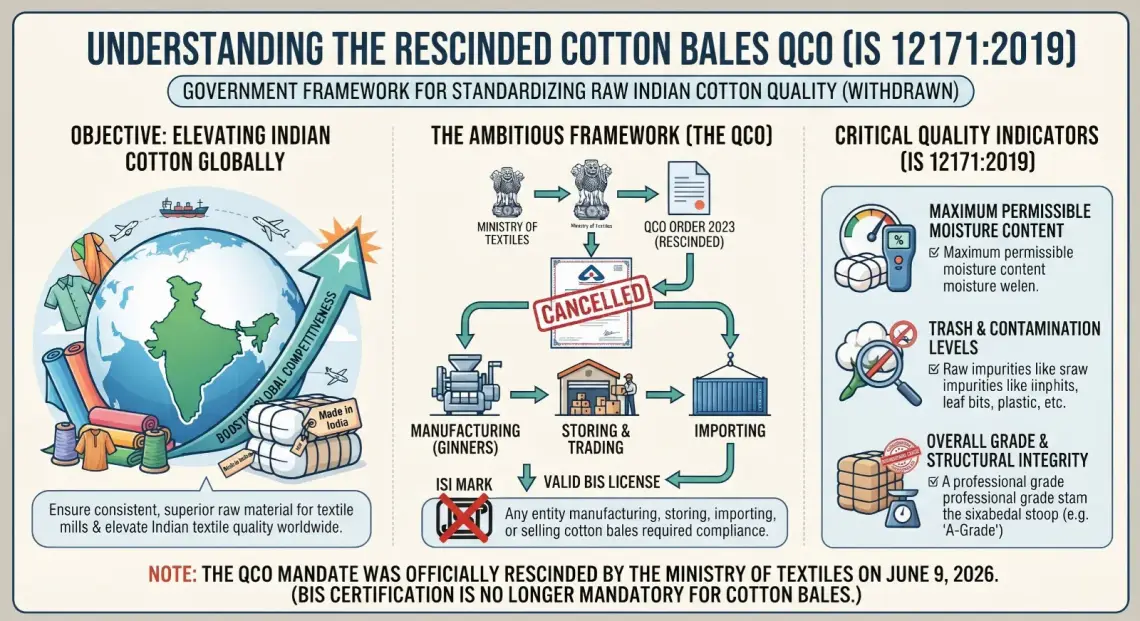
The governing standard, IS 12171:2019, set forth rigorous testing parameters for critical quality indicators, including:
- Maximum permissible moisture content
- Trash and contamination levels
- Overall grade and structural integrity of the bales
The government's primary objective was to elevate the global competitiveness of Indian cotton. By enforcing strict quality parameters at the ginning stage, the Ministry hoped to ensure that downstream textile mills received a consistent, superior grade of raw material, thereby boosting the quality of Indian garments and textiles on the international market. However, the timeline for enforcement faced immediate and sustained roadblocks.
Why Was the QCO Withdrawn?
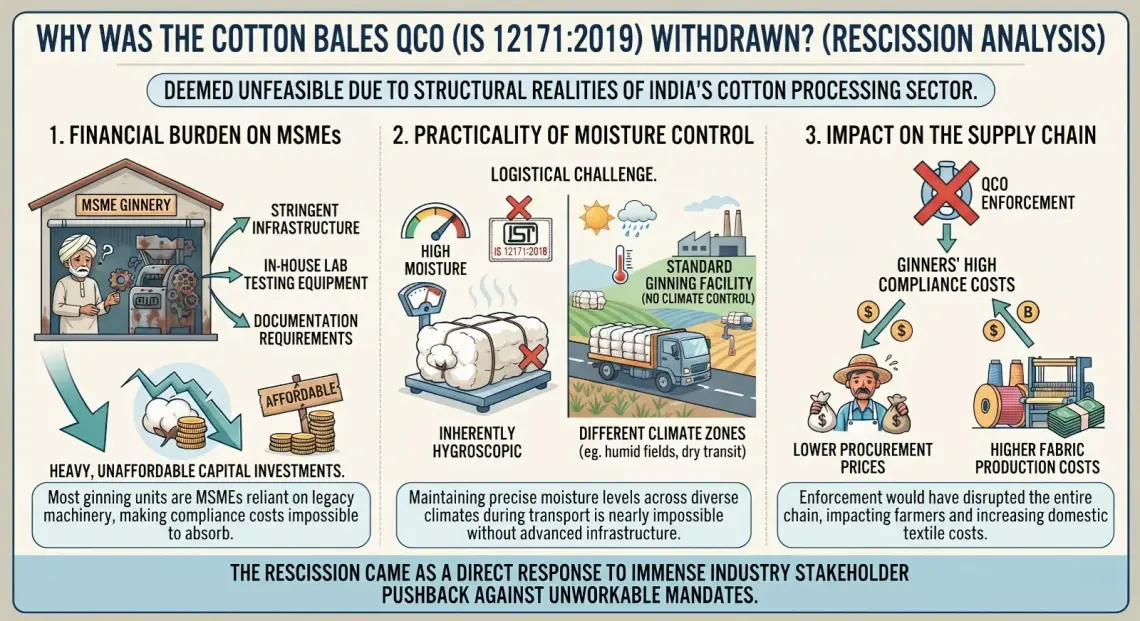
Despite multiple deadline extensions over the past few years, the implementation of the QCO was ultimately deemed unfeasible due to the structural realities of India's cotton processing sector. The rescission comes as a direct response to immense pushback from industry stakeholders, primarily for the following reasons:
Financial Burden on MSMEs
The vast majority of ginning and pressing factories in India operate as Micro, Small, and Medium Enterprises (MSMEs). These units frequently rely on legacy machinery and traditional processing methods. Complying with the stringent infrastructure, in-house laboratory testing, and documentation requirements of the BIS standard would have forced these small-scale operators to make heavy, unaffordable capital investments.
Practicality of Moisture Control
Controlling moisture content to the exact specifications of IS 12171:2019 proved to be a severe logistical challenge. Because cotton is inherently hygroscopic (it absorbs moisture from the air), maintaining precise moisture levels across different climate zones and transport routes without advanced, expensive climate-controlled infrastructure is incredibly difficult for standard ginning facilities.
Impact on the Supply Chain
Industry bodies heavily petitioned the government, arguing that enforcing the QCO would disrupt the entire supply chain. If ginners were forced to absorb high compliance costs, those expenses would inevitably be passed down to the farmers in the form of lower procurement prices for raw cotton, or passed up to textile mills, increasing the cost of domestic fabric production.
What This Means for Importers and the Industry
The immediate withdrawal of the QCO completely alters the current compliance requirements for the industry:
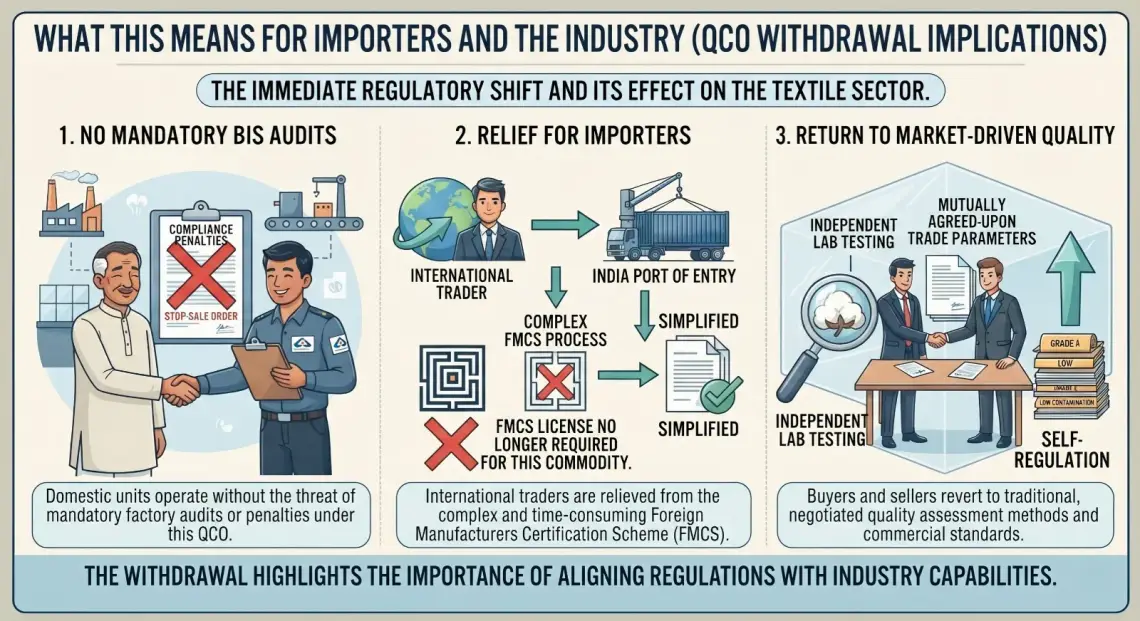
- No Mandatory BIS Audits: Domestic ginners and pressing units can operate without the looming threat of mandatory factory audits, compliance penalties, or stop-sale orders from the Bureau of Indian Standards regarding this specific QCO.
- Relief for Importers: International traders and businesses importing cotton bales into India are no longer required to navigate the complex and time-consuming Foreign Manufacturers Certification Scheme (FMCS) to obtain a BIS license for this commodity.
- Return to Market-Driven Quality: The market will now revert to its traditional quality assessment methods. Buyers and sellers will continue to rely on mutually agreed-upon trade parameters, independent lab testing, and established commercial standards rather than a mandatory government certification mark.
While the government's foundational intention to improve the quality of Indian cotton remains valid, the withdrawal of the Cotton Bales QCO highlights the critical importance of aligning regulatory frameworks with the actual ground-level capabilities of the industry. For now, the textile sector will continue to self-regulate without the heavy burden of mandatory BIS certification.