Did you Know
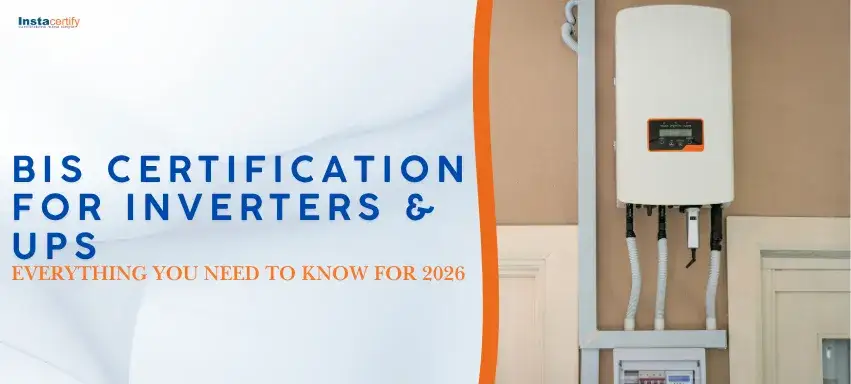
BIS Certification for Inverters & UPS: Everything You Need to Know for 2026
Uninterruptible Power Systems (UPS) and inverters have become an essential part of modern electrical and electronic infrastructure. They are used to maintain power continuity for computers, networking equipment, medical systems, industrial machinery, communication equipment, household appliances and other critical loads.
Because these products handle electrical power and may incorporate batteries, power conversion circuits and protective systems, their safety cannot be treated as a simple product-quality issue. Regulatory compliance is an important part of bringing UPS and applicable inverter products into the Indian market.
In India, certain UPS/inverter products fall under the Bureau of Indian Standards (BIS) Compulsory Registration Scheme (CRS). BIS identifies UPS/Inverters under the applicable electronics and IT goods framework, with the relevant safety standard being IS 16242 (Part 1).
For businesses manufacturing or importing these products, understanding the applicable standard, product classification, testing requirements and BIS registration process before commercialisation can prevent avoidable compliance delays.
What is BIS Certification for UPS and Inverters?
BIS is India's National Standards Body and is responsible for establishing standards and operating conformity-assessment schemes for various products.
For products covered under the applicable compulsory registration framework, the manufacturer must demonstrate that the product conforms to the prescribed Indian Standard through testing at an appropriate BIS-recognized laboratory and subsequently complete the applicable BIS registration process.
For UPS and applicable inverters, the relevant product category is identified in the BIS compulsory registration framework as:
UPS/Inverters — IS 16242 (Part 1)
The BIS Scheme-II listing identifies UPS/Inverters within the compulsory registration framework.
It is important to understand that BIS registration is not simply a document-based approval. Product testing, technical documentation, manufacturer information and the actual configuration of the product all play a role in determining whether an application can proceed successfully.
Which Standard Applies to UPS and Inverters?
The principal standard relevant to UPS/inverter products under the BIS registration framework is:
IS 16242 (Part 1)
Uninterruptible Power Systems (UPS) — Part 1: Safety Requirements
BIS documentation describes the standard as covering UPS systems with an electrical energy storage device in the DC link, with the primary function of maintaining continuity of an alternating power source. The scope includes different installation configurations such as movable, stationary, fixed and built-in UPS systems, subject to the applicable conditions of the standard.
A significant update: IS 16242 (Part 1):2025
Manufacturers should pay particular attention to the 2025 revision.
BIS laboratory records currently show IS 16242 (Part 1):2025 — Uninterruptible power systems UPS Part 1 Safety requirements (First Revision) being used for testing. Current BIS records also show CRS samples being tested against the 2025 edition during September and October 2026.
Therefore, businesses should not automatically rely on older references to IS 16242 (Part 1):2014 when preparing a new application. The applicable edition and transition requirements should be verified against the latest BIS requirements at the time of application.
Does Every Inverter Require BIS Certification?
This is one of the most common questions asked by manufacturers and importers.
The answer is not necessarily based on the word "inverter" alone.
The applicability of BIS requirements depends on factors such as:
- Product type
- Intended application
- Electrical configuration
- Rating
- Applicable BIS notification/order
- Applicable Indian Standard
- Product design and construction
- Whether the product falls within the notified compulsory category
The BIS compulsory registration framework specifically identifies UPS/Inverters under the applicable product category.
Therefore, manufacturers should not assume that every device marketed as an "inverter" automatically follows exactly the same certification route.
A technical review of the product should ideally be performed before selecting the certification route.
UPS vs Inverter: Are They the Same for BIS Purposes?
Although the terms UPS and inverter are sometimes used interchangeably in commercial markets, they are not necessarily identical from a technical or regulatory perspective.
UPS
A UPS is primarily designed to provide continuity of power to connected equipment when the normal power source is interrupted or falls outside specified conditions.
Typical applications include:
- Computers
- Servers
- Data centres
- Networking systems
- Medical equipment
- Security systems
- Industrial control systems
- Communication equipment
Inverter
An inverter generally converts DC electrical energy into AC power. Depending on its design, it may form part of a backup power system, solar energy system, home power solution or other electrical installation.
Some inverter products can fall within the UPS/inverter category covered by the applicable BIS requirements, while other products may need to be assessed against a different regulatory framework.
The product's actual technical characteristics matter more than the marketing name printed on the box.
Why is BIS Compliance Important for UPS and Inverters?
UPS and inverter products can involve several safety considerations, including:
- Electric shock hazards
- Short-circuit conditions
- Overload conditions
- Abnormal operation
- Energy-storage protection
- Electrical isolation
- Earthing and bonding
- Fire and thermal hazards
- Enclosure-related safety
- Marking and safety instructions
The applicable BIS testing framework addresses safety-related characteristics rather than simply checking whether the product turns on and supplies power.
BIS's official testing documentation for UPS/inverters includes areas such as protection against shock and energy hazards, protective earthing and bonding, AC/DC power isolation, protection against abnormal conditions, power interfaces and marking/instructions.
This is why certification should ideally be considered during the product-design stage, rather than after manufacturing has already been completed.
BIS Certification Process for UPS and Inverters
The overall process can be understood in the following stages.
1. Product and Standard Assessment
The first step is to establish:
- Exact product category
- Model numbers
- Rated capacity
- Input/output specifications
- Phase configuration
- Battery/energy-storage arrangement
- Intended application
- Manufacturer details
- Applicable BIS standard and current edition
This stage is particularly important because an incorrect product classification can result in unsuitable testing or unnecessary rework.
2. Technical Document Review
Before testing begins, the manufacturer should prepare the relevant technical information.
Depending on the product and application, this may include:
- Product datasheet
- Technical specifications
- Circuit diagrams
- Block diagrams
- User manual
- Product photographs
- Model/variant details
- Rating label artwork
- Critical component information
- Battery details
- Component approvals/certificates, where applicable
- Manufacturing details
- Factory information
- Existing test reports, where relevant
The exact documentation should be determined based on the product and current BIS requirements rather than using a generic checklist for every UPS.
3. Selection of Appropriate Testing Laboratory
The product needs to be tested through an appropriate laboratory having the required scope for the applicable Indian Standard.
This is an area where manufacturers should exercise caution.
A laboratory may have experience with an older edition of a standard while another laboratory may have the scope for the newer edition.
For example, BIS's current laboratory database shows laboratories with scopes for IS 16242 (Part 1):2025, while some records continue to display the 2014 edition.
Therefore, laboratory selection should be based on the current applicable standard, product configuration and available scope, not simply on the lowest quoted testing price.
4. Product Testing
The sample is submitted for the applicable tests.
Depending on the product configuration and applicable edition of the standard, testing may address areas such as:
Electrical safety
The product may be evaluated for relevant electrical safety conditions, including protection against electric shock and energy hazards.
Abnormal and fault conditions
The product may be examined under specified abnormal operating or fault conditions to determine whether appropriate protection is provided.
Short-circuit and overload protection
Protection mechanisms are important because UPS and inverter systems can handle significant electrical energy.
Protective earthing and bonding
The relevant safety provisions for protective earthing and bonding are evaluated where applicable.
Isolation
The design may need to demonstrate appropriate isolation between relevant electrical circuits.
Thermal and fire-related safety
The product's construction and materials may be evaluated against applicable thermal and fire hazards.
Marking and instructions
Product markings, ratings, warnings and user instructions also form part of the compliance assessment.
The BIS uniform test-report format for UPS/inverters specifically identifies testing against IS 16242 (Part 1) and provides the framework for documenting the test item, manufacturer, model/type reference, ratings and applicable test specification.
5. Test Report Review
Once testing is completed, the test report should be carefully reviewed.
A good compliance review should verify:
- Manufacturer name
- Factory address
- Brand/trademark
- Model numbers
- Ratings
- Applicable standard and edition
- Test results
- Test scope
- Any exclusions
- Supporting technical documents
- Consistency between the report and BIS application
This step is often underestimated.
A technically successful test can still create problems during registration if the model information, manufacturer details or supporting documentation do not correspond correctly.
6. BIS Application / Registration
After the applicable testing and documentation requirements are completed, the manufacturer can proceed with the relevant BIS registration process.
The application should accurately reflect the product that was tested.
Particular attention should be given to:
- Manufacturer details
- Manufacturing address
- Brand
- Model/series
- Product ratings
- Test report details
- Required declarations
- Technical documentation
- Applicable marking requirements
The registration should not be treated as a generic approval that automatically covers every product manufactured by a company.
7. BIS Registration and Marking
Once the applicable registration requirements are successfully completed, the manufacturer can follow the prescribed BIS requirements for product marking and registration details.
The marking should correspond to the applicable BIS scheme and current requirements.
Manufacturers should also ensure that the information appearing on:
Product → Packaging → User Manual → Technical Documents → BIS Application
remains consistent.
Inconsistencies between these documents can create unnecessary compliance questions.
Documents Generally Required for UPS/Inverter BIS Registration
The exact documentation varies according to the product and application, but manufacturers should generally be prepared with information such as:
Document / Information | Purpose |
Manufacturer details | Identifies the legal manufacturing entity |
Factory address | Establishes manufacturing location |
Product datasheet | Defines technical characteristics |
User manual | Provides operating and safety information |
Circuit/block diagram | Helps understand product construction |
Model list | Identifies products covered |
Product photographs | Supports product identification |
Rating label | Confirms product markings |
Critical component information | Supports safety assessment |
Test report | Demonstrates conformity with applicable standard |
Authorisation documents | Required where applicable |
Trademark/brand information | Establishes brand identification |
Important: This is an indicative list, not a universal BIS document checklist. Requirements can change depending on the product, applicant structure and applicable BIS scheme.
Can Multiple UPS/Inverter Models Be Covered Under One BIS Registration?
Potentially, yes—but this should never be assumed simply because the products have the same brand.
Different models may have differences in:
- Rated power
- Circuit design
- PCB
- Transformer
- Battery configuration
- Enclosure
- Components
- Input/output characteristics
- Safety-critical construction
BIS scope and model grouping therefore need to be evaluated based on the actual product configuration and applicable requirements.
A series approach may be possible in appropriate cases, but the manufacturer should determine the permissible model coverage based on BIS requirements rather than adding every commercially similar model automatically.
What About Battery Certification?
UPS and inverter systems often contain batteries or other energy-storage systems.
This creates an important compliance distinction:
Certification of the UPS/inverter does not automatically mean that every battery used inside the system is independently compliant with every applicable battery regulation or standard.
The battery technology, construction, application and regulatory requirements should be assessed separately where applicable.
For example, BIS's current laboratory database separately identifies standards for certain secondary cells and batteries, including IS 16046 (Part 2):2018 for lithium systems for portable applications.
Therefore, manufacturers should review the complete product architecture rather than considering the UPS certification in isolation.
Common Mistakes Manufacturers Should Avoid
1. Selecting the standard based only on an old quotation
Standards can be revised.
The current BIS database demonstrates that IS 16242 (Part 1):2025 is now actively being used for testing.
Always verify the applicable edition before starting a new project.
2. Assuming the lowest testing quotation is the best option
Testing charges can vary significantly depending on:
- Laboratory
- Product capacity
- Testing scope
- Standard edition
- Test configuration
- Applicable exclusions
BIS's current laboratory records show materially different testing scopes and charges for IS 16242 (Part 1):2025.
The correct question is not simply:
"Which laboratory is cheapest?"
It is:
"Which laboratory has the appropriate current scope for my exact product?"
3. Sending a sample without reviewing the design
If a product fails testing because of a design issue, the manufacturer may have to modify the product and repeat some testing.
A pre-testing technical review can help identify potential problems before the sample reaches the laboratory.
4. Treating all models as identical
Two products may look almost identical externally but have different internal components or electrical configurations.
Model grouping should therefore be technically justified.
5. Ignoring the rating label and manual
The label and user documentation are part of the product's compliance presentation.
Incorrect ratings, inconsistent model numbers or incomplete safety information can create avoidable issues.
How Long Does BIS Certification Take?
There is no single universal timeline that can responsibly be promised for every UPS or inverter project.
The actual duration can depend on:
- Laboratory availability
- Product complexity
- Testing requirements
- Sample readiness
- Test failures/retesting
- Documentation quality
- BIS application processing
- Clarifications raised during the process
- Model/series scope
For this reason, manufacturers should be cautious about consultants who guarantee a fixed approval period without first reviewing the product.
A more practical approach is to establish a project timeline after the product, applicable standard and testing route have been assessed.
How Much Does BIS Certification for UPS/Inverters Cost?
The total project cost generally consists of multiple components rather than one single "BIS fee."
Depending on the case, costs can involve:
- Testing charges
- BIS government/statutory fees
- Consultancy or compliance support
- Sample transportation
- Modification/retesting costs, if required
- Additional model/series-related costs, where applicable
Testing charges are not necessarily identical across laboratories. Current BIS laboratory records for IS 16242 (Part 1):2025 show different testing charges depending on the laboratory and scope.
Therefore, it is better to prepare a product-specific quotation instead of publishing a misleading fixed price on a website.
Why Choose a Compliance Consultant?
A manufacturer can approach the certification process directly, but a specialist compliance consultant can help coordinate the technical and administrative stages.
A competent consultant can assist with:
- Product classification
- Applicable standard identification
- Technical document review
- Laboratory coordination
- Sample submission
- Test report review
- BIS application preparation
- Clarification management
- Model/series assessment
- Certification documentation
- Post-registration support
The consultant's role should be to facilitate compliance, not to bypass testing or promise approval irrespective of the product's actual performance.
BIS Certification for Imported UPS and Inverters
Importers should pay particular attention to the distinction between the brand owner/importer and the actual manufacturer.
BIS compliance generally needs to be linked appropriately to the manufacturing entity and the product being assessed.
Before importing a UPS or inverter into India, businesses should verify:
- Who is the actual manufacturer?
- Where is the product manufactured?
- Which brand will appear on the product?
- Which models are being imported?
- Which Indian Standard applies?
- Is the required BIS registration already available?
- Does the existing registration cover the intended models and manufacturing location?
Importing first and attempting to resolve certification later can create commercial and regulatory complications.
Frequently asked questions
Is BIS certification mandatory for UPS in India?
UPS products falling under the applicable compulsory registration framework are subject to the prescribed BIS requirements. BIS identifies UPS/Inverters under the relevant registration scheme with IS 16242 (Part 1) as the applicable standard.
What is the BIS standard for UPS?
The relevant standard is IS 16242 (Part 1). The current BIS ecosystem includes the 2025 first revision, while older references may mention the 2014 edition.
What is the BIS standard for inverter?
Certain UPS/inverter products fall under IS 16242 (Part 1) under the applicable compulsory registration framework. However, the exact applicability should be confirmed from the product's technical characteristics and current BIS requirements.
Can a single BIS registration cover multiple models?
Potentially, depending on the applicable requirements and whether the models qualify for inclusion under the same registration scope. Model grouping should be technically assessed rather than assumed.
Is battery certification separate from UPS certification?
It can be. The applicable battery requirements depend on the battery technology and intended application. UPS compliance should therefore not automatically be considered equivalent to independent battery compliance.
Can an overseas manufacturer obtain BIS registration?
Yes, applicable BIS registration routes can involve overseas manufacturers, but the exact requirements depend on the applicable scheme and applicant/manufacturer structure.
Is testing compulsory?
Where the applicable BIS compulsory registration route requires conformity testing, testing through the appropriate laboratory is a fundamental part of the process.