Did you Know
MSDS for Exports: The Certification Your Shipment Cannot Fly Without

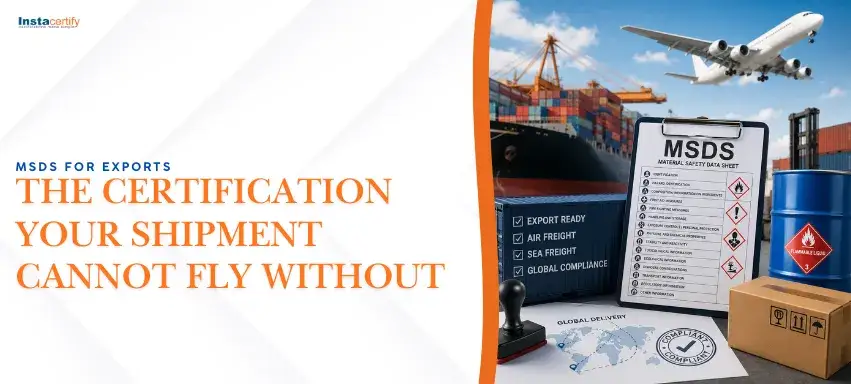
If you have ever had a courier, freight forwarder or airline email you asking for "the MSDS of your product" — usually the day before pickup — you already know how quickly this one document can hold up an entire consignment.
This guide explains, in plain language, what an MSDS is, what it contains, why it matters so much in export and air freight, who is allowed to prepare one, and how to get it done without losing a week.
What is an MSDS, and Why Do Exporters Need One?
MSDS stands for Material Safety Data Sheet. It is a structured technical document that tells anyone handling your product three things:
- What is inside it
- What can go wrong with it — fire, corrosion, toxicity, reaction, environmental damage
- What to do about it — how to store it, ship it, handle a spill, and give first aid
Think of it as the product's safety passport. It travels with the goods and answers the questions a warehouse worker, a pilot, a customs officer or an emergency responder would need answered in a hurry.
A quick note on the name
You will see two terms used interchangeably:
- MSDS — the older term, still widely used in India, the Middle East and Asia
- SDS (Safety Data Sheet) — the modern, globally harmonised term
Since the UN introduced the Globally Harmonized System of Classification and Labelling of Chemicals (GHS), the document was standardised into a fixed 16-section format and renamed SDS. Regulators in the EU, US, UK, Japan, Korea and elsewhere now formally use "SDS". In practice, when your buyer or airline says "send the MSDS", they mean a GHS-format Safety Data Sheet.
It is a declaration, not a certificate
This is worth being clear about, because the phrase "MSDS certification" causes real confusion.
An MSDS is not a licence issued by a government department, and there is no worldwide authority that stamps and approves it. It is a manufacturer's or supplier's declaration, prepared by a competent person, supported by test data and raw-material information, and issued on the responsibility of the company placing the product on the market.
What people usually mean by "MSDS certification" is: a properly compiled, GHS-compliant SDS issued by a recognised technical body or laboratory, backed by test reports where required. That is what buyers and airlines accept — and that is what this article covers.
What people usually mean by "MSDS certification" is: a properly compiled, GHS-compliant SDS issued by a recognised technical body or laboratory, backed by test reports where required. That is what buyers and airlines accept — and that is what this article covers.
Inside an MSDS for Exports: The 16 Mandatory Sections
Under GHS, every compliant SDS follows the same 16-section sequence. Same order, every country, every product. That consistency is the whole point.
# | Section | What it covers |
1 | Identification | Product name, supplier details, recommended use, emergency contact |
2 | Hazard identification | GHS classification, pictograms, signal word, hazard and precautionary statements |
3 | Composition / ingredients | Chemical identity, CAS numbers, concentration ranges |
4 | First-aid measures | What to do on inhalation, skin/eye contact, ingestion |
5 | Fire-fighting measures | Suitable extinguishing media, special hazards, protection for responders |
6 | Accidental release measures | Spill containment and clean-up |
7 | Handling and storage | Safe handling practice, incompatible storage conditions |
8 | Exposure controls / PPE | Exposure limits, engineering controls, protective equipment |
9 | Physical and chemical properties | Appearance, odour, pH, flash point, boiling point, density, solubility |
10 | Stability and reactivity | Conditions and materials to avoid, hazardous decomposition |
11 | Toxicological information | Acute and chronic health effects, routes of exposure |
12 | Ecological information | Aquatic toxicity, persistence, bioaccumulation |
13 | Disposal considerations | Safe disposal of product and packaging |
14 | Transport information | UN number, proper shipping name, hazard class, packing group, marine pollutant status |
15 | Regulatory information | Applicable safety, health and environmental regulations |
16 | Other information | Date of issue, revision number, abbreviations, references |
Section 14 is the one your freight forwarder cares about most. It is what decides whether your goods travel as ordinary cargo or as dangerous goods — and that single line changes your packaging, labelling, documentation and freight cost.
Forms of MSDS an Exporter May Be Asked For
Buyers and logistics providers often ask for the SDS alongside related documents. Knowing the difference saves time:
- GHS / REACH-format SDS — the 16-section document, in the language of the destination country. The EU requires it in the official language of each member state where the product is sold.
- Non-DG Declaration (Non-Dangerous Goods Certificate) — a short letter confirming the goods are not restricted for air or sea transport. Airlines frequently want this in addition to the SDS.
- DGD (Dangerous Goods Declaration / Shipper's Declaration) — required when the product is classified as dangerous goods, prepared per IATA or IMDG rules.
- UN 38.3 Test Summary — mandatory for lithium batteries and any product containing them, in addition to the SDS.
- Product-specific supporting reports — flash point, pH, corrosivity or toxicity test reports, where the classification cannot be established from existing data.
Which Products Need an MSDS for Export?
This is where most exporters get tripped up, because the legal requirement and the commercial requirement are two different things.
Legally, GHS-based rules (REACH, OSHA HazCom and their equivalents) apply to substances and mixtures — things you can pour, spray, spread or dissolve. Finished manufactured goods are treated as "articles" and are largely outside that scope.
Commercially, it does not matter. Airlines, couriers, customs officers and importers ask for an MSDS on almost anything, and the honest answer to "do I need one?" is usually yes, in some form — even if that form is a non-hazardous declaration rather than a full 16-section sheet.
Here is how the major categories break down.
MSDS for Export of Chemicals and Formulations — Always Required
This is the core, unambiguous case. Industrial chemicals, solvents, acids, alkalis, paints, inks, coatings, adhesives, resins, lubricants, greases, dyes, pigments, cleaning agents, disinfectants, fertilisers, pesticides and agrochemicals all require a full GHS-format SDS by law in virtually every destination market.
If your product is a chemical or a mixture of chemicals, there is no debate — you need a proper SDS, and the classification must be defensible.
MSDS for Export of Cosmetics and Personal Care Products
Finished cosmetic products are specifically exempt from the REACH SDS obligation in the EU, because they are regulated separately under the Cosmetic Products Regulation. Similar carve-outs exist elsewhere.
But that exemption applies to product safety law, not transport law. A perfume, deodorant, hair spray, nail polish remover, sanitiser or alcohol-based toner is a flammable liquid the moment it enters a cargo terminal, and the airline will not move it without transport classification data.
Meanwhile, cosmetic raw materials — surfactants, preservatives, fragrance concentrates, essential oils, actives — do require a full SDS, and your formulator will need those from your suppliers anyway.
Practical position: cosmetics need an SDS or a non-DG declaration for shipping, near enough always.
MSDS for Export of Food Products and Food Ingredients
Food in its finished, consumer-ready form is excluded from GHS/REACH SDS requirements. A carton of packaged biscuits, rice, tea or ready-to-eat snacks does not have a "hazard classification" in any meaningful sense.
Despite that, importers and freight forwarders routinely ask for an MSDS for food shipments. What they actually need is proof the goods are non-hazardous and safe to carry. The correct documents are usually:
- A non-hazardous / Non-DG declaration confirming the goods are not restricted for air or sea transport
- A Certificate of Analysis (CoA) with the composition and quality parameters
- A food-grade / composition declaration for customs and health authorities
However, several food-adjacent products do need a genuine SDS:
- Food additives, preservatives and processing aids — citric acid, sodium benzoate, sulphites, phosphates
- Food colours and dyes
- Flavour concentrates and essential oils — many are flammable
- Spice oleoresins and extracts, often in solvent carriers
- Nutraceutical and supplement raw materials in powder or concentrate form
- Enzymes, cultures and fermentation inputs
- Food-contact cleaning and sanitation chemicals
- Dry ice used as a coolant — that is UN 1845, Class 9, and needs declaring in its own right
Rule of thumb: finished food, declaration. Food ingredient or additive, full SDS.
MSDS for Export of Machinery and Industrial Equipment
A pump, a motor, a compressor, a CNC machine, an industrial oven — as articles, none of these needs an SDS for the metal and plastic they are made of.
What triggers the requirement is what is inside them:
- Residual lubricating oil, hydraulic fluid or gearbox oil
- Coolants, antifreeze and refrigerant gases
- Fuel residue in engines and generator sets
- Batteries — including small backup cells on control boards
- Paints, sealants and adhesives applied in manufacture
Airlines and forwarders will ask for the SDS of each of those fluids, plus confirmation of whether the equipment has been drained. Machinery with internal combustion engines or fuel cells is itself regulated for transport (UN 3528 / 3529 / 3530, depending on fuel type).
Practical position: supply the SDSs for the fluids and batteries, plus a drained-and-purged declaration for the machine. That combination clears most shipments.
MSDS for Export of Electronics and Finished Articles
Cables, PCBs, appliances, tools and consumer electronics are articles. On their own they need no SDS, though buyers often request one for their files and a non-DG declaration will satisfy them.
The exception, and it is a large one, is batteries — which deserve their own section below.
Why an MSDS Matters So Much in Export
1. It is a legal requirement in most destination markets
Depending on where you ship, an SDS is mandated by law:
- European Union — REACH Regulation (EC) 1907/2006, Annex II, with classification under the CLP Regulation
- United States — OSHA Hazard Communication Standard, 29 CFR 1910.1200
- India — Manufacture, Storage and Import of Hazardous Chemical Rules, 1989
- UK, Canada, Australia, Japan, Korea, China, GCC — each with its own GHS-aligned implementation
Your importer cannot legally receive, store or resell many products without one on file.
2. Customs and buyers ask for it as standard
For chemicals, cosmetics, paints, adhesives, lubricants, batteries, cleaning products and countless others, the SDS is now a routine part of the document set alongside the invoice, packing list and certificate of analysis. Missing it means detained cargo and demurrage charges.
3. It protects you commercially and legally
A properly written SDS documents that you disclosed the hazards. If something goes wrong downstream, that record matters.
MSDS for Air Freight Exports: Where It Becomes Non-Negotiable
Air cargo is the strictest link in the chain, and for an obvious reason — an aircraft in flight cannot pull over.
Air transport of dangerous goods is governed by the ICAO Technical Instructions, implemented commercially through the IATA Dangerous Goods Regulations (DGR), which every airline follows. Under these rules, the carrier is responsible for knowing exactly what is in the hold.
So who asks you for the MSDS?
- The airline — before accepting the booking
- The freight forwarder / consolidator — to classify and document the cargo
- The courier (DHL, FedEx, UPS, Aramex and others) — as part of shipment screening
- Ground handling and warehouse operators — for storage segregation
- Customs, at both ends — for clearance and classification
- Your buyer — for their own regulatory and warehouse compliance
Products that almost always trigger the request:
- Perfumes, deodorants, sanitisers and anything alcohol-based (flammable liquid, Class 3)
- Aerosols and pressurised containers (Class 2)
- Paints, inks, thinners, adhesives, resins
- Lithium-ion and lithium-metal batteries, and devices containing them (Class 9)
- Cosmetics, essential oils, hair oils and personal-care formulations
- Cleaning chemicals, disinfectants, acids and alkalis
- Powders, pigments, dyes, fertilisers and agrochemicals
- Magnets, dry ice, and any temperature-sensitive or reactive goods
Here is the part exporters often miss: even if your product is completely safe, you still need the SDS to prove it. A non-hazardous cosmetic cream and a flammable solvent go through the same screening. The document is how the airline tells them apart. "It's just a face cream" is not an accepted answer at the cargo terminal.
MSDS for Export of Lithium Batteries — and Why UN 38.3 Is Also Required
If you are exporting lithium batteries — or any product with a lithium battery inside it — this is the single most important section of this article.
Lithium batteries are Class 9 dangerous goods. They have caused in-flight fires, and the aviation industry treats them accordingly. For these shipments, an MSDS is necessary but not sufficient. You must also furnish a UN 38.3 Test Summary.
What Is the UN 38.3 Test?
UN 38.3 is a section of the UN Manual of Tests and Criteria, Part III, Sub-section 38.3. It is the mandatory transport safety qualification for every lithium cell and battery moved by air, sea or road — anywhere in the world.
The battery must pass a defined series of abuse tests:
Test | What it simulates |
T1 — Altitude simulation | Low-pressure conditions in an unpressurised aircraft hold |
T2 — Thermal test | Repeated extreme hot/cold cycling |
T3 — Vibration | Vibration during transport |
T4 — Shock | Impact and rough handling |
T5 — External short circuit | A short across the terminals |
T6 — Impact / Crush | Physical deformation of a cell |
T7 — Overcharge | Charging beyond design limits (rechargeable batteries) |
T8 — Forced discharge | Discharge beyond design limits (cells) |
T1 to T5 apply to both cells and batteries. T6 and T8 apply to cells; T7 applies to rechargeable batteries.
The UN 38.3 Test Summary the Shipper Must Furnish
Here is the requirement that catches exporters out most often.
Since 1 January 2020, manufacturers and distributors of lithium cells and batteries must make available a UN 38.3 Test Summary for every cell and battery type they supply. That obligation flows down the chain — which means you, as the shipper, must be able to produce it on demand. Airlines, forwarders and couriers now ask for it as standard before accepting the booking.
The Test Summary is a specific document with prescribed contents:
- Name of the cell/battery manufacturer
- Contact details — address, phone, email, website
- Name of the testing laboratory, with its contact details
- Test report number, and the date of the report
- Description of the cell or battery — lithium ion or lithium metal, mass, watt-hour rating or lithium content, physical description, model number
- List of the tests conducted and the results
- Reference to the assembled battery testing requirements, where applicable
- The revision/edition of the UN Manual of Tests and Criteria the testing was performed against
- Signature, with name and title of the signatory
A test report is not a substitute for the Test Summary, and the Test Summary is not a substitute for the SDS. You need both.
Full Document Set for a Lithium Battery Export Shipment
Document | Purpose |
MSDS / SDS | Composition, hazards, handling, emergency response, transport classification |
UN 38.3 Test Summary | Proof the cell/battery passed transport safety qualification |
Shipper's Declaration for Dangerous Goods (DGD) | Required for Section IA / IB consignments |
Lithium battery mark or Class 9 hazard label | Applied to the outer packaging |
Packing / drop-test declaration | Confirms 1.2 m drop test compliance where required |
Air Waybill with the correct DG statement | Carrier documentation |
Getting the UN Number Right for Export
Your classification depends on chemistry and how the battery is packed:
- UN 3480 — Lithium ion batteries shipped on their own
- UN 3481 — Lithium ion batteries contained in, or packed with, equipment
- UN 3090 — Lithium metal batteries shipped on their own
- UN 3091 — Lithium metal batteries contained in, or packed with, equipment
- UN 3536 — Lithium batteries installed in a cargo transport unit
Two further points that regularly cause rejected shipments:
- State of charge. Lithium ion cells and batteries shipped alone under UN 3480 must be at a state of charge not exceeding 30% of rated capacity when offered for air transport.
- Watt-hour marking. Each battery must be marked with its watt-hour rating. Cells above 20 Wh and batteries above 100 Wh fall into the stricter handling sections (IA / IB) with full DGD requirements, rather than the lighter Section II regime.
Products That Count as Lithium Battery Shipments
The requirement follows the cell, not the product name. It applies to power banks, laptops, tablets, phones, e-bikes and e-scooters, cordless power tools, drones, IoT gateways and sensors, medical devices, wearables, LED emergency lights, hearing aids, toys, GPS trackers, and any equipment with a coin cell or backup battery on its control board.
If it holds charge, assume you need a UN 38.3 Test Summary for it.
Who Can Prepare an MSDS for Export?
There is no single licence for SDS authoring. What the regulations require — REACH Annex II states this explicitly — is that the SDS be compiled by a competent person who keeps their knowledge current, and that the content be accurate and defensible.
In practice, a reliable SDS comes from one of these:
1. The manufacturer's own regulatory or R&D team
Workable if you have in-house chemists who understand GHS classification. Most SMEs do not.
2. A testing laboratory
Where the classification depends on measured properties — flash point, pH, corrosivity, acute toxicity, aquatic toxicity — an ISO/IEC 17025 accredited laboratory generates the underlying test data. The lab supplies the numbers; the SDS is then compiled around them.
3. A regulatory compliance consultancy
This is the most common route for exporters. The consultant collects your formulation and raw-material data, applies GHS classification logic, arranges any testing that is genuinely required, and issues the finished 16-section document in the correct format and language.
What a competent preparer actually does:
- Reviews your formulation, CAS numbers and concentration ranges
- Pulls hazard data from raw-material SDSs and recognised toxicological databases
- Applies GHS classification rules to the mixture — including cut-off and additivity calculations
- Determines UN number, proper shipping name, class and packing group for Section 14
- Commissions physical testing only where existing data is insufficient
- Formats to the destination country's requirements and language
- Signs and dates it, with a revision number
How long is it valid? An SDS has no fixed expiry, but it must be reviewed and revised whenever the formulation, classification or applicable regulation changes. Good practice — and what most buyers expect — is a documented review at least every three years.
How Instacertify Makes MSDS for Exports Simple
Most exporters do not have a chemist on staff, and they usually discover they need an SDS at the worst possible moment — when the shipment is already booked.
Instacertify Labs Private Limited works with importers, manufacturers and exporters across India and internationally to turn compliance documentation from a bottleneck into a routine step.
What we do for MSDS/SDS:
- Fast turnaround. For most non-hazardous and standard formulations where the composition data is available, we issue a complete GHS-format 16-section SDS in a very short window — usually within a working day or two, not weeks.
- Correct format, correct market. EU (REACH/CLP), US (OSHA HazCom), UK, GCC, ASEAN or Indian format, prepared for the market you are actually shipping to.
- Air-freight-ready classification. We complete Section 14 properly and, where applicable, issue the accompanying Non-DG Declaration that airlines and couriers ask for — so your forwarder gets everything in one go.
- Testing where it is genuinely needed. Where classification requires measured data, we arrange testing through ISO/IEC 17025 accredited partner laboratories, selected for the target market and turnaround. We do not push you into tests you do not need.
- Lithium battery shipments handled end to end. We prepare the SDS, arrange UN 38.3 testing and the Test Summary through accredited partner laboratories, and confirm your UN number, packing instruction and labelling — so the whole file goes to the airline in one piece instead of in three separate emails a week apart.
- The right document for your product type. Chemicals get a full 16-section SDS. Food and finished consumer goods usually need a non-hazardous declaration and CoA rather than a hazard sheet. Machinery needs fluid SDSs plus a drained-and-purged declaration. We tell you which one applies before you pay for anything.
- Minimal effort from you. Send the product details, formulation or ingredient breakdown, and your raw-material data sheets. We handle the classification logic and the drafting.
- One point of contact for the wider file. MSDS rarely travels alone. If your consignment also needs BIS, CE, EPR, RoHS, REACH, CDSCO, FSSAI, WPC, CE or ISO documentation, it is handled by the same team rather than five different vendors.
In Short : an MSDS is not a formality you can improvise the night before pickup, and it is not something a template downloaded off the internet will survive scrutiny on. It is a technical document with legal weight — but with the right formulation data and the right people preparing it, it is also one of the quickest compliance items to close out.
If you are exporting and someone has just asked you for an MSDS, get in touch with Instacertify. We will tell you exactly what your product needs — and, just as importantly, what it does not.