Did you Know
BIS IS/IEC 62368-1:2023 Migration FAQs Explained in Simple Language
The safety requirements for electronic and information technology products in India are evolving with the migration to IS/IEC 62368-1:2023. This updated Indian Standard brings audio/video equipment, information technology equipment, and communication technology equipment under a modern, hazard-based safety framework.
For manufacturers, importers, brand owners, and existing BIS CRS licensees, understanding the migration process is important to maintain product compliance and avoid delays in registration, model addition, renewal, or market access.
The Bureau of Indian Standards (BIS) issued detailed FAQs on 22 July 2026 to clarify important matters related to licence continuity, testing, lead models, critical components, migration applications, fees, and marking requirements.
This guide explains the migration process in simple language and highlights the key compliance points that businesses should understand.
What Is IS/IEC 62368-1:2023?
IS/IEC 62368-1:2023 is an Indian safety standard for:
- Audio and video equipment
- Information technology equipment
- Communication technology equipment
- Related electronic products
The standard follows a Hazard-Based Safety Engineering (HBSE) approach. Instead of focusing only on traditional product categories, it identifies possible energy-related hazards within equipment and requires suitable safeguards to reduce the risk of injury, electric shock, fire, thermal burns, or other safety concerns.
The standard covers various safety aspects, including:
- Electrical safety
- Protection against electric shock
- Fire safety
- Thermal safety
- Mechanical safety
- Energy source classification
- Insulation requirements
- Component safety
- Battery-related safeguards
- Protection under normal and abnormal operating conditions
IS/IEC 62368-1:2023 is intended to support modern electronic technologies and provide a more unified safety framework for products that may combine audio, video, information, and communication functions.
Why Is Migration to IS/IEC 62368-1:2023 Important?
Previously, many products were assessed under standards such as:
- IS 13252 (Part 1):2010
- IS 616:2017
The migration to IS/IEC 62368-1:2023 is intended to align product safety requirements with the latest applicable framework and create a common safety approach for a wide range of electronic and ICT equipment.
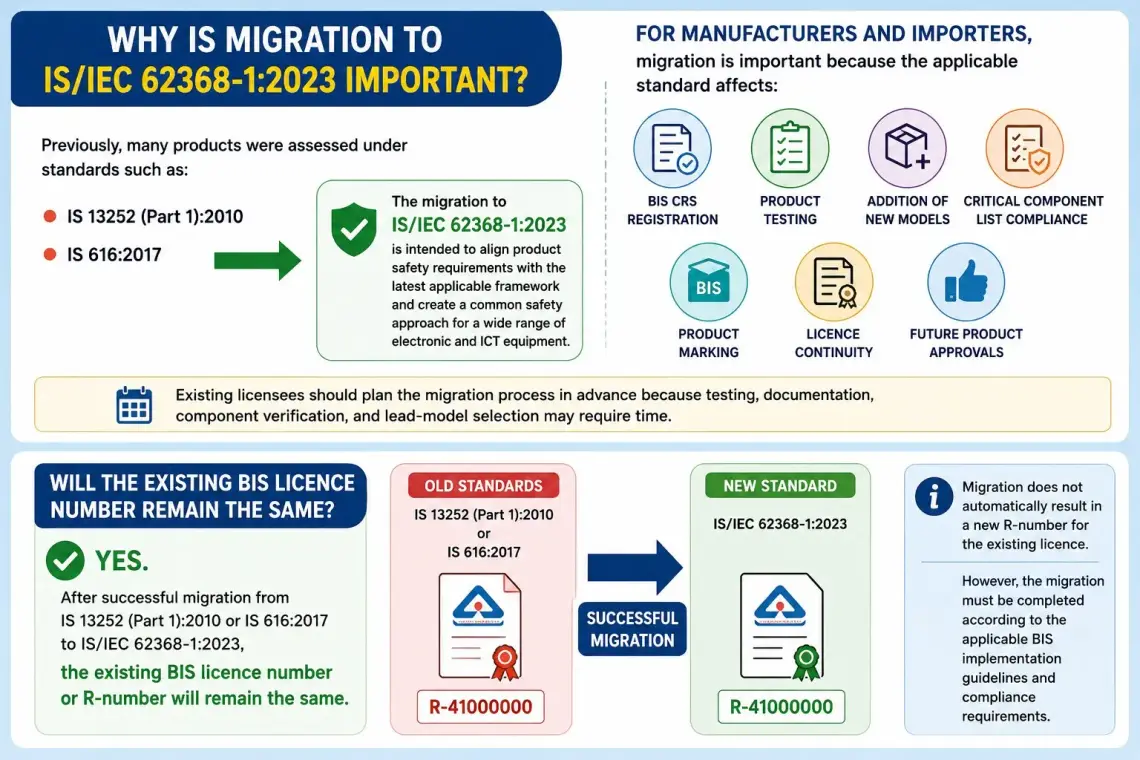
For manufacturers and importers, migration is important because the applicable standard affects:
- BIS CRS registration
- Product testing
- Addition of new models
- Critical Component List compliance
- Product marking
- Licence continuity
- Future product approvals
Existing licensees should plan the migration process in advance because testing, documentation, component verification, and lead-model selection may require time.
Will the Existing BIS Licence Number Remain the Same?
Yes. After successful migration from IS 13252 (Part 1):2010 or IS 616:2017 to IS/IEC 62368-1:2023, the existing BIS licence number or R-number will remain the same.
This means that migration does not automatically result in a new R-number for the existing licence. However, the migration must be completed according to the applicable BIS implementation guidelines and compliance requirements.
What Happens When a Manufacturer Has Multiple Licences?
Some manufacturers may hold separate BIS licences for different product categories under the earlier standards.
After successful migration, separate licences for different product categories will continue to remain separate. Each licence must be migrated individually according to the applicable implementation requirements.
For example, licences for different product categories, including different types of power adaptors, may continue as separate licences after migration.
Manufacturers should therefore review each R-number separately and avoid assuming that one migration application will automatically cover all existing licences.
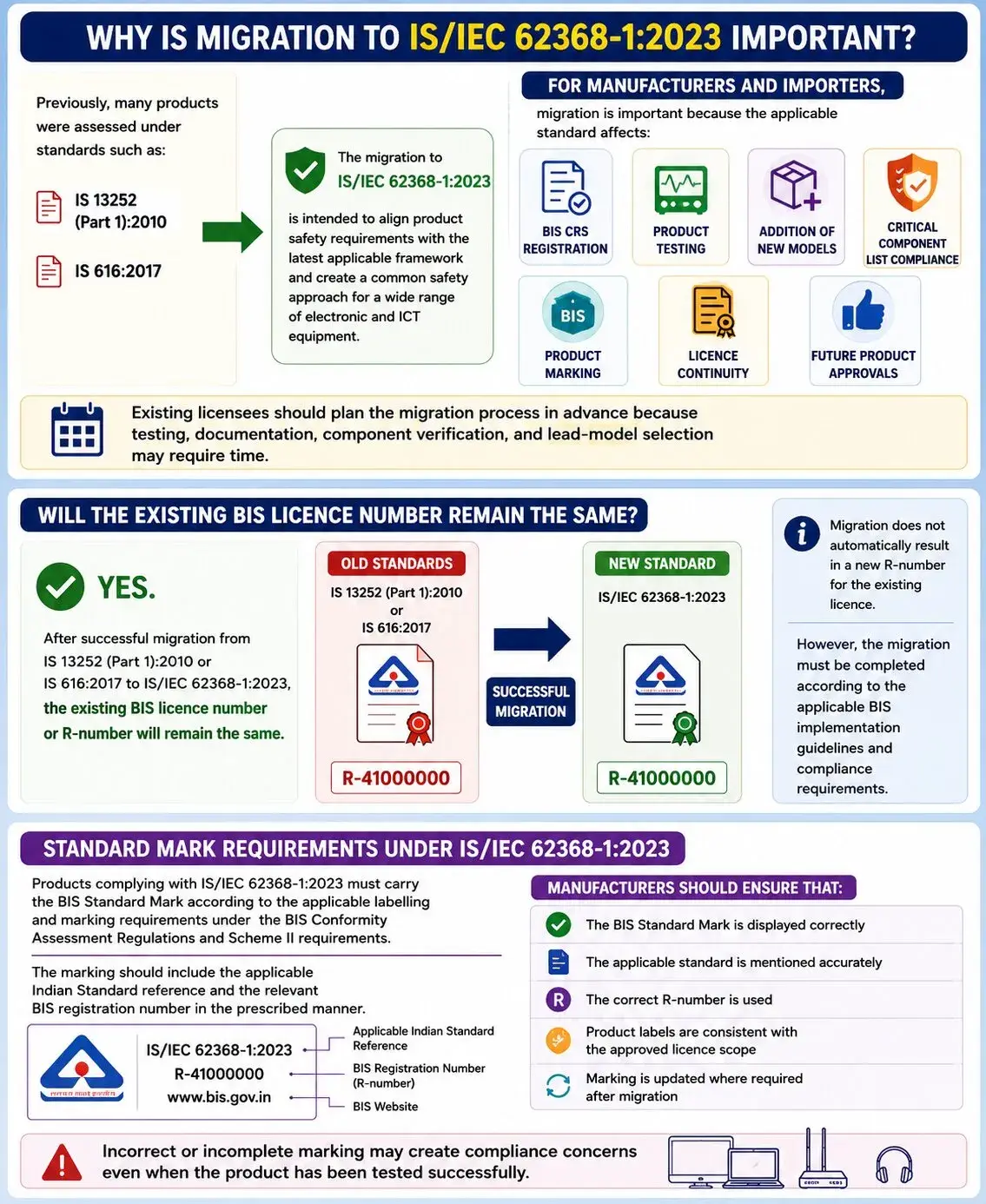
Products complying with IS/IEC 62368-1:2023 must carry the BIS Standard Mark according to the applicable labelling and marking requirements under the BIS Conformity Assessment Regulations and Scheme II requirements.
The marking should include the applicable Indian Standard reference and the relevant BIS registration number in the prescribed manner.
Manufacturers should ensure that:
- The BIS Standard Mark is displayed correctly
- The applicable standard is mentioned accurately
- The correct R-number is used
- Product labels are consistent with the approved licence scope
- Marking is updated where required after migration
Incorrect or incomplete marking may create compliance concerns even when the product has been tested successfully.
Are BIS-Recognized Laboratories Available for Testing?
Yes. BIS-recognized laboratories are available for testing under IS/IEC 62368-1:2023.
Manufacturers can search for suitable laboratories through the BIS Laboratory Information Management System (LIMS) by entering the applicable Indian Standard number.
Before sending samples, manufacturers should confirm that the selected laboratory has the relevant testing scope and can perform the required tests for the specific product category.
It is also advisable to review the product design, technical documents, critical components, and applicable series requirements before submitting samples. Early preparation can help reduce the possibility of additional testing or avoidable delays.
Can Existing Licences Be Renewed Under the Old Standards?
During the notified transition period, renewal under IS 13252 (Part 1):2010 or IS 616:2017 may be permitted according to the applicable implementation timeline.
The BIS FAQs state that renewal under the earlier standards may continue up to 01 November 2028, which is the last date of concurrent running mentioned for the old and new standards.
However, manufacturers should not treat the transition period as a reason to postpone migration. Testing, component evaluation, and documentation may take time, particularly when multiple product series or manufacturing locations are involved.
Should New Applications Be Submitted Under IS/IEC 62368-1:2023?
New applications may be processed under the earlier standards or under IS/IEC 62368-1:2023 during the applicable concurrent-running period, subject to the relevant BIS guidelines.
Where an application is submitted under an earlier standard during the permitted transition period, the applicant may be required to provide a declaration confirming that migration to IS/IEC 62368-1:2023 will be completed by the applicable deadline.
BIS encourages applicants to submit new applications under IS/IEC 62368-1:2023.
After the end of the concurrent-running period, new licences will not be granted under the earlier standards, and new applications will need to comply with IS/IEC 62368-1:2023.
What Happens If Migration Is Not Completed on Time?
If an existing licensee does not complete migration by the applicable deadline, BIS may initiate action according to the relevant provisions.
Depending on the circumstances, this may include:
- Cancellation of the licence
- Deletion of models from the licence scope
- Other applicable compliance action
Manufacturers should therefore track the migration status of every applicable licence and product model.
Can New Models Be Added Under an Existing Licence?
Yes. New models tested according to IS/IEC 62368-1:2023 may be included under an existing R-number issued under the earlier standards, subject to the applicable BIS requirements.
The applicant must follow the relevant migration and series guidelines. The new model should be appropriately evaluated to confirm that it falls within the permitted scope and meets the applicable safety requirements.
Is One Representative Sample Enough for Migration?
No. One representative sample per licence is not automatically sufficient.
Existing licensees must submit complete test reports for all applicable lead models identified according to the revised series guidelines.
This means that manufacturers should first review their complete licence scope and determine:
- Which models are active
- Which models are lead models
- Which models belong to the same product series
- Whether the selected lead model represents the applicable series
- Whether additional testing is required
A complete model review before testing can help avoid incomplete migration applications.
What If the Existing Lead Model Is End-of-Life?
If an existing lead model has become End-of-Life (EOL), the manufacturer may withdraw that model from the licence.
The next suitable lead model in the same series may then be identified according to the revised series guidelines.
Manufacturers should ensure that the replacement lead model is technically appropriate and represents the relevant product series. The replacement should not be selected only because it is easily available for testing.
Are Separate Test Reports Required for Different Factories?
Yes. Separate test reports are required when products are manufactured at different manufacturing locations because separate BIS licences are issued for separate manufacturing locations under the CRS framework.
A test report for one factory should not automatically be assumed to cover products manufactured at another location.
Manufacturers operating multiple factories should prepare a separate migration plan for each applicable manufacturing location.
Can Components and End Products Be Tested in Parallel?
Yes. Critical components and end products may be tested in parallel according to the applicable BIS Parallel Testing Guidelines.
Parallel testing may help reduce the overall compliance timeline when properly planned. However, manufacturers should ensure that the component details, product design, test samples, and technical documentation remain consistent throughout the process.
Any mismatch between the tested component and the final product configuration may result in additional review or testing requirements.
Is There Any BIS Fee for Migration?
No separate fee is applicable for the migration of already registered models covered under the existing licence scope when the application is submitted through the applicable Standard Revision provision available to licensees.
However, manufacturers may still incur costs related to:
- Product testing
- Laboratory evaluation
- Sample preparation
- Component testing
- Technical documentation
- Product modifications
- Compliance support
Therefore, “no migration fee” should not be understood as “no migration cost.”
Critical Component List Requirements
The Critical Component List, commonly called the CCL, is an important part of product compliance.
Critical components that serve as safeguards or form part of a safeguard must comply with the requirements of IS/IEC 62368-1:2023 or the applicable safety requirements of relevant component standards.
Components complying only with IS 13252 (Part 1):2010 or IS 616:2017 may not be accepted in the CCL after migration where compliance with the new standard is required.
Manufacturers should review critical components such as:
- Power supply components
- Insulation-related components
- Protective devices
- Safety-related switches
- Batteries and protection circuits
- Fire-protection components
- Other components that act as safety safeguards
A detailed CCL review should be completed before final product testing.
Can a BIS-Marked Product Be Submitted for Migration Testing?
Yes. A model already registered under the existing licence may bear the BIS Standard Mark.
When such a product is submitted to a BIS-recognized laboratory for testing under IS/IEC 62368-1:2023, the applicant must declare that the model is already registered.
The laboratory should record this information in the test report.
Can Testing Begin Before the Migration Application Is Submitted?
Yes. Manufacturers may begin testing according to the applicable implementation guidelines and revised series guidelines before submitting the migration application.
Starting the technical preparation and testing process early may help manufacturers:
- Identify product design gaps
- Review critical components
- Select the correct lead models
- Prepare complete test reports
- Reduce the risk of last-minute delays
However, testing should be planned carefully to ensure that the correct product configuration and applicable requirements are used.
Step-by-Step BIS Migration Process
Step 1: Review Existing BIS Licences
Prepare a complete list of:
- R-numbers
- Product categories
- Registered models
- Manufacturing locations
- Existing lead models
- Active and EOL models
Step 2: Review the Revised Series Guidelines
Identify the applicable product series and determine the required lead models.
Step 3: Check Product Design and Components
Review the product design against IS/IEC 62368-1:2023 and verify the compliance status of all critical components.
Step 4: Select a BIS-Recognized Laboratory
Confirm that the laboratory has the applicable testing scope for the product and standard.
Step 5: Conduct Testing
Submit the required lead models and obtain complete test reports according to the applicable requirements.
Step 6: Prepare the Migration Application
Existing licensees should use the applicable Standard Revision/Amendment/Essential Requirement provision available through the BIS CRS login.
Step 7: Upload Test Reports and Supporting Information
Submit complete test reports and other required documents according to the implementation guidelines.
Step 8: Complete BIS Review
BIS may review the submitted information and request clarification or additional details where required.
Step 9: Confirm Successful Migration
After approval, verify that the licence scope, product details, and marking information are correctly updated.
Common Mistakes to Avoid
Manufacturers should avoid the following mistakes during migration:
- Assuming that one test report covers all models
- Selecting an incorrect lead model
- Ignoring revised series guidelines
- Using outdated component compliance information
- Submitting incomplete test reports
- Forgetting to review separate factory licences
- Delaying migration until the final deadline
- Using incorrect BIS marking
- Failing to update the Critical Component List
- Assuming that old-standard compliance automatically proves compliance with the new standard
Benefits of Early Migration
Early migration can provide several practical benefits:
- More time for testing and technical review
- Reduced risk of deadline-related delays
- Better planning for multiple product series
- Early identification of non-compliant components
- Smoother addition of new models
- Improved readiness for future applications
- Reduced risk of licence or model-scope action
Manufacturers with a large number of models or multiple factories should begin the review process well before the final transition date.
Conclusion Migration to IS/IEC 62368-1:2023 is an important compliance step for manufacturers and importers of applicable electronic, audio/video, information technology, and communication products. The migration process involves more than simply updating the standard number. Manufacturers may need to review product series, lead models, test reports, critical components, manufacturing locations, product marking, and licence scope. Existing R-numbers may remain unchanged after successful migration, but each licence must be handled according to the applicable BIS requirements. Businesses should begin technical preparation early, complete testing through BIS-recognized laboratories, and submit the migration application through the appropriate provision in the BIS CRS portal. A structured migration plan can help maintain compliance, reduce delays, and support uninterrupted access to the Indian market.Frequently asked questions
What is IS/IEC 62368-1:2023?
IS/IEC 62368-1:2023 is an Indian safety standard for audio/video, information technology, and communication technology equipment. It uses a hazard-based safety approach and covers risks related to electrical energy, fire, heat, mechanical hazards, batteries, and other product safety concerns.
Will my existing BIS R-number change after migration?
No. The existing BIS licence number or R-number will remain the same after successful migration to IS/IEC 62368-1:2023. However, the migration must be completed according to the applicable BIS implementation guidelines and product compliance requirements.
Can I renew my licence under IS 13252 or IS 616?
During the applicable transition period, renewal under the earlier standards may be permitted according to the notified implementation timeline. Manufacturers should still prepare for migration because compliance with IS/IEC 62368-1:2023 will become mandatory after the concurrent-running period ends.
Is one test report enough for all models?
Not necessarily. Complete test reports are required for all applicable lead models identified according to the revised series guidelines. Manufacturers must review their licence scope and product series before deciding how many models need to be tested.
Can an End-of-Life lead model be replaced?
Yes. An End-of-Life lead model may be withdrawn from the licence, and the next suitable lead model in the same series may be identified according to the revised series guidelines for demonstrating compliance with IS/IEC 62368-1:2023.
Are separate test reports required for different factories?
Yes. Separate test reports are required for products manufactured at different locations because separate BIS licences are granted for different manufacturing locations under the Compulsory Registration Scheme.
Is any migration fee payable to BIS?
No separate fee applies for migration of already registered models within the existing licence scope when the application is submitted through the applicable Standard Revision provision. However, laboratory testing, sample preparation, and technical compliance costs may still apply.
Can old-standard critical components be used after migration?
Critical components must meet the requirements applicable under IS/IEC 62368-1:2023. Components complying only with the earlier standards may not be accepted in the Critical Component List where compliance with the new standard is required.
Can product and component testing be conducted together?
Yes. Components and end products may be tested in parallel according to the applicable BIS Parallel Testing Guidelines. Proper coordination is necessary to ensure that the tested components match the final product configuration and technical documentation.
What happens if migration is not completed by the deadline?
If migration is not completed by the applicable deadline, BIS may initiate action under the relevant provisions. Depending on the case, this may include cancellation of the licence or deletion of models from the approved licence scope.