Global Compliance
CCC Certification for China: Product List, Process, Cost & Timeline (2026 Guide)
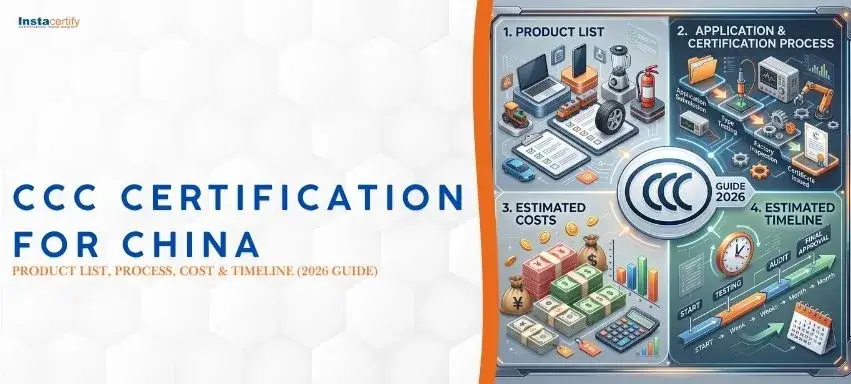
CCC (China Compulsory Certification, also called 3C) is mandatory for products in the CNCA catalogue before they can be imported into, sold in or used commercially in China. It covers electrical appliances, IT and audio-video equipment, lighting, wiring, toys, vehicles and parts, and more. A first CCC certificate typically takes 8–12 weeks and involves type testing in a CNCA-designated Chinese laboratory plus an initial factory inspection; the certificate is valid for five years subject to annual surveillance. This guide lists the product categories, walks through the process, gives a cost band and explains CCC vs CQC.
[IMAGE PLACEHOLDER – Graphic: CCC mark with the main product categories in the CNCA catalogue]
Insert image here; add descriptive alt text with the primary keyword.
What is CCC certification?
CCC is China's unified product-safety mark, administered by the Certification and Accreditation Administration of China (CNCA) and the State Administration for Market Regulation (SAMR). Certificates are issued by CNCA-designated bodies, the largest being the China Quality Certification Centre (CQC). Products in the catalogue must carry the CCC mark; Chinese customs and market inspectors check for it, and uncertified goods are refused entry or removed from sale.
Which products need CCC certification? (Product catalogue)
The catalogue is defined by HS code and product description and is revised periodically. The main categories are:
| Category | Examples |
|---|---|
| Electrical wires, cables and cords | PVC-insulated cables, cord sets |
| Circuit switches, protection and connection devices | Plugs, sockets, MCBs, RCDs, switches |
| Low-voltage electrical apparatus | Contactors, relays, motor starters |
| Small power motors | Single-phase and three-phase motors |
| Electric tools | Drills, grinders, saws |
| Welding machines | Arc welders, TIG/MIG sets |
| Household and similar electrical appliances | Refrigerators, fans, washing machines, ACs, water heaters, kitchen appliances |
| Audio and video equipment | TVs, amplifiers, speakers, set-top boxes |
| Information technology equipment | Computers, monitors, printers, servers, power adapters |
| Lighting equipment | Luminaires, LED drivers, ballasts |
| Vehicles and safety parts | Cars, motorcycles, tyres, seat belts, brake hoses, lamps, glass, helmets |
| Agricultural machinery | Tractors, irrigation pumps |
| Fire-fighting products | Extinguishers, alarms, sprinklers |
| Safety glass | Automotive and building glass |
| Toys | Electric, plastic, metal, ride-on toys, dolls |
| Telecommunication terminal equipment | Modems, phones (also needs SRRC/NAL) |
| Explosion-proof electrical products | Ex motors, lights, junction boxes |
If your product is not in the catalogue, CCC is not required, but a voluntary CQC mark or a customs "no-CCC-required" clarification letter may still be needed to clear goods smoothly.
CCC certification modes
- Type test + initial factory inspection + follow-up inspection – the standard mode for most products.
- Type test + follow-up inspection (no initial factory audit) – allowed for some lower-risk categories.
- Self-declaration (SDoC) – since 2018 CNCA allows self-declaration for certain categories (e.g., some IT/AV accessories, lighting components, small motors). Testing must still be done in a CNCA-recognised lab and the declaration filed on the CNCA platform.
[IMAGE PLACEHOLDER – Flowchart: CCC certification – application, type test, factory inspection, certificate, follow-up]
Insert image here; add descriptive alt text with the primary keyword.
CCC certification process: step by step
Step 1 – Product classification
Confirm the product's HS code and whether it is in the CCC catalogue, and identify the applicable GB standards (Chinese equivalents of IEC/ISO, e.g., GB 4706 for household appliances, GB 4943 for IT equipment, GB 6675 for toys).
Step 2 – Application to the certification body
Submit the application (usually to CQC) with applicant, manufacturer and factory details, product description, model list and technical documents. An application number is issued in about a week.
Step 3 – Sample submission and type testing
Ship samples to the CNCA-designated laboratory in China. Testing takes 3–6 weeks depending on the product; the lab may request modifications if a test fails.
Step 4 – Initial factory inspection
Two Chinese auditors visit the manufacturing site (in India or elsewhere) for 1–2 days to verify quality-control procedures, production consistency, testing equipment and routine tests. Travel and audit days are charged to the applicant.
Step 5 – Certificate issuance
Once the test report and factory report are approved, the CCC certificate is issued. Certificates are model-specific; families of similar models can be grouped.
Step 6 – CCC mark permission and labelling
Apply for permission to print the CCC mark (self-printing) or purchase standard mark labels, and update the rating plate and packaging.
Step 7 – Annual follow-up inspection
The factory is audited annually (or at set intervals); failure to host the audit suspends the certificate. Product changes require a change application.
Documents required for CCC certification
- Application form and business licence / incorporation certificate of applicant and manufacturer
- Product description, photographs, model differences list
- Circuit diagrams, PCB layouts, BOM with critical component list (CCC- or CQC-certified components where required)
- User manual and rating label in Chinese
- Existing CB / IEC test reports (can shorten testing)
- Factory quality manual, production flow chart and test-equipment list
- Trademark registration certificate (if the brand is not the applicant's)
How much does CCC certification cost?
Costs vary with product category, number of models and whether a factory audit is needed. Indicative ranges for an Indian manufacturer:
| Cost item | Indicative range |
|---|---|
| Application and certificate fees | ₹50,000 – ₹1,00,000 |
| Type testing in a Chinese lab | ₹1,00,000 – ₹4,50,000 (product dependent) |
| Initial factory inspection (auditor days) | ₹1,50,000 – ₹2,00,000 |
| Auditor travel and accommodation | ₹2,00,000 – ₹3,00,000 |
| Annual follow-up inspection | ₹1,50,000 – ₹3,00,000 per year including travel |
| Consulting, translation, sample logistics | ₹50,000 – ₹1,50,000 |
Grouping models into families and sharing a factory audit across several product lines reduces the per-product cost substantially.
CCC certification timeline
- Application acceptance: about 1 week
- Type testing: 3–6 weeks
- Factory inspection scheduling and audit: 2–4 weeks
- Certificate issue: 1–2 weeks after approval
- Total: 8–12 weeks for a well-prepared application; longer if tests fail or components are uncertified.
CCC vs CQC: what is the difference?
| CCC mark | CQC mark | |
|---|---|---|
| Status | Mandatory for catalogue products | Voluntary quality/safety mark |
| Issued by | CNCA-designated bodies (CQC is the main one) | China Quality Certification Centre |
| Purpose | Market access / customs clearance | Buyer confidence for products outside the CCC catalogue; component certification |
| Validity | 5 years with annual surveillance | Typically 5 years with surveillance |
"CQC" is also the name of the certification body that issues most CCC certificates, which is why the two are often confused.
Exemptions from CCC
CCC exemption can be applied for on samples for testing and R&D, exhibition goods, spare parts for imported equipment, components used only in export production and certain project-specific imports. Exemption is granted per shipment through the local market-regulation authority and is not a substitute for certification of commercial sales.
How Instacertify helps with CCC certification
Instacertify Labs, with offices in Noida and Guangdong, coordinates CCC for Indian and international manufacturers: catalogue and GB-standard mapping, pre-compliance testing through ISO/IEC 17025-accredited partner labs, application filing with CQC, sample logistics, factory-inspection preparation and annual surveillance management. Existing CB/IECEE reports are used to cut testing time. Related market approvals: MIC Japan, SNI Indonesia, PSE Japan.
Get a CCC quote – send your product list and we will confirm catalogue status and standards within one working day.
Frequently asked questions
Is CCC certification mandatory?
Yes, for every product listed in the CNCA CCC catalogue. Products outside the catalogue do not need it.
How long does CCC certification take?
Typically 8–12 weeks including type testing and the initial factory inspection.
How long is a CCC certificate valid?
Five years, provided annual follow-up factory inspections are passed and the product is unchanged.
Can testing for CCC be done in India?
Type testing must be performed by a CNCA-designated laboratory in China. Indian accredited labs can run pre-compliance tests to avoid failures.
What is the difference between CCC and CQC?
CCC is the mandatory mark; CQC is a voluntary mark and also the name of the main body that issues CCC certificates.
Do I need a Chinese company to apply for CCC?
No. Foreign manufacturers can apply directly; a local agent is optional but helpful for sample logistics and communication.