Did you Know
Did You Know – Ingress Protection (IP) Testing for IoT Devices
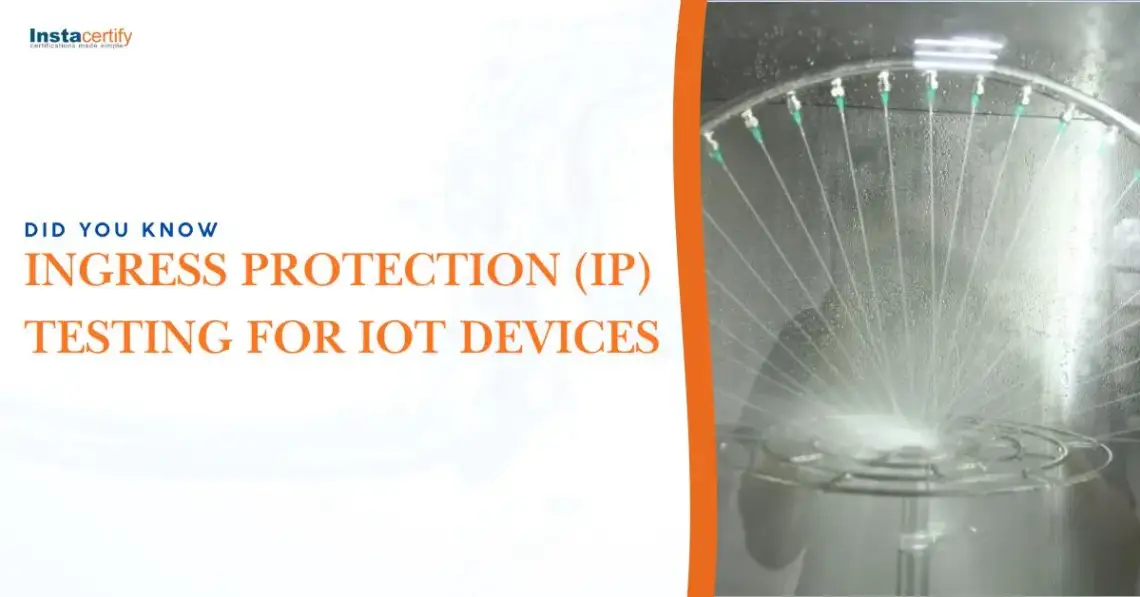
Electric and electronic equipment are inherently vulnerable to their environment. When water or dust enters a device, performance degrades, failures occur, and safety risks increase. This risk is amplified in IoT devices, which are often deployed outdoors, in industrial areas, or in unattended locations.
To address this, the International Electrotechnical Commission (IEC) developed the Ingress Protection (IP) rating system, now widely used across industries to describe how well an enclosure resists the ingress of solids and liquids.
Yet despite its widespread use, IP ratings remain one of the most misunderstood aspects of product compliance.
Marketing Myth Around IP Ratings
Terms such as waterproof or water-resistant are frequently used in marketing—especially for smartphones and IoT devices. Unfortunately, these terms have no standardized technical meaning.
What does have a defined meaning is the IP rating, established under IEC 60529.
But here’s the critical distinction that is often missed:
IP ratings are not certifications
They are statements of conformity based on testing
An enclosure is not “IP65” or “IP68” because it was designed that way.
It is only IP-rated after it has successfully passed defined tests.
What IEC 60529 Actually Does
IEC 60529 was developed to:
- Grade the resistance of enclosures against dust and liquid ingress
- Assess protection against access to hazardous parts
- Define test methods to verify these protections
The standard applies to electrical equipment with rated voltages up to 72.5 kV and is prepared by IEC Technical Committee 70.
Importantly, IEC 60529 does not approve products—it defines how protection must be tested and demonstrated.
Understanding the IP Code Structure
The IP code consists of two numerals:
First Numeral – Protection Against Solids
Rated from 0 to 6:
- 0 – No protection
- 1–4 – Protection against large to small solid objects
- 5 – Dust-protected (limited ingress allowed)
- 6 – Dust-tight (no ingress of dust)
Second Numeral – Protection Against Liquids
Rated from 0 to 9:
- 0 – No protection
- 1–4 – Dripping and splashing water
- 5–6 – Water jets and powerful water jets
- 7 – Temporary immersion
- 8 – Continuous immersion (manufacturer-defined conditions)
- 9 – High-pressure, high-temperature water jets
Each combination (IP45, IP56, IP65, IP68, etc.) represents a specific level of tested protection, not a generic approval.
Why This Matters More for IoT Devices
IoT devices are rarely simple enclosures. They include:
- Cables and connectors
- Antennas and vents
- Displays and seals
- Long-term exposure to temperature and pressure variation
Even if individual components are “IP-rated,” the final assembled product may fail. That’s why testing must be performed on the complete device, not just the enclosure.
IP Ratings = Conformity Through Testing
An IP rating becomes valid only when the product has been tested according to IEC 60529.
Without testing:
- The IP marking is only a claim
- Customers and tender authorities have no technical proof
- Liability and rejection risks increase
This is why IP ratings should be viewed as conformity statements, not certifications.
Why ISO/IEC / NABL 17025–Accredited Labs Are Essential
A reliable conformity claim can only come from a competent testing laboratory.
Testing carried out by ISO/IEC 17025–accredited laboratories, including NABL-accredited labs, ensures:
- Use of validated test methods
- Calibrated and traceable equipment
- Controlled and repeatable conditions
- Test reports accepted by regulators, customers, and tender committees
Such labs don’t just test products—they create defensible evidence of compliance.
If you wan’t the get Ingress Protection Testing please visit: IP Testing
Frequently asked questions
What is Ingress Protection (IP) testing?
IP testing is a standardized evaluation process that measures how effectively an electronic device’s enclosure protects its internal components against the intrusion of solid objects, such as dust, and liquids, such as water.
Why is IP testing important for IoT devices?
IoT devices are often deployed in diverse, uncontrolled environments. IP testing ensures these devices remain safe, reliable, and functional when exposed to environmental hazards like rain, dust, or accidental moisture.
How is an IP rating structured?
An IP rating consists of two digits following "IP." The first digit (0–6) indicates protection against solid objects and dust. The second digit (0–9) indicates the level of resistance against liquids and water ingress.
What do the first and second digits represent?
The first digit ranges from 0 (no protection) to 6 (dust-tight). The second digit ranges from 0 (no protection) to 9 (protection against high-pressure, high-temperature water jets or steam cleaning).
What is the difference between IP67 and IP68?
Both offer complete dust protection. The difference is in water resistance: IP67 allows for temporary immersion up to 1 meter for 30 minutes, while IP68 covers continuous immersion at depths specified by the manufacturer.
Is IP testing mandatory for IoT manufacturers?
While often voluntary, IP testing is critical for marketing claims, consumer confidence, and compliance in specific industries like medical, industrial automation, or outdoor infrastructure where equipment reliability is non-negotiable.
Can a device have different IP ratings for different components?
Yes. An IoT device might have a sealed internal sensor rated IP68, while its outer casing is only rated IP54. Manufacturers often test individual critical modules to ensure overall system reliability under specific conditions.
Does an IP rating cover protection against corrosive substances?
No, standard IP ratings only measure protection against physical solids and water. Resistance to chemicals, oils, or corrosive substances requires additional specialized testing, often referenced under different industrial safety standards or certifications.