Global Compliance
EN71 Toy Safety Testing: Part 1, 2 & 3 Requirements, Process and Cost
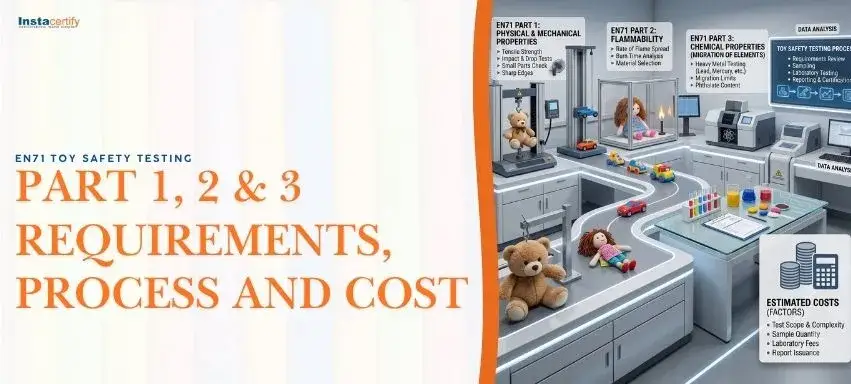
EN71 is the European toy safety standard, and it is split into three core parts that test completely different hazards: Part 1 checks mechanical and physical safety, Part 2 checks flammability, and Part 3 checks how much lead, cadmium and other elements can migrate out of the toy material. A toy can pass Part 1 and still fail Part 3, so exporters need all three covered, not just the one that matches their product's most obvious risk. If you manufacture in India, there is a second layer to plan for: toys sold domestically need BIS certification under IS 9873, a separate mandatory requirement from EN71. This guide covers both.
[IMAGE PLACEHOLDER – diagram of EN71 Part 1, 2 and 3 test categories with icons for mechanical, flammability and chemical testing]Insert image here; add descriptive alt text with the primary keyword.
What is EN71?
EN71 is the harmonised European safety standard for toys, referenced under the EU Toy Safety Directive. Toys placed on the EU market must meet its requirements and carry the CE mark, supported by a technical file that includes EN71 test reports. It applies to products designed or clearly intended for use in play by children under 14, covering everything from soft toys and building blocks to ride-on toys and children's jewellery-style items.
EN71 Part 1, 2 and 3: what each part actually tests
| Part | What it covers | Typical tests |
|---|---|---|
| Part 1 – Mechanical and physical properties | Choking, injury and structural hazards | Small-parts cylinder test, pull/torque tests on detachable components, sharp-edge and sharp-point checks, stability and structural integrity, cord and elastic length limits |
| Part 2 – Flammability | Fire risk from materials and construction | Rate of flame spread when the toy is exposed to a small ignition source; plush and soft toys must not burn rapidly or support sustained combustion |
| Part 3 – Migration of certain elements | Chemical safety of toy materials accessible to a child | Extraction testing (simulating stomach acid/saliva conditions) followed by analysis for lead, cadmium, mercury, arsenic, chromium, antimony and other regulated elements, checked against migration limits by material category |
Depending on the toy category, additional EN71 parts may apply too — for example, Part 4 for chemistry-set type experimental toys, Part 5 for chemical toys other than experiment sets, or Part 9–13 for organic chemical compounds in certain materials. Most general toys are covered by Parts 1–3.
Step-by-step: getting an EN71 test report
- Identify the applicable parts based on your toy category, materials and age grading.
- Prepare technical information – bill of materials, age recommendation, intended use, and any small parts or battery compartments.
- Submit samples in production-representative condition, including packaging if labelling/warning claims are also being verified.
- Mechanical testing (Part 1) is usually run first, since a structural failure can affect what other tests are meaningful.
- Flammability testing (Part 2) is carried out on fabric, foam and plastic components as applicable.
- Chemical migration testing (Part 3) extracts and analyses accessible materials — coatings, paints, plastics, textiles — for regulated elements.
- Test report and, where required, the technical file/CE documentation are compiled for your EU market entry.
Insert image here; add descriptive alt text with the primary keyword.
India's own toy safety requirement: BIS and IS 9873
EN71 covers the EU market only. If you manufacture or import toys for sale in India, a separate mandatory requirement applies under the Toys (Quality Control) Order: non-electric toys must comply with IS 9873 and electric/electronic toys with IS 15644, both certified under the BIS scheme (ISI mark for domestic manufacturers, BIS FMCS for overseas factories). The two frameworks test broadly similar hazard categories — mechanical safety, flammability and chemical migration — but they are legally distinct certifications, and a toy sold in both markets typically needs both an EN71 report for the EU and a BIS licence for India.
| EN71 (EU) | BIS / IS 9873 & IS 15644 (India) | |
|---|---|---|
| Market | European Union | India (Toys Quality Control Order) |
| Mandatory since | Under the EU Toy Safety Directive, ongoing | India's Toys QCO – mandatory for domestic sale and import |
| Certification route | CE marking supported by test reports/technical file | BIS ISI licence (domestic) or FMCS licence (foreign manufacturers) |
| Applicable standard | EN71 Parts 1–3 (plus others by category) | IS 9873 (non-electric) / IS 15644 (electric) |
Documents required
- Product bill of materials and component breakdown
- Age grading and intended use statement
- Manufacturing site details and, for BIS, factory inspection readiness
- Packaging and labelling artwork (for warning statement compliance)
- Prior test reports, if any, for reference
Cost and timeline
EN71 testing is priced per sample set and typically covers Parts 1–3 together for a standard toy, with turnaround commonly running 1–3 weeks depending on the lab's queue and whether retesting is needed. BIS certification for the Indian market runs on a separate, longer timeline that includes application, factory inspection (for domestic manufacturers) and licence grant. Get a written quote for your specific product category before budgeting either route.
How Instacertify helps
Instacertify coordinates EN71 toy safety testing for exporters and, separately, BIS registration under IS 9873 and IS 15644 for the Indian market — helping toy manufacturers and importers plan both certifications together rather than discovering the gap after a shipment is held. See our toy testing and certification services. Contact us for a free consultation.
Frequently asked questions
What does EN71 testing cover?
EN71 Part 1 covers mechanical and physical safety, Part 2 covers flammability, and Part 3 covers migration of certain elements such as lead and cadmium from toy materials. Additional parts apply to specific toy categories.
Is EN71 mandatory for toys sold in India?
No. EN71 applies to the EU market. Toys sold in India need separate BIS certification under IS 9873 (non-electric) or IS 15644 (electric) as required by the Toys (Quality Control) Order.
Do I need both EN71 and BIS certification?
If you sell the same toy in both the EU and India, yes — the two are legally distinct certifications and one does not substitute for the other.
What elements does EN71 Part 3 test for?
Lead, cadmium, mercury, arsenic, chromium, antimony and other regulated elements, extracted from accessible toy materials and checked against category-specific migration limits.
How long does EN71 testing take?
Typically 1–3 weeks for Parts 1–3 on a standard toy, depending on the lab and whether any retesting is required.