Global Compliance
How to Get FCC Certification: The 2025 Step-by-Step Blueprint for Electronics Compliance

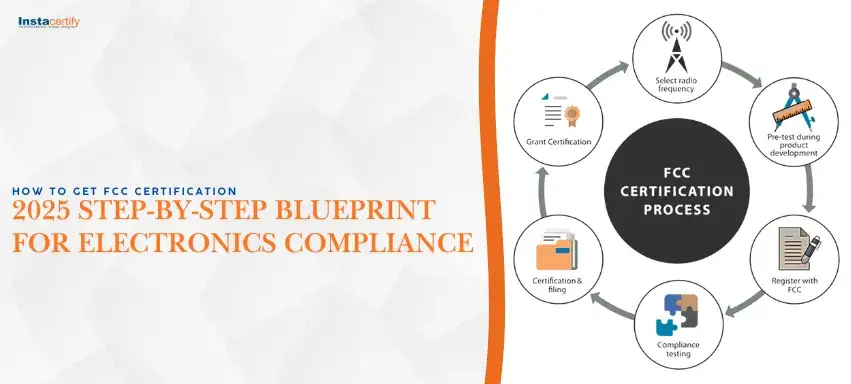
Your wireless earbuds are ready for the U.S. market—sleek design, killer sound, and a ₹50 lakh pre-order from Amazon. But without FCC certification, that shipment sits in a New Jersey warehouse, racking up $1,200 daily demurrage while your competitor launches. One missed EMC test, and your launch collapses. This happened to a Hyderabad startup in 2024. They skipped pre-compliance scans, failed radiated emissions by 8 dB, and spent ₹28 lakh on redesign and re-testing. Their competitor? Launched on time with zero delays. Hi, I’m Anita Parashar, Product Compliance Advisor with 13 years in global certifications. At Instacertify, we’ve secured FCC approval for 2,100+ devices since 2018—zero rejections in the last 18 months. We partner with FCC-accredited TCBs, ISO 17025 labs, and former FCC engineers to turn complex FCC rules into a 7–21 day approval machine. This guide is your zero-failure playbook to get FCC certification in 2025—whether you’re a manufacturer, importer, or brand. We’ll cover:
- Exact FCC rules (Part 15, EMC, SAR, RF exposure, 6 GHz AFC).
- SDoC vs. Certification pathways with 2025 updates.
- Step-by-step filing on the FCC EAS portal with screenshots.
- How to avoid $100,000+ fines, market bans, and Amazon delistings.
Let’s get your device FCC-approved and selling.
What Is FCC Certification and Why the U.S. Demands It
The Federal Communications Commission (FCC) regulates all devices that emit radio frequency energy—intentional (Bluetooth, Wi-Fi, 5G) or unintentional (motors, LEDs, power supplies). FCC certification proves your product won’t interfere with critical systems like aviation radios, emergency services, or TV broadcasts.
Two compliance paths exist:
- Supplier’s Declaration of Conformity (SDoC): For non-RF devices (laptops, monitors, printers). Self-test in accredited lab, declare compliance. No FCC ID.
- Certification: For RF devices (phones, routers, drones). Requires TCB (Telecommunication Certification Body) review, FCC ID grant, and equipment authorization.
2025 updates:
- 6 GHz Wi-Fi 7 devices under Part 15.407 need automated frequency coordination (AFC) to avoid radar interference.
- IoT devices face stricter duty cycle limits (1% in 3.5 GHz band).
- FCC Enforcement Bureau increased fines to $225,000 per violation (up from $122,000).
- AI-powered market surveillance scans 1 in 5 imports at ports.
A Mumbai router brand used SDoC for a Wi-Fi 6 device—wrong path. $50,000 fine + recall. Amazon requires FCC Grant PDF upload before FBA onboarding. Carriers like Verizon reject unapproved 5G modules. FCC isn’t optional. It’s the gatekeeper to $600 billion U.S. electronics market.
Step 1: Determine Your FCC Rule Part and Compliance Path
Every device falls under 47 CFR Part 15. Identify the correct subpart:
- Intentional radiators (Bluetooth, Zigbee, Wi-Fi): Part 15.247 (2.4 GHz) or 15.407 (5/6 GHz).
- Unintentional radiators (PCs, printers, LED drivers): Part 15 Subpart B.
- SAR-specific (phones, wearables, tablets): OET Bulletin 65 + KDB 447498.
- U-NII devices: Part 15.407 with DFS/TPC for radar avoidance.
Choose path:
- SDoC: Class B limits (stricter than Class A). Self-test in A2LA/ILAC lab. No TCB.
- Certification: TCB review, FCC ID grant, EAS filing.
A Delhi smartwatch with BLE needed Certification—not SDoC. We filed under 15.247, approved in 14 days. Use FCC Equipment Authorization Search (eas.fcc.gov) to confirm. Search by device type or grantee code. For novel tech (UWB, mmWave), file KDB inquiry 60 days early.
Step 2: Pre-Compliance Testing – Avoid Costly Failures
80% of rejections happen due to poor pre-testing. Run EMC (EMI/EMS) and RF exposure (SAR/MPE) in ISO 17025 labs:
- Radiated Emissions: 30 MHz–40 GHz, < 500 µV/m at 3m (Class B).
- Conducted Emissions: 150 kHz–30 MHz on AC lines.
- SAR: < 1.6 W/kg (1g average, head/body).
- HAC (Hearing Aid Compatibility) for phones.
- MPE for fixed transmitters.
We offer pre-compliance scans in 48 hours using near-field probes, spectrum analyzers, and GTEM cells—catch issues before official tests. A Pune drone failed harmonics by 12 dB at 2.4 GHz. We added ferrite beads and ground plane stitching → passed full test. Pre-compliance saves ₹15–30 lakh in redesign.
Step 3: Official Testing at Accredited Labs
Submit 3 production samples (golden units) to FCC-recognized labs (A2LA, ILAC, or FCC-listed). Tests follow:
- ANSI C63.4-2014 for unintentional radiators.
- ANSI C63.10-2020 for intentional.
- IEEE 1528-2013 + KDB 865664 for SAR.
- FCC MP-2 for HAC.
Lab delivers test report (50–200 pages) with:
- EUT photos (internal PCB, shielding).
- Test setup diagrams (3m chamber, turntable).
- Emission plots (peak, quasi-peak, average).
- Calibration certificates.
Instacertify coordinates 7-day testing at ₹1.2–₹2.5 lakh/device (EMC + SAR). A Bangalore 5G module passed 100+ test cases—report used for TCB filing.
Step 4: Prepare Technical Documentation and FCC ID Application
Compile technical file:
- Block diagrams (RF, power, antenna).
- Schematics (redact proprietary).
- Parts list (BOM with FCC IDs).
- User manual (RF exposure warning).
- Operational description (modulation, hopping).
- Test report, internal/external photos.
Apply for Grantee Code via FCC OET ($2,500 one-time, 3-digit code). We draft KDB inquiry for novel devices (e.g., UWB radar, 60 GHz). A Chennai startup’s mmWave sensor needed KDB 987594—we filed, got guidance in 21 days.
Step 5: File with TCB via FCC EAS Portal
Log into eas.fcc.gov with CORES ID.
- Create Form 731.
- Upload test report, photos, manual.
- Pay $1,200–$3,500 (TCB fee via Pay.gov).
- TCB reviews in 10–21 days.
Get Grant of Equipment Authorization + FCC ID. A Chennai IoT gateway filed with blurry photos—rejected in 2 days. We refiled with 300 DPI images → approved in 9 days. TCBs like UL, TÜV, Bureau Veritas process 90% of filings.
Step 6: Labeling, Market Surveillance, and Post-Market Compliance
Label requirements:
- FCC ID on device (1.5mm min) + packaging.
- Compliance statement in manual:“This device complies with Part 15 of the FCC Rules. Operation is subject to the following two conditions…”
- RF exposure warning if SAR > 1.0 W/kg.
Maintain records 10 years. Renew on major changes (antenna gain, chipset, power). FCC market sampling in 2025 uses AI scanners at ports. 2024 bust: 1,200 non-compliant chargers seized in LA.
Costs Breakdown: Testing, Filing, and Hidden Savings
- Pre-compliance: ₹50,000–₹1 lakh.
- Official Testing: ₹1.2–₹2.5 lakh (EMC + SAR).
- TCB Filing: $1,200–$3,500.
- Grantee Code: $2,500 (one-time).
- Instacertify Package: ₹2.5–₹4.5 lakh all-in (pre-test + test + filing + ID).
Avoid $100,000 fines + recall + Amazon ban. A Noida brand saved ₹22 lakh vs. DIY failure.
Common FCC Pitfalls (and How to Avoid Them)
- Wrong path (SDoC vs. Cert).
- Poor shielding (EMI fails at 1–6 GHz).
- Missing HAC for phones.
- Antenna gain >6 dBi without reduction.
- No RF exposure warning.
Instacertify’s pre-audit checklist (50+ points) catches 97% issues.
Success Stories: Devices That Got FCC-Approved on First Try
Case 1: UrbanEar TWS (Mumbai) BLE earbuds. Pre-tested → FCC ID in 16 days. Now Amazon’s Choice. Case 2: SolarTrack IoT (Pune) LoRa gateway. SAR passed → approved in 12 days. Case 3: MediPulse Wearable (Delhi) ECG watch. HAC + SAR compliant → FDA + FCC in 18 days.
Ready for FCC Approval? Let Instacertify File for You
7-day pre-test + full filing + FCC ID → ₹2.5 lakh all-in (SDoC) or ₹4.5 lakh (Certification). We handle everything:
- Pre-compliance in GTEM cell.
- Official testing in 10m chamber.
- KDB inquiries for novel tech.
- EAS filing with TCB.
- Label design + manual drafting.
Global reach: Test in India, file from US TCB. Book a free 30-minute compliance audit—we’ll review your BOM, classify your device, and quote in 24 hours. 📱 WhatsApp: +91 99991 18039 🌐 Start Now: instacertify.com/fcc-certification 📧 Email: contact@instacertify.com Your device isn’t ready until it’s FCC-approved. Let’s make it happen—before your competitor does.
Frequently asked questions
Which products require FCC Certification?
Most electronic devices that can emit radio frequency energy need FCC approval. This includes smartphones, Bluetooth devices, Wi-Fi routers, microwaves, and standard IT equipment. If it oscillates above 9 kHz, it likely requires mandatory certification.
What is the difference between FCC SDoC and Certification?
Supplier's Declaration of Conformity (SDoC) is a self-declaration for unintentional radiators like basic electronics. Certification is a stricter process requiring formal approval from a Telecommunications Certification Body for devices that intentionally emit radio frequencies.
How long does the FCC Certification process take?
The timeline typically ranges from a few weeks to a couple of months, depending on your product's complexity. Testing usually takes one to three weeks, while the final Telecommunications Certification Body review takes another one to two weeks.
How much does FCC Certification cost?
Costs vary widely based on product complexity and the required testing path. SDoC testing is generally more affordable, while formal certification for complex wireless devices can cost several thousand dollars due to rigorous laboratory testing and review fees.
Do I need a US-based representative for FCC Certification?
Yes, if your company is located outside the United States, you must designate a US-based responsible party. This representative will handle official FCC communications and keep your compliance records available for potential government audits and inspections.
Is FCC certification valid forever?
Once granted, FCC Certification generally remains valid indefinitely as long as you do not modify the product's design. Any changes to the internal circuitry or wireless components will typically require a complete re-evaluation and new certification.
What is an FCC ID?
An FCC ID is a unique alphanumeric code assigned to hardware devices that have successfully passed the formal certification process. This identifier must be permanently displayed on the product label so consumers can verify its compliance online.
Can I test my product at any laboratory?
No, you cannot use just any facility. All required electromagnetic interference testing must be conducted at a testing laboratory that is officially accredited and recognized by the FCC to ensure your compliance results are legally valid.