Instacertify
Which IEC Standards Are Used for EMC Testing? A Practical Guide to Key EMC Immunity Tests
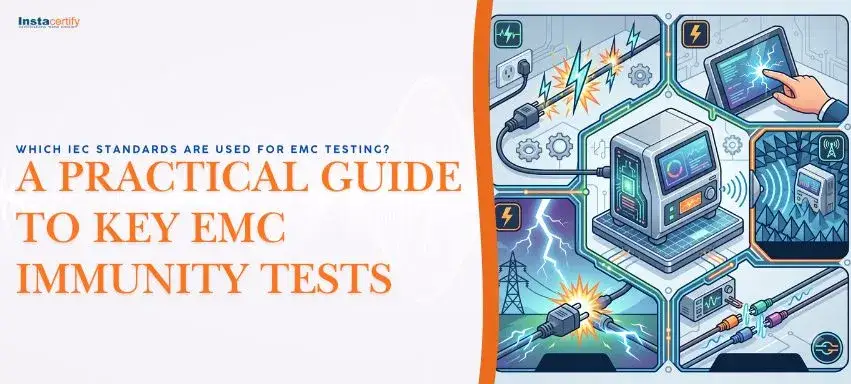
Modern electrical and electronic products are expected to operate reliably in environments filled with electromagnetic disturbances. A device may encounter electrostatic discharge from a person, electrical surges caused by switching or lightning, radio-frequency interference, fast electrical transients, or fluctuations in its power supply.
This is where Electromagnetic Compatibility (EMC) testing becomes important.
EMC testing evaluates whether an electrical or electronic product can function as intended when exposed to electromagnetic disturbances and, depending on the applicable requirements, whether its own electromagnetic emissions remain within acceptable limits.
The IEC 61000 series provides a major international framework for EMC testing. Within this series, the IEC 61000-4 family contains a range of basic test methods used to evaluate the immunity of equipment against specific electromagnetic phenomena. The exact tests and severity levels applicable to a product depend on its product standard, intended environment, power configuration and other technical characteristics.
For manufacturers, importers, exporters, product designers and compliance teams, understanding these standards is essential because EMC compliance is not simply a matter of performing one universal test. Different disturbances require different test methods.
This article explains some of the most frequently encountered IEC EMC immunity standards, including:
- IEC 61000-4-2 – Electrostatic Discharge (ESD)
- IEC 61000-4-3 – Radiated RF Electromagnetic Field Immunity
- IEC 61000-4-4 – Electrical Fast Transient/Burst
- IEC 61000-4-5 – Surge Immunity
- IEC 61000-4-6 – Conducted RF Immunity
- IEC 61000-4-11 – AC Voltage Dips, Short Interruptions and Variations
- IEC 61000-4-29 – DC Voltage Dips, Short Interruptions and Variations
What Is EMC Testing?
Electromagnetic Compatibility refers to the ability of equipment to operate properly within its electromagnetic environment without creating unacceptable electromagnetic disturbance for other equipment.
In practical terms, EMC involves two closely connected considerations:
1. Emissions
How much electromagnetic disturbance the equipment produces.
2. Immunity
How well the equipment continues to function when exposed to electromagnetic disturbances from external sources.
The IEC 61000 family addresses different aspects of EMC through basic, generic and other standards. For example, the IEC 61000-3 family addresses certain limits related to disturbances produced on public low-voltage supply systems, while the IEC 61000-4 family provides numerous testing and measurement techniques for immunity phenomena.
A manufacturer should therefore avoid assuming that every product requires exactly the same EMC test package. The applicable product or product-family standard normally determines which basic EMC tests are relevant and the corresponding performance criteria and test levels.
Key IEC Standards Used for EMC Immunity Testing
1. IEC 61000-4-2 – Electrostatic Discharge Immunity Test
Test phenomenon: Electrostatic discharge (ESD)
Electrostatic discharge is one of the most familiar forms of electromagnetic disturbance. It can occur when a person or object carrying static electricity comes into contact with equipment or when a discharge occurs near the equipment.
IEC 61000-4-2 establishes a standardized method for evaluating the immunity of electrical and electronic equipment against electrostatic discharges. The standard covers test levels, discharge characteristics, test equipment, test setup, procedures, calibration and measurement uncertainty.
Typical product concerns include:
- Touch-sensitive equipment
- Consumer electronics
- Control panels
- Industrial equipment
- Computer and IT equipment
- Medical and laboratory equipment
- Electronic instruments
The test helps determine whether an ESD event can cause issues such as temporary malfunction, loss of functionality, unexpected reset or other unacceptable behaviour.
Important update
The current IEC publication is IEC 61000-4-2:2025, which replaced the previous 2008 edition. The 2025 edition introduced several technical changes, including updated calibration requirements and additional guidance concerning test setups, wearable devices, test points and measurement uncertainty.
Therefore, manufacturers should verify which edition is referenced by their applicable product standard or regulatory requirement before testing.
2. IEC 61000-4-3 – Radiated Radio-Frequency Electromagnetic Field Immunity
Test phenomenon: Radiated RF electromagnetic fields
Electronic products can be exposed to electromagnetic fields generated by sources such as radio transmitters and other RF-emitting equipment.
IEC 61000-4-3 provides a standardized test method for assessing the immunity of electrical and electronic equipment to radiated radio-frequency electromagnetic fields. It establishes test levels and procedures for evaluating equipment under controlled RF field exposure.
The purpose is essentially to determine whether the product can continue to operate acceptably when exposed to defined electromagnetic fields.
This test can be particularly relevant for:
- Electronic control systems
- Industrial automation equipment
- Consumer electronics
- Information technology equipment
- Instrumentation
- Products containing sensitive digital electronics
- Equipment intended for environments with significant RF activity
Why is IEC 61000-4-3 important?
A product may operate correctly inside a laboratory under normal conditions but behave differently when exposed to an RF field. Radiated immunity testing creates a controlled environment in which this susceptibility can be evaluated.
The applicable product standard determines the appropriate test levels, frequency range and performance criteria.
3. IEC 61000-4-4 – Electrical Fast Transient/Burst Immunity Test
Test phenomenon: Electrical fast transients and bursts
Electrical switching operations can generate rapid transient disturbances. These disturbances may occur on power, signal, control or earth connections.
IEC 61000-4-4 provides a repeatable test method for evaluating equipment immunity against electrical fast transients and bursts. The standard addresses test waveforms, test levels, test equipment, verification, setup and procedures.
The test is particularly relevant to equipment connected to electrical infrastructure where switching activity may occur.
Examples include:
- Industrial controllers
- Automation equipment
- Power electronics
- Control systems
- Electronic appliances
- Measurement equipment
- Industrial machinery electronics
The objective is to determine whether rapid repetitive disturbances can cause unacceptable degradation in the equipment's operation.
What makes burst testing different from surge testing?
This distinction is important.
A burst test represents a sequence of rapid electrical transients, while a surge test represents a much higher-energy transient associated with phenomena such as switching and lightning effects.
Consequently, IEC 61000-4-4 and IEC 61000-4-5 should not be treated as interchangeable tests.
4. IEC 61000-4-5 – Surge Immunity Test
Test phenomenon: Surge caused by switching and lightning-related overvoltages
Electrical systems can experience high-energy transient disturbances resulting from switching operations or lightning-related effects.
IEC 61000-4-5 establishes a standardized method for evaluating the immunity of electrical and electronic equipment against specified surge conditions. It defines test levels, equipment, test setups and procedures for conducting the evaluation.
Surge testing is particularly significant for equipment connected to power networks or interconnection lines where transient overvoltages may occur.
Applications can include:
- Power supplies
- Industrial electronics
- Automation systems
- Electrical control equipment
- Communication equipment
- Consumer and commercial electronic products
- Equipment installed in electrically exposed environments
Why surge testing matters
Unlike a small transient disturbance, a surge can involve considerably more energy and can stress components such as:
- Power supply circuits
- Insulation
- Protection devices
- Input stages
- Communication interfaces
- Switching components
The purpose of the test is not simply to determine whether a component survives. It evaluates whether the equipment maintains the required level of functionality when exposed to the specified surge disturbance.
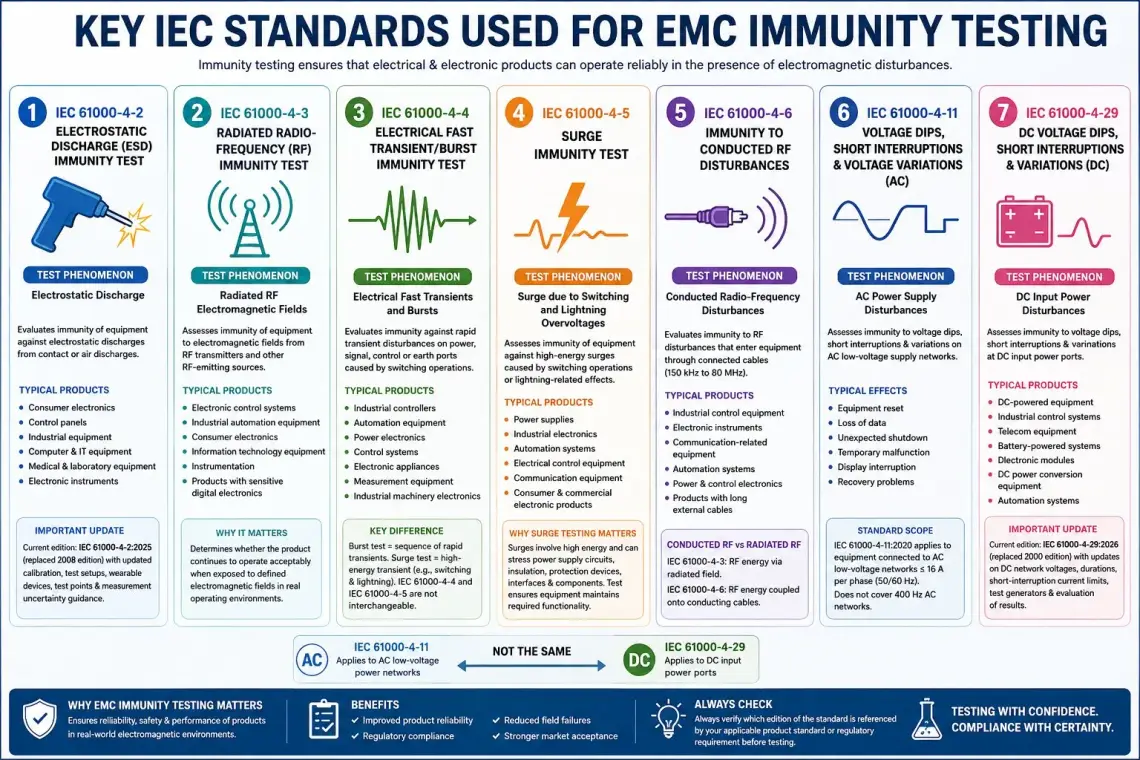
5. IEC 61000-4-6 – Immunity to Conducted RF Disturbances
Test phenomenon: Conducted radio-frequency disturbances
Not every electromagnetic disturbance reaches equipment through the air.
RF energy can also enter equipment through connected cables, including power, signal, control or other conducting connections.
IEC 61000-4-6 addresses immunity to conducted disturbances induced by radio-frequency fields. The current 2023 edition covers the conducted immunity of equipment to disturbances from intended RF transmitters, primarily within 150 kHz to 80 MHz, with additional provisions described in the standard for certain applications.
This makes the standard particularly relevant for products with external cables that can act as pathways for RF disturbances.
Potential applications include:
- Industrial control equipment
- Electronic instruments
- Communication-related equipment
- Automation systems
- Power and control electronics
- Products containing long external cables
Conducted RF vs. Radiated RF
The distinction between IEC 61000-4-3 and IEC 61000-4-6 is straightforward:
- IEC 61000-4-3: RF electromagnetic fields are applied to the equipment through a controlled radiated field.
- IEC 61000-4-6: RF disturbances are coupled onto conducting cables connected to the equipment.
Both tests address RF immunity, but they simulate different coupling mechanisms.
6. IEC 61000-4-11 – Voltage Dips, Short Interruptions and Voltage Variations
Test phenomenon: AC power supply disturbances
Electronic equipment connected to an AC power network may experience temporary reductions in supply voltage, short interruptions or voltage variations.
IEC 61000-4-11:2020 specifies immunity test methods and preferred test levels for equipment connected to low-voltage AC supply networks and rated at no more than 16 A per phase. The standard applies to 50 Hz and 60 Hz AC networks and does not cover equipment connected to 400 Hz AC networks.
This test is important because a product may not always receive a perfectly stable AC supply during real-world operation.
Potential effects of voltage disturbances can include:
- Equipment reset
- Loss of stored data
- Unexpected shutdown
- Temporary malfunction
- Display interruption
- Controller malfunction
- Recovery problems after supply restoration
IEC 61000-4-11 vs IEC 61000-4-29
These standards may sound similar, but their applications differ.
IEC 61000-4-11 focuses on applicable equipment connected to AC low-voltage power networks.
IEC 61000-4-29 focuses on voltage dips, short interruptions and voltage variations occurring at DC input power ports.
This distinction becomes especially important for products powered by DC systems, batteries or external DC power supplies.
7. IEC 61000-4-29 – DC Voltage Dips, Short Interruptions and Variations
Test phenomenon: DC input power disturbances
Many modern products operate from DC power rather than directly from an AC supply. Such products can experience voltage changes, short interruptions or dips on their DC input.
The latest IEC 61000-4-29:2026 specifies immunity test methods for voltage dips, short interruptions and voltage variations at DC input power ports. It applies to equipment and systems whose DC input ports are intended to connect to external low-voltage DC networks.
The 2026 edition is particularly important to note because it replaces the original 2000 edition and includes technical updates relating to DC network voltages, voltage-change durations, short-interruption current limitations, test-generator requirements and evaluation of test results.
Typical applications may include:
- DC-powered electronic equipment
- Industrial control systems
- Telecom-related equipment
- Battery-powered systems
- Electronic modules
- DC power conversion equipment
- Automation systems
The test determines whether the equipment can maintain the required performance when its DC supply experiences defined disturbances.
IEC 61000-4-2 to IEC 61000-4-29: At a Glance
IEC Standard | EMC Phenomenon | What It Evaluates |
IEC 61000-4-2 | Electrostatic discharge | Immunity against ESD events |
IEC 61000-4-3 | Radiated RF field | Immunity against radiated electromagnetic fields |
IEC 61000-4-4 | Electrical fast transient/burst | Immunity against repetitive fast transients |
IEC 61000-4-5 | Surge | Immunity against switching/lightning-related surges |
IEC 61000-4-6 | Conducted RF | Immunity against RF disturbances coupled through cables |
IEC 61000-4-11 | AC voltage dips/interruption/variation | Immunity to AC power disturbances |
IEC 61000-4-29 | DC voltage dips/interruption/variation | Immunity to DC input power disturbances |
Are These the Only IEC Standards Used for EMC Testing?
No.
The IEC 61000-4 family contains many additional EMC test methods covering different disturbance phenomena.
Depending on the product and applicable requirements, EMC evaluation may also involve standards addressing areas such as:
- Harmonics and interharmonics
- Voltage fluctuations and flicker
- Power-frequency magnetic fields
- Pulsed magnetic fields
- Damped oscillatory magnetic fields
- Common-mode disturbances
- Ring wave immunity
- Harmonic current emissions
- Voltage fluctuations
- Generic EMC requirements
- Product-specific EMC requirements
For example, IEC 61000-6-1 provides generic immunity requirements for residential, commercial and light-industrial environments when an applicable dedicated product or product-family immunity standard does not exist.
Similarly, generic emission standards such as IEC 61000-6-3 can become relevant where no dedicated product or product-family emission standard applies. The IEC published a new edition of IEC 61000-6-3 in 2026.
Therefore, simply selecting a few IEC 61000-4 tests does not automatically establish complete EMC compliance.
How Do You Determine Which EMC Tests Apply to Your Product?
One of the most common mistakes in EMC compliance is selecting tests solely from a generic list.
The correct test program should be established after considering the product's:
1. Product category
Different products can be governed by different product or product-family EMC standards.
2. Intended environment
A product designed for a residential environment may face different EMC requirements from equipment intended for industrial applications.
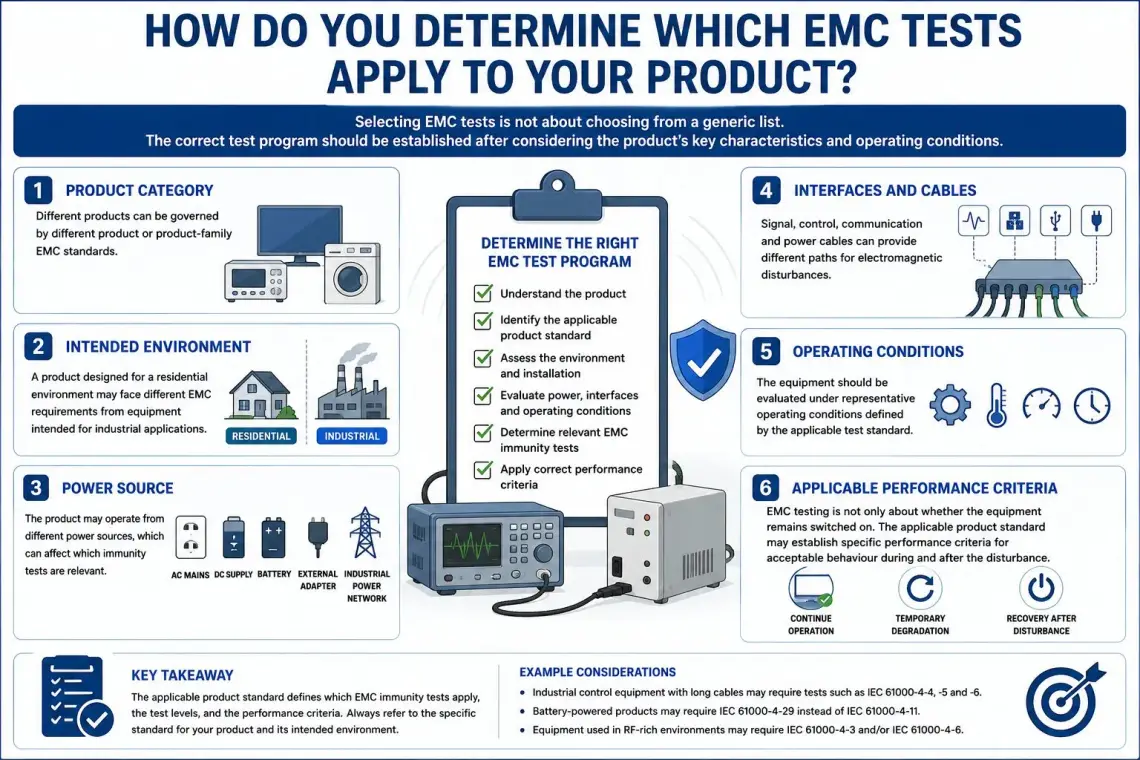
3. Power source
The product may operate from:
- AC mains
- DC supply
- Battery
- External adapter
- Industrial power network
This can affect which immunity tests are relevant.
4. Interfaces and cables
Signal, control, communication and power cables can provide different paths for electromagnetic disturbances.
5. Operating conditions
The equipment should be evaluated under representative operating conditions defined by the applicable test standard.
6. Applicable performance criteria
EMC testing is not only about whether the equipment remains switched on. The applicable product standard may establish specific performance criteria for acceptable behaviour during and after the disturbance.
Why EMC Testing Is Important for Manufacturers
EMC testing provides more than a laboratory test report.
A well-designed EMC assessment can help manufacturers:
Improve product reliability
Identify susceptibility to real-world electromagnetic disturbances before products reach customers.
Reduce redesign costs
Finding EMC weaknesses during product development is generally more efficient than discovering them after production.
Support regulatory compliance
Many markets require manufacturers to demonstrate that products meet applicable EMC requirements.
Improve market access
Internationally recognized standards can support technical documentation and conformity assessment for different markets.
Protect product reputation
A product that unexpectedly resets, shuts down or behaves incorrectly around other electrical equipment can create customer complaints and costly returns.
Frequently asked questions
What is the most common IEC standard for ESD testing?
IEC 61000-4-2 is the key IEC basic EMC standard for electrostatic discharge immunity testing. The current IEC publication is the 2025 edition.
Which IEC standard is used for radiated immunity?
IEC 61000-4-3 covers immunity to radiated radio-frequency electromagnetic fields. The current IEC publication is IEC 61000-4-3:2020.
Which standard covers EFT/burst testing?
IEC 61000-4-4 covers electrical fast transient/burst immunity testing.
Which IEC standard covers surge testing?
IEC 61000-4-5 covers surge immunity testing associated with specified transient overvoltage conditions, including switching and lightning-related effects.
What is IEC 61000-4-6 used for?
It is used to evaluate immunity against conducted RF disturbances coupled onto conducting cables connected to the equipment. The current edition is IEC 61000-4-6:2023.
What is the difference between IEC 61000-4-11 and IEC 61000-4-29?
IEC 61000-4-11 addresses specified voltage dips, short interruptions and variations on applicable AC low-voltage power networks, whereas IEC 61000-4-29 addresses these disturbances at DC input power ports.
Does every electronic product need all seven tests?
Not necessarily. The applicable product or product-family standard determines which tests are relevant. Factors such as product design, intended environment, power source, interfaces and operating conditions influence the final EMC test plan.