Instacertify
LM-79 and LM-80 Testing: The Complete Guide to LED Photometric and Lumen Maintenance Testing
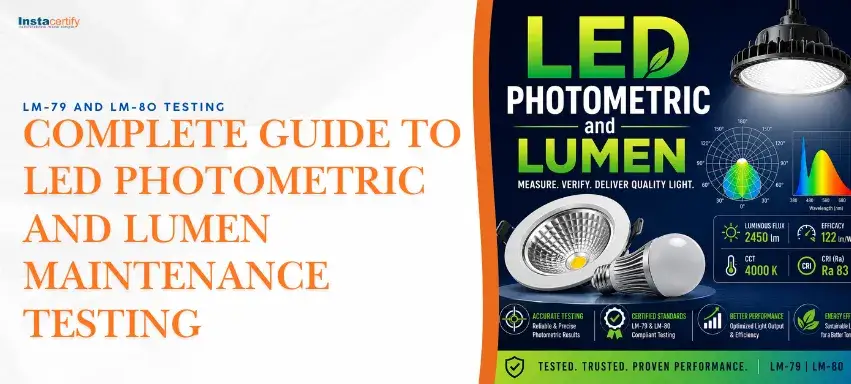
LED lighting has taken over the global market on the strength of three promises: high efficiency, accurate light quality, and a long service life. But a promise printed on a carton means nothing unless it is backed by test data generated under a recognized method. That is exactly what LM-79 and LM-80 — two test standards published by the Illuminating Engineering Society (IES) — were created to do.
If you manufacture, import, or export LED lamps or luminaires, these two reports are among the most frequently requested documents in your compliance file. Buyers ask for them. Tender authorities ask for them. Energy-labelling programs and certification schemes are built on them. This guide explains what each standard covers, how the testing is actually performed, and how Instacertify helps you get accredited LM-79/LM-80 test reports quickly and economically.
What is LM-79?
LM-79: currently published as ANSI/IES LM-79-19, “Approved Method: Optical and Electrical Measurements of Solid-State Lighting Products” — defines how the electrical and photometric performance of a complete solid-state lighting product is measured. It applies to LED luminaires, integrated LED lamps, LED light engines, and OLED lighting products.
The key idea behind LM-79 is absolute photometry: the entire product is tested as a whole, with its own driver and optics, rather than testing the light source separately and calculating the rest. This makes LM-79 data a true, comparable snapshot of what the product actually delivers out of the box.
What is Measured in an LM-79 Test?
Photometric (Optical) Parameters:
- Luminous flux: total light output in lumens
- Luminous efficacy: lumens per watt, the headline efficiency figure
- Luminous intensity distribution: how light is spread in space (candela values, beam and field angles), reported as .ies photometric files
- Chromaticity coordinates: the exact colour point (x, y and u′, v′)
- Correlated Colour Temperature (CCT): warm white, neutral, cool white
- Colour Rendering Index (CRI / Ra), including individual indices such as R9 (deep red rendering)
- Duv: deviation from the blackbody locus, an indicator of colour tint
Electrical Parameters:
- Input voltage, current and frequency
- Input power (watts)
- Power factor
- Total harmonic distortion (THD)
How is LM-79 Testing Performed?
Two instruments do the heavy lifting:
- Integrating sphere with spectroradiometer: the product is stabilized and operated inside a large sphere that captures all emitted light, giving total luminous flux, spectral data, CCT, CRI and chromaticity in a single measurement.
- Goniophotometer (typically Type C): the product is rotated through precisely controlled angles while a detector records intensity, producing the full spatial light distribution needed for street lights, flood lights, downlights and any application where beam shape matters.
The standard prescribes tight control over ambient temperature, airflow, product orientation, stabilization time and electrical supply, so that a report generated in one accredited laboratory is directly comparable to a report generated in another.
What is LM-80?
Where LM-79 is a snapshot, LM-80 is a movie. IES LM-80, “Approved Method: Measuring Luminous Flux and Color Maintenance of LED Packages, Arrays, and Modules” measures how the light output and colour of the LED source itself hold up over thousands of hours of continuous operation.
LM-80 applies to LED packages, arrays and modules — the components at the heart of a finished product — and is normally performed by or on behalf of the LED chip/module manufacturer.
What is Measured in an LM-80 Test?
- Lumen maintenance — the percentage of initial light output retained over time (lumen depreciation is the inverse)
- Colour shift — change in chromaticity over the test duration
- Behaviour at multiple case temperatures and drive currents — because heat is the number one enemy of LED longevity, LM-80 requires data at defined case temperatures so real-world thermal conditions can be evaluated
Testing runs for a minimum of 6,000 hours, with data collected at regular intervals; many manufacturers extend testing to 10,000 hours or more for stronger lifetime claims.
LM-80 and TM-21: How Lifetime Claims are Actually Made
LM-80 data on its own does not state a product’s life. Lifetime projections — the familiar L70, L80 and L90 figures (the hours at which output falls to 70%, 80% or 90% of initial) — are calculated by applying IES TM-21, the companion extrapolation method, to LM-80 data. When you see “50,000 hours (L70)” on a datasheet, a credible manufacturer is standing on an LM-80 report processed through TM-21. If a supplier quotes a long life but cannot produce the underlying LM-80 data, treat the claim with caution
LM-79 vs LM-80 at a Glance
Aspect | LM-79 | LM-80 |
What is tested | Complete product (luminaire, lamp, light engine) | LED package, array or module |
What it answers | How much light, of what quality, at what efficiency — today | How well output and colour hold up over time |
Duration | Hours (single measurement session) | Minimum 6,000 hours |
Key outputs | Lumens, efficacy, CCT, CRI, chromaticity, distribution, electrical data | Lumen maintenance and colour shift data at defined temperatures |
Used with | Product datasheets, certifications, tenders | TM-21 lifetime projection (L70 / L80 / L90) |
Why These Reports Matter for Market Access
LM-79 and LM-80 are voluntary test methods, but they sit underneath a long list of mandatory and voluntary schemes worldwide:
- India: LED product testing under IS 16102 (self-ballasted LED lamps) and the IS 10322 luminaire series draws on the same photometric parameters, and BEE star labelling for LED lamps requires performance data of exactly this kind from recognized laboratories. Government and EESL procurement tenders routinely demand LM-79 reports from NABL/ILAC-accredited labs.
- United States: LM-79 is the referenced test method for the FTC Lighting Facts label for general service lamps, and it is the required measurement standard for ENERGY STAR and the DesignLights Consortium (DLC) programs — the two gateways to utility rebates in the North American commercial lighting market.
- Export markets generally: buyers, specifiers and certification bodies across the EU, Middle East and Southeast Asia accept LM-79/LM-80 data as the common language of LED performance, provided the report comes from an ISO/IEC 17025 accredited laboratory.
The accreditation point deserves emphasis: an LM-79 report is only as strong as the laboratory behind it. Reports from ISO/IEC 17025 accredited facilities carry mutual recognition through ILAC, which is what allows a single test report to support certifications and tenders in multiple countries.
How Instacertify Can Be Your Partner for LM-79 and LM-80 Testing
Getting an LED product tested is rarely difficult; getting it tested at the right lab, at the right price, on a timeline that matches your launch or tender deadline is where most manufacturers and importers lose weeks. This is precisely the gap Instacertify closes.
- Testing exclusively through ISO/IEC 17025 accredited laboratories. Instacertify delivers LM-79 and LM-80 testing through its network of ISO/IEC 17025 accredited partner facilities, so every report you receive carries the accreditation needed for certifications, energy-labelling programs, government tenders and international buyers.
- Lab selection matched to your target market. Whether you are targeting the Indian market (BIS, BEE star labelling, EESL tenders), North America (ENERGY STAR, DLC), or export markets in the Middle East, Europe or Southeast Asia, Instacertify routes your samples to the partner laboratory whose accreditation and recognition best fit that market — so you test once and use the report where it counts.
- Transparent, competitive pricing. LM-79 testing through Instacertify’s partner facilities typically costs USD 120–250 per sample, depending on the size of the sample — a small LED bulb sits at the lower end, while large luminaires such as street lights and flood lights that require full goniophotometric distribution sit at the higher end. You receive a clear quotation before testing begins, with no hidden charges.
- Great timelines, every time. Because Instacertify works with multiple accredited facilities rather than a single in-house lab, your samples go to the laboratory with available capacity — not to the back of one lab’s queue. The result is consistently faster turnaround and dependable delivery dates you can plan a launch or tender submission around.
- End-to-end support. From advising which tests your product actually needs, to sample logistics, to reviewing the draft report before release, a dedicated Instacertify project manager handles the process so your team can stay focused on the product.
Get an LM-79 / LM-80 Quote Today
Share your product details — type, wattage, physical size and target market — and the Instacertify team will confirm the right test plan, the applicable partner laboratory, exact pricing within the USD 120–250 range, and a committed timeline, usually within one working day.
Contact Instacertify at to get your LED products tested, certified and market-ready.
Frequently asked questions
Is LM-79 testing mandatory in India?
LM-79 itself is a test method, not a regulation. However, LED lamps and luminaires sold in India face mandatory BIS requirements (e.g., IS 16102 series for self-ballasted LED lamps), BEE star labelling for LED lamps, and tender specifications from EESL and government buyers that frequently demand LM-79 reports from accredited laboratories.
How long does LM-79 testing take?
The measurement itself takes only hours per sample. Practical turnaround through Instacertify’s partner labs is typically a few working days to about two weeks, depending on lab capacity and product size — far faster than LM-80, which by definition runs a minimum of 6,000 hours.
What does LM-79 testing cost?
Through Instacertify’s ISO/IEC 17025 accredited partner facilities, LM-79 testing costs approximately USD 120–250 per sample depending on sample size, with the exact figure confirmed in advance based on your product and target market.
Do I need to run LM-80 testing myself?
Usually not. LM-80 applies to LED packages, arrays and modules and is normally performed by the LED component manufacturer. As a finished-product manufacturer, you typically obtain the LM-80/TM-21 data from your LED supplier and pair it with your own LM-79 report.
What is the difference between L70, L80 and L90?
These are lifetime projections calculated from LM-80 data using IES TM-21. L70 is the number of operating hours until light output falls to 70% of its initial value; L80 and L90 correspond to 80% and 90% respectively. A “50,000-hour L70” rating means the product is projected to retain at least 70% of its output at 50,000 hours.
Can one test report be used in multiple markets?
Often, yes. Reports from ISO/IEC 17025 accredited laboratories carry international recognition through ILAC mutual recognition arrangements. Instacertify selects the partner laboratory whose accreditation is accepted in your target market so a single report goes as far as possible.