Global Compliance
IP67 vs IP68 Testing: IEC 60529 Ratings, Process, Timeline & Cost Explained
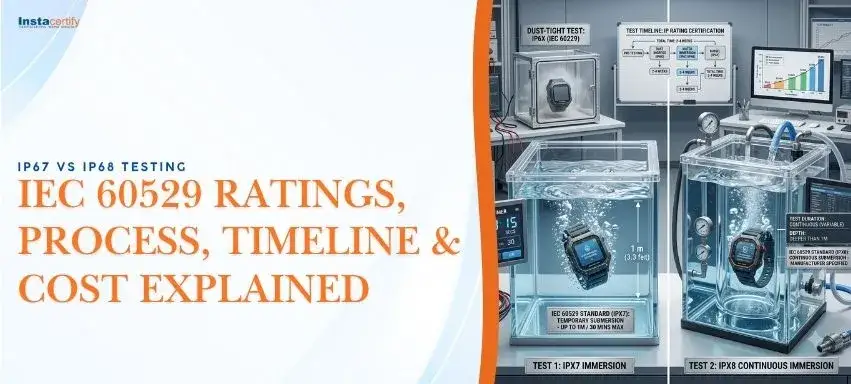
IP67 and IP68 both describe dust-tight enclosures that survive water immersion, but they are not interchangeable: IP67 is a fixed test — 1 metre of water for 30 minutes — while IP68 has no fixed depth or duration at all; the manufacturer sets the target and the lab tests to that claim. Getting this wrong on a datasheet or packaging is one of the most common ingress-protection mistakes exporters make. This guide breaks down what each digit of the IP code means, how the dust and water tests are actually performed, what documentation you need before you claim a rating, and what testing typically costs and takes in India.
[IMAGE PLACEHOLDER – IP67 vs IP68 comparison chart showing test depth, duration and typical use cases]Insert image here; add descriptive alt text with the primary keyword.
What does the IP code actually mean?
IP stands for Ingress Protection, and the rating comes from IEC 60529 (also published in India as IS/IEC 60529). Every IP rating has two digits after the letters: the first digit rates protection against solid objects and dust, the second rates protection against water. A device rated IP67 is dust-tight (6) and protected against temporary immersion (7); IP68 is dust-tight (6) with protection against continuous immersion under conditions the manufacturer specifies (8).
| Digit | What it protects against | Relevant grades |
|---|---|---|
| First digit | Solid particles and dust | 0 (none) up to 6 (dust-tight, no ingress at all) |
| Second digit | Water | 0 (none) up to 9K (high-pressure, high-temperature jets) |
| X in place of a digit | That aspect was not tested or is not being claimed | e.g., IPX7 means water-tested only, dust ingress not evaluated |
IP67 vs IP68: what is actually different
| Parameter | IP67 | IP68 |
|---|---|---|
| Dust protection | IP6X – fully dust-tight, verified in a dust chamber under vacuum/negative pressure with talc powder over a set exposure period | Same IP6X dust requirement as IP67 |
| Water test depth | Fixed at 1 metre, defined in IEC 60529 | Not fixed by the standard – the manufacturer declares the depth (commonly 1.5 m to 10 m for consumer electronics) |
| Water test duration | Fixed at 30 minutes | Not fixed by the standard – the manufacturer declares the duration, and the lab tests to that declared value |
| Who sets the test parameters | The standard itself | The manufacturer, which is then verified by the test lab and must be disclosed with the rating (e.g., "IP68, 1.5 m for 30 minutes") |
| Typical use case | Outdoor equipment, junction boxes, industrial sensors exposed to rain or accidental splashing/dunking | Smartphones, wearables, underwater cameras, devices marketed for swimming or diving use |
This is the detail most product listings get wrong: an "IP68" claim with no stated depth and duration is technically incomplete, and a buyer or regulator is entitled to ask for the test report before accepting the claim.
How the IP67 and IP68 tests are actually performed
Dust test (common to both)
The sample is placed in a sealed chamber with fine talc powder circulated by low-pressure air or drawn through by a vacuum pump connected to the enclosure. After the exposure period, the unit is opened and inspected — for a 6-rating, no dust may have entered at all, regardless of whether it would have affected the product's function.
Water test – IP67
The sample is fully submerged 1 metre below the water surface (measured to the lowest point of the enclosure) for 30 minutes at room temperature, then inspected for water ingress and tested for continued function.
Water test – IP68
The lab submerges the sample to the depth and for the duration the manufacturer specifies in the test request — this could be 1.5 metres for 30 minutes, or 3 metres for 1 hour, or any other combination the product is designed and marketed for. The rating certificate should always carry these declared conditions alongside "IP68," not the number alone.
[IMAGE PLACEHOLDER – lab technician submerging a device sample in an IP68 test chamber]Insert image here; add descriptive alt text with the primary keyword.
Step-by-step: getting an IP67 or IP68 test report
- Define the claim you want to make. Decide whether you need IP67 (fixed conditions) or IP68 (you set the depth and duration based on how the product is actually used and marketed).
- Share product drawings and seal details with the lab – gasket locations, port covers, button seals and any pressure-equalising vents.
- Submit samples – most labs ask for at least 2–3 units so dust and water tests, plus a function check, can run without one damaged sample invalidating the whole batch.
- Dust chamber test is run first since it is non-destructive if the unit passes.
- Water immersion test follows, at the fixed IP67 conditions or your declared IP68 conditions.
- Functional verification – the unit is checked for continued operation and internal dryness (often by partial disassembly) after each test.
- Test report and rating certificate are issued, stating the exact conditions tested – this is the document you should keep on file to support any IP claim on packaging, datasheets or e-commerce listings.
Documents and information the lab will ask for
- Product technical drawings showing seals, gaskets, seams and openings
- Bill of materials for sealing components
- Intended IP claim and, for IP68, the depth and duration you want verified
- Sample units (new, uncycled, unless durability-after-use testing is also required)
- Any prior IP or environmental test reports for reference
Cost and timeline
Ingress-protection testing is priced per sample configuration rather than as a flat fee — it depends on enclosure size, the number of samples, whether dust and water are tested together or separately, and whether IP68 conditions go beyond standard chamber depths. As a rough guide, a single-configuration IP67/IP68 test typically takes 3–7 working days once samples are received, with charges quoted after the lab reviews your drawings. Get an exact quote before committing.
Common mistakes to avoid
- Marketing "IP68" without stating the tested depth and duration
- Assuming an IP68 rating automatically covers IP67 conditions – it usually does, but only the specific tested configuration is technically certified
- Testing only water resistance and skipping the dust chamber, then still printing the full IP6X digit
- Ignoring that IP ratings apply to the unit as tested – a cracked case, a replaced battery door or a third-party accessory can invalidate the original rating
How Instacertify helps
Instacertify coordinates IP67 and IP68 ingress-protection testing through accredited testing partners, helping electronics manufacturers and importers define the right test conditions, prepare samples and documentation, and get a defensible test report before a product goes to market. See our electronics and electricals testing services and wireless device testing. Contact us for a free consultation and quote.
Frequently asked questions
What is the difference between IP67 and IP68?
IP67 is tested to a fixed condition: 1 metre of water for 30 minutes. IP68 has no fixed depth or duration under IEC 60529 — the manufacturer specifies the conditions, and the lab tests and certifies to that declared value.
Does IP68 automatically include IP67 protection?
In practice an IP68-rated product usually withstands IP67 conditions too, but formally the certificate only covers the exact configuration and conditions that were tested.
Which standard governs IP ratings?
IEC 60529 (adopted in India as IS/IEC 60529), which defines the two-digit Ingress Protection code for solids and water.
How long does IP67/IP68 testing take?
Typically 3–7 working days once samples and drawings are received, depending on how many configurations need testing.
Can I claim IP68 without stating a depth and duration?
You can, but it is an incomplete claim. A proper IP68 rating always specifies the tested depth and time, since the standard leaves those parameters open.