
Indian Compliance
LMPC Certificate in India: Complete Guide to Registration, Rules, Eligibility, Fees & Rule 27

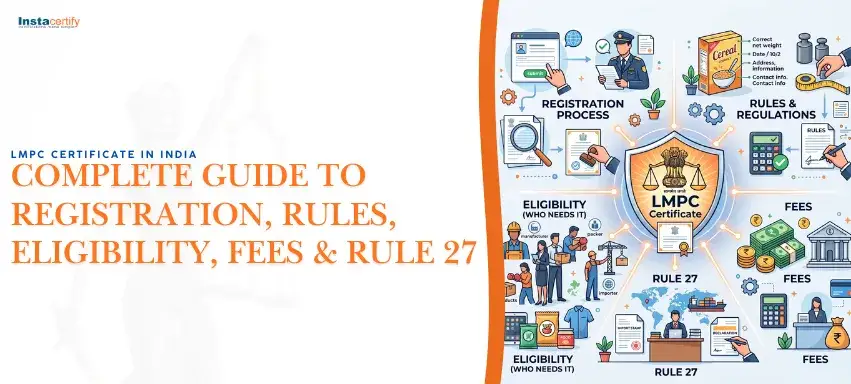
In today's highly regulated marketplace, businesses involved in importing, manufacturing, and packaging products must comply with various legal requirements before selling goods in India. One such important compliance is the LMPC Certificate. Whether you are an importer, manufacturer, e-commerce seller, or brand owner, understanding LMPC regulations is essential to avoid penalties and ensure smooth business operations.
This complete guide explains everything about the LMPC Certificate, including its meaning, registration process, rules, eligibility, fees, and the significance of Rule 27 under the Legal Metrology framework.
What is the LMPC Certificate?
LMPC stands for Legal Metrology Packaged Commodities Certificate.
The LMPC Certificate is issued under the Legal Metrology Act, 2009 and the Legal Metrology (Packaged Commodities) Rules, 2011. It is mandatory for importers who import pre-packaged commodities into India for sale, distribution, or delivery.
The certificate ensures that all packaged products sold in India carry accurate declarations regarding quantity, weight, price, manufacturing details, importer details, and other mandatory information.
Why is LMPC Important?
The primary objectives of LMPC registration are:
- Protect consumers from misleading packaging practices.
- Ensure transparency in product information.
- Prevent unfair trade practices.
- Standardize packaging and labeling requirements.
- Ensure accurate quantity declarations.
Without an LMPC Certificate, importers may face customs clearance issues, penalties, product seizures, or legal actions.
Who Needs an LMPC Certificate?
LMPC registration is generally required for:
Importers
Any business importing pre-packaged goods into India.
Manufacturers
Businesses manufacturing packaged products for sale.
Packers
Entities engaged in packing or repacking commodities.
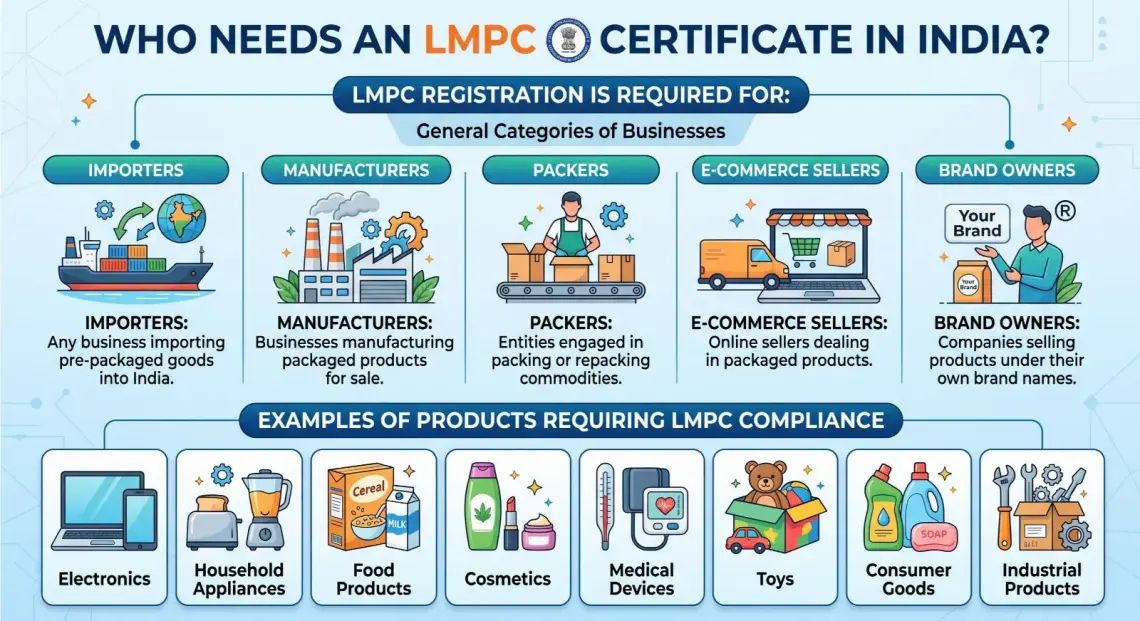
E-commerce Sellers
Online sellers dealing in packaged products.
Brand Owners
Companies selling products under their own brand names.
Examples of products requiring LMPC compliance include:
- Electronics
- Household appliances
- Food products
- Cosmetics
- Medical devices
- Toys
- Consumer goods
- Industrial products sold in packaged form
How Do I Get an LMPC Certificate?
Obtaining an LMPC Certificate involves a systematic registration process. The process may vary slightly from one state to another, but the overall procedure remains similar.
Step 1: Prepare Required Documents
Applicants must collect and arrange all necessary documents before filing the application.
Common documents include:
- Import Export Code (IEC)
- GST Registration Certificate
- PAN Card of the company
- Company Incorporation Certificate
- Memorandum and Articles of Association
- Address Proof of Business Premises
- Identity Proof of Authorized Signatory
- Passport-sized photographs
- Product details
- Packaging label samples
- Authorization Letter
Step 2: File the Application
The importer or authorized representative must submit the LMPC application to the concerned State Legal Metrology Department.
The application should contain:
- Applicant details
- Business address
- Nature of business
- Product information
- Packaging details
Step 3: Document Verification
The Legal Metrology Department scrutinizes all submitted documents to verify compliance with applicable rules.
Authorities may seek additional information if required.
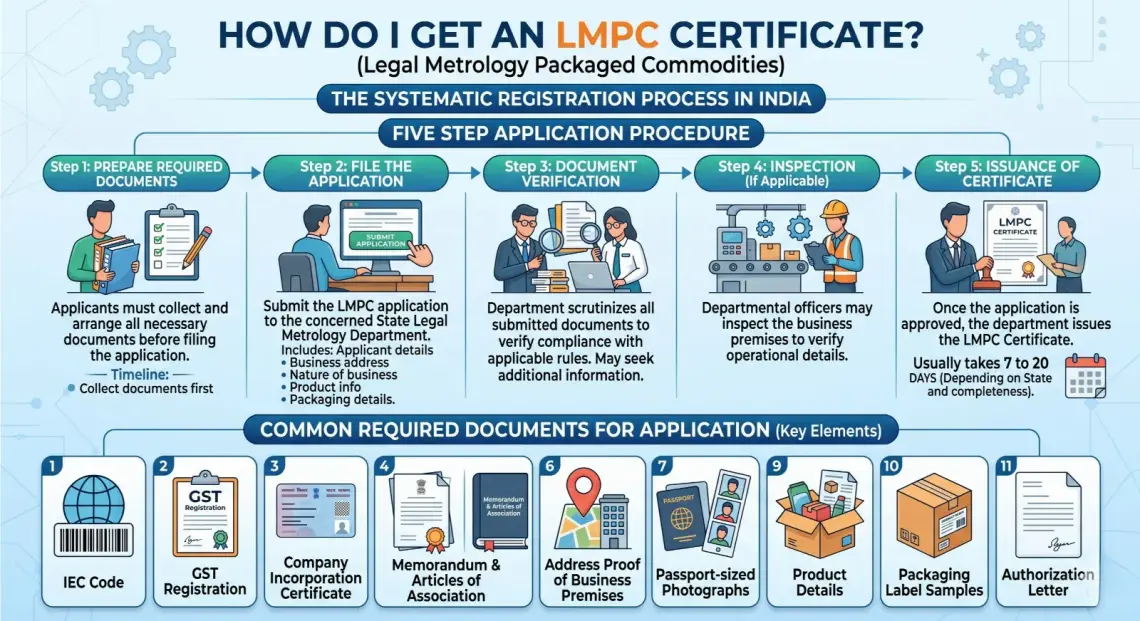
Step 4: Inspection (If Applicable)
In some cases, departmental officers may inspect the business premises to verify operational details.
Step 5: Issuance of Certificate
Once the application is approved, the department issues the LMPC Certificate.
The entire registration process usually takes between 7 to 20 working days, depending upon the state authority and document completeness.
What Are LMPC Rules?
LMPC Rules refer to the provisions laid down under the Legal Metrology (Packaged Commodities) Rules, 2011.
These rules govern packaging, labeling, declarations, and sale of packaged commodities in India.
Some important LMPC rules include:
1. Mandatory Declarations on Packages
Every package must prominently display:
- Name and address of manufacturer/importer/packer
- Common or generic name of commodity
- Net quantity
- Maximum Retail Price (MRP)
- Date of manufacture/import/packing
- Customer care details
- Country of origin (for imported products)
2. Standard Units Requirement
Weight, length, area, and volume must be declared using standard units prescribed under the Legal Metrology Act.
Examples include:
- Kilogram (kg)
- Gram (g)
- Liter (L)
- Meter (m)
3. Font Size Requirements
Declarations must appear in a clear, legible, and conspicuous manner using prescribed font sizes.
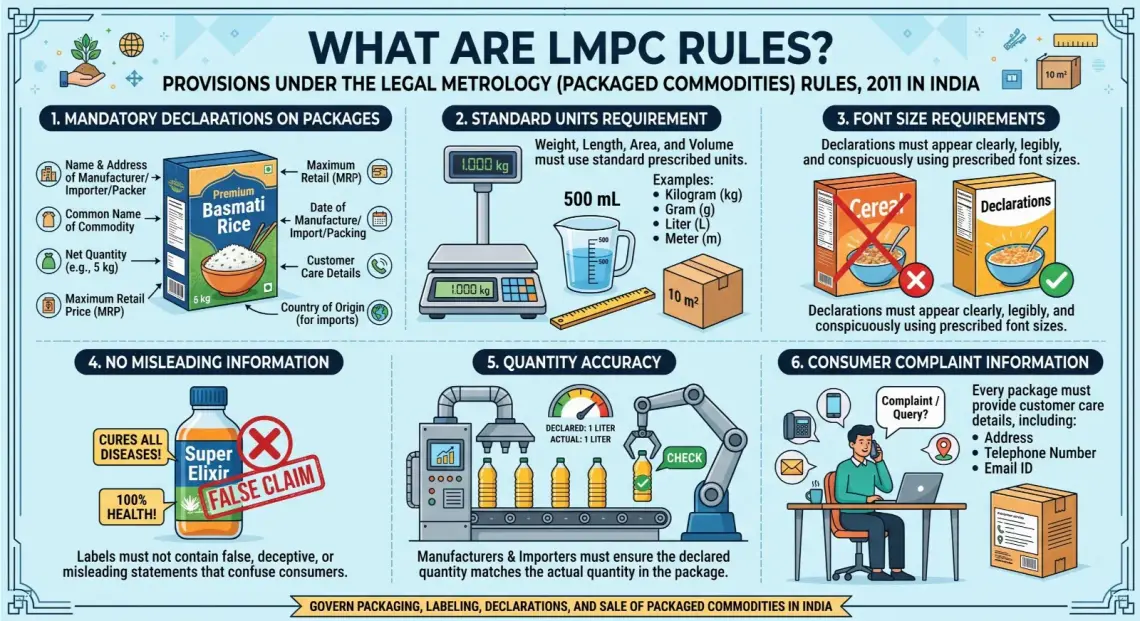
4. No Misleading Information
Labels must not contain false, deceptive, or misleading statements that can confuse consumers.
5. Quantity Accuracy
Manufacturers and importers must ensure that the quantity declared on the package matches the actual quantity contained in the package.
6. Consumer Complaint Information
Every package must provide customer care details, including:
- Address
- Telephone Number
- Email ID
These details help consumers register complaints or seek information.
Who is Eligible for LMPC Registration?
Any business entity involved in importing, manufacturing, packaging, or selling pre-packaged commodities can apply for LMPC registration.
Eligible entities include:
Private Limited Companies
Companies registered under the Companies Act.
Limited Liability Partnerships (LLPs)
Businesses registered as LLPs are fully eligible for LMPC registration.
Partnership Firms
Traditional partnership businesses engaged in packaging or importing activities.
Sole Proprietorship Firms
Individual business owners involved in pre-packaged commodity business.
One Person Companies (OPCs)
Single-owner corporate entities.
Manufacturers and Importers
Domestic manufacturers and overseas product importers.
Who is Eligible for LLP?
An LLP (Limited Liability Partnership) is a business structure combining features of both partnership firms and companies.
The following persons are eligible to form an LLP:
- Minimum two designated partners.
- Individuals above 18 years of age.
- Indian citizens and foreign nationals.
- Body corporates or companies.
- Entrepreneurs, professionals, consultants, and startups.
Basic Requirements for LLP Registration
- Minimum two partners.
- At least one resident Indian partner.
- Registered office address.
- PAN and identity documents.
LLPs are widely preferred due to:
- Limited liability protection.
- Separate legal identity.
- Lower compliance burden.
- Operational flexibility.
What is Rule 27 of LMPC?
Rule 27 of the Legal Metrology (Packaged Commodities) Rules, 2011 deals with the Registration of Importers.
According to Rule 27:
Every importer of pre-packaged commodities intended for sale, distribution, or delivery in India must register with the Director or Controller of Legal Metrology.
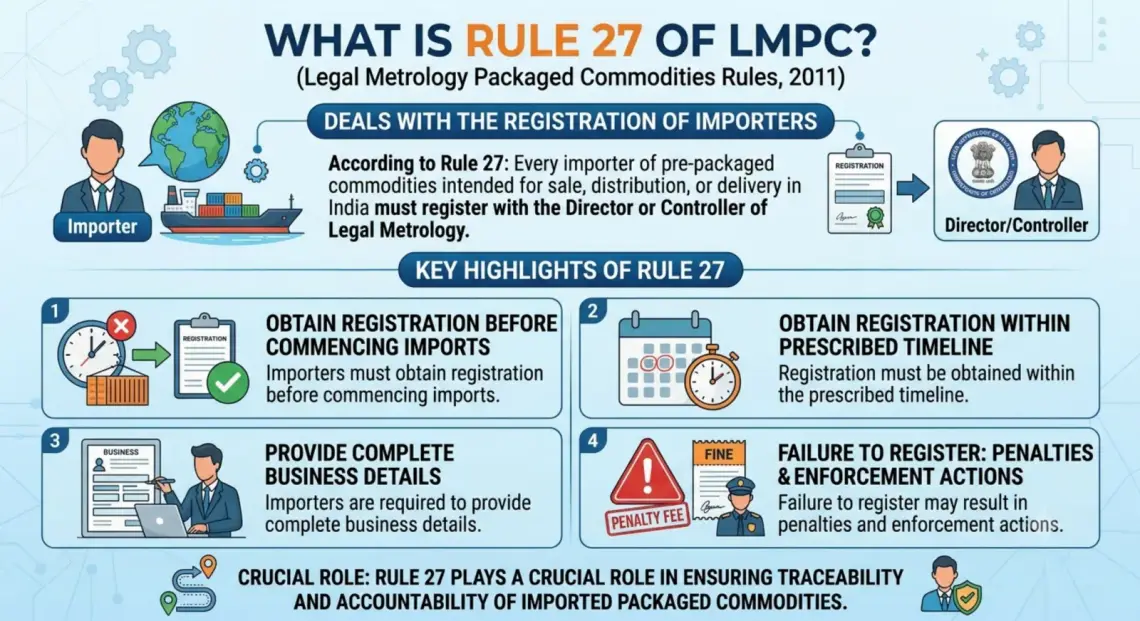
Key Highlights of Rule 27
- Importers must obtain registration before commencing imports.
- Registration must be obtained within the prescribed timeline.
- Importers are required to provide complete business details.
- Failure to register may result in penalties and enforcement actions.
Rule 27 plays a crucial role in ensuring traceability and accountability of imported packaged commodities.
How to Get an LLP Certificate?
Registering an LLP in India involves the following steps:
Step 1: Obtain Digital Signature Certificate (DSC)
All designated partners must obtain DSCs for electronic filing.
Step 2: Apply for Director Identification Number (DIN)
Designated partners must obtain DIN through the Ministry of Corporate Affairs.
Step 3: Reserve LLP Name
File an application to reserve the proposed LLP name.
Step 4: Incorporation Filing
Submit incorporation forms along with required documents to the Ministry of Corporate Affairs.
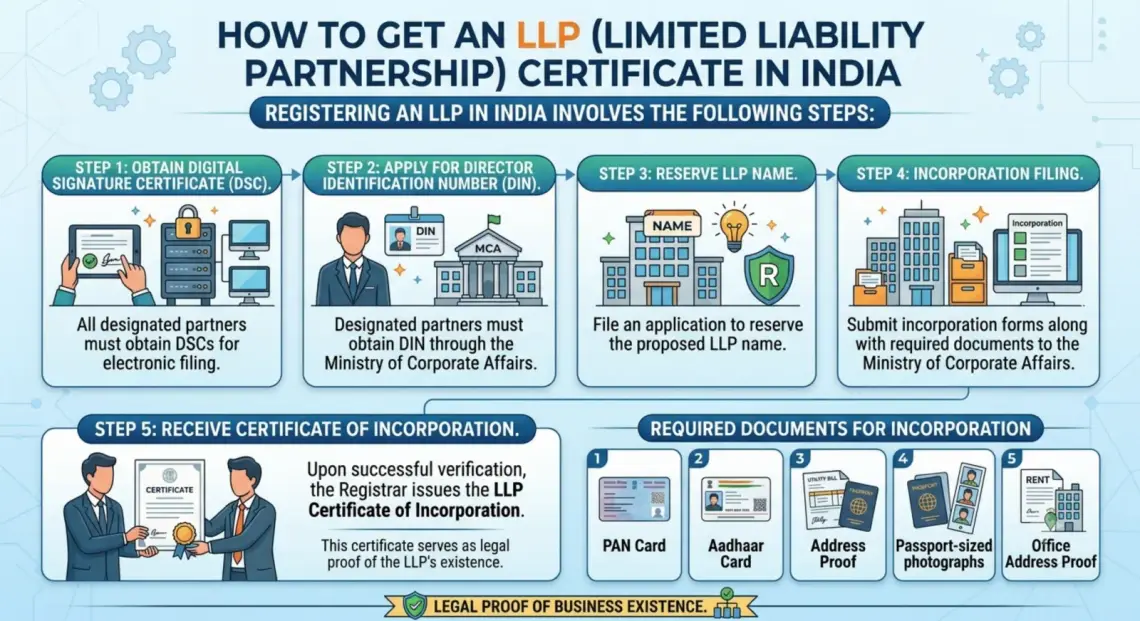
Required documents include:
- PAN Card
- Aadhaar Card
- Address Proof
- Passport-sized photographs
- Office address proof
Step 5: Receive Certificate of Incorporation
Upon successful verification, the Registrar issues the LLP Certificate of Incorporation.
This certificate serves as legal proof of the LLP's existence.
What is the Fee for LMPC Registration?
LMPC registration fees vary from state to state because Legal Metrology is administered by respective state authorities.
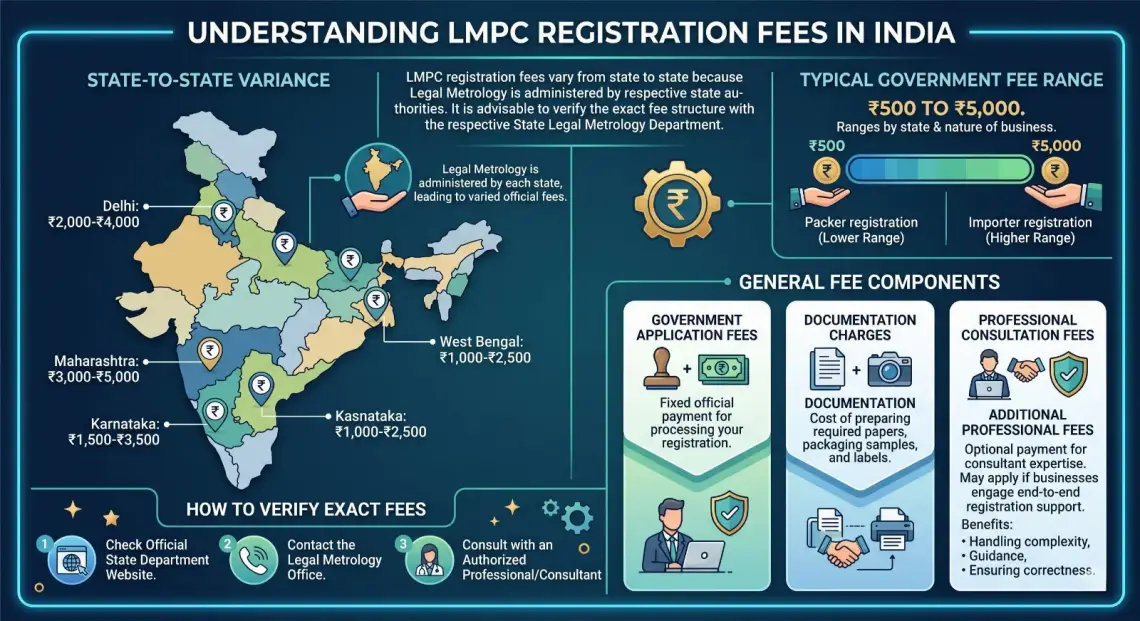
Generally, fees may include:
- Government application fees.
- Professional consultation charges.
- Documentation charges.
The government fee typically ranges from ₹500 to ₹5,000, depending on the state and nature of registration.
Additional professional fees may apply if businesses engage consultants for end-to-end registration support.
It is advisable to verify the exact fee structure with the respective State Legal Metrology Department.
Penalties for Non-Compliance
Businesses failing to comply with LMPC requirements may face:
- Monetary penalties.
- Product seizure.
- Customs clearance delays.
- Suspension of business activities.
- Legal prosecution.
Therefore, obtaining timely LMPC registration is essential for uninterrupted business operations.
Conclusion
The LMPC Certificate is an essential compliance requirement for businesses dealing with pre-packaged commodities in India. It ensures transparency, consumer protection, and fair trade practices while enabling smooth market access.
Whether you are an importer, manufacturer, LLP, startup, or e-commerce seller, understanding LMPC rules and obtaining timely registration can help avoid penalties and enhance customer trust.
Businesses planning to import packaged products into India should ensure full compliance with Rule 27 and other Legal Metrology requirements to operate seamlessly and legally in the Indian market.
Frequently asked questions
Why is LMPC compliance important for businesses?
LMPC compliance enhances consumer trust, ensures transparency, prevents unfair trade practices, and helps businesses avoid legal complications. It also enables smooth product distribution and uninterrupted access to the Indian market.
Does LMPC registration help in customs clearance?
Yes, LMPC registration significantly facilitates customs clearance for imported packaged commodities. Customs authorities may ask for LMPC registration proof during import procedures to verify compliance with Indian packaging and labeling regulations.
Is there any penalty for incorrect package labeling?
Yes, incorrect or misleading labeling may attract penalties under the Legal Metrology Act and Packaged Commodities Rules. Authorities may impose fines, seize products, or initiate legal action against non-compliant businesses.
Is LMPC registration applicable to manufacturers?
Yes, manufacturers involved in producing pre-packaged commodities for sale in India must comply with Legal Metrology regulations. They must ensure accurate labeling, quantity declarations, and other mandatory information on product packaging.
Can LMPC registration be renewed?
Yes, LMPC registration can be renewed as per the applicable provisions and state-specific guidelines. Businesses should apply for renewal before the expiry date to avoid penalties and ensure continued legal compliance.
How long is an LMPC Certificate valid?
The validity of an LMPC Certificate may vary depending on the state authority issuing it. Businesses should monitor renewal requirements and renew their registration on time to maintain uninterrupted compliance with Legal Metrology regulations.
Is LMPC registration required for e-commerce sellers?
Yes, e-commerce sellers dealing with pre-packaged commodities must ensure that their products comply with Legal Metrology requirements. Proper labeling and mandatory declarations are essential for selling products through online marketplaces in India.