Global Compliance
LWG Certification in India: Audit Levels (Gold/Silver/Bronze), Cost & Traceability Requirements
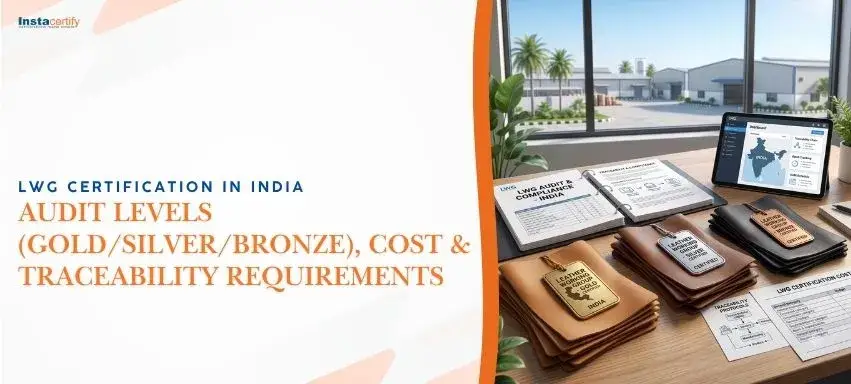
LWG (Leather Working Group) certification is an environmental and traceability audit for tanneries, leather traders and finishing units, rated Gold, Silver, Bronze or Audited. Global brands such as Nike, Adidas, H&M, Timberland, Zara and Clarks require LWG-rated leather from their suppliers. The audit covers water, energy, chemicals (including Chromium VI), effluent, waste and the ability to trace hides back to the slaughterhouse. This guide explains the levels, what auditors check, how much an LWG audit costs in India and how to prepare.
[IMAGE PLACEHOLDER – Graphic: LWG rating levels Gold 85% / Silver 75% / Bronze 65% / Audited 50%]
Insert image here; add descriptive alt text with the primary keyword.
What is LWG? (LWG full form and background)
LWG stands for Leather Working Group, a UK-based multi-stakeholder organisation of brands, retailers, tanners, chemical suppliers and NGOs founded in 2005. It publishes the Leather Manufacturer Standard (currently Protocol 7 / P7) and related standards for traders, subcontractors and commissioning manufacturers. LWG Assurance Services, set up in 2025, now administers audits, which may only be performed by LWG-approved auditors.
Who needs LWG certification?
- Tanneries / leather manufacturers converting raw or wet-blue hides into crust or finished leather – the core Leather Manufacturer Standard.
- Commissioning manufacturers that own the leather but outsource processing.
- Leather traders (raw, wet-blue, crust or finished) – rated "Approved".
- Subcontractors performing part-processes such as finishing or splitting – rated "Audited".
Indian clusters in Kanpur, Unnao, Chennai (Ambur, Ranipet, Vaniyambadi), Kolkata (Bantala), Jalandhar and Agra supply footwear, gloves, garments and leather goods to buyers who now make LWG a condition of order.
LWG audit levels and scoring
| Rating | Minimum overall score | What it signals |
|---|---|---|
| Gold | 85% | Best-in-class environmental performance; preferred by premium brands |
| Silver | 75% | Strong performance with some improvement areas |
| Bronze | 65% | Meets baseline; typical first-audit outcome for well-run Indian tanneries |
| Audited | 50% | Compliant but below medal thresholds |
The lowest-scoring section caps the rating: a facility cannot be Gold overall if any scored section falls below the Gold threshold. Traceability is scored separately and reported alongside the environmental rating.
What does the LWG audit cover?
Protocol 7 has 17 sections. The main ones auditors examine are:
- General facility details and operating permits – Consent to Operate, hazardous-waste authorisation, water abstraction rights.
- Production data – square-feet of leather produced, used to normalise consumption figures.
- Incoming and outgoing material traceability – see below.
- Environmental management system – policy, objectives, monitoring and ISO 14001 alignment.
- Restricted substances and Chromium VI management – RSL/MRSL compliance, ZDHC chemical inventory, Cr(VI) prevention and testing.
- Energy consumption – MJ per m² of leather; renewable share.
- Water usage – litres per m²; recycling.
- Air and noise emissions, waste management and effluent treatment – ETP/CETP performance, sludge handling, discharge consents.
- Health, safety and emergency preparedness and chemical management – storage, SDS, PPE, spill control.
- Social audit – evidence of a recognised social compliance audit.
LWG traceability requirements explained
Buyers increasingly ask for the traceability score as much as the medal. Under P7 a tannery must show it can trace incoming material back to a specific slaughterhouse through physical marking on hides and matching documentation (purchase records, batch numbers, lot cards). Percentages of traceable material are scored in bands; sourcing from traders who are themselves LWG-Approved makes this far easier. Downstream, outgoing leather must be traceable to the customer and batch. For Indian tanneries buying through hide merchants, setting up supplier declarations and lot marking is usually the single largest preparation task.
[IMAGE PLACEHOLDER – Flowchart: LWG audit process from gap assessment to published rating]
Insert image here; add descriptive alt text with the primary keyword.
LWG certification process: step by step
1. Gap assessment
Instacertify walks the plant against the P7 checklist, identifies missing permits, monitoring data and traceability records, and estimates the likely rating.
2. Data collection (12 months)
Auditors need 12 months of energy, water, chemical and production data for a first audit (24 months thereafter). Meters, logs and ETP records must be in order.
3. Corrective actions
Typical fixes: ZDHC MRSL-conformant chemical inventory, Cr(VI) control procedure, hazardous-waste manifests, emergency drills, traceability procedure and lot marking.
4. Application to LWG Assurance Services and auditor allocation
The tannery applies, pays the audit fee and an LWG-approved auditor is assigned.
5. On-site audit (2–3 days)
Document review, plant walk-through, ETP inspection, interviews and sample testing.
6. Report and rating
The report is published on the LWG website with the medal and traceability score.
LWG audit cost in India
Costs have three parts: the LWG audit fee (set by LWG, paid in GBP/USD and depending on facility size), the auditor's time and travel, and your preparation and testing. As an indicative budget for an Indian tannery:
| Cost item | Indicative range |
|---|---|
| LWG audit fee + auditor days (medium tannery) | ₹3,00,000 – ₹6,00,000 |
| Gap assessment and documentation support | ₹1,00,000 – ₹2,50,000 |
| Effluent, Cr(VI) and chemical testing (accredited lab) | ₹40,000 – ₹1,50,000 |
| ETP / metering / infrastructure upgrades | Site-specific |
Certificates are valid for 24 months for manufacturers (12 months for a first audit using 12 months of data, and for part-processed traders), so budget for re-audit every two years.
Important notice for Kolkata tanneries
LWG suspended certifications linked to the Bantala CETP (Kolkata Leather Complex) from 18 July 2025 due to effluent-treatment concerns. Units in that cluster should speak to us about the current position before applying.
How Instacertify supports LWG certification
Instacertify Labs provides LWG gap assessment, environmental data systems, chemical-management (ZDHC) alignment, effluent and Cr(VI) testing through ISO/IEC 17025-accredited partner labs, traceability procedure design and audit-day support for tanneries and traders across India. Related services: Halal certification, Consent to Operate (CTO) and ISO 14001.
Book an LWG gap assessment – we will tell you within a week which medal is realistic and what it will take.
Frequently asked questions
What is LWG certification?
An audit-based environmental and traceability rating for leather manufacturers, traders and subcontractors under the Leather Working Group's standards, awarded as Gold, Silver, Bronze or Audited.
Is LWG certification mandatory in India?
No legal mandate exists, but most international footwear, apparel and leather-goods brands require LWG-rated leather, so exporters cannot do without it.
How long is LWG certification valid?
24 months for leather manufacturers, commissioning manufacturers and subcontractors; 12 months for part-processed material traders and for a first audit based on 12 months of data.
What score is needed for LWG Gold?
An overall score of at least 85%, with every scored section also meeting the Gold threshold.
What is LWG traceability?
The ability to trace hides back to a specific slaughterhouse through physical marking and documentation, scored separately from the environmental rating.
How much does an LWG audit cost?
For a medium-sized Indian tannery, roughly ₹3–6 lakh for the audit itself plus preparation, testing and any plant upgrades.