Global Compliance
MSDS for Amazon Sellers: Requirements, Documents, Fees and Listing Reactivation Guide 2026

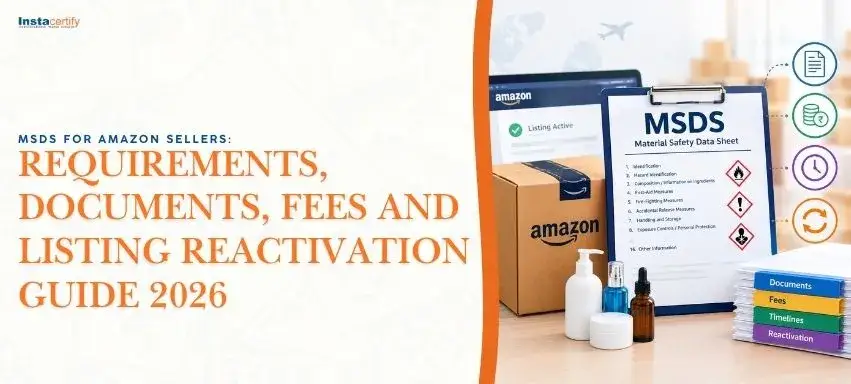
If your Amazon listing has been deactivated or blocked with a message asking you to submit a Safety Data Sheet (SDS) or Material Safety Data Sheet (MSDS) for your product or its ingredients, you are not alone. Hazmat and dangerous-goods gating is one of the most common reasons Amazon suspends otherwise healthy listings — and one of the fastest to resolve, provided the document you upload is technically correct the first time.
This guide explains exactly what Amazon is asking for, what information you need to gather, who is qualified to prepare the document, what it costs, and how long it takes.
What is an MSDS?
An MSDS (Material Safety Data Sheet) — now formally called an SDS (Safety Data Sheet) — is a structured technical document that describes the chemical composition of a product, the hazards it presents, and how it should be handled, stored, transported and disposed of safely.
The document follows a globally standardised 16-section format defined under the GHS (Globally Harmonized System of Classification and Labelling of Chemicals):
Section | Contents |
1 | Identification of the substance / mixture and of the supplier |
2 | Hazard identification |
3 | Composition / information on ingredients |
4 | First-aid measures |
5 | Fire-fighting measures |
6 | Accidental release measures |
7 | Handling and storage |
8 | Exposure controls / personal protection |
9 | Physical and chemical properties |
10 | Stability and reactivity |
11 | Toxicological information |
12 | Ecological information |
13 | Disposal considerations |
14 | Transport information |
15 | Regulatory information |
16 | Other information |
The older term "MSDS" came from a pre-GHS era when formats varied by country. Since GHS adoption, the correct term is SDS — but Amazon, freight forwarders and buyers still use both interchangeably, so treat them as the same thing.
Is there such a thing as an "MSDS certificate"?
This is worth clearing up, because a lot of sellers are sold the wrong thing.
An MSDS is a document, not a certificate. There is no government authority that issues it, no registration number, and no online portal where its validity can be verified. Anyone claiming to issue a "government-approved MSDS certificate" is misrepresenting the requirement.
What actually matters is that the SDS is authored by a competent person, is technically accurate, is classified under the correct regulation for the country you are selling in, and matches your product exactly. That is what Amazon’s reviewers check — not a certificate number.
Why does Amazon require an MSDS?
Amazon stores millions of units across fulfilment centres and moves them by road and air. A single mislabelled flammable liquid or lithium cell can shut down a warehouse. Amazon therefore collects hazard data on every product it handles, so that it can:
- Determine whether your product is a dangerous good (hazmat) under transport regulations.
- Assign the correct UN number, hazard class and packing group, if it is regulated.
- Decide storage placement and handling procedures inside the fulfilment centre.
- Prepare a spill or fire response if the product leaks or ignites.
- Confirm the product is NOT regulated, so it can move through the normal network.
That last point is important and often misunderstood: an SDS is frequently required to prove your product is safe, not to prove it is hazardous. A shampoo, a face serum or a scented candle may be entirely non-regulated — but Amazon will not assume that. It needs the data.
When Amazon asks for it
- At listing creation on FBA, when the category or ingredient list triggers a hazmat review
- During a catalogue audit, when Amazon re-screens existing ASINs
- After a customer or carrier complaint about leakage, odour or damage
- When your listing is deactivated and appears in Account Health with an SDS request
- When you apply to the FBA Dangerous Goods programme
Major product categories that require an MSDS on Amazon
Amazon’s hazmat screening is triggered by ingredients, not by category name — but in practice these categories account for the overwhelming majority of SDS requests.
Highest volume
- Beauty and personal care — perfumes, deodorants, body sprays, nail polish and removers, hair sprays, serums, sunscreens, alcohol-based toners. This is the single largest source of SDS requests on Amazon.
- Household and cleaning chemicals — detergents, disinfectants, floor and toilet cleaners, drain openers, degreasers, bleach.
- Aerosols and pressurised products — air fresheners, dry shampoos, spray paints, insect sprays, deodorant sprays.
- Batteries and battery-powered goods — power banks, lithium-ion cells, electronics with embedded batteries. These generally need a battery exemption sheet rather than a full SDS, unless the exemption is rejected.
Consistently gated
- Essential oils, aromatherapy, incense sticks and candles — flammable liquids and flammable solids
- Automotive and industrial — engine oils, lubricants, coolants, brake fluid, adhesives, sealants, paints, thinners
- Agrochemicals and pest control — insecticides, pesticides, fertilisers, rodenticides, mosquito repellents
- Nutraceuticals and food additives — flavour concentrates, extracts with alcohol carriers, certain supplements
- Art, craft, stationery and printing — adhesives, resins, markers, printer inks, toners and cartridges
- Pool, garden and pet care — chlorine tablets, pH adjusters, flea and tick treatments
Less obvious but frequently flagged
Magnetised items (speakers, magnetic toys), matches and lighters, hand sanitisers, sports goods with CO₂ cartridges or compressed gas, apparel with chemical finishes and stiffeners, and dry ice or gel-pack shipments.
SDS or exemption sheet — which one do you need?
Amazon accepts a simpler exemption sheet in place of a full SDS in only two situations.
Situation | Document needed |
Product is, contains, or is powered by a battery | Battery exemption sheet |
Product contains no hazardous or flammable chemicals | Non-hazardous exemption sheet |
Product contains any chemical, oil, alcohol, aerosol or reactive ingredient | Full 16-section SDS |
Exemption sheets are downloaded from Seller Central and can cover up to 10 ASINs at a time — which makes them cost-effective for large electronics catalogues. Chemical and cosmetic catalogues, on the other hand, need one SDS per formulation, because the composition differs between products. If your exemption sheet is rejected, Amazon will escalate and demand a full SDS.
What Amazon actually checks (and why documents get rejected)
Uploading an SDS is not the same as uploading an acceptable SDS. The most common rejection reasons are:
- Product name mismatch — the SDS names a bulk raw material or a different SKU than the ASIN. The product name, brand and manufacturer on the SDS must match the listing.
- Outdated document — Amazon generally expects an SDS revised within the last three to five years. Old sheets in pre-GHS format are rejected outright.
- Missing sections — anything short of the full 16 sections is rejected.
- No GHS/CLP classification — Section 2 must carry proper hazard statements (H-codes), precautionary statements (P-codes), signal word and pictograms, or a clear statement that the product is not classified.
- Wrong regulatory basis — an Indian-format SDS uploaded to Amazon EU, or a US OSHA sheet uploaded to Amazon UK.
- Ingredient SDS missing — where Amazon has asked for "SDS of all ingredients", a single finished-product SDS will not close the case.
- No transport data — Section 14 left blank or marked "not applicable" without justification.
Documents and information required to prepare an MSDS
To author a defensible SDS, the following inputs are needed. The more complete these are, the faster and more accurate the outcome.
Mandatory
- Full ingredient breakdown with percentages — the complete formulation, including carriers, solvents, preservatives and fragrances
- CAS numbers for each ingredient (and EC/EINECS numbers for EU markets)
- Product name, brand name and manufacturer/importer details exactly as they appear on the Amazon listing
- Intended use and target market(s)
- Packaging details — container type, material, net volume or weight
Strongly recommended
- Certificate of Analysis (COA) for the finished product or key raw materials
- Supplier SDS for each raw material — the primary source for toxicological and ecological data
- Physico-chemical test data — flash point, pH, density, boiling point, viscosity, appearance and odour
- Existing product label artwork
- The exact rejection or deactivation notice text received from Amazon
Where flash point matters most: any product containing alcohol, essential oils, solvents or fragrance oils. Flash point determines whether your product falls under UN 1993 / Class 3 flammable liquids or is unregulated for transport — and it is the single data point that most often decides whether Amazon treats your listing as hazmat.
Who can prepare an MSDS?
Under GHS and regional regulations, an SDS must be prepared by a competent person — someone with sufficient training in toxicology, chemistry and hazard classification to assign the correct classification and defend it.
In practice, an SDS can be issued by:
- The manufacturer or formulator of the product — always the first place to ask
- The raw material supplier, for single-substance products
- A qualified regulatory consultancy or SDS-authoring service, where the manufacturer cannot supply one, or where the existing sheet is in the wrong format or the wrong regulatory framework
A seller cannot simply write their own. Amazon’s reviewers look for correct hazard classification, correct UN transport assignment and correct regulatory citations — none of which can be filled in by copying another product’s sheet. An incorrectly classified SDS creates a worse problem than no SDS at all, because it becomes a false declaration on a transport document.
This is where most sellers get stuck: the overseas or domestic factory supplies a two-page sheet in a non-GHS format, Amazon rejects it, and the listing stays down while the seller and the factory exchange emails for three weeks.
Selling globally: one product, different SDS requirements
An SDS is not a universal document. The classification logic is shared, but the legal framework, the language and the regulatory citations in Section 15 change by market.
Market | Governing framework | Key points |
European Union | REACH Annex II, CLP Regulation | Official language of each member state; EU importer details; UFI code and Poison Centre notification for mixtures |
United Kingdom | UK REACH, GB CLP | Post-Brexit divergence; GB-based supplier address required |
United States | OSHA HazCom 2012 (29 CFR 1910.1200) | Aligned to GHS Rev. 3; DOT / PHMSA transport rules apply |
Canada | WHMIS 2015 / HPR | Bilingual English and French requirement |
India | MSIHC Rules; GHS-aligned practice | Relevant for domestic FBA listings and for import clearance |
China | GB/T 16483 and GB/T 17519 | Simplified Chinese; national classification catalogue |
Australia | Model WHS Regulations, GHS Rev. 7 | Australian supplier details required |
If you sell the same product on Amazon.in, Amazon.com and Amazon.de, you need three correctly framed versions — not one sheet uploaded three times. This is the most common reason a seller clears a US listing and is then blocked in the EU with the same product.
Fees, charges and timelines
Pricing depends on formulation complexity, the number of markets, and whether existing data is available. Indicative ranges:
Service | Indicative fee (INR) | Timeline |
Non-hazardous / battery exemption sheet support | ₹2,500 – ₹5,000 | 1 – 2 working days |
Single-market SDS, simple formulation (5–10 ingredients) | ₹5,000 – ₹9,000 per product | 2 – 4 working days |
Single-market SDS, complex formulation or mixture | ₹9,000 – ₹15,000 per product | 4 – 6 working days |
Multi-market SDS (EU + US + UK), per additional market | ₹4,000 – ₹7,000 per market | 2 – 3 additional days |
Review and correction of an existing / rejected SDS | ₹3,000 – ₹6,000 per product | 1 – 3 working days |
Bulk catalogue (10+ SKUs) | Volume pricing on request | Scheduled |
Supporting testing (flash point, pH, density) | Quoted per test | 5 – 10 working days |
Amazon listing reactivation support and appeal drafting | Included with SDS authoring | — |
Timelines run from receipt of the complete formulation and ingredient data. Where flash point or other laboratory data is not available and testing is required, add the testing turnaround. Fees are indicative; a firm quotation is issued after reviewing your formulation.
What usually delays a project: an incomplete ingredient list, percentages withheld by the factory, missing raw material SDS, or the seller not sharing the exact wording of Amazon’s rejection notice.
How to reactivate an Amazon listing blocked for a missing SDS
If your listing has been deactivated, Amazon’s notification will direct you through Seller Central. The process is:
- Open your Account Health page in Seller Central — sellercentral.amazon.com/performance/dashboard
- Locate the affected listing and select Submit new information
- Follow the on-screen instructions for the specific violation
- Upload the required documentation — typically the SDS / MSDS of the product and of all ingredients, as specified in the notice
A few practical notes that make the difference between a one-round approval and a month of back-and-forth:
- Read the notice literally. If it says "SDS of all ingredients", Amazon wants the raw material sheets as well as the finished-product sheet. Sending only the finished-product SDS will get the appeal rejected.
- Upload as a single, clearly named PDF set, with the product name matching the ASIN.
- Do not submit an SDS older than the product itself, or one that names a different brand.
- Attach a short covering explanation stating the hazard classification conclusion and why the product is or is not regulated. This helps the reviewer close the case in one pass.
- Do not open multiple parallel cases for the same ASIN — it slows the queue.
Once approved, keep the SDS on file and diarise a review every three years, or whenever the formulation changes.
Why work with Instacertify
Getting an SDS is easy. Getting one that Amazon accepts, that is correct for the market you are selling in, and that will not create a transport declaration problem later — that is the part that needs expertise.
- Authoring by regulatory specialists, not template fill-in — with correct GHS/CLP classification, H- and P-statements, and UN transport assignment
- Market-specific versions for India, EU, UK, US, Canada, China and Australia, framed under the correct regulation from the start
- Rejected-document rescue — we review what Amazon turned down, identify the actual defect, and correct it
- Supporting testing through ISO/IEC 17025-accredited partner laboratories, where flash point, pH or density data is missing
- Listing reactivation support — we help you assemble and word the submission so it closes in a single round
- Confidentiality — formulation data is handled under NDA and never disclosed in the SDS beyond what the regulation requires
Sellers come to us either before they list, to get it right the first time, or after a deactivation, to get the listing back live quickly. The first route is cheaper and far less stressful.
Get your Amazon MSDS sorted
Share your product name, ingredient list and the exact wording of Amazon’s notice, and we will tell you within one working day whether you need an SDS or an exemption sheet, what it will cost, and how long it will take.
Instacertify Labs Private Limited PK-01, Sector 63A, Noida, Uttar Pradesh 201301, India CIN: U74999UP2022PTC170291 Phone: +91 99991 18039 | Email: contact@instacertify.com | Enquiry form |
Frequently asked questions
Is an MSDS mandatory for every Amazon product?
No. It is required only where the product is, or may be, a dangerous good. Amazon decides this from the category and ingredient data, and will ask you directly. Products with no chemical content typically clear with an exemption sheet.
How long is an SDS valid?
There is no fixed expiry, but it must be revised whenever the formulation, classification or regulation changes. Amazon and most buyers expect a document revised within the last three to five years.
Can I use my supplier’s MSDS?
Yes, if it is in the current 16-section GHS format, is framed under the right regulation for your market, and names your product. In practice, most factory-supplied sheets fail at least one of these tests.
My product is completely natural — do I still need one?
Often yes. "Natural" is not the same as "non-hazardous". Essential oils, citrus extracts and plant-based solvents can be flammable or skin-sensitising, and several are classified under CLP.
What is the difference between MSDS and SDS?
None in practice. SDS is the current, GHS-standardised term; MSDS is the legacy term still widely used commercially.