Global Compliance
REACH SVHC Testing: What Exporters to the EU Need to Know
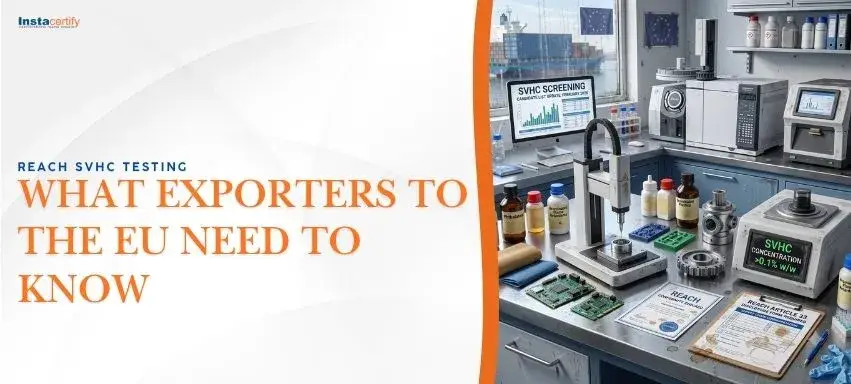
Under EU REACH, any article containing more than 0.1% weight-by-weight of a Substance of Very High Concern (SVHC) triggers notification and disclosure obligations — regardless of whether the finished product itself is regulated. The SVHC Candidate List runs into the hundreds of substances and is updated at least twice a year, so a product that was compliant last year can fall out of compliance the moment a new chemical is added. This guide covers what SVHC means, how the 0.1% rule is actually applied, when testing is needed versus when documentation is enough, and what the SCIP notification duty requires.
[IMAGE PLACEHOLDER – infographic showing the REACH SVHC 0.1% threshold applied at the article/component level]Insert image here; add descriptive alt text with the primary keyword.
What is an SVHC under REACH?
A Substance of Very High Concern is a chemical the European Chemicals Agency (ECHA) has identified as posing a serious risk to human health or the environment — because it is carcinogenic, mutagenic or toxic for reproduction (CMR), persistent, bioaccumulative and toxic (PBT), very persistent and very bioaccumulative (vPvB), or gives rise to an equivalent level of concern such as endocrine disruption. Once ECHA adds a substance to the Candidate List, it carries legal obligations even before it moves to full authorisation or restriction.
The 0.1% w/w threshold: how it is actually applied
The rule that catches most exporters off guard is that the 0.1% threshold is assessed per article, not per finished product. An "article" under REACH is any object with a specific shape, surface or design that determines its function more than its chemical composition does — a screw, a cable, a button, a coating layer. For a complex product made of many components, each component is its own article and is checked separately against the 0.1% limit. This is often summarised as "once an article, always an article": a component doesn't lose its separate identity just because it becomes part of a bigger assembly.
| Scenario | How the 0.1% rule applies |
|---|---|
| A single-material product (e.g., a plastic toy part) | Tested as one article against the 0.1% threshold |
| A multi-component product (e.g., an electronic device) | Each distinct component — casing, cable, PCB coating, connector — is assessed as its own article |
| A textile with a coating or print | The coating/print layer and the base fabric may need to be evaluated separately if they qualify as distinct articles |
Do you need to notify ECHA, and what is SCIP?
If an article placed on the EU market contains an SVHC above 0.1% w/w, the supplier generally has two duties: inform the recipient (business customer or, on request, a consumer) about safe use, and notify the SCIP database — the database for Substances of Concern In articles as such or in complex objects (Products), maintained under the EU Waste Framework Directive. SCIP notification applies to manufacturers, importers and distributors placing qualifying articles on the EU market; retailers supplying only end consumers are generally exempt from the notification duty itself, though the underlying information obligation still exists.
[IMAGE PLACEHOLDER – screenshot-style graphic representing the SCIP database notification workflow]Insert image here; add descriptive alt text with the primary keyword.
Step-by-step: assessing REACH SVHC compliance
- Map your product into articles. Break the product down into its distinct components based on materials and function.
- Check the current SVHC Candidate List. ECHA updates it roughly twice a year, so a product assessed twelve months ago needs re-checking against the latest list.
- Collect supplier declarations first. Material safety data, supplier SVHC declarations and prior test reports can often establish compliance without new lab work.
- Test where documentation is weak or contradictory. Laboratory testing — typically screening methods followed by confirmatory chemical analysis for any substance flagged — is used where supply-chain paperwork doesn't give a clear answer, or where the material composition is unknown (recycled content, mixed-origin components).
- Notify SCIP if the threshold is exceeded and no exemption applies, and pass the required safe-use information down the supply chain.
- Re-assess after every SVHC list update — this is the step most manufacturers skip, and it's how compliant products quietly become non-compliant.
Which industries and products need SVHC testing
- Electronics and electricals – cables, connectors, circuit board coatings, plastic housings
- Textiles and apparel – dyes, prints, finishes and coatings
- Toys and childcare articles – plastics, paints, textile components
- Cosmetics and personal care ingredients
- Automotive components, adhesives and plastics
- Chemicals, coatings and polymer products sold as articles into the EU
Documents to prepare before testing or notification
- Bill of materials with supplier and material source for each component
- Existing material safety data sheets and supplier SVHC declarations
- Product breakdown identifying each distinct "article" within the finished product
- Any earlier REACH, RoHS or SVHC test reports
- Intended EU market entry point (manufacturer, importer or distributor of record)
How Instacertify helps
Instacertify coordinates REACH and SVHC testing and compliance assessment for exporters, working with accredited chemical testing laboratories to screen materials, interpret the current Candidate List against your product's bill of materials, and prepare the documentation needed for SCIP notification. See our REACH testing services and chemical product testing. Contact us for a free consultation.
Frequently asked questions
What does SVHC stand for?
Substance of Very High Concern — a category of chemicals identified by ECHA under REACH as carcinogenic, mutagenic, toxic for reproduction, persistent/bioaccumulative, or of equivalent concern.
What is the SVHC threshold that triggers obligations?
0.1% weight-by-weight of an SVHC within an individual article, not the finished product as a whole.
Is REACH SVHC testing mandatory?
Laboratory testing itself is not always mandatory — supplier documentation and material data can establish compliance. Testing becomes necessary when that documentation is missing, unreliable or contradictory.
What is SCIP notification?
A database notification required for articles placed on the EU market that contain an SVHC above the 0.1% threshold, covering manufacturers, importers and distributors.
How often does the SVHC Candidate List change?
ECHA typically updates it at least twice a year, so products should be reassessed against the current list rather than a one-time historical check.