Global Compliance
SEDEX & SMETA Certification in India: Membership, Audit Process, Pillars & Cost
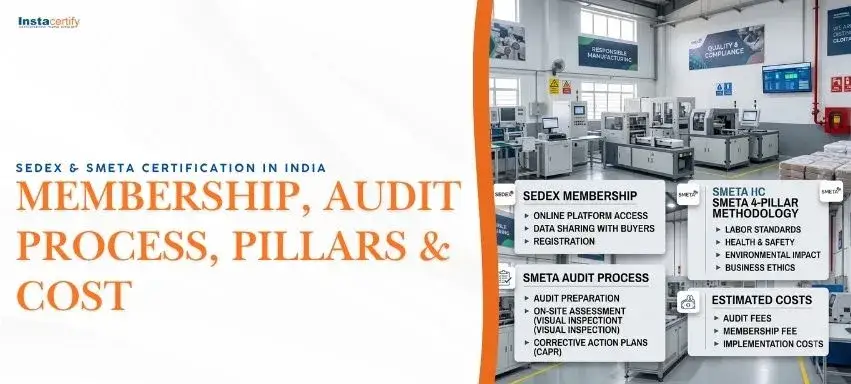
SEDEX and SMETA are not the same thing: SEDEX is the platform you join to share ethical-trade data with buyers, while SMETA is the actual on-site audit you complete and upload to that platform. Buyers across the EU, UK and US increasingly ask suppliers for a current SMETA audit before placing or renewing orders, and getting the scope wrong — a 2-pillar audit when the buyer wanted 4-pillar — is one of the most common (and expensive) mistakes exporters make. This guide covers what each term means, how the audit actually runs, and what it costs and takes in India.
[IMAGE PLACEHOLDER – diagram showing SEDEX platform membership feeding into a SMETA 2-pillar vs 4-pillar audit]Insert image here; add descriptive alt text with the primary keyword.
SEDEX vs SMETA: the difference that trips people up
| SEDEX | SMETA | |
|---|---|---|
| What it is | A global platform for sharing ethical-trade and responsible-sourcing data between suppliers and buyers | The actual audit methodology used to assess a site's labour, health & safety, environmental and business-ethics practices |
| What you do | Register for a Sedex membership and get a Sedex ID | Book an accredited audit firm to carry out a SMETA audit at your site |
| What buyers see | Your company profile and self-assessment questionnaire (SAQ) | Your uploaded SMETA audit report, shared with the buyers you authorise |
| Renewal | Annual membership | Audit report typically valid for 12 months, depending on buyer requirements and audit grading |
The four pillars of a SMETA audit
SMETA audits are aligned with the ETI Base Code and relevant ILO conventions, and can be scoped as a 2-pillar or 4-pillar audit depending on what your buyer requires.
| Pillar | What it assesses | Included in |
|---|---|---|
| Labour standards | Wages, working hours, freely chosen employment, no child labour, non-discrimination, freedom of association | 2-pillar and 4-pillar |
| Health & safety | Fire safety, machine guarding, chemical handling, worker welfare facilities, emergency preparedness | 2-pillar and 4-pillar |
| Environment | Waste management, effluent handling, environmental permits and compliance | 4-pillar only |
| Business ethics | Anti-bribery, anti-corruption and ethical business conduct | 4-pillar only |
Always confirm which pillars your specific buyer requires before booking the audit — a 2-pillar audit generally cannot be "upgraded" after the fact without a fresh site visit for the remaining pillars.
[IMAGE PLACEHOLDER – auditor conducting a site walkthrough at a manufacturing facility for a SMETA audit]Insert image here; add descriptive alt text with the primary keyword.
Step-by-step: SEDEX registration and SMETA audit process
- Register on Sedex and obtain your Sedex membership ID – this is a prerequisite for uploading and sharing a SMETA report.
- Complete the Self-Assessment Questionnaire (SAQ) covering your site's labour, health & safety, environmental and business-ethics practices.
- Confirm the audit scope with your buyer – 2-pillar (labour and health & safety) or 4-pillar (adds environment and business ethics).
- Book an accredited SMETA audit firm and schedule the on-site visit.
- On-site audit – typically one to three days depending on factory size and workforce, covering document review, site inspection and worker interviews.
- Corrective action plan (if needed) – non-conformances raised during the audit are addressed and evidenced before or after the final report is issued, depending on severity.
- Upload the report to Sedex and share it with the buyers who require it.
Documents and preparation needed
- Business registration, factory licence and relevant statutory approvals
- Employee records – contracts, wage registers, attendance and working-hours data
- Health and safety documentation – fire safety certificates, machine safety checks, first-aid and emergency plans
- Environmental permits and waste-disposal records (for 4-pillar audits)
- Anti-bribery and business-ethics policies (for 4-pillar audits)
- Organisation chart and worker headcount by shift
Cost and validity in India
SMETA audit fees in India vary by pillar scope, factory size, workforce headcount and the audit firm, so it's worth getting a written quote for your specific facility rather than budgeting from a generic figure. A SMETA audit report is generally accepted by buyers for around twelve months, though some buyers set their own review cycle. Non-conformances found during the audit can also add time and cost if a follow-up visit is required to verify corrective actions.
How Instacertify helps
Instacertify supports Indian manufacturers and exporters through Sedex registration, SAQ completion, audit-scope confirmation with buyers, and coordination with accredited SMETA audit firms — including preparing documentation and closing corrective actions between audit rounds. See our SEDEX & SMETA certification services. Contact us for a free consultation.
Frequently asked questions
What is the difference between SEDEX and SMETA?
SEDEX is the platform where ethical-trade data is registered and shared with buyers. SMETA is the audit methodology used to assess a site, and the resulting report is what gets uploaded to Sedex.
What is the difference between a 2-pillar and 4-pillar SMETA audit?
A 2-pillar audit covers labour standards and health & safety. A 4-pillar audit adds environment and business ethics on top of those two.
How long is a SMETA audit report valid?
Typically around twelve months, though the exact validity a buyer will accept can vary.
How long does a SMETA audit take on-site?
Usually one to three days, depending on the size of the facility and the number of workers.
Do I need a Sedex membership before booking a SMETA audit?
Yes — you need a Sedex membership ID to upload and share the completed SMETA audit report with your buyers.