Global Compliance
SNI Certification for Indonesia: Mandatory Products, SPPT-SNI Process, Cost & Timeline
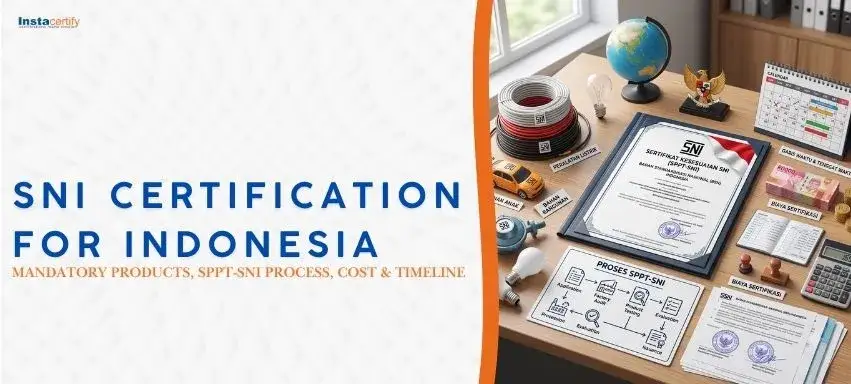
SNI (Standar Nasional Indonesia) certification is mandatory for a growing list of products – electrical goods, cables, tyres, steel, cement, toys, helmets, ceramics, footwear, food products and more – before they can be imported into or sold in Indonesia. Certification is granted by a KAN-accredited Product Certification Body (LSPro) after testing in an accredited laboratory and a factory audit, and the mark is registered with the Ministry of Industry. A first SNI certificate takes about 3–6 months, requires an Indonesian representative for foreign manufacturers, and is valid for four years with annual surveillance. This guide covers the product list, process, documents, cost and FAQs.
[IMAGE PLACEHOLDER – Graphic: SNI mark and main mandatory product categories]
Insert image here; add descriptive alt text with the primary keyword.
What is SNI certification?
SNI standards are developed by the National Standardization Agency (BSN). Most are voluntary, but the Ministry of Industry (Kemenperin), Ministry of Trade, Ministry of Energy and other ministries make specific SNIs mandatory by regulation. For those products, the manufacturer must obtain an SPPT-SNI (Sertifikat Produk Penggunaan Tanda SNI – certificate for the use of the SNI mark) and apply the SNI logo. Indonesian customs blocks mandatory-SNI goods that lack the registration.
Mandatory SNI products (main categories)
| Sector | Examples of mandatory-SNI products |
|---|---|
| Electrical and electronics | Cables and wires, plugs and sockets, switches, MCBs, electric fans, refrigerators, air conditioners, washing machines, rice cookers, irons, TVs and audio-video equipment, LED lamps, ballasts, batteries, power banks |
| Automotive | Tyres and tubes, motorcycle helmets, safety glass, brake pads, wheel rims, batteries |
| Steel and metals | Rebar, hot-rolled and cold-rolled steel sheet, galvanised sheet, steel pipes, aluminium sheets |
| Building materials | Cement, ceramic tiles, sanitaryware, glass, gypsum board, PVC pipes |
| Consumer goods | Toys, footwear, garments (children's), baby products, water dispensers, LPG stoves, regulators and hoses, pressure cookers |
| Food and agriculture | Wheat flour, cocoa powder, sugar, bottled water, instant coffee, fertilisers |
| Chemicals and others | Detergents, matches, hand tools, safety equipment |
The list changes frequently through Ministry of Industry regulations. Check the HS code against the current mandatory list before shipping; Instacertify does this as the first step of every project.
Who applies and what a foreign manufacturer needs
- Indonesian manufacturers apply directly to an LSPro.
- Foreign manufacturers must apply through a locally registered Official Representative / importer that holds the SNI registration on their behalf; since 2025 one representative may represent only one foreign manufacturer/brand for a given product.
- A registered Indonesian trademark is required for the brand on the product (trademark registration can take 12–18 months, so file early or license an existing mark).
- The factory must operate a quality management system – ISO 9001 certification, or at least a documented system that passes the LSPro audit.
[IMAGE PLACEHOLDER – Flowchart: SPPT-SNI process – LSPro application, factory audit, testing, registration]
Insert image here; add descriptive alt text with the primary keyword.
SNI certification process: step by step
Step 1 – Classification and regulation check
Confirm whether the product's HS code is mandatory-SNI, which SNI standard applies (e.g., SNI IEC 60335 series for appliances, SNI 04-6629 for cables, SNI 0038 for tyres) and which ministry regulation governs it.
Step 2 – Appoint the Indonesian representative and prepare documents
Company legal documents, trademark certificate, factory quality manual, product specifications, drawings and existing test reports (IEC/CB reports help).
Step 3 – Application to a KAN-accredited LSPro
Submit through the LSPro; many applications are now filed via the Ministry of Industry's SIINas system. The LSPro reviews documents and schedules the audit.
Step 4 – Factory audit
LSPro auditors visit the manufacturing site (in India or elsewhere) for 2–3 days to audit the QMS, production control, in-house testing and traceability. Samples are drawn and sealed during the audit.
Step 5 – Product testing
Samples are tested in a KAN-accredited laboratory (usually in Indonesia; some standards accept foreign accredited labs under MRA). Testing takes 4–8 weeks.
Step 6 – SPPT-SNI issued and registered
The LSPro issues the SPPT-SNI. The certificate and the SNI mark registration (NRP – Nomor Registrasi Produk – for domestic goods or NPB – Nomor Pendaftaran Barang – for imports) are recorded with the Ministry of Industry/Trade and appear in the customs single-window system.
Step 7 – Marking and surveillance
Apply the SNI logo and registration number on the product and packaging in accordance with the standard. Annual surveillance audits and market sample tests maintain the certificate.
Documents required
- Business licence and company registration of manufacturer and Indonesian representative
- Indonesian trademark registration certificate or licence agreement
- ISO 9001 certificate or quality manual and procedures
- Product technical specification, drawings, BOM, photographs
- Existing test reports (IEC / CB / ISO)
- Manufacturing process flow and in-house test-equipment list
- Letter of appointment for the representative
- Label artwork in Bahasa Indonesia
SNI certification cost (indicative)
| Item | Indicative range |
|---|---|
| LSPro application, audit and certificate fees | ₹2,00,000 – ₹4,00,000 |
| Auditor travel to the factory (overseas) | ₹1,50,000 – ₹3,00,000 |
| Product testing in accredited lab | ₹80,000 – ₹4,00,000 depending on product |
| Indonesian representative / registration service | ₹1,00,000 – ₹2,50,000 per year |
| Trademark registration in Indonesia | ₹40,000 – ₹80,000 |
| Annual surveillance | ₹1,50,000 – ₹3,00,000 per year including travel |
Timeline and validity
- Document preparation: 2–4 weeks
- Application review and audit scheduling: 3–6 weeks
- Factory audit and sampling: 1 week
- Testing: 4–8 weeks
- Certificate and registration: 2–4 weeks
- Total: about 3–6 months (excluding trademark registration)
- Validity: SPPT-SNI four years with annual surveillance; renewal audit before expiry
Recent changes exporters should know
- Electronic filing through the Ministry of Industry's SIINas portal for many product groups.
- One-representative-one-manufacturer rule for foreign brands (2025).
- Expanding mandatory list for electrical appliances, LED lighting, batteries and steel; energy-efficiency labelling for ACs, refrigerators and TVs alongside SNI.
- Bahasa Indonesia labelling and user-manual requirements under Ministry of Trade rules.
How Instacertify helps with SNI certification
Instacertify Labs supports Indian and international manufacturers entering Indonesia: mandatory-list and standard mapping, pre-compliance testing through ISO/IEC 17025-accredited partner laboratories, quality-system preparation for the LSPro audit, Indonesian representative and trademark coordination, application filing, sample logistics and surveillance management. Combine with CCC (China), MIC (Japan), SABER (Saudi Arabia) and CB/IECEE reports to serve multiple markets from one test programme. Get an SNI quote – send your HS codes and we will confirm mandatory status within a working day.
Frequently asked questions
Is SNI certification mandatory?
Only for products whose SNI has been made mandatory by ministerial regulation; those products cannot be imported or sold in Indonesia without the SNI mark. Other SNIs are voluntary.
Can a foreign manufacturer apply for SNI directly?
No. A locally registered representative or importer must hold the registration; the factory is audited and tested as part of the process.
How long does SNI certification take?
Usually 3–6 months from application to certificate, plus trademark registration time if the brand is not yet registered in Indonesia.
How long is an SNI certificate valid?
The SPPT-SNI is valid for four years, subject to annual surveillance audits and market sampling.
Does testing have to be done in Indonesia?
Generally yes, in a KAN-accredited laboratory; some standards accept reports from foreign labs accredited under mutual-recognition arrangements.
Is ISO 9001 required for SNI?
The factory must demonstrate an effective quality management system in the LSPro audit; ISO 9001 certification is the simplest way to do so and is required for many product groups.