Global Compliance
UN 38.3 Battery Testing: A Mandatory Requirement for Safe Global Transit
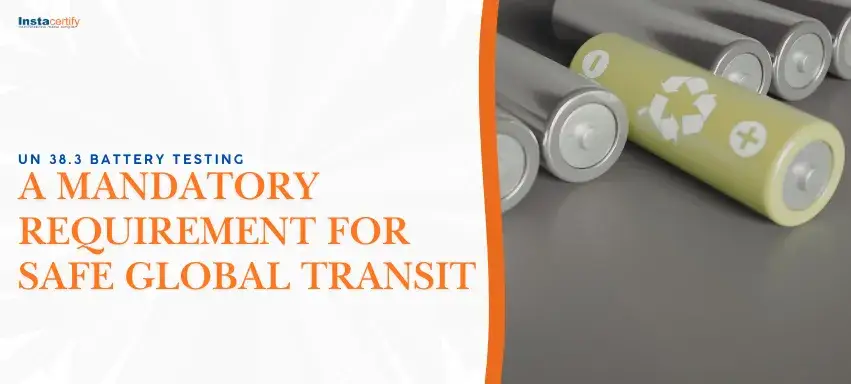
From the smartphone in your pocket and the laptop on your desk to the electric vehicle parked in your garage, lithium batteries power modern life. They are lightweight, energy-dense, and highly efficient. However, that high energy density comes with a catch: under the wrong conditions, lithium batteries can become volatile fire hazards.
Because of these inherent risks, international regulatory bodies classify lithium-ion and lithium-metal batteries as Class 9 Dangerous Goods. If you are a manufacturer, e-commerce retailer, or logistics provider, you cannot simply box up these batteries and hand them over to a courier.
To ship them safely and legally by air, sea, rail, or road, they must comply with a stringent global benchmark: UN 38.3.
In this comprehensive guide, we will break down what UN 38.3 is, why it is a non-negotiable mandatory requirement, and how it impacts your business supply chain.
What Exactly is UN 38.3?
UN 38.3 refers to Section 38.3 of the United Nations Manual of Tests and Criteria. It is an internationally recognized standard that outlines a rigorous series of environmental, mechanical, and electrical tests designed to ensure that lithium cells and batteries can withstand the harsh, unpredictable conditions of transport.
Whether you are shipping standalone batteries (UN 3480 / UN 3090) or batteries packed within or alongside electronic equipment (UN 3481 / UN 3091), the core components must have a verified UN 38.3 test summary. Without this certification, major global transport networks—including commercial airlines, shipping lines, and freight forwarders—will outright refuse to handle your cargo.
Why is UN 38.3 a Mandatory Requirement for Shipping?
The primary driver behind making UN 38.3 mandatory is catastrophe prevention. During international transit, cargo experiences extreme environmental shifts that are vastly different from standard household use.
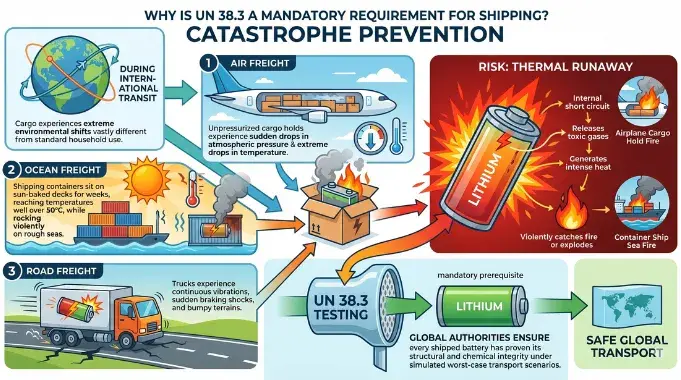
Consider what happens to cargo during transit:
- Air Freight: Unpressurized cargo holds experience sudden drops in atmospheric pressure and extreme drops in temperature.
- Ocean Freight: Shipping containers can sit on sun-baked decks for weeks, reaching temperatures well over 50°C, all while rocking violently on rough seas.
- Road Freight: Trucks experience continuous vibrations, sudden braking shocks, and bumpy terrains.
If a poorly designed or untested lithium battery suffers an internal short circuit under these conditions, it can enter a state known as thermal runaway. This is a rapid, uncontrollable chain reaction where the battery releases toxic gases, generates intense heat, and can violently catch fire or explode. In an airplane cargo hold or a massive container ship at sea, a lithium battery fire can be catastrophic.
By enforcing UN 38.3 as a mandatory prerequisite, global authorities ensure that every shipped battery has proven its structural and chemical integrity under simulated worst-case transport scenarios.
8 Crucial Tests of UN 38.3 (T1–T8)
To receive a UN 38.3 certification, a battery design must pass a gauntlet of eight distinct tests conducted by an accredited third-party testing laboratory. The batteries are evaluated for leaks, venting, disassembly, rupture, and fire.
Here is what the testing process involves:
T1: Altitude Simulation
This test simulates unpressurized aircraft cargo enclosures. The batteries are stored at a low pressure ($\leq11.6 \text{ kPa}$) for at least six hours at a ambient temperature of 20°C.
T2: Thermal Test
Batteries must prove they can handle sudden, violent temperature swings. They are stored at an extreme high of 72°C for at least six hours, followed immediately by an extreme low of -40°C for another six hours. This cycle is repeated 10 times.
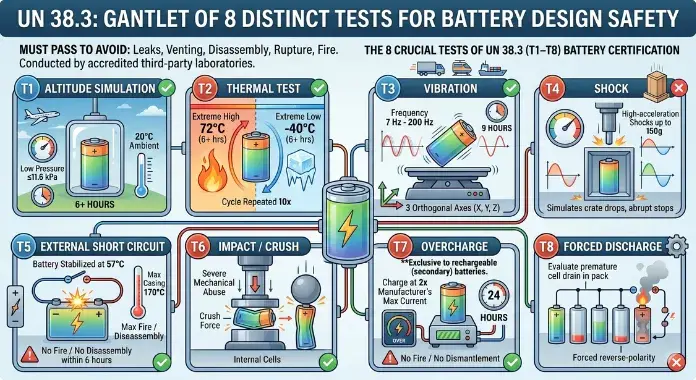
T3: Vibration
To simulate the constant rumbling of transport vehicles, the batteries are subjected to a sinusoidal vibration wave that sweeps between 7 Hz and 200 Hz over a total of 9 hours across three orthogonal axes.
T4: Shock
This test simulates sudden, violent impacts, such as a crate being dropped or a transport truck stopping abruptly. The batteries are subjected to high-acceleration shocks (up to 150g for small cells) using half-sine waveforms.
T5: External Short Circuit
This test ensures the battery can handle an accidental external connection between its positive and negative terminals. The battery is stabilized at 57°C, and an external short circuit is introduced. The battery casing must not exceed 170°C, and it must not catch fire or disassemble within six hours of the test.
T6: Impact / Crush
This test is applied directly to the internal cells of the battery. It simulates a heavy internal tool or external debris crushing the cell casing, testing its resistance to severe mechanical abuse.
T7: Overcharge
Exclusive to secondary (rechargeable) batteries, this test evaluates the ability of the battery to handle an electrical current that exceeds its maximum rated limit. The battery is charged at twice the manufacturer’s recommended maximum current for 24 hours to ensure it doesn't catch fire or dismantle.
T8: Forced Discharge
This test evaluates a cell’s ability to withstand a forced discharge condition, which can happen when an individual cell drains prematurely within a multi-cell battery pack, forcing it into a reverse-polarity state.
Who Needs to Comply with UN 38.3?
If your business touches the production or distribution of lithium batteries, compliance is your responsibility. This applies to:
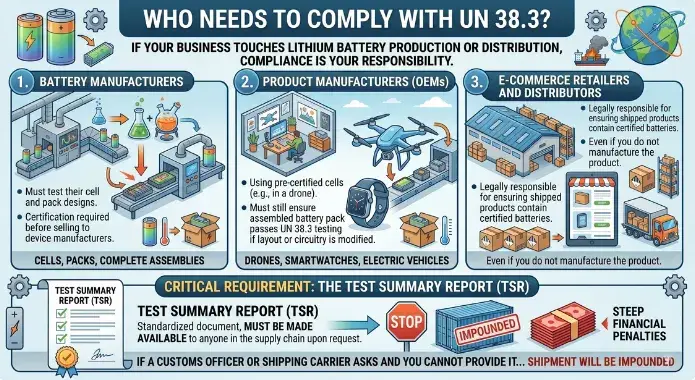
- Battery Manufacturers: Must test their cell and pack designs before selling them to device manufacturers.
- Product Manufacturers (OEMs): If you build a consumer electronic device (like a drone or smartwatch) using a pre-certified cell, you must still ensure that the assembled battery pack passes UN 38.3 testing if you modify the layout or circuitry.
- E-commerce Retailers and Distributors: Even if you do not manufacture the product, you are legally responsible for ensuring the products you ship contain UN 38.3 certified batteries.
Important Note: UN 38.3 requires a Test Summary Report (TSR). This is a standardized document that must be made available to anyone in the supply chain upon request. If a customs officer or shipping carrier asks for your TSR and you cannot provide it, your shipment will be impounded, and you could face steep financial penalties.
Business Advantages of UN 38.3 Compliance
While the certification process requires an investment of time and money, viewing UN 38.3 compliance purely as a regulatory hurdle misses the bigger picture. Compliance offers substantial business benefits:
- Mitigates Liability and Legal Risks: Shipping uncertified dangerous goods is a serious legal offense. If an untested battery causes a cargo fire, your business could face devastating lawsuits, catastrophic financial liability, and criminal charges.
- Smoother Customs and Freight Clearance: Providing a valid UN 38.3 test summary alongside correct dangerous goods labeling guarantees your products move seamlessly through international borders without delays.
- Protects Brand Reputation: Product recalls due to battery safety failures can instantly destroy consumer trust. Passing UN 38.3 proves to your customers that you prioritize their physical safety and product quality.
Final Thoughts: Prioritize Compliance from Day One
The UN 38.3 standard is not just an arbitrary piece of paperwork—it is a critical, life-saving international framework that keeps global trade moving safely. As regulatory bodies like IATA and the IMO continuously tighten safety protocols, compliance is only becoming more vital.
If you are developing a new battery-powered product or expanding your e-commerce shipping operations globally, always factor UN 38.3 testing into your timeline and budget early. Partnering with certified testing laboratories and maintaining clean documentation ensures your supply chain remains safe, legal, and highly profitable.
Frequently asked questions
What is UN 38.3 certification?
UN 38.3 is a mandatory global safety standard that ensures lithium-ion and lithium-metal batteries can withstand extreme environmental and mechanical conditions during international transit, effectively preventing hazardous incidents like thermal runaway, fires, or explosions.
What is a Test Summary Report (TSR)?
A Test Summary Report is a standardized document tracking a battery's UN 38.3 compliance. It must be readily accessible across the global supply chain, as failing to provide it to customs officials or carriers results in cargo impoundment.
Who is legally responsible for UN 38.3 compliance?
Compliance is mandatory for anyone manufacturing or distributing lithium batteries. This legally binds battery manufacturers, product OEMs modifying battery configurations, and e-commerce retailers who must verify that all electronics they ship contain properly certified power cells.
What types of tests does UN 38.3 include?
The protocol subjects batteries to an intensive eight-part gauntlet. These safety tests include altitude simulation, thermal cycling, vibration, shock impact, external short circuits, structural crush testing, overcharge protection verification, and forced cell discharge simulation.
Do Batteries Inside Devices Need UN 38.3 Certification?
Yes. Whether batteries are shipped separately, packed alongside equipment, or fully installed within a device, they must pass this required testing. The application offers protection, but the internal battery itself must still be completely certified for safe global transportation.
Are There Any UN 38.3 Testing Exceptions for Prototypes?
Yes, there are exceptions for prototypes or low production runs of under one hundred batteries. However, these specialized shipments require custom packaging, extensive documentation, and explicit government approvals, making standard transportation significantly more difficult and expensive.
Does Modifying a Battery Void Its Existing Certification?
Modifying a battery design, including minor changes to its internal circuitry, casing, or core components, typically invalidates the existing certification. You must repeat the entire testing suite to guarantee the revised product remains safely compliant for global shipping.
What is the 2026 State of Charge (SoC) Rule?
Starting in the year 2026, air transport regulations dictate that all standalone lithium batteries and those packaged with devices cannot exceed a thirty percent charge. This strict limit heavily reduces the risk of dangerous overheating and fires during flights.