Global Compliance
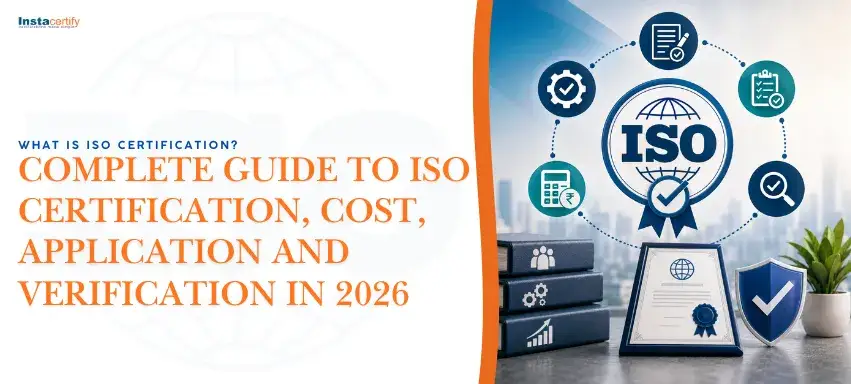
What Is ISO Certification? Complete Guide to ISO Certification, Cost, Application and Verification in 2026

For businesses operating in India and global markets, demonstrating consistent quality, reliable processes, customer focus, and effective management has become increasingly important. This is where ISO certification can add significant value.
An ISO management system certification provides independent assurance that an organization’s management system has been assessed against the requirements of a particular ISO standard. Depending on the organization’s needs, this could relate to quality, environmental management, information security, food safety, occupational health and safety, or another specialized area.
However, ISO certification is often misunderstood. Many businesses assume that ISO itself issues certificates, that every company must be certified, or that simply purchasing an ISO certificate means an organization is compliant. These assumptions are incorrect.
This comprehensive guide explains what ISO certification is, the ISO certification full form, how to get ISO certification, how to apply for ISO certification, how to verify an ISO certificate, ISO certification cost factors, and ISO 9001 certification in Chennai. It also covers important 2026 updates, including the upcoming revision of ISO 9001.
What Is ISO Certification?
ISO certification is the process through which an independent certification body assesses an organization’s management system against the requirements of a specific ISO standard and, when conformity is demonstrated, issues a certificate.
ISO standards are developed by the International Organization for Standardization (ISO). ISO develops standards but does not itself conduct certification or issue ISO certificates. ISO explains that certification is the provision of written assurance by an independent body that a product, service, or system meets specified requirements.
For example, an organization may seek:
- ISO 9001 certification for quality management
- ISO 14001 certification for environmental management
- ISO 45001 certification for occupational health and safety
- ISO/IEC 27001 certification for information security
- ISO 22000 certification for food safety management
The exact certification needed depends on the organization’s activities, risks, customer expectations, contractual requirements, and business objectives.
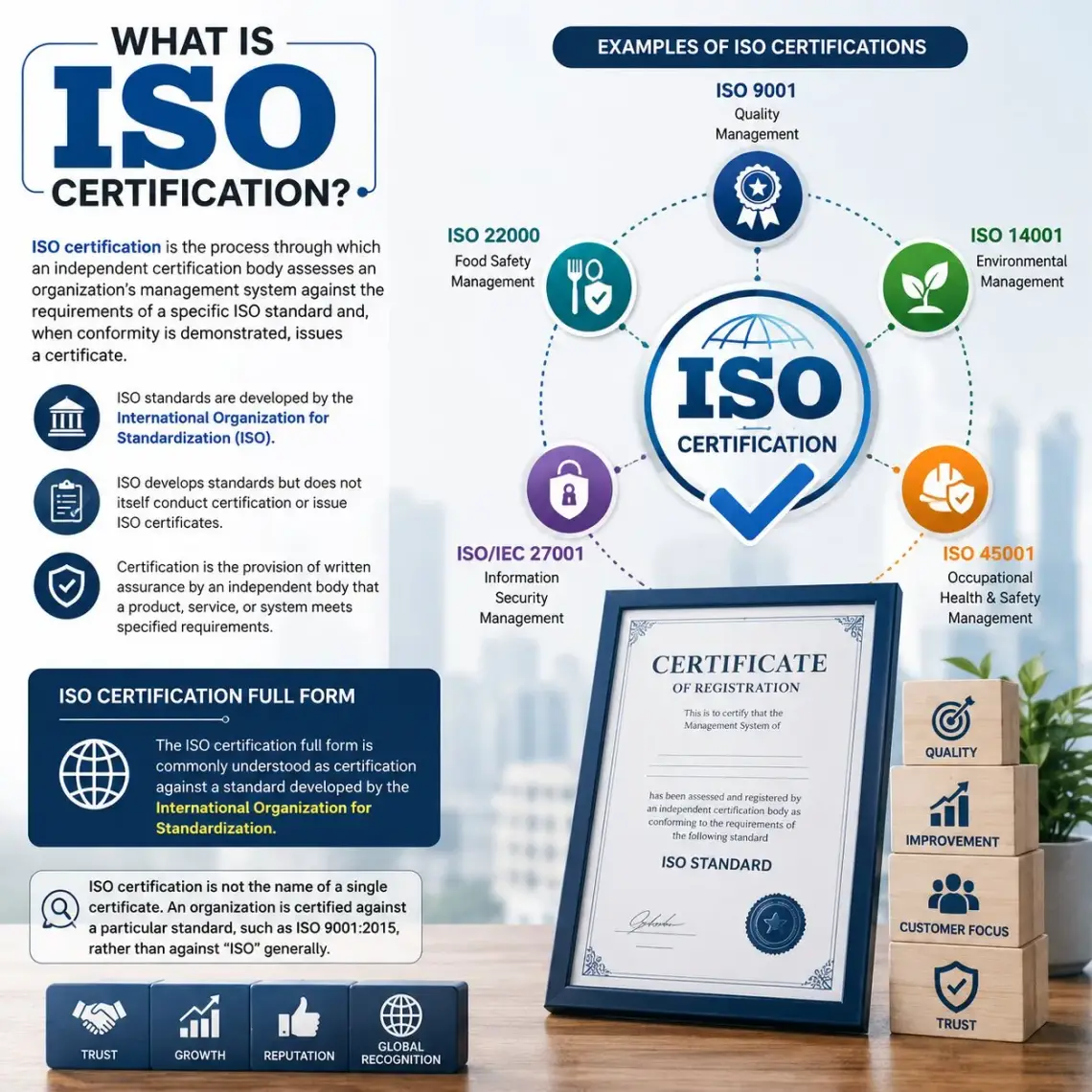
The ISO certification full form is commonly understood as certification against a standard developed by the International Organization for Standardization.
Strictly speaking, however, “ISO certification” is not the name of a single certificate. ISO publishes many different standards, and an organization is certified against a particular standard, such as ISO 9001:2015, rather than against “ISO” generally.
This distinction is important when preparing contracts, websites, tender documents, marketing material, and certification statements.
Does ISO Issue ISO Certificates?
No. This is one of the most important facts businesses should understand.
ISO does not perform certification or issue certificates. Instead, independent certification bodies evaluate organizations against applicable standards. ISO also advises organizations to consider the competence and accreditation status of certification bodies when choosing one.
In India, certification bodies can be accredited through recognized accreditation arrangements. The National Accreditation Board for Certification Bodies (NABCB) provides accreditation for management-system certification bodies, including quality, environmental, food safety, occupational health and safety, information security, and other management-system areas.
This creates an important distinction:
ISO standard → Certification body → Organization
The standard defines requirements. The certification body conducts the conformity assessment. The organization implements and maintains the management system.
How to Get ISO Certification?
The process for obtaining ISO certification varies according to the standard, organization, scope, complexity, and selected certification body. However, a practical ISO certification journey generally follows a sequence of preparation, implementation, evaluation, and independent audit.
Step 1: Identify the Correct ISO Standard
First determine which ISO standard is relevant to your organization.
For example:
ISO 9001 → Quality management
ISO 14001 → Environmental management
ISO 45001 → Occupational health and safety
ISO/IEC 27001 → Information security
ISO 22000 → Food safety management
Choosing the wrong standard can waste time and resources, so the certification objective should be clearly defined before implementation begins.
Step 2: Define the Certification Scope
The organization needs to determine what part of the business will be covered by certification.
The scope may involve:
- A particular location
- Multiple branches
- Particular products or services
- Manufacturing activities
- Design and development
- Sales and support activities
- Specific business divisions
A clearly defined scope helps ensure that the management system is neither unnecessarily broad nor too narrow for the organization's actual requirements.
Step 3: Conduct a Gap Assessment
A gap assessment compares the organization’s existing processes with the requirements of the selected standard.
This can identify areas such as:
- Missing procedures
- Weak process controls
- Inadequate records
- Undefined responsibilities
- Missing performance indicators
- Unaddressed risks
- Incomplete internal audit arrangements
- Corrective-action issues
The gap assessment provides a practical roadmap before the certification audit.
Step 4: Develop and Implement the Management System
The organization then implements the applicable management system.
Depending on the standard, this may include establishing:
- Quality policies and objectives
- Operational procedures
- Risk assessment methods
- Document control
- Competence and training processes
- Supplier controls
- Monitoring and measurement
- Customer feedback mechanisms
- Internal audit processes
- Corrective action processes
- Management review arrangements
The emphasis should be on making the system work in real operations rather than creating paperwork solely for the audit.
Step 5: Train Employees and Create Awareness
A management system is only effective when employees understand their responsibilities.
Employees should know:
- What processes apply to their roles
- Which controls they must follow
- What records must be maintained
- How to report problems
- How corrective actions work
- How quality or management-system objectives affect their responsibilities
Training and awareness should be appropriate to employees' actual responsibilities.
Step 6: Conduct Internal Audit
An internal audit helps determine whether the management system has been implemented effectively and whether it conforms to the applicable requirements.
ISO identifies auditing as an important part of the management-system approach because it enables organizations to evaluate whether objectives are being achieved and whether the system conforms to requirements.
Internal audits can reveal weaknesses before an external certification audit does.
Step 7: Conduct Management Review
Top management should evaluate the performance and effectiveness of the management system.
The review may consider:
- Audit results
- Customer feedback
- Process performance
- Objectives
- Risks and opportunities
- Nonconformities
- Corrective actions
- Resource requirements
- Opportunities for improvement
Step 8: Select a Certification Body
The organization then selects an independent certification body capable of auditing the applicable standard and industry scope.
When comparing certification bodies, businesses should evaluate:
- Relevant accreditation
- Scope of accreditation
- Industry experience
- Auditor competence
- Certification process
- Audit arrangements
- Reputation and credibility
- Commercial terms
ISO recommends evaluating certification bodies and checking accreditation status when selecting a certification provider.
Step 9: Certification Audit
The certification body conducts an audit to determine whether the organization's management system conforms to the applicable standard.
Depending on the certification scheme and circumstances, the assessment involves examination of documented information, implementation, records, personnel, processes, and system performance.
Step 10: Correct Nonconformities
Auditors may identify nonconformities during the assessment.
The organization may need to:
- Identify the cause.
- Define corrective action.
- Implement the corrective action.
- Provide objective evidence.
- Undergo review by the certification body.
Certification follows once the certification body determines that the applicable requirements have been satisfactorily addressed under its certification process.
How to Apply for ISO Certification?
Many people search for “how to apply for ISO certification” expecting a single government application form. In reality, the process depends on the standard and certification route.
A typical application involves providing information such as:
- Legal organization name
- Address and locations
- Number of employees
- Business activities
- Desired certification standard
- Certification scope
- Number of operational sites
- Existing management-system information
- Relevant industry or process details
The certification body uses this information to evaluate the certification requirements and determine the appropriate audit arrangements.
How Much Does ISO Certification Cost?
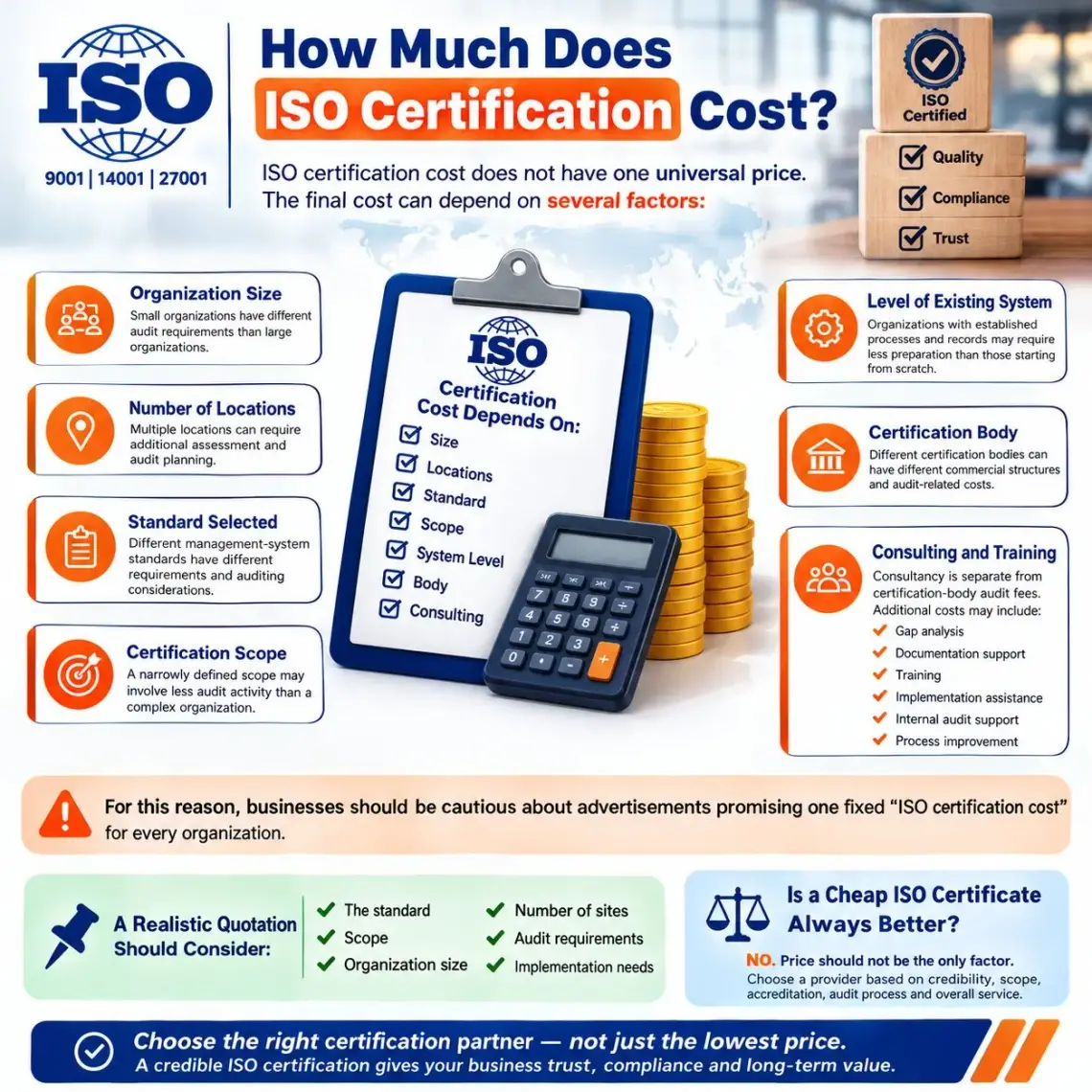
ISO certification cost does not have one universal price.
The final cost can depend on several factors, including:
Organization Size
A small organization with a limited scope generally has different audit requirements from a large organization with hundreds of employees and multiple operational sites.
Number of Locations
Certification covering multiple locations can require additional assessment and audit planning.
Standard Selected
Different management-system standards have different requirements and auditing considerations.
Certification Scope
A narrowly defined scope may involve less audit activity than a complex organization covering many business processes or industry activities.
Level of Existing System
Organizations that already have established processes, records, internal audits, and management reviews may require less preparation than organizations starting from scratch.
Certification Body
Different certification bodies can have different commercial structures and audit-related costs.
Consulting and Training
Consultancy is separate from certification-body audit fees. A business may incur additional costs for:
- Gap analysis
- Documentation support
- Training
- Implementation assistance
- Internal audit support
- Process improvement
For this reason, businesses should be cautious about advertisements promising one fixed “ISO certification cost” for every organization.
A realistic quotation should consider the standard, scope, organization size, number of sites, audit requirements, and implementation needs.
Is a Cheap ISO Certificate Always Better?
No.
Price should not be the only factor when selecting a certification provider.
A certificate has practical value when it results from a credible conformity-assessment process and accurately represents the organization's management system. ISO specifically highlights the importance of considering certification-body competence and accreditation when choosing a provider.
Businesses should therefore compare the credibility, scope, accreditation, audit process, and overall service, rather than choosing solely on the lowest quotation.
How to Verify ISO Certificate?
The question “how to verify ISO certificate” has become especially important because businesses may encounter certificates with unclear accreditation status or misleading claims.
A proper verification process should begin by checking the certificate itself.
Check the Certificate Number
A legitimate certificate should have an identifiable certificate or registration number that can be referenced.
Check the Certified Organization Name
Make sure the legal or certified organization name on the certificate matches the business you are evaluating.
Check the ISO Standard
Confirm whether the certificate specifies the exact standard and edition, rather than simply stating “ISO Certified.”
For example, an organization may be certified to ISO 9001:2015.
Check the Scope
The scope should correspond with the organization's actual operations.
A company should not market a certificate as covering activities that fall outside the documented certification scope.
Check Issue and Expiry Details
Review the certificate's issue date, validity status, and certification cycle information.
Check the Certification Body
Determine which body issued the certificate and investigate its accreditation or certification status.
Use Recognized Verification Channels
ISO recommends using IAF CertSearch for verifying accredited certifications, or contacting the relevant certification body or accreditation body directly.
In India, NABCB maintains information on accredited certification bodies and their accreditation arrangements.
Why Accreditation Matters
Accreditation provides independent confirmation of the competence of a certification body.
NABCB explains that its international recognition is connected to its participation in the international accreditation framework and IAF Multilateral Recognition Arrangement.
However, businesses should distinguish between certification and accreditation. A certification body issues a certificate to an organization; an accreditation body evaluates the competence of certification bodies.
ISO Certification in Chennai
For businesses searching for ISO certification in Chennai, the process is fundamentally the same as elsewhere in India: select the applicable standard, define the scope, establish and implement the management system, conduct internal evaluation, and undergo certification by an appropriate certification body.
Chennai is an important industrial, technology, engineering, manufacturing, healthcare, automotive, logistics, and service-business hub. Organizations operating in these sectors may consider management-system certification according to their operational needs and customer requirements.
The important point is that ISO 9001 certification in Chennai is not a separate version of ISO 9001. The standard is international. The location simply identifies where the organization or certification activity is based.
Businesses in Chennai should therefore focus on choosing a competent certification route rather than selecting a provider simply because it advertises itself as a “Chennai ISO certificate provider.”
As one example of the accredited ecosystem, NABCB's current listings include certification organizations with operations in Chennai. Its listing for DNV Business Assurance India shows an operation office on GST Road near Kathipara Flyover, Chennai, and identifies ISO 9001 within its accreditation scope.
This illustrates why businesses should verify the specific certification scope and current accreditation status rather than relying only on geographic marketing claims.
Benefits of ISO 9001 Certification in Chennai
Businesses pursuing ISO 9001 certification in Chennai may use the standard to strengthen their quality-management approach in areas such as:
Better Process Control
Organizations can define and monitor critical business processes instead of depending heavily on informal practices.
Improved Customer Focus
ISO 9001 places strong importance on understanding customer requirements and monitoring customer satisfaction.
Reduction of Process Errors
A structured QMS can help organizations identify recurring problems and establish corrective-action processes.
Improved Internal Accountability
Clearly defined responsibilities and measurable objectives can make it easier to manage performance.
Support for Supplier Management
Organizations can establish structured approaches for evaluating and monitoring relevant external providers.
Continual Improvement
The QMS provides a framework for reviewing performance and identifying improvement opportunities.
ISO describes the benefits of an effective quality-management system as including greater consistency, reduced errors, improved customer satisfaction, and continual evaluation and improvement.
Latest ISO Certification Update for 2026
One of the most important developments for businesses planning ISO 9001 certification in 2026 is the upcoming revision of the ISO 9001 standard.
ISO 9001:2015 Remains the Current Published Edition Today
As of 12 August 2026, ISO's published ISO 9001:2015 standard remains the current edition, with the 2024 climate-action amendment incorporated into the existing standard.
The 2024 amendment is particularly important because it added climate-change considerations to management-system context requirements.
The amendment adds language requiring organizations to determine whether climate change is a relevant issue, while noting that relevant interested parties can have requirements related to climate change.
This means organizations maintaining ISO 9001 should not simply assume climate-related issues are irrelevant without considering them within the context of their management system.
ISO 9001:2026 Is Expected in September 2026
ISO's current information states that the next edition is expected to be published in September 2026. The Final Draft International Standard, ISO/FDIS 9001, is currently in the publication pathway and is expected to replace ISO 9001:2015.
ISO says the revision is intended to keep the standard relevant to modern business needs. Current ISO information describes expected improvements including:
- Clearer wording
- Stronger focus on leadership and quality culture
- Greater clarity around risks and opportunities
- A new Annex A
- Closer alignment with other ISO management-system standards
Because the revised edition is expected later in 2026, organizations planning certification now should pay attention to transition information issued by ISO, accreditation organizations, and their certification body.
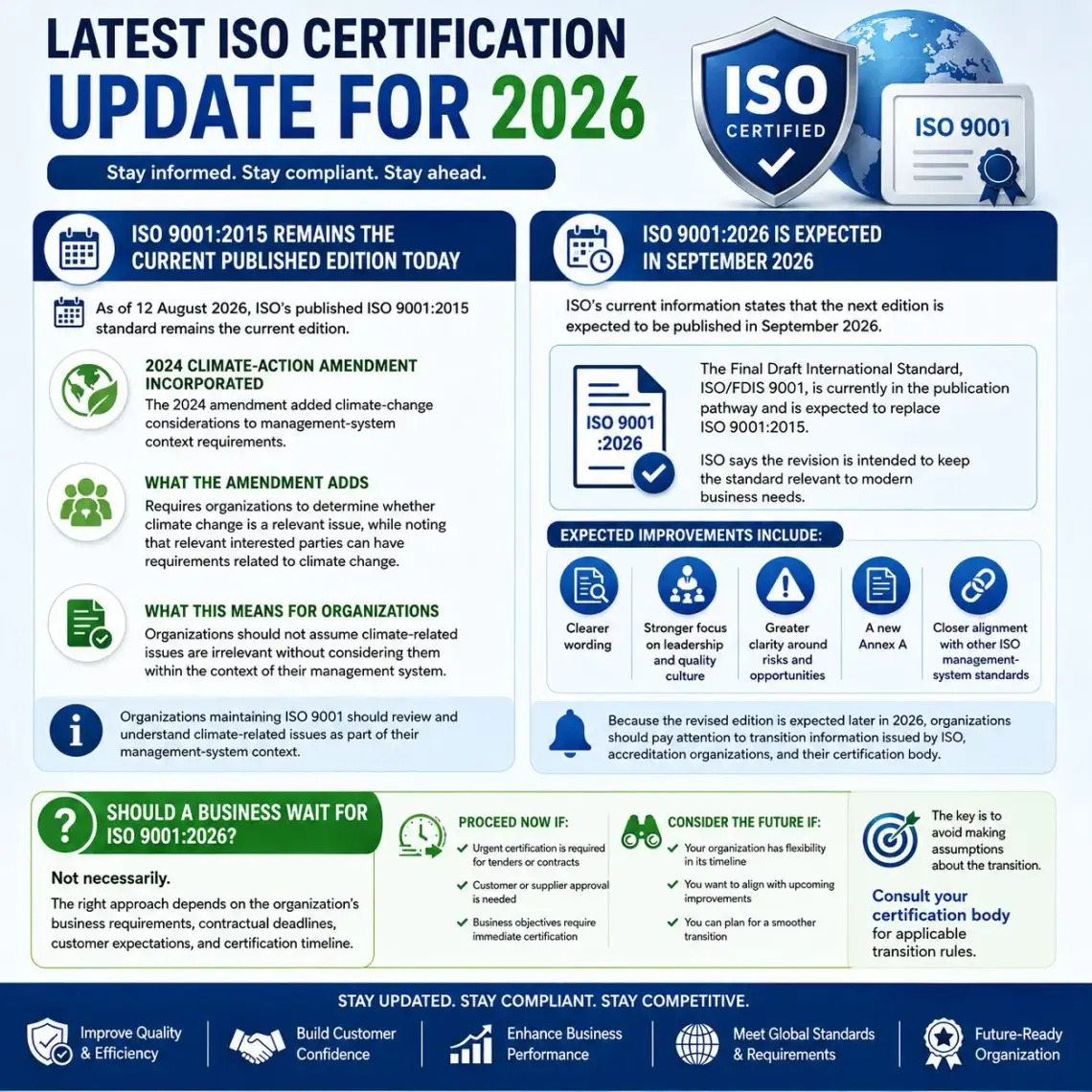
Should a Business Wait for ISO 9001:2026?
Not necessarily.
The right approach depends on the organization's business requirements, contractual deadlines, customer expectations, and certification timeline.
A company that urgently requires certification for a tender, customer, supplier approval, or business objective may need to proceed under the applicable current requirements.
On the other hand, an organization with flexibility may benefit from understanding the upcoming revision and incorporating appropriate forward-looking improvements into its QMS.
The key is to avoid making assumptions about the transition. Certification bodies and accreditation organizations should be consulted for the applicable transition rules.
Common Mistakes to Avoid When Applying for ISO Certification
Choosing an Unverified Certification Provider
A business should not select a provider based only on a certificate price or a promise of instant certification.
Treating ISO Certification as a Documentation Exercise
ISO certification should support actual business processes. Documents that employees do not understand or use are unlikely to create a strong management system.
Ignoring the Certification Scope
A certificate is only meaningful within its defined scope.
Not Conducting Internal Audits
Internal auditing is a fundamental management-system evaluation mechanism and can identify issues before external assessment.
Ignoring Corrective Actions
Repeated problems should be investigated systematically rather than simply closed with temporary fixes.
Failing to Monitor 2026 Updates
Organizations pursuing ISO 9001 should remain aware of the transition from the 2015 edition to the upcoming 2026 edition and the implications for their certification cycle.
ISO Certification vs ISO 9001 Certification
These terms are related but not identical.
- ISO certification is a general term referring to certification against an applicable ISO standard.
- ISO 9001 certification specifically refers to certification of a quality management system against ISO 9001.
For example, an organization can hold ISO 9001 certification for quality management and ISO 14001 certification for environmental management.
Therefore, when writing marketing content, tender documents, or corporate profiles, it is better to identify the exact standard rather than simply claiming that a company is “ISO certified.”
Why Choose Professional Support for ISO Certification?
Organizations often seek professional consultancy when they need help understanding standard requirements, conducting gap assessments, developing management systems, preparing internal audits, or preparing employees for certification audits.
Professional support can be particularly useful for organizations that:
- Are obtaining certification for the first time
- Have limited internal compliance resources
- Need a structured implementation plan
- Are preparing for a customer or tender deadline
- Are transitioning to a revised ISO standard
- Need help interpreting complex requirements
However, consultancy and certification are separate functions. An independent certification body should conduct the certification assessment, rather than a consultant simply “approving” the client's own system.
Conclusion
ISO certification is more than a certificate or logo. It is a formal conformity-assessment process that demonstrates that an organization's management system has been independently evaluated against the requirements of a particular ISO standard.
Businesses researching what is ISO certification, how to get ISO certification, how to apply for ISO certification, how to verify ISO certificate, or ISO 9001 certification in Chennai should first identify the correct standard, define the certification scope, implement the relevant management system, conduct internal evaluation, and select a suitable certification body.
When considering ISO certification cost, businesses should evaluate the complete certification process rather than choosing solely on the lowest advertised price.
For organizations pursuing ISO 9001 certification, 2026 is especially important. ISO 9001:2015 remains the current published edition as of August 2026, including the 2024 climate-action amendment, while ISO expects the revised ISO 9001 edition to be published in September 2026.
Businesses that prepare their quality systems around genuine process improvement, customer requirements, risk management, performance monitoring, and continual improvement will be better positioned to handle certification and future transition requirements.
Frequently asked questions
What is ISO certification?
ISO certification is independent confirmation from a certification body that an organization's management system has been assessed against the requirements of a specified ISO standard and found to conform to the applicable certification requirements.
What is the ISO certification full form?
The term refers to certification against standards developed by the International Organization for Standardization, commonly abbreviated as ISO. ISO itself develops standards but does not issue company certificates.
How can I get ISO certification?
You generally need to select the appropriate ISO standard, define the scope, conduct a gap assessment, implement the management system, perform internal audits and management review, and undergo an independent certification audit.
How do I apply for ISO certification?
You usually apply through a certification body by providing information about your organization, activities, locations, workforce, proposed certification scope, and selected ISO standard. The certification body then determines appropriate audit arrangements.