Electronics & Electrical
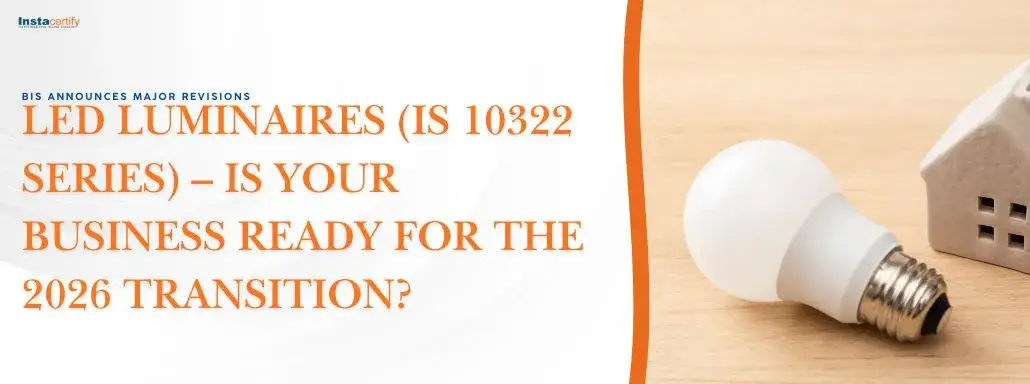
BIS Announces Major Revisions for LED Luminaires (IS 10322 Series) – Is Your Business Ready for the 2026 Transition?
The Bureau of Indian Standards (BIS) has officially rolled out critical new guidelines that will directly impact manufacturers, importers, and sellers of LED luminaires across India. Issued on March 20, 2026, this notification brings a sweeping revision to the IS 10322 Series of standards under the Compulsory Registration Order (CRO).
With the LED market evolving rapidly, these updated standards are designed to enhance product safety, improve energy efficiency, and align India’s electrical safety requirements with the latest international IEC benchmarks. If your business deals with LED lighting, the clock is officially ticking. The final deadline for concurrent running of the old and new standards is 02 August 2026. Failing to transition by this date could result in the cancellation of your BIS license and a complete halt to your product sales.
At Instacertify, we are committed to keeping you ahead of the regulatory curve. Here is a complete, simplified breakdown of the latest BIS guidelines, the technical changes you need to know, and the exact steps you must take to ensure uninterrupted market access.
Which LED Products Are Affected?
The revised guidelines apply to a wide spectrum of LED lighting products. The BIS has mandated that the following seven product categories must upgrade to their respective newly published 2026 standards:
- Fixed General Purpose LED Luminaires: Transitioning from the 2012 standard to IS 10322 (Part 5/Sec 1): 2026 (IEC 60598-2-1: 2020).
- Recessed LED Luminaires: Transitioning from the 2012 standard to IS 10322 (Part 5/Sec 2): 2026 (IEC 60598-2-2: 2023).
- LED Luminaires for Road and Street Lighting: Transitioning to IS 10322 (Part 5/Sec 3): 2026.
- LED Flood Lights: Transitioning from the 2013 standard to IS 10322 (Part 5/Sec 5): 2026 (IEC 60598-2-5: 2015).
- LED Hand Lamps: Transitioning from the 2013 standard to IS 10322 (Part 5/Sec 6): 2026.
- LED Lighting Chains: Transitioning from the 2017 standard to IS 10322 (Part 5/Sec 7): 2026 (IEC 60598-2-20: 2022).
- LED Luminaires for Emergency Lighting: Transitioning from the 2013 standard to IS 10322 (Part 5/Sec 8): 2026 (IEC 60598-2-22: 2022).
All of these specific product standards refer back to the core foundational standard, IS 10322 (Part 1), which has also been extensively revised and published as IS 10322 (Part 1): 2026.
Big Shifts: Key Technical Upgrades Explained
The transition isn’t just a change in paperwork; it brings substantial technical upgrades to how LED luminaires are tested and validated. The most significant changes introduced in IS 10322 (Part 1): 2026 include:
- Advanced Ingress Protection: The introduction of the IPX9 testing standard, which tests products against high-pressure, high-temperature water jets.
- Health and Safety Overhauls: A major inclusion is the new EMF (Electromagnetic Field) safety requirements. There is also an extension of Photo Biological requirements to better protect human eyes from hazardous light exposure.
- Electrical Shock Prevention: The new standard introduces strict touch voltage and touch current limits to establish whether a conductive part can cause an electric shock. Furthermore, the Protective Extra-Low-Voltage (PELV) system has been formally introduced.
- Mechanical Safety: A brand new clause has been added requiring protection against fast-rotating parts, such as moving fan blades inside the luminaires.
- Energy Storage & Batteries: The update includes a new normative annexure covering battery and Electric Double Layer Capacitor (EDLC) operated luminaires.
Category-Specific Changes to Watch Out For:
Recessed Luminaires: Now include requirements for air-handling luminaires and additional specific marking requirements.
- LED Flood Lights: Must now undergo a strict glass breaking test.
- LED Lighting Chains: Specific provisions for Temporarily Installed Protected Lighting (TPL) chains have been integrated, alongside new terms and definitions.
- Emergency Lighting: Manufacturers will face new requirements for lithium batteries and EDLCs, alongside updated rules for “rest mode” and “inhibiting mode”.
What Does This Mean for Your Business?
Whether you already hold a BIS license or are in the process of applying for one, the BIS has laid out strict implementation rules.
1. For Existing BIS Licensees
If you already manufacture or sell under the current IS 10322 standards, you have a grace period to upgrade. However, this period is strictly capped. You must implement the revised standards by 02 August 2026.
- Action Required: You must submit complete, updated test reports issued by a BIS-recognized laboratory for all lead models covered under your current license.
- Undertaking: You are required to provide an official undertaking confirming that the new requirements have been implemented across all other series models in your scope.
- The Risk: If you fail to complete these actions by the August deadline, the BIS will initiate the cancellation of your license or delete those specific models from your approved scope.
2. For New Applicants
If you are currently applying for a BIS certification, the rules depend on where you are in the process:
- Already Submitted: If your samples are already in the lab or your test reports have just been issued, your application may still be processed under the old standard.
- Applying Now: New applications can currently be processed under either the old or the revised standard. However, if you choose the old standard, it is only permitted until the concurrent running deadline of 02 August 2026. In this case, you must submit a declaration promising to implement the revised standard by that August deadline.
- Post-Deadline: Beyond 02 August 2026, absolutely no new licenses will be granted under the old, outdated standard.
Similar rules apply to any manufacturers looking to Change the Scope of their License (e.g., adding new models). You can only request changes under the old standard up to the date you officially switch to the new standard, or by August 02, 2026—whichever comes first.