Electronics & Electrical
BIS Extends Implementation Date of IS 16102 (Part 1):2026 for LED Lamps to February 2027
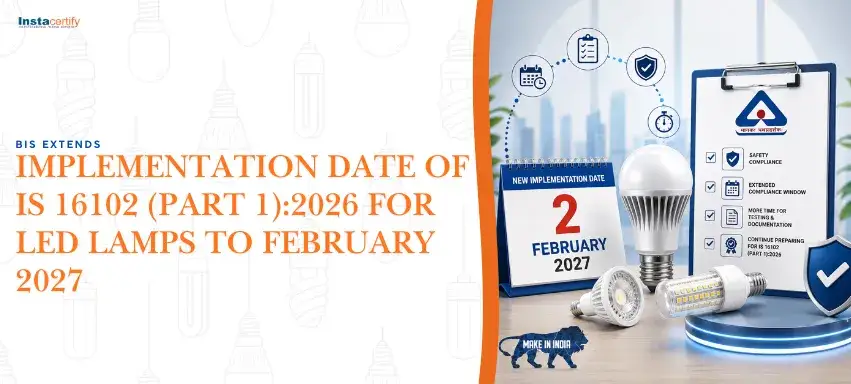
New Delhi, August 2026: The Bureau of Indian Standards (BIS) has extended the implementation date of the revised IS 16102 (Part 1):2026, applicable to Self-Ballasted LED Lamps for General Lighting Services – Part 1: Safety Requirements, providing manufacturers and other stakeholders additional time to transition to the updated requirements.
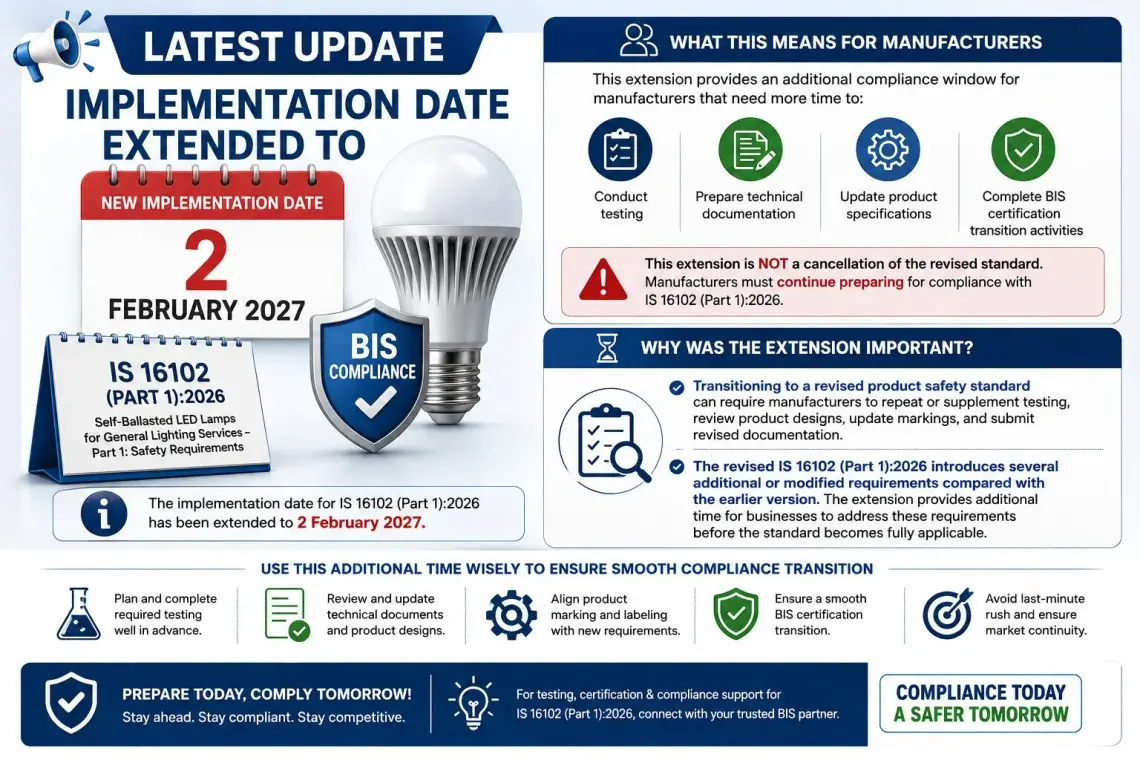
As per the latest BIS communication dated 31 July 2026, the implementation date of IS 16102 (Part 1):2026 has been extended to 2 February 2027. The extension gives manufacturers additional time to complete testing, documentation, and other compliance activities associated with the revised standard.
What Is IS 16102 (Part 1):2026?
IS 16102 (Part 1):2026 is the revised Indian Standard titled “Self-Ballasted LED Lamps for General Lighting Services – Part 1: Safety Requirements.” It is the first revision of the earlier IS 16102 (Part 1):2012 and establishes updated safety requirements and testing provisions for applicable self-ballasted LED lamps.
BIS had earlier issued implementation guidelines on 24 February 2026, requiring manufacturers to transition from the 2012 version to the revised 2026 standard. The latest communication extends the implementation timeline while retaining the other provisions of the original guidelines.
Latest Update: Implementation Date Extended to 2 February 2027
The most important development for manufacturers is the revised compliance timeline.
The implementation date for IS 16102 (Part 1):2026 has been extended to 2 February 2027. This provides an additional compliance window for manufacturers that need more time to conduct testing, prepare technical documentation, update product specifications, and complete the necessary BIS certification transition activities.
The extension should not be interpreted as a cancellation of the revised standard. Manufacturers should continue preparing for compliance with IS 16102 (Part 1):2026 and use the additional time to complete the required transition activities.
Why Was the Extension Important?
Transitioning to a revised product safety standard can require manufacturers to repeat or supplement testing, review product designs, update markings, and submit revised documentation.
For LED lamp manufacturers, the revised IS 16102 (Part 1):2026 introduces several additional or modified requirements compared with the earlier version. The extension therefore provides additional time for businesses to address these requirements before the revised standard becomes fully applicable.
Key Changes in IS 16102 (Part 1):2026
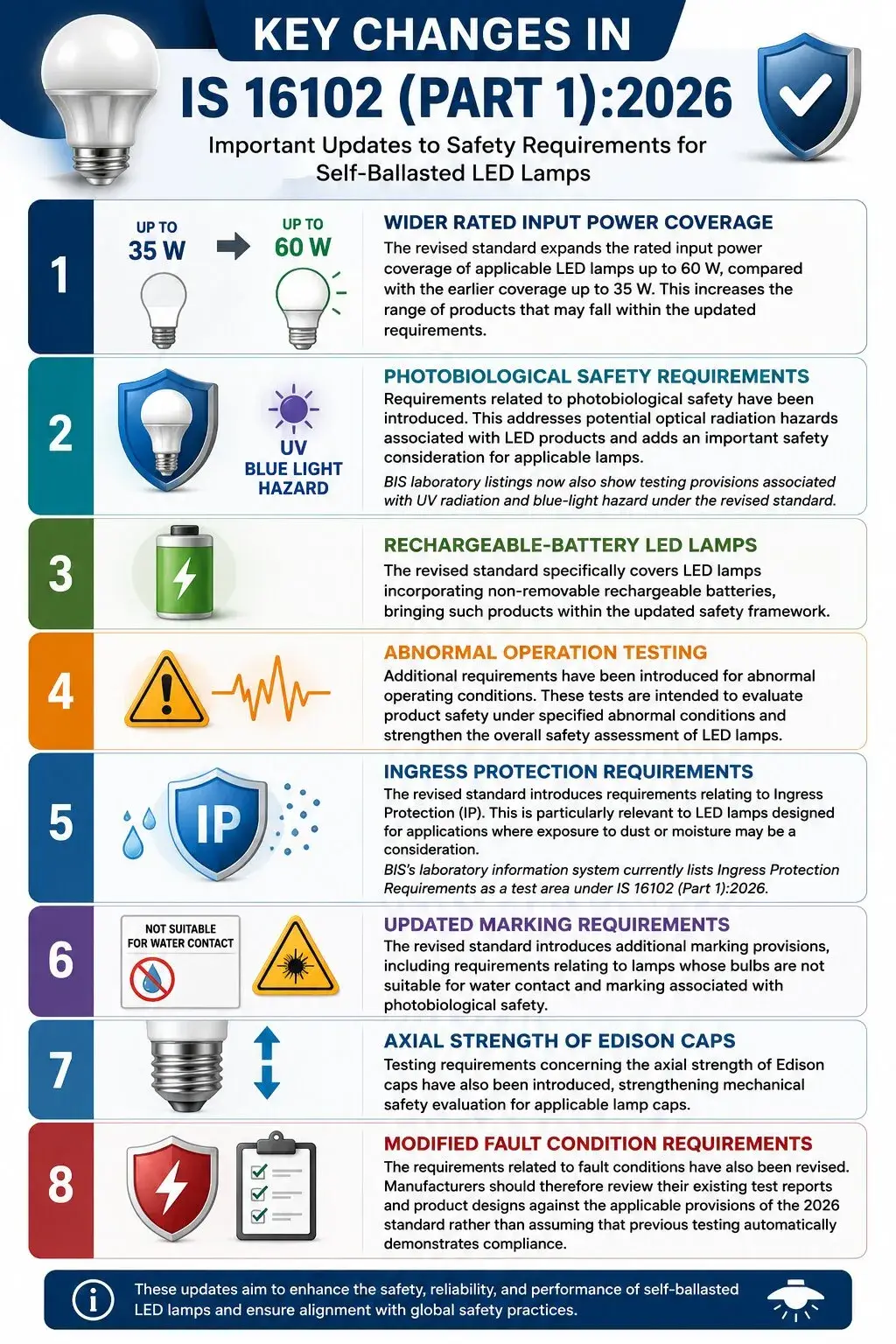
The 2026 revision introduced several important changes to the safety requirements for self-ballasted LED lamps.
1. Wider Rated Input Power Coverage
The revised standard expands the rated input power coverage of applicable LED lamps up to 60 W, compared with the earlier coverage up to 35 W. This increases the range of products that may fall within the updated requirements.
2. Photobiological Safety Requirements
Requirements related to photobiological safety have been introduced. This addresses potential optical radiation hazards associated with LED products and adds an important safety consideration for applicable lamps.
BIS laboratory listings now also show testing provisions associated with UV radiation and blue-light hazard under the revised standard.
3. Rechargeable-Battery LED Lamps
The revised standard specifically covers LED lamps incorporating non-removable rechargeable batteries, bringing such products within the updated safety framework.
4. Abnormal Operation Testing
Additional requirements have been introduced for abnormal operating conditions. These tests are intended to evaluate product safety under specified abnormal conditions and strengthen the overall safety assessment of LED lamps.
5. Ingress Protection Requirements
The revised standard introduces requirements relating to Ingress Protection (IP). This is particularly relevant to LED lamps designed for applications where exposure to dust or moisture may be a consideration.
BIS's laboratory information system currently lists Ingress Protection Requirements as a test area under IS 16102 (Part 1):2026.
6. Updated Marking Requirements
The revised standard introduces additional marking provisions, including requirements relating to lamps whose bulbs are not suitable for water contact and marking associated with photobiological safety.
7. Axial Strength of Edison Caps
Testing requirements concerning the axial strength of Edison caps have also been introduced, strengthening mechanical safety evaluation for applicable lamp caps.
8. Modified Fault Condition Requirements
The requirements related to fault conditions have also been revised. Manufacturers should therefore review their existing test reports and product designs against the applicable provisions of the 2026 standard rather than assuming that previous testing automatically demonstrates compliance.
What Does the Extension Mean for Manufacturers?
The extension to 2 February 2027 gives manufacturers additional time to prepare their products and certification documentation.
Businesses manufacturing or supplying applicable self-ballasted LED lamps should use this period to:
- Review the revised IS 16102 (Part 1):2026 requirements.
- Identify differences between the 2012 and 2026 versions.
- Conduct required testing through applicable BIS-recognized laboratories.
- Review existing BIS licence scopes and covered models.
- Update technical and product documentation.
- Verify applicable product marking requirements.
- Evaluate photobiological safety requirements.
- Assess IP and abnormal-operation testing requirements where applicable.
- Prepare revised test reports and supporting documentation.
- Complete BIS transition or scope-related activities within the revised timeline.
The BIS laboratory information system already lists laboratories and testing facilities covering various clauses of IS 16102 (Part 1):2026, including marking, abnormal operation, ingress protection and other safety requirements.
What Should Existing BIS Licensees Do?
Existing BIS licence holders should not wait until the revised deadline to begin compliance activities.
Manufacturers should review their existing certification against the revised standard and determine whether additional testing or documentation is required. The original BIS implementation guidelines required existing licensees to submit relevant test reports for lead models and provide an undertaking regarding compliance of series models.
Since the latest communication extends the implementation date to 2 February 2027, the additional time can be used to complete these transition activities in an organised manner.
Businesses should also monitor further BIS communications in case additional clarification or procedural instructions are issued.
Impact on New BIS Applications
Manufacturers planning new BIS registration for products covered by IS 16102 (Part 1) should consider the revised standard while planning product testing and certification.
The original implementation framework provided transitional arrangements for applications where samples had already been submitted or testing was underway. The latest extension changes the implementation timeline, while the other provisions of the original guidelines continue to apply.
Therefore, manufacturers should carefully assess their application status and applicable requirements rather than relying solely on the previous deadline.
Revised Compliance Timeline
| Compliance Aspect | Earlier Position | Latest Position |
|---|---|---|
| Previous Standard | IS 16102 (Part 1):2012 | Transitioning to revised version |
| Revised Standard | IS 16102 (Part 1):2026 | Applicable |
| Original Implementation Date | 2 August 2026 | Extended |
| New Implementation Date | — | 2 February 2027 |
| Product Category | Self-Ballasted LED Lamps | Self-Ballasted LED Lamps |
| Key Compliance Areas | Safety requirements | Updated safety and testing requirements |
The extension effectively gives industry additional time to complete the transition to the 2026 standard.
Why Manufacturers Should Start Preparing Now
Although the deadline has been extended, manufacturers should avoid postponing compliance activities until early 2027.
Testing under a revised standard can require additional time, particularly where products need design modifications, supplementary testing, laboratory scheduling, updated technical files, or BIS application/registration changes.
Early preparation can help businesses identify non-compliances before the final implementation date and reduce the risk of delays in certification or product-market activities.
What Manufacturers and Importers Should Do Now
Manufacturers and importers dealing with self-ballasted LED lamps should treat the extension as an opportunity to complete their compliance transition rather than as a reason to delay it.
Businesses should first identify which products fall under IS 16102 (Part 1):2026 and compare their current certification and test documentation against the revised requirements. Where necessary, products should undergo testing through an appropriate BIS-recognized laboratory.
Companies should also ensure that product markings, technical documentation, model details and certification records are consistent with the revised requirements.
Conclusion The BIS extension of the implementation date for IS 16102 (Part 1):2026 to 2 February 2027 provides valuable additional time for manufacturers of self-ballasted LED lamps to complete the transition to the revised safety standard. However, the extension does not remove the need to comply with the revised standard. Manufacturers and importers should use the additional compliance window to complete testing, review existing BIS certification, update documentation and address the new safety requirements. With the revised deadline approaching in February 2027, early preparation can help businesses avoid last-minute testing and certification challenges while supporting continued access to the Indian market. Source: Bureau of Indian Standards (BIS), Extension in Date of Implementation of IS 16102 (Part 1):2026. The latest update extends the implementation date to 2 February 2027.