Manufacturing Practices
2026 Turning Point: Why Urban Battery Mining Will Soon Dominate India

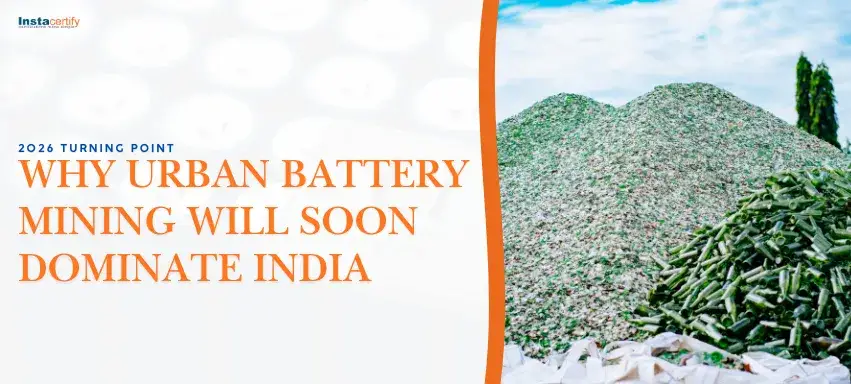
Have you ever looked at your dying smartphone or the bulky battery of an old electric vehicle (EV) and thought, "That's a goldmine"? Well, legally, economically, and chemically, it actually is.
We are standing on the brink of a massive shift in how we source our most precious metals. Welcome to the era of the circular economy. This blog breaks down everything you need to know about urban mining, battery lifespans, the impending 2026 boom in India, and how businesses can stay compliant in this rapidly changing landscape.
What is Urban Recycling?
Urban recycling—more commonly known in the industry as urban mining—is the process of reclaiming raw materials from spent products, buildings, and electronic waste generated by city populations.
Instead of blasting mountains and drilling deep into the earth's crust to find virgin ores, urban mining treats our cities as the primary resource reserve. E-waste, discarded appliances, and end-of-life batteries are rich in lithium, cobalt, nickel, and copper. By "mining" our metropolitan waste, we create a closed-loop system that drastically reduces the need for destructive geological extraction and secures local supply chains.
What are the 5 Steps of the Recycling Process?
When it comes to advanced lithium-ion batteries, recycling is a high-tech, hazardous, and highly precise operation. The journey from a "dead battery" to a "usable metal" involves five critical steps:
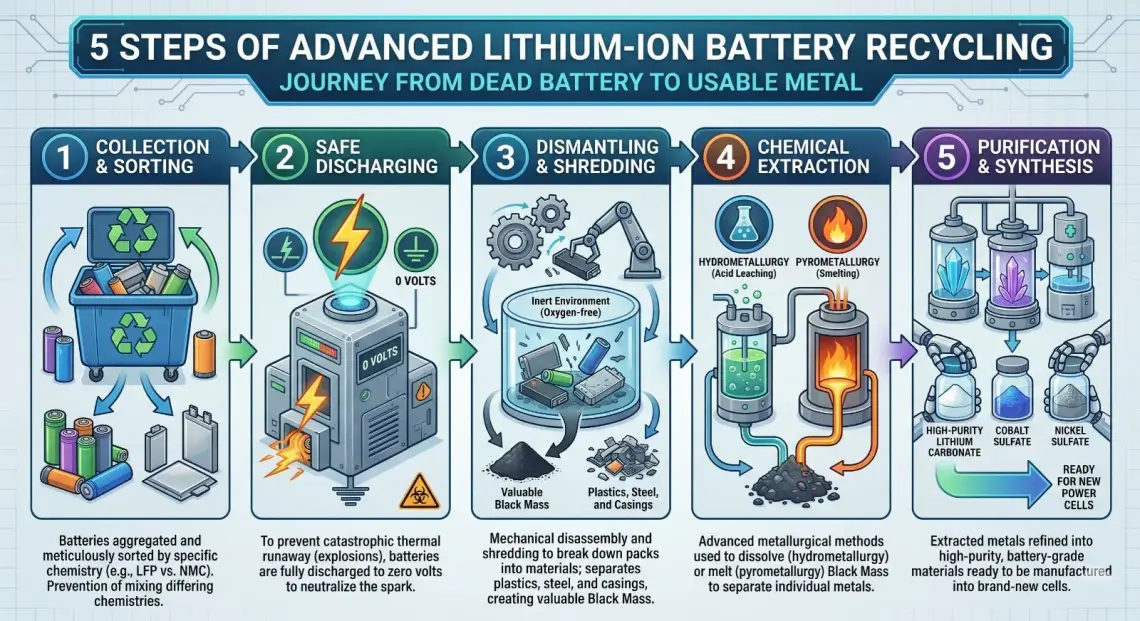
- Collection and Sorting: Batteries are aggregated and meticulously sorted by their specific chemistry (e.g., LFP vs. NMC). You cannot mix them because the downstream chemical recovery processes differ significantly.
- Safe Discharging: Lithium batteries hold residual, highly volatile energy. To prevent catastrophic thermal runaway (explosions), they must be fully discharged to zero volts to neutralize the spark.
- Dismantling and Shredding: The batteries are mechanically broken down, often in an oxygen-free (inert) environment. Plastics, steel, and casings are removed, leaving behind a valuable dark powder known in the industry as "Black Mass."
- Chemical Extraction: Using advanced metallurgical methods like hydrometallurgy (acid leaching) or pyrometallurgy (high-heat smelting), the Black Mass is dissolved or melted to separate the individual metals.
- Purification and Synthesis: The extracted metals are refined into high-purity, battery-grade lithium carbonate, cobalt sulfate, and nickel sulfate—ready to be manufactured into brand-new power cells.
What is the 40-80 Rule for Batteries?
Before we recycle a battery, we want it to live as long as possible. Enter the 40-80 rule.
This is a golden rule for lithium-ion battery longevity. It suggests that you should keep your device's state of charge between 40% and 80%. Why? Lithium cells undergo immense chemical and thermal stress when pushed to a full 100% charge or drained completely to 0%.
By avoiding these extreme charge states, you reduce the depth of discharge (DoD). Treating your battery to "shallow" charge cycles can extend its lifespan from a mere 300 full cycles to over 1,500 to 3,000 cycles. Whether it's a smartphone, an electric bike, or a massive solar storage system, following the 40-80 rule delays the inevitable trip to the recycling plant and maximizes the battery's usable life.
2026: A Turning Point for Urban Mining in India?
Mark your calendars, because 2026 is the year the Indian recycling landscape fundamentally shifts. Driven by the explosive growth of the EV sector, the Indian government implemented the strict Battery Waste Management Rules (BWMR) 2022.
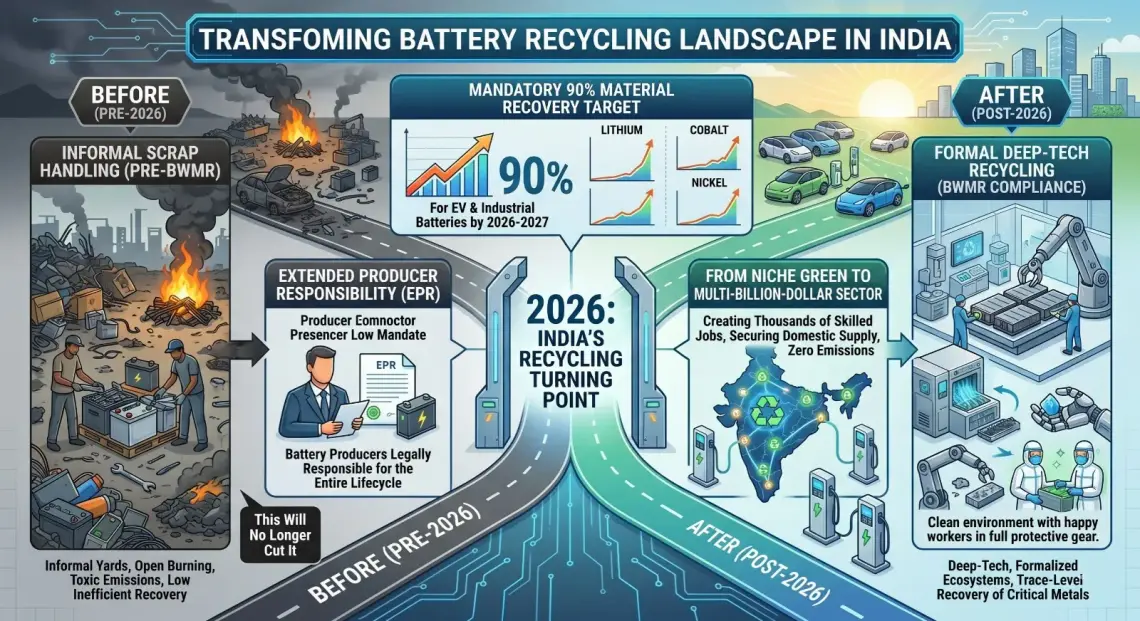
These rules mandate Extended Producer Responsibility (EPR), meaning battery producers are legally responsible for the recycling of their products at the end of their life. The rules are being enforced in phases, but by 2026-2027, the compliance targets hit a massive milestone: a mandatory material recovery rate of 90% for EV and industrial batteries.
This means informal scrap yards burning wires will no longer cut it. By 2026, the industry must transition entirely to deep-tech, formalized recycling ecosystems capable of proving trace-level recovery of critical metals. It is a regulatory turning point that will transform urban mining from a niche green initiative into a multi-billion-dollar organized sector in India.
What Do You Mean by Battery Recycling?
At its core, battery recycling is the industrial process of safely dismantling spent energy storage devices to extract their core elemental components for reuse.
It is not just about "crushing and melting." True battery recycling is a highly sophisticated chemical engineering feat. The goal is to isolate active cathode and anode materials—like lithium, graphite, cobalt, and manganese—and refine them back to their original purity. Done correctly, a recycled lithium atom is chemically identical to a freshly mined lithium atom, meaning it can be reused infinitely without any quality degradation.
What are the 7 Different Types of Recycling?
To understand where batteries fit into the global waste ecosystem, it helps to look at the broader picture. The recycling industry is generally divided into seven major material categories:
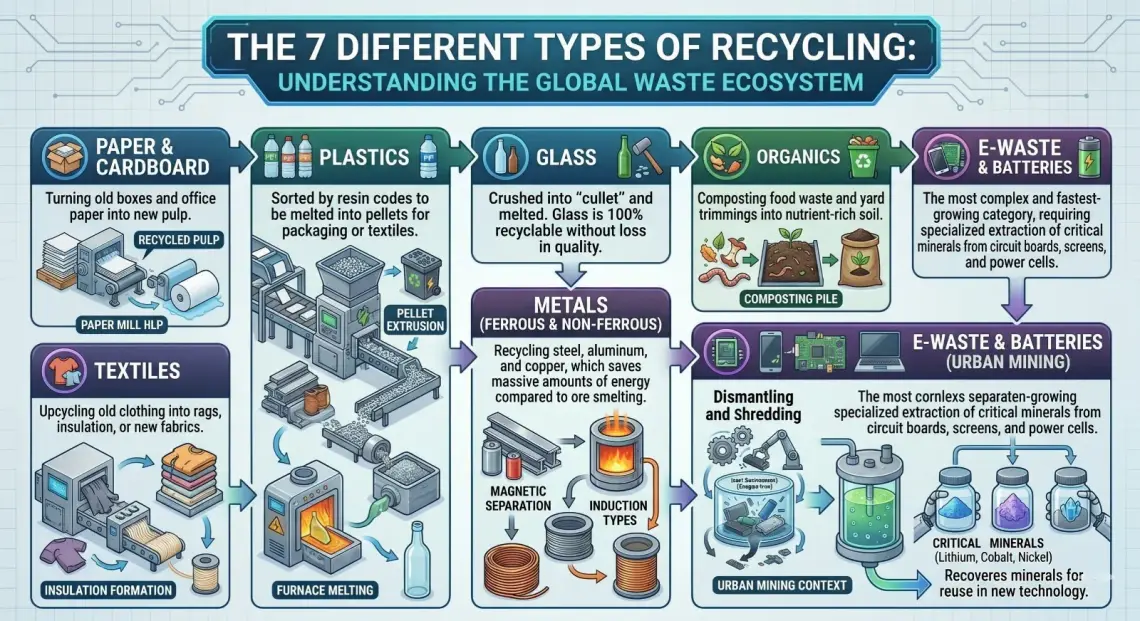
- Paper and Cardboard: Turning old boxes and office paper into new pulp.
- Plastics: Sorted by resin codes to be melted into pellets for packaging or textiles.
- Glass: Crushed into "cullet" and melted. Glass is 100% recyclable without loss in quality.
- Metals (Ferrous & Non-Ferrous): Recycling steel, aluminum, and copper, which saves massive amounts of energy compared to ore smelting.
- Textiles: Upcycling old clothing into rags, insulation, or new fabrics.
- Organics: Composting food waste and yard trimmings into nutrient-rich soil.
- E-Waste & Batteries (Urban Mining): The most complex and fastest-growing category, requiring specialized extraction of critical minerals from circuit boards, screens, and power cells.
What is the Difference Between Mining and Urban Mining?
The difference boils down to the source material, yield, and environmental impact.
- Traditional Mining: Involves geological surveys, deforestation, massive earth-moving machinery, and chemical extraction from natural ores. It is resource-intensive and environmentally destructive. For context, you have to process roughly 250 tons of raw earth ore to get just 1 ton of lithium.
- Urban Mining: Sources materials from end-of-life manufactured goods. It treats city waste as high-grade ore. Astonishingly, just 1 ton of discarded lithium-ion batteries contains significantly higher concentrations of lithium and cobalt than 1 ton of the highest-grade natural ore. Urban mining skips the drilling and deforestation, jumping straight to the extraction of metals that have already been refined once before.
Environmental and Economic Benefits of Urban Mining
The pivot to urban mining offers a phenomenal dual advantage.
Environmental Benefits:
- Zero Deforestation: Protects ecosystems from being bulldozed for new mines.
- Reduced Carbon Footprint: Recycling battery metals produces up to 70% fewer greenhouse gas emissions compared to raw extraction.
- Toxicity Prevention: Keeps hazardous chemicals, heavy metals, and volatile organic compounds out of landfills and groundwater.
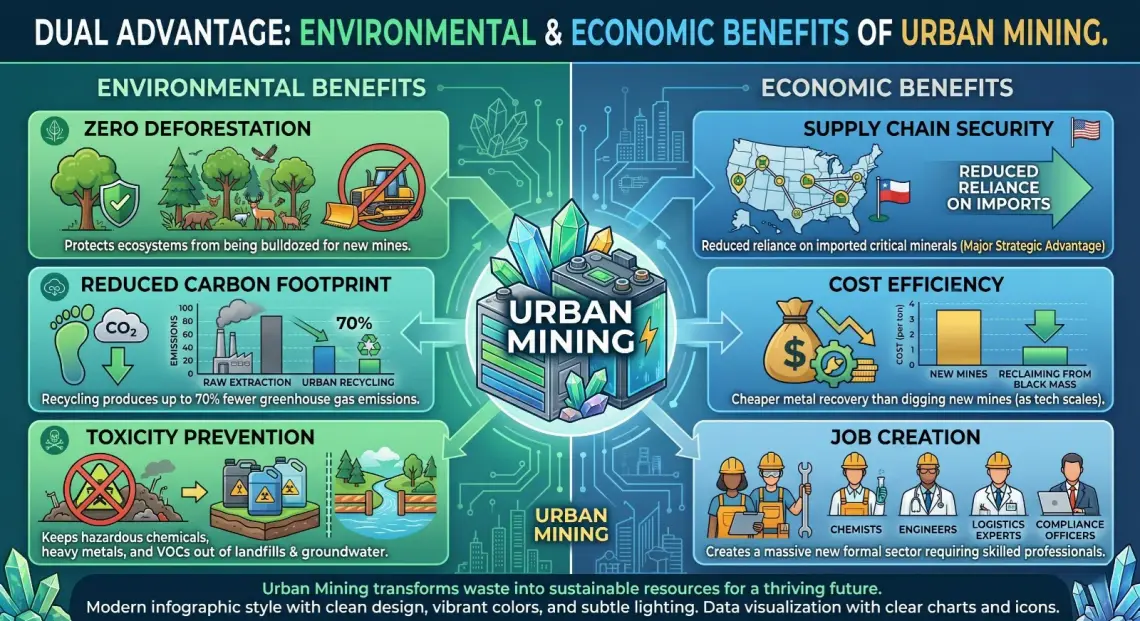
Economic Benefits:
- Supply Chain Security: Reduces reliance on imported critical minerals (a major strategic geopolitical advantage).
- Cost Efficiency: As recycling tech scales, recovering metals from black mass will become cheaper than digging new mines.
- Job Creation: Creates a massive new formal sector requiring skilled chemists, engineers, logistics experts, and compliance officers.
How Does Instacertify Help with Battery Recycling Compliance?
With the BWMR 2022 rules tightening the noose, regulatory compliance is the biggest hurdle for manufacturers, importers, and recyclers today. This is where Instacertify steps in.
As India’s leading compliance and certification marketplace, Instacertify acts as the central command for regulatory readiness. They help businesses navigate the incredibly complex web of Central Pollution Control Board (CPCB) mandates.
- EPR Registration: Seamlessly registering producers and recyclers on the centralized CPCB portal.
- Annual Returns & Traceability: Managing the heavy paperwork and mass-balance auditing required to prove those strict 2026 material recovery targets.
- BIS Certification: Ensuring that secondary/recycled materials meet the strict Bureau of Indian Standards (BIS) for reuse in new products.
Instacertify removes the regulatory headache, allowing tech companies and recyclers to focus on innovation while maintaining bulletproof legal compliance.
Summary
The concept of "waste" is becoming obsolete. The batteries powering our phones, laptops, and electric vehicles are not disposable commodities—they are temporary vessels for infinitely reusable elements.
Urban mining is the bridge to a sustainable future, taking the pressure off our planet while fueling the next generation of technology. With the massive 2026 BWMR targets fast approaching in India, the shift from informal scrap handling to high-tech, regulated recycling is inevitable. By extending our devices' lifespans with the 40-80 rule and partnering with compliance experts like Instacertify, we can build a circular economy where technological progress doesn’t cost us the earth.
If you want to Registration EPR for your battery waste please visit: EPR Battery Waste
India vs China in Lithium? E-Waste Critical Minerals Strategy
This video breaks down how India is leveraging urban mining and e-waste recycling as a geopolitical strategy to secure critical minerals and challenge global supply chain monopolies.
Frequently asked questions
What is urban recycling?
Urban recycling, or urban mining, is the process of reclaiming valuable raw materials like lithium, cobalt, and copper from discarded electronics, buildings, and end-of-life batteries within cities, bypassing the need for environmentally destructive traditional mining.
What are the 5 steps of the recycling process?
The process involves five critical steps: collecting and sorting by chemistry, safely discharging residual energy to prevent explosions, mechanically dismantling and shredding into black mass, chemically extracting metals via metallurgy, and purifying them into battery-grade materials.
What is the 40-80 rule for batteries?
The 40-80 rule recommends keeping a lithium-ion battery's charge between 40% and 80%. Avoiding extreme full charges or complete drains minimizes internal chemical stress, significantly extending the overall health and operational lifespan of the power cell.
Why is 2026 a turning point for urban mining in India?
In 2026, India's Battery Waste Management Rules mandate a strict 90% material recovery target for EV batteries. This regulatory shift forces the industry to transition from informal scrap yards to highly formalized, deep-tech recycling ecosystems.
What do you mean by battery recycling?
Battery recycling is an advanced industrial and chemical process that safely processes spent batteries. It extracts core elements like lithium and nickel from the cathode and anode, refining them to their original purity for infinite reuse.
What are the 7 different types of recycling?
The global waste ecosystem categorizes recycling into seven distinct streams: paper and cardboard, plastics, glass, metals, textiles, organic waste for composting, and highly complex e-waste and battery recycling, also known as urban mining.
What is the difference between mining and urban mining?
Traditional mining destroys ecosystems to extract raw, low-concentration ore from the earth. Conversely, urban mining processes discarded metropolitan products, yielding much higher concentrations of refined, critical metals with a significantly lower carbon footprint.
What are the environmental and economic benefits of urban mining?
Urban mining prevents deforestation, cuts carbon emissions by up to 70%, and stops toxic landfill contamination. Economically, it secures domestic mineral supply chains, reduces costly import reliance, and creates high-skilled jobs in engineering and compliance.