
Indian Compliance
FSSAI Labelling Rules 2026: Complete Food Packaging Compliance Guide in India

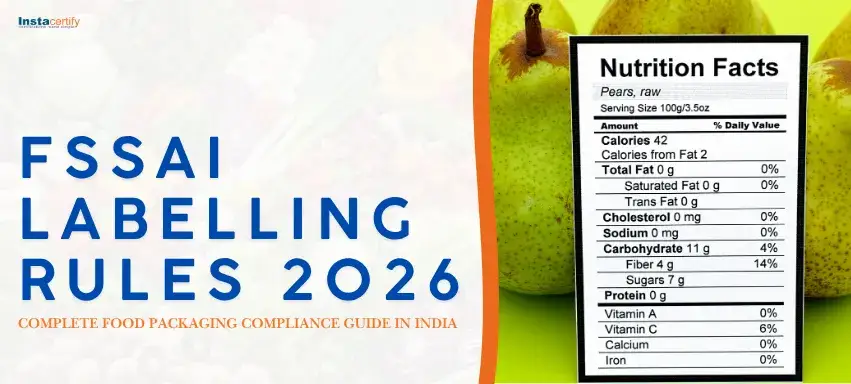
For a food product, packaging is more than branding. The label is an important regulatory communication between the Food Business Operator and the consumer. In India, pre-packaged food labelling is primarily governed by the Food Safety and Standards (Labelling and Display) Regulations, 2020, supported by related FSSAI regulations dealing with food standards, claims, additives, imports and specific food categories. FSSAI maintains amendments to the 2020 regulations, so businesses should check the latest applicable requirements before finalising artwork for printing.
What Are FSSAI Labelling Rules?
FSSAI labelling rules specify the information that must be provided on pre-packaged food so consumers can understand the product and regulators can trace it through the supply chain. The regulations require label information to be clear, prominent, conspicuous, indelible and readily legible under normal conditions of purchase and use.
The rules also apply to food sold through e-commerce or other direct-selling channels, where applicable mandatory information must be made available to consumers before sale. Certain traceability details, such as the batch or lot number and date-related information, are specifically treated differently for pre-sale online disclosure.
Mandatory FSSAI Labelling Requirements
The exact label declarations depend on the nature of the food, package size, processing, claims and route of sale. However, the following are key areas that businesses should review.
1. Name or True Nature of the Food
The front of the pack should carry the name of the food indicating its true nature. Where a standard or regulation specifies the identity and composition of a food, the prescribed name should be used. A common or usual name or an appropriate description may be used where no specific name is prescribed. Brand or fancy names can additionally be used subject to applicable advertising and claims requirements.
2. List of Ingredients
Except for applicable single-ingredient foods, ingredients must be declared under an appropriate heading such as “Ingredients” or “List of Ingredients.”
Ingredients are generally listed in descending order of composition by weight or volume at the time of manufacture. Food additives also have specific declaration requirements, including functional class together with the relevant specific name or INS number, where applicable.
3. Nutrition Information
Nutritional information has to be prepared in accordance with the applicable FSSAI requirements rather than simply copied from a standard template.
The prescribed nutrition declaration includes information such as:
- Energy value
- Protein
- Carbohydrate
- Total sugars
- Added sugars
- Total fat
- Saturated fat
- Trans fat, where applicable
- Cholesterol, where applicable
- Sodium
The regulations provide for nutritional information per 100 g, 100 ml or per single-consumption pack, along with the applicable percentage contribution to Recommended Dietary Allowance per serve. There are exemptions for certain food categories and product types, so the product should be assessed before assuming that a nutrition panel is mandatory in every case.
Important correction for businesses
Do not assume that every food product needs exactly the same nutrition format. FSSAI provides exemptions and specific conditions, including provisions related to single-ingredient/minimally processed foods and certain specialised products. A label review should therefore be based on the actual product category.
4. Vegetarian and Non-Vegetarian Symbol
The vegetarian/non-vegetarian declaration is a specific FSSAI labelling requirement for applicable food products.
Under the current regulations:
- Vegetarian food: green filled circle inside a green-outlined square.
- Non-vegetarian food: brown filled triangle inside a brown-outlined square.
The symbol must be prominently displayed on the principal display panel, close to the name or brand name, with the required size based on the area of the principal display panel.
This is an important correction to the older version of the Instacertify article, which currently describes the non-vegetarian symbol as a brown circle.
5. Allergen Declaration
Certain recognised food allergens must be declared separately where applicable. The current rules cover:
Cereals containing gluten, crustaceans, milk and milk products, eggs, fish, peanuts and tree nuts, soybeans, and sulphites at the prescribed concentration threshold.
The regulations provide for a separate “Contains” declaration. Cross-contamination-related declarations may also be made as “May Contains” where applicable. There are specific exceptions and conditions, so allergen labelling should be reviewed against the actual formulation and manufacturing process.
6. FSSAI Logo and Licence Number
The FSSAI logo and applicable licence number must be displayed on the food package in the prescribed manner and with suitable contrast.
Where the brand owner, manufacturer, marketer, packer or bottler are different entities, the relevant licence details may also need to be displayed according to the applicable provisions. Imported foods have additional importer-related requirements.
Small package exemption
A significant detail often missed by brands is that the regulations provide exemptions for certain declarations on packages with a surface area of not more than 100 cm², subject to the conditions in the regulations. The information may then need to be provided on the multi-unit package. Therefore, it is not technically correct to state that every packaged food product must always print every declaration directly on every individual small pack.
7. Name and Address of the Brand Owner
The label must identify the brand owner and give the complete address using the applicable qualifying wording, such as:
Manufactured by, Marketed by, Manufactured & Marketed by, Packed & Marketed by
depending on the actual business arrangement.
Imported foods also require importer information, and additional country-of-origin and packing information can apply where food manufactured outside India undergoes specified processing or is packaged/bottled in India.
8. Net Quantity, Retail Sale Price and Consumer Care
Declarations relating to net quantity, retail sale price and consumer-care details are governed through the applicable Legal Metrology framework in addition to the food labelling requirements.
Businesses should therefore review FSSAI labelling and Legal Metrology declarations together rather than treating them as completely separate packaging exercises.
9. Batch or Lot Number
A batch number, code number or lot number is an important traceability declaration and must be included according to the applicable requirements.
Traceability information becomes especially important when investigating complaints, conducting market withdrawals or identifying a particular production batch.
10. Date of Manufacture, Expiry and Best Before
One common mistake is treating Best Before and Use By/Expiry as interchangeable.
Under the current labelling regulation, the label should declare:
- Date of manufacture or packaging
- Expiry/Use By
“Best Before” may also be used as optional or additional information where appropriate.
The regulation also specifies how date information is presented depending on the product's shelf life and provides certain exceptions for specific categories. Where shelf life depends on storage conditions, the relevant storage instructions must also be declared.
11. Storage and Instructions for Use
Where a product requires particular handling, preparation or storage instructions, those instructions should be provided on the label.
Examples can include directions such as refrigeration after opening or instructions for reconstitution. The purpose is to help consumers use the product correctly and safely.
FSSAI Rules for Imported Food Labels
Imported food products require additional attention because labelling under the FSSAI Import Regulations applies along with the general labelling requirements.
The label should include the applicable country of origin declaration, and imported products must carry the required importer information. Where processing in another country changes the nature of the food and results in a change in HS code at the six-digit level, the regulation provides a specific country-of-origin principle for labelling.
This is particularly relevant for brands importing packaged food, ingredients, private-label products and finished food products into India.
FSSAI Labelling Requirements for Online Food Sales
Food businesses selling through websites, marketplaces or other online channels should not assume that the physical package alone is sufficient for digital sales.
FSSAI requires applicable mandatory label information to be provided to consumers before the sale through appropriate means. However, the regulation specifically excludes certain traceability/date details from that pre-sale requirement, including batch/lot information and manufacturing/packing and date-related declarations.
For e-commerce operations, businesses should therefore perform two checks:
Physical label compliance + online product-information compliance.
The two should contain consistent product information.
FSSAI Labelling Rules for Non-Retail Packaging
Non-retail containers have separate provisions under Regulation 10.
The current requirements include information such as the name of the food, net quantity, FSSAI logo and licence number, date marking, lot number, and manufacturer/packer details including country of origin for imported packages.
Certain information may be supplied through accompanying documents where permitted by the regulation. Non-retail packs also have a specific “NOT FOR RETAIL SALE” declaration.
This makes non-retail labelling particularly relevant for bulk ingredients, B2B food supplies, institutional packs and industrial food distribution.
Latest FSSAI Labelling Updates in 2026
Businesses should distinguish between amendments that are already applicable and amendments that have been notified for future implementation.
Coffee-Chicory Labelling — Effective 1 July 2026
The 2025 amendment relating to coffee-chicory mixtures became effective on 1 July 2026. Packages containing coffee and chicory mixtures must carry the prescribed front-of-pack declaration showing the respective coffee and chicory percentages. Specific wording also applies to instant coffee-chicory mixtures.
First Amendment Regulations, 2026 — Effective 1 July 2027
FSSAI notified the Food Safety and Standards (Labelling and Display) First Amendment Regulations, 2026 on 24 March 2026, but these provisions are stated to come into force on 1 July 2027.
The amendment covers areas including:
- exemptions relating to RDA declarations for infant nutrition products;
- revised nutrition-labelling exemptions for minimally processed raw agricultural products and certain single-ingredient foods;
- changes concerning certain health supplements, nutraceuticals and FSDU formats;
- a provision concerning notified logos for packages with surface area of not more than 100 cm²;
- revised provisions for non-retail containers and accompanying documents.
Practical point: these 2027 changes should not be presented as though they are already mandatory in October 2026. Businesses can, however, monitor them while planning future artwork and packaging revisions.
FSSAI's official amendment page currently lists five amendments to the 2020 Labelling and Display Regulations.
Food Claims Must Also Be Checked
A label can be technically complete and still create a compliance issue because of its marketing claims.
FSSAI's Food Safety and Standards (Advertising and Claims) Regulations, 2018 require claims to be truthful, unambiguous, meaningful and not misleading. Nutritional or health claims must meet the applicable conditions and should be scientifically substantiated where required. The rules also address potentially misleading use of terms such as “natural,” “pure,” “fresh,” “original,” “authentic” and similar expressions in relevant circumstances.
For this reason, businesses should review not only the mandatory information panel but also:
Front-of-pack claims + promotional wording + product descriptions + online claims.
FSSAI Label Compliance Checklist for Food Businesses
Before approving packaging artwork, a business should verify:
| Checkpoint | What to Review |
|---|---|
| Product identity | Correct name/true nature of food |
| Ingredients | Correct order and applicable additive declarations |
| Nutrition | Applicable nutrition information and serving basis |
| Allergens | “Contains” declaration and applicable allergen requirements |
| Veg/Non-Veg | Correct symbol, colour, size and placement |
| FSSAI details | Logo and applicable licence number |
| Brand owner | Name and complete address |
| Importer | Required importer and country-of-origin details |
| Quantity & MRP | Compliance with applicable Legal Metrology requirements |
| Traceability | Batch/Lot/Code |
| Date marking | Manufacture/packing and Use By/Expiry requirements |
| Storage | Applicable storage/use instructions |
| Claims | Nutrition, health and marketing claims |
| Online sales | Required pre-sale information for e-commerce |
| Package size | Check exemptions for small packs |
| Special category | Product-specific declarations under applicable standards |
The final checklist should always be matched against the product's formulation, category, package size and intended route of sale.
Why FSSAI Label Review Matters Before Printing
Correcting a label after thousands of packages have been printed can be far more expensive than reviewing the artwork during product development.
A proper compliance review can identify issues with ingredients, allergens, nutrition values, mandatory symbols, licence information, dates, imported-food declarations and marketing claims before the design reaches production.
The Food Safety and Standards Act also provides penalties for misbranded food and misleading advertisements. For example, Section 52 provides for a penalty that may extend to ₹3 lakh for misbranded food, while Section 53 provides for a penalty that may extend to ₹10 lakh for misleading advertisements. The exact regulatory consequence depends on the nature of the contravention and applicable legal provisions.
FSSAI Labelling Compliance with Instacertify
Instacertify can support businesses in reviewing food packaging information against applicable FSSAI requirements, including mandatory declarations, nutrition information, allergen declarations, symbols, imported-food information and label claims.
The review can be performed before artwork approval so businesses can address compliance gaps before printing and market launch.
Planning a new food product or redesigning an existing package? Get the label reviewed against the applicable FSSAI requirements before going to print.
Frequently asked questions
Is FSSAI labelling mandatory for all packaged food?
FSSAI labelling requirements generally apply to pre-packaged food, although the regulations provide exemptions and modified requirements for certain products, package sizes and circumstances.
Does every food package need the FSSAI logo and licence number?
The general rule requires the applicable FSSAI logo and licence information, but the regulations contain specific exemptions for certain small packages and other situations. Package size should therefore be checked before finalising artwork.
What information is required on a food label in India?
Depending on the product, a label may require the food name, ingredients, nutrition information, allergen declaration, veg/non-veg symbol, FSSAI details, brand-owner information, quantity, batch or lot number, date marking, storage instructions and other applicable declarations.
Is the FSSAI licence number required on online food listings?
Applicable mandatory label information must be made available to consumers before online sale, subject to the specific exclusions provided in the Labelling and Display Regulations.
What allergens must be declared under FSSAI?
The current rules cover allergens including gluten-containing cereals, crustaceans, milk, eggs, fish, peanuts/tree nuts, soy and sulphites at the prescribed threshold, subject to specified exceptions.
Are Best Before and Expiry dates the same?
No. FSSAI treats “Expiry/Use By” and “Best Before” differently. The applicable date marking depends on the product and regulatory requirements.
Do imported food products need country-of-origin information?
Yes. Imported food products are subject to country-of-origin and importer-related labelling requirements under the applicable FSSAI provisions.
Do B2B or wholesale food packages need labels?
Yes. Non-retail food containers have specific mandatory labelling provisions, including requirements relating to product identification, FSSAI details, dates, lot information and manufacturer/packer information.