
Global Compliance
G-Mark Certification for Electronic Appliances: Complete Guide to GCC Conformity Mark Requirements
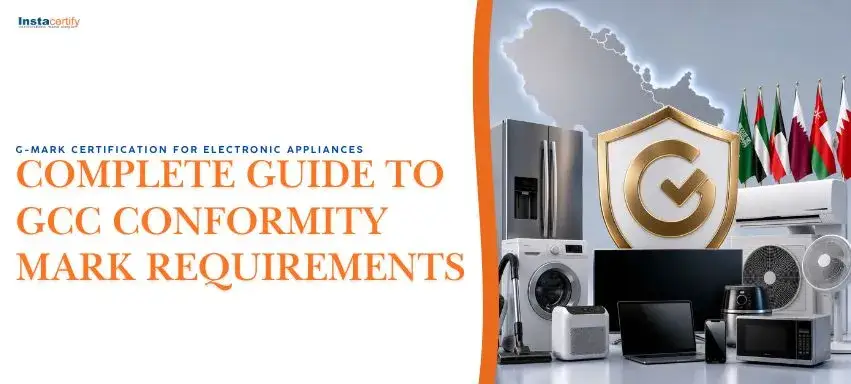
The Gulf region has become an important destination for manufacturers and exporters of electrical and electronic products. However, placing an electronic appliance on the GCC market is not simply a matter of shipping the product to a distributor. Products falling under applicable Gulf technical regulations must demonstrate conformity with the relevant requirements before they can be legally marketed.
One of the most important conformity mechanisms for applicable products is the Gulf Conformity Mark, commonly known as the G-Mark.
For manufacturers, exporters, importers and brand owners dealing with electrical appliances, understanding the G-Mark system is essential for avoiding customs problems, market-surveillance issues and delays in commercial launch.
This guide explains what G-Mark certification means, which electronic and electrical appliances may fall within its scope, how the conformity assessment process works, what documents are generally required, the role of a GSO Notified Body, product marking requirements, testing considerations and how businesses can prepare their products for GCC market entry.
What Is G-Mark Certification?
The G-Mark (Gulf Conformity Mark) is a conformity marking established within the GCC regulatory framework and administered through the Gulf Standardization Organization (GSO).
The purpose of the marking is to indicate that a product covered by applicable GCC technical regulations has undergone the required conformity assessment and meets the relevant regulatory requirements.
GSO explains that the Gulf Conformity Mark is not a quality mark. Instead, it indicates conformity with applicable GCC technical regulations and their essential requirements, including areas such as health, safety and environmental protection.
For an electronic appliance manufacturer, this distinction is important.
A G-Mark does not mean that one particular brand is “better” than another. Rather, it indicates that the product has been evaluated against the regulatory requirements applicable to that product category.
The G-Mark framework was introduced to help reduce technical barriers between GCC markets and facilitate the movement of compliant products within the region.
Why Is G-Mark Important for Electronic Appliances?
Electronic and electrical appliances can create different types of risks if they are improperly designed, manufactured or installed. These can include:
- Electric shock
- Fire and overheating
- Mechanical hazards
- Insulation failure
- Electromagnetic compatibility problems
- Excessive temperature
- Incorrect operation
- Environmental or energy-related concerns, where applicable
The GCC conformity system therefore provides a regulatory mechanism for demonstrating that products falling under the relevant technical regulations meet the required safety and conformity criteria.
For manufacturers exporting from countries such as India, China, Korea, Vietnam, Turkey or other manufacturing locations, G-Mark compliance can therefore become an important part of the GCC market-entry strategy.
Which Countries Does the GCC/G-Mark Framework Cover?
The Gulf Standardization Organization works within the GCC framework covering the Gulf states:
- Saudi Arabia
- United Arab Emirates
- Kuwait
- Bahrain
- Oman
- Qatar
However, manufacturers should not assume that obtaining a G-Mark automatically eliminates every country-specific requirement.
Depending on the product and destination market, additional national requirements, registration systems, customs procedures, energy-efficiency requirements or other regulatory obligations may apply.
Therefore, G-Mark compliance should be treated as one component of GCC market access rather than a universal replacement for every national requirement.
G-Mark and Low Voltage Electrical Equipment
One of the key regulatory areas for G-Mark is the GCC Technical Regulation for Low Voltage Electrical Equipment and Appliances, referenced as BD-142004-01.
The regulation covers specified electrical equipment and appliances and establishes conformity assessment requirements according to the applicable product classification.
The GSO guidance identifies products in the higher-risk List (2) category, particularly household and similar appliances intended for use by consumers and non-trained users. Certain appliances used in public or commercial environments can also fall within the scope where they are intended for use by non-professionals.
This means that simply describing a product as an “electronic product” is not sufficient to determine its G-Mark obligations.
The exact product function, design, voltage characteristics, intended use, product category and applicable technical regulation must be evaluated.
What Types of Electronic Appliances May Require G-Mark?
Depending on the applicable scope and current regulatory lists, electrical and electronic appliances can include products such as:
Household Appliances
Examples include:
- Electric fans
- Refrigerators and freezers
- Washing machines
- Clothes dryers
- Electric irons
- Microwave ovens
- Ovens
- Cookers
- Grills
- Electric heating appliances
- Water heaters
- Food mixers and grinders
- Juice extractors
- Hair dryers
- Hand dryers
- Hair-care appliances
- Air conditioners
- Dehumidifiers
The GSO's conformity guidance and notified-body scopes include several appliance categories associated with IEC 60335-family standards, including microwave ovens, room heaters, air conditioners, hair-care appliances, warming plates and cooking appliances.
Other Electrical Products
Depending on the applicable technical regulation and scope, the regulatory assessment can also involve products such as:
- Plugs and sockets
- Certain electrical accessories
- Power-related equipment
- Lighting products
- Electrical control equipment
- Other low-voltage equipment
Important: The above should not be treated as a blanket list stating that every product automatically requires the same G-Mark procedure. Product classification must be checked against the current GSO technical regulation and applicable scope.
What Voltage Range Is Relevant to the Low Voltage Regulation?
The GSO low-voltage framework is generally associated with electrical equipment operating within the following voltage ranges:
- 50 V to 1000 V AC
- 75 V to 1500 V DC
However, determining whether a particular product is regulated requires more than checking its rated voltage.
The product's function, intended use, technical construction and applicable product category must also be considered.
Therefore, manufacturers should perform a product-specific scope assessment before beginning certification.
List 1 vs List 2 Products Under G-Mark
A major aspect of the G-Mark conformity system is the classification of products according to their conformity assessment route.
List 1 Products
Products falling under a self-declaration route may generally be assessed by the manufacturer through the prescribed conformity assessment procedure.
The manufacturer remains responsible for demonstrating that the product complies with the applicable GCC technical requirements.
This typically involves:
- Product identification
- Applicable standards identification
- Risk assessment
- Technical documentation
- Relevant test evidence
- Manufacturer's Declaration of Conformity
- Production controls
- Correct product marking
The exact procedure depends on the applicable regulation.
List 2 Products
List 2 covers higher-risk categories where Notified Body involvement is required.
For these products, the conformity assessment can involve:
- Product testing
- Technical documentation review
- Risk assessment
- Assessment of the manufacturing arrangements
- Notified Body evaluation
- Gulf Type Examination
- Issuance of the applicable conformity documentation
- Product registration/marking requirements
The GSO guidance describes List 2 as including household and similar products considered higher risk because they are intended for consumers and non-trained users.
This distinction is particularly important for manufacturers of household electrical appliances.
What Is a GSO Notified Body?
A GSO Notified Body is a conformity assessment body that has been notified within the GSO system for specified technical regulations and product categories.
The Notified Body performs the third-party conformity assessment activities required by the relevant GCC technical regulation.
GSO maintains a dedicated platform listing notified conformity assessment bodies and their applicable technical scopes.
A manufacturer should therefore avoid selecting a certification body solely because it offers “G-Mark services.”
The organization must have an appropriate GSO notification scope for the relevant product and technical regulation.
For example, the GSO platform currently provides notified-body scope information for the Gulf Technical Regulation for Low Voltage Electrical Equipment and Appliances.
Can CE Certification Be Used for G-Mark?
This is one of the most common questions asked by manufacturers.
A CE certificate or CE Declaration of Conformity should not automatically be considered equivalent to G-Mark compliance.
However, existing international test reports and certification evidence may sometimes support the GCC conformity assessment where they satisfy the applicable requirements and are accepted under the relevant procedure.
For example, manufacturers may already have:
- IEC test reports
- CB Scheme documentation
- EMC reports
- Safety reports
- CE technical documentation
- Product risk assessments
These documents can potentially reduce duplicated work, but their suitability must be reviewed against the applicable GCC requirements.
The key question is not simply:
“Do I have CE?”
The correct question is:
“Does my existing technical evidence satisfy the current GCC conformity assessment requirements for this particular product?”
G-Mark vs CE Mark
Although G-Mark and CE marking may appear similar because both are conformity-marking systems, they belong to different regulatory frameworks.
G-Mark | CE Mark |
GCC regulatory framework | European Union regulatory framework |
Managed within GSO conformity system | European Union conformity framework |
Applies to products covered by GCC technical regulations | Applies to products covered by applicable EU legislation |
Focuses on GCC requirements | Focuses on EU requirements |
May require GSO Notified Body assessment depending on product | Third-party assessment depends on the applicable EU legislation |
Intended for applicable GCC markets | Intended for applicable EU/EEA market access |
A manufacturer exporting to both Europe and the Gulf may therefore need to satisfy both regulatory systems.
G-Mark vs SABER for Saudi Arabia
Manufacturers frequently confuse G-Mark with Saudi product compliance requirements.
They are not necessarily the same thing.
The G-Mark relates to the GCC conformity framework, while Saudi Arabia has its own national market-access mechanisms and conformity processes.
For products entering Saudi Arabia, exporters should determine whether additional Saudi requirements, registration or shipment-level conformity procedures apply.
Therefore:
G-Mark ≠ automatic completion of every Saudi Arabia compliance requirement.
A product destined specifically for Saudi Arabia should be assessed for both the applicable GCC requirements and Saudi-specific obligations.
How Long Does G-Mark Certification Take?
There is no single fixed timeline applicable to every electronic appliance.
The overall duration depends on factors such as:
- Product complexity
- Product category
- Whether it is List 1 or List 2
- Availability of existing test reports
- Testing requirements
- Laboratory capacity
- Technical file quality
- Number of models
- Notified Body review
- Corrective actions
- Label/document revisions
Products with complete and acceptable existing test evidence can generally move more efficiently than products requiring a completely new testing program.
For this reason, manufacturers should conduct a pre-assessment before committing to a certification timeline.
How Manufacturers Can Prepare Before Applying for G-Mark
A manufacturer can make the process considerably smoother by preparing the following information before contacting a conformity assessment body:
- Product name and model
- Complete technical datasheet
- Electrical rating
- Product photographs
- User manual
- Circuit diagram
- Bill of materials
- Existing IEC/CB reports
- Existing EMC reports
- CE documentation, if available
- Product risk assessment
- Factory/manufacturer details
- Target GCC countries
- Current product label
- Packaging artwork
A preliminary document review can then determine whether the existing evidence is sufficient or additional testing is required.
Frequently asked questions
What is G-Mark certification?
G-Mark is the Gulf Conformity Mark used within the GCC conformity framework to demonstrate that applicable products comply with the relevant GCC technical requirements.
Does G-Mark apply to electronic appliances?
It can apply to specified electrical and electronic appliances, particularly products covered by the GCC Low Voltage Technical Regulation.
Is G-Mark the same as CE?
No. G-Mark and CE belong to different regulatory frameworks. Existing CE documentation may support the assessment in some cases, but it does not automatically replace GCC conformity requirements.
Is a Notified Body required?
For products subject to a third-party conformity assessment route, such as applicable List 2 products, Notified Body involvement is required.
Can an existing IEC or CB test report be used?
Potentially. Existing reports can sometimes support the assessment, but their suitability depends on the applicable GCC requirements, standard edition, scope and conformity procedure.
