Instacertify
IS 17051:2018 vs NIJ 0101.06: Key Differences Every Manufacturer Should Know
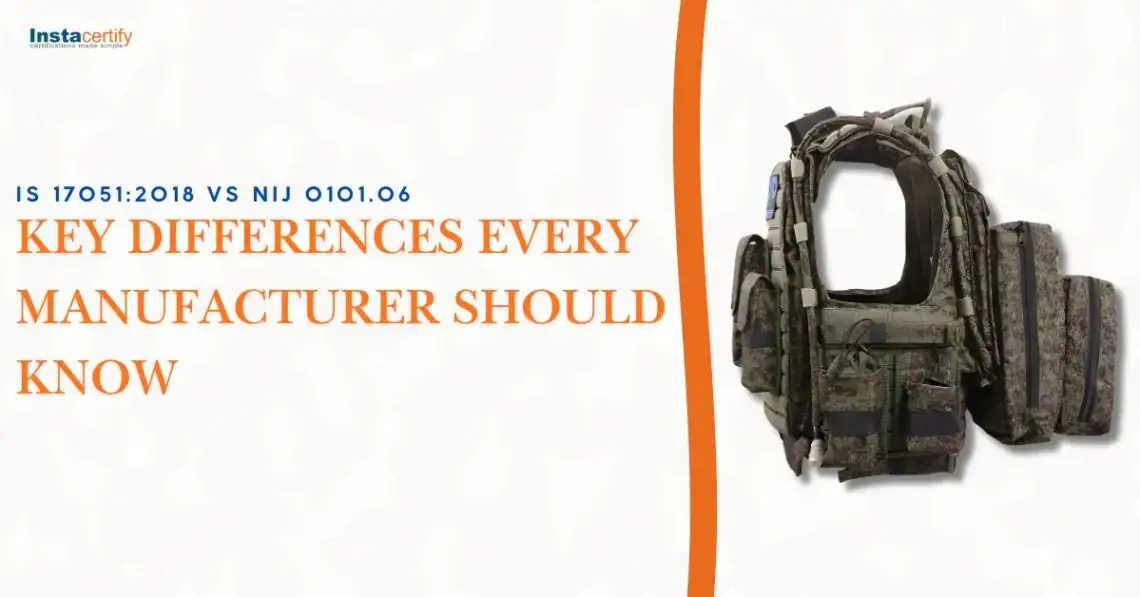
In the high-stakes world of defense and personal protection, “good enough” is never acceptable. For years, the Indian defense sector relied on international standards like the US NIJ (National Institute of Justice) for ballistic protection. However, the threats faced by Indian security forces—ranging from insurgency operations in Kashmir to border security in Rajasthan—are unique.
Enter IS 17051:2018, the indigenous Indian Standard for Bullet Resistant Jackets (BRJ).
With the recent Quality Control Orders (QCO) issued by the Government of India, compliance with this standard is no longer optional—it is mandatory. Whether you are a domestic manufacturer or a foreign brand looking to enter the Indian market, obtaining BIS Certification (ISI Mark) is now the gateway to doing business.
In this guide, we decode the technical requirements of IS 17051:2018, the insights from the BIS Product Manual, and the path to certification.
Why IS 17051:2018? The Shift to “Indian Threats”
The primary reason for the introduction of IS 17051 was the mismatch between western standards and Indian ground realities. The NIJ standards, while robust, did not account for specific ammunition types used by adversaries in the Indian subcontinent.
IS 17051:2018 addresses this by categorizing threats into six distinct levels, specifically tailored to the ammunition encountered by the Indian Army, Para-Military, and State Police forces.
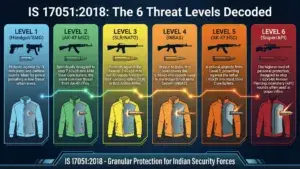
The 6 Threat Levels Decoded
Unlike the 4-level system of NIJ, the Indian Standard offers more granular protection classes:
Level 1 (Handgun/SMG):
Protects against 9×19 mm pistol and carbine rounds. Ideal for police patrolling in low-threat urban areas.
Level 2 (AK-47 MSC):
Specifically designed to stop 7.62×39 mm Mild Steel Core bullets, the most common threat from AK-47 rifles.
Level 3 (SLR/NATO):
Protects against the heavier 7.62×51 mm NATO rounds fired from Self-Loading Rifles (SLR) or Bolt Action Rifles.
Level 4 (INSAS):
Unique to India, this level covers the 5.56×45 mm rounds used in the Indian Small Arms System (INSAS).
Level 5 (AK-47 HSC):
A critical upgrade from Level 2, protecting against the lethal 7.62×39 mm Hard Steel Core bullets.
Level 6 (Sniper/API):
The highest level of personal protection, designed to stop 7.62x54R Armour Piercing Incendiary (API) rounds often used in sniper rifles.
Critical Differentiator: Back Face Signature (BFS)
One of the most stringent aspects of IS 17051:2018—and a key point for manufacturers to note—is the Back Face Signature (BFS) limit.
BFS refers to the depth of the indentation caused on the body side of the jacket when a bullet strikes the armor. Even if the bullet doesn’t penetrate, the shockwave (blunt force trauma) can cause broken ribs or internal bleeding.
- Global Standard (NIJ): Allows up to 44 mm of deformation.
- IS 17051 Standard: Mandates a stricter limit of 25 mm for several categories.
This reduction from 44mm to 25mm ensures that a soldier remains combat-effective even after taking a hit, significantly raising the bar for material science and manufacturing quality.
Insights from the Product Manual (PM/17051)
Based on the July 2023 Product Manual (PM-17051), the Bureau of Indian Standards has laid out clear guidelines for how these jackets are grouped and tested. Understanding these “Grouping Guidelines” can save manufacturers time and money during the testing phase.
1. Grouping Guidelines
To avoid testing every single size and variation, the Product Manual allows for grouping.

- Size Grouping: If a manufacturer produces jackets in sizes Small (S), Medium (M), Large (L), and Extra Large (XL), they do not necessarily need to test every single size for every single shot. The manual specifies which “Index” size (usually Large) is subjected to the full battery of ballistic tests.
- Design Grouping: Jackets are classified by their coverage area (Soft Armour Panel vs. Hard Armour Panel) and their usage (Standalone vs. In-Conjunction With).
2. Raw Material Control
The manual emphasizes that quality starts at the source. Manufacturers must maintain strict test certificates for:
- Outer Carrier Fabric: Tested for tear strength, color fastness, and breaking strength.
- Ballistic Panels (SAP/HAP): Must have traceability to the original fiber/fabric manufacturer (e.g., Aramid or UHMWPE suppliers).
3. Shelf Life Mandate
The Product Manual explicitly mentions shelf-life declarations:
- Ballistic Panels: Minimum 5 years warranty.
- Outer Carrier: Minimum 10 years shelf life under proper storage conditions.
BIS Certification Process (Scheme-I)
For manufacturers targeting the Indian defense market, the certification process under Scheme-I involves four major stages:
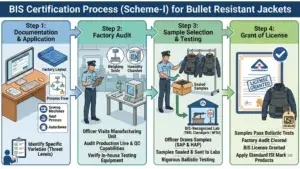
Step 1: Documentation & Application
Submission of the factory layout, manufacturing process flow, and list of machinery (sewing machines, heat presses, autoclaves). You must also identify the specific varieties (Threat Levels) you intend to cover in the license.
Step 2: Factory Audit
A BIS officer visits the manufacturing unit to audit the production line and Quality Control (QC) capabilities. They will verify if you have the in-house testing equipment defined in the Product Manual (e.g., weighing scales, humidity chambers).
Step 3: Sample Selection & Testing
During the audit, the officer will draw samples of the jackets (both SAP and HAP). These samples are sealed and sent to BIS-recognized labs (like TBRL Chandigarh or NFSU) for the rigorous ballistic testing described above.
Step 4: Grant of License
Once the samples pass the ballistic tests and the factory audit is cleared, the BIS license is granted. The manufacturer can then apply the standard ISI Mark on their products.
Conclusion: Don’t Compromise on Compliance
The implementation of IS 17051:2018 is a game-changer for the Indian defense industry. It ensures that our soldiers are equipped with gear that is specifically engineered for the threats they face, tested against the harshest environmental conditions (from -40°C to +70°C).
For manufacturers, navigating the complexities of BFS limits, grouping guidelines, and environmental conditioning can be challenging. However, with the right guidance, achieving compliance is a streamlined process that opens doors to massive government tenders and contracts.
Ready to certify your protective gear?
Ensure your products are mission-ready and compliant. Contact the experts at Instacertify today for end-to-end support on BIS certification for Bullet Resistant Jackets.