
Global Compliance
Is CE Certification Mandatory? A Complete Breakdown of Costs, Benefits, and Rules

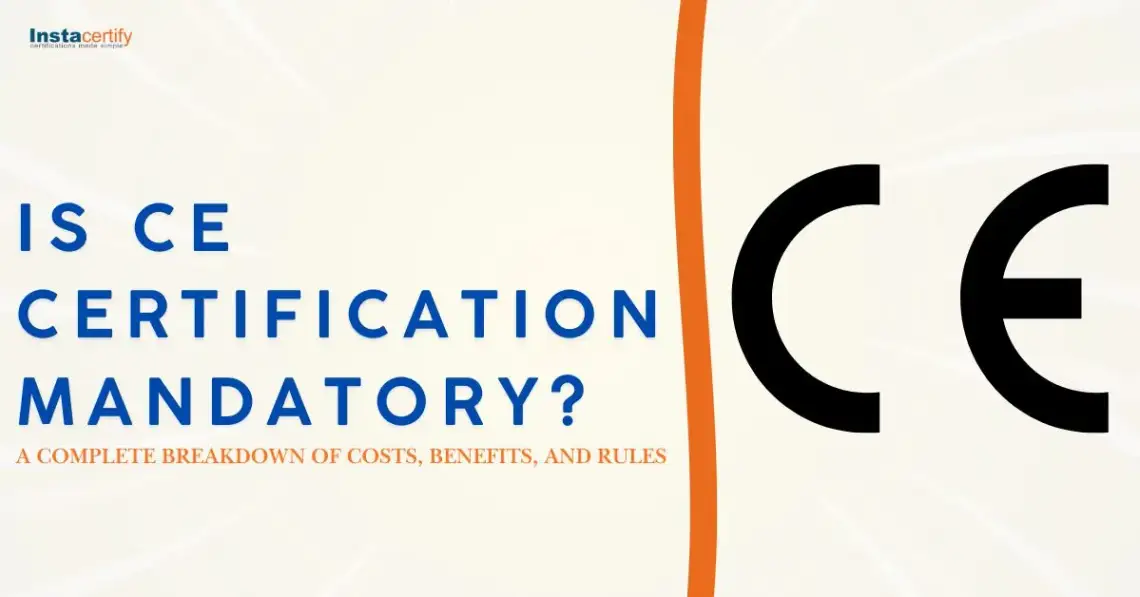
CE stands for Conformité Européenne (European Conformity). It is a mandatory conformity marking for certain products sold within the European Economic Area (EEA).
By affixing the CE marking to a product, a manufacturer declares that the product meets all the legal requirements for CE marking and can be sold throughout the EEA. This applies to products made in other countries (like India) that are sold in the EEA. It is not just a quality mark; it is a safety, health, and environmental protection standard.
Is CE Certification Accepted in India?
This is a common confusion. Technically, no. The CE mark is a European regulatory requirement, not an Indian one.
- For Domestic Sales: The CE mark does not replace Indian standards. For example, many electronic products sold in India require BIS (Bureau of Indian Standards) certification. You cannot use a CE certificate to bypass BIS requirements for the Indian market.
- For Quality Assurance: However, CE is highly respected in India. Many Indian buyers, especially in B2B (Business-to-Business) sectors, view the CE mark as a benchmark of superior quality and safety. It acts as a strong marketing tool within India, even if it’s not a legal requirement for domestic sales.
Is CE Equivalent to CSA?
No, they are not equivalent.
- CE (European Conformity): Mandatory for the European Union (EU) and EEA. It is largely based on self-declaration for many products, though high-risk items need independent testing.
- CSA (Canadian Standards Association): Recognized in Canada and often the USA (if accompanied by the “US” indicator). It usually requires third-party testing and factory inspections.
While both prove a product is safe, a CE certificate will not allow you to sell in Canada, and a CSA mark will not allow you to sell in Europe. They serve different markets with different voltage and safety standards.
What is Meant by Product Directives?
Directives are the “laws” of the CE marking world. The EU publishes Directives that set out the essential requirements your product must meet. You don’t just “get CE certified”—you get certified under a specific directive.
Common examples include:
- Machinery Directive (2006/42/EC): For industrial machines.
- Low Voltage Directive (LVD): For electrical equipment.
- Medical Device Regulation (MDR): For healthcare products.
Your product might fall under one or multiple directives. Identifying the right one is the first step in the process.
Who Issues a CE Certificate in India?
This is the most misunderstood part of the process.
- Self-Declaration: For many low-risk products, you (the manufacturer) issue the “Declaration of Conformity” yourself after testing the product. There is no external “certificate” in the traditional sense, just your technical file and declaration.
- Notified Bodies: For higher-risk products (like medical devices or pressure equipment), you must use a Notified Body—an organization designated by an EU country to assess conformity.
- Role of Indian Agencies: There are no “Indian” Notified Bodies. However, many global Notified Bodies (like TUV, SGS, Intertek, or Nemko) have branches in India. Indian consultants can help you prepare the documentation, but the final validation for high-risk products usually comes from the European office of these testing agencies.
Countries That Accept the CE Marking for Medical Devices
The CE mark is the gold standard for medical devices in:
- The European Union (27 countries)
- EFTA Countries: Iceland, Liechtenstein, Norway.
- Switzerland & Turkey: (With specific mutual recognition agreements).
Bonus: Many non-European countries use CE compliance as a way to fast-track registration. Countries like Australia, Saudi Arabia, Malaysia, and Israel often have expedited approval pathways if your medical device already holds a valid CE certificate.
Can You Sell Without a CE Mark?
In the European market? Absolutely not. If your product falls under a CE directive (like toys, electronics, or machinery) and you import it into the EU without the mark:
- Customs will seize and destroy the shipment.
- You may face heavy fines.
- Your company can be blacklisted from the EU market.
Benefits of Obtaining a CE Certificate
- Market Access: Instant access to 30+ countries in the European Economic Area without needing separate certifications for each one.
- Global Trust: It is recognized globally (including in the Middle East and Asia) as a sign of safety and quality.
- Reduced Liability: It proves you have done your due diligence in ensuring the product is safe, which protects your brand in case of legal disputes.
- Customer Confidence: Even in non-mandatory markets, customers prefer products that carry the CE symbol.
How Much Does a CE Certificate Cost?
The cost varies wildly depending on the complexity of the product and the route to conformity.
- Self-Certification (Low Risk): If you only need a consultant to help compile a technical file, it might cost between ₹25,000 to ₹60,000.
- Notified Body (High Risk): If your product requires lab testing by an accredited European body (e.g., a medical device), costs can range from ₹1.5 Lakh to ₹10 Lakhs or more.
Note: Always beware of “cheap” CE certificates sold for a few thousand rupees. These are often fake and invalid in Europe.
How Long is a CE Certificate Valid?
- Self-Declaration: Technically, it has no expiry date. It remains valid as long as the product design doesn’t change and the EU standards (Directives) remain the same. If the law changes, you must update your file.
- Notified Body Certificate: These typically have a validity of 3 to 5 years. They often require annual surveillance audits to ensure the factory is still maintaining quality standards.
